
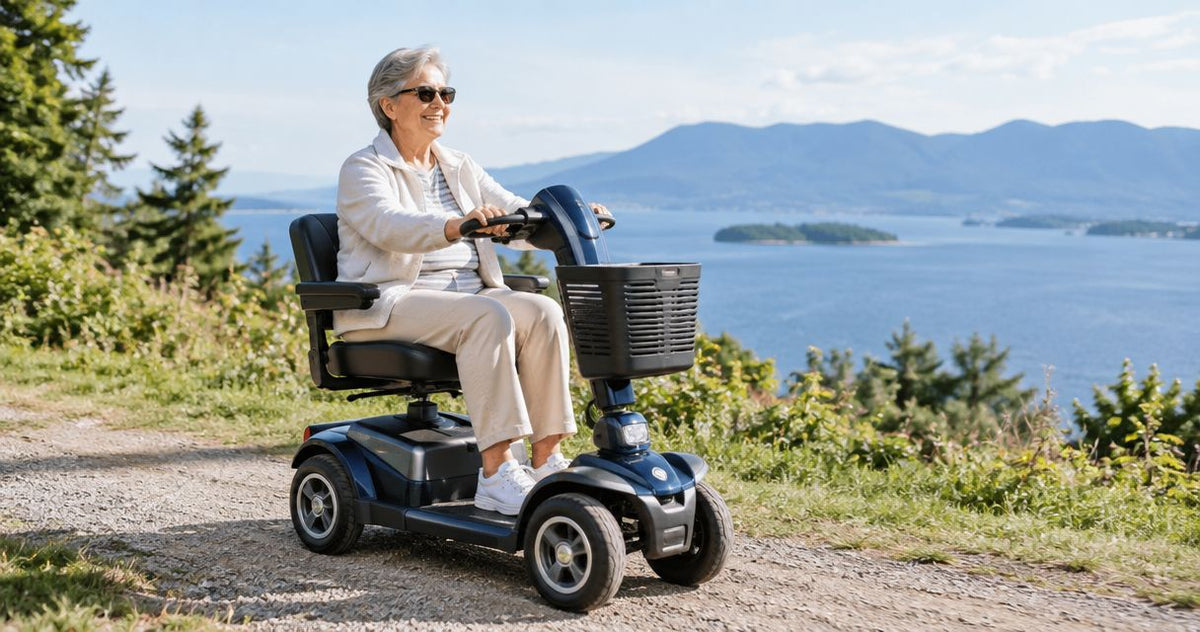
Mobility scooters ranked by travel range in 2026 come down to class: full-size heavy-duty scooters go farthest, folding and ultra-light travel scooters go the shortest distance. Published manufacturer ranges run from roughly 8 miles to 40 miles per charge, and the real number on your route is lower. For the full range math, see how far a mobility scooter can travel on a single charge.
- Best overall for range: a full-size 4-wheel scooter, typically listed at 25 to 40 miles per charge.
- Best balance of range and size: a mid-size 4-wheel scooter, typically 15 to 25 miles.
- Travel and folding scooters list about 8 to 15 miles, so skip them for daily errands beyond a few miles.
- Rated range is a best case: rider weight, hills and cold cut it, so buy 30 to 40 percent more than you need.
Best overall for range: full-size 4-wheel scooter. Best for daily use: mid-size 4-wheel scooter. Best for travel: folding 3-wheel scooter. Best for carrying in a trunk: ultra-light portable scooter.
Why travel range matters in 2026
Range decides whether a scooter replaces a car trip or just a walk to the mailbox. A scooter that stops 2 miles from home is a stranded rider, not a mobility aid.
The figure on a spec sheet is a manufacturer's best case. It is measured on flat ground, with a lighter rider, at a moderate speed, on a fresh battery. Your 2026 daily route will not match it.
This ranking uses scooter classes, not individual models, because range is set by class: battery capacity, motor size and frame weight move together. The ranges below are typical published class figures. Check the exact rated range on the model you are considering.
What makes a scooter good for range
Five factors decide how far a scooter really goes. Use them to audit the ranking before you read the table.
- Battery capacity (amp-hours): the single biggest driver. More Ah means more miles, and more weight.
- Rider and cargo weight: a rider near the weight limit drains the battery faster than a lighter rider on the same model.
- Terrain: hills, grass, gravel and curb cuts pull more current than flat pavement.
- Speed: running at top speed uses more power per mile than a moderate pace.
- Battery age and temperature: cold weather and batteries past their first few years both cut usable range.
Weight capacity and range are linked. If you are near a class limit, read how much weight a mobility scooter can carry before you compare ranges.
Mobility scooters at a glance
| Rank | Class | Typical rated range | Best for | Key limitation |
|---|---|---|---|---|
| 1 | Full-size heavy-duty 4-wheel | 25 to 40 miles | Rural roads, all-day outings | Heavy, does not fit a car trunk |
| 2 | Mid-size 4-wheel | 15 to 25 miles | Daily errands and neighborhood use | Needs a ramp or lift to transport |
| 3 | Standard 3-wheel | 10 to 20 miles | Indoor-outdoor use, tight turns | Less stable on slopes |
| 4 | Folding travel scooter | 8 to 15 miles | Trips, cruises, car travel | Short range, small battery |
| 5 | Ultra-light portable | 5 to 12 miles | Airport and mall use | Lowest range of the five |
The order above is by typical maximum range. A higher rank means more miles per charge, not a better buy for every rider.
1. Full-size heavy-duty 4-wheel: best mobility scooter for maximum range
Full-size 4-wheel scooters carry the largest batteries, so they top the range ranking at about 25 to 40 miles on a published basis. They also have the widest frames and the highest weight capacities.
If your day involves a long route with no charging stop, this is the class that finishes it.
Full-size 4-wheel pros:
- Longest rated range in the category.
- Higher weight capacity than smaller classes.
- Four wheels give the most stable ride on uneven ground.
- Larger seats and suspension suit long rides.
Full-size 4-wheel cons:
- Too heavy to lift into a car; transport needs a ramp or hitch lift.
- Wide turning radius makes indoor use awkward.
- Larger batteries take longer to charge.
Best for: riders with long, regular outdoor distances, such as rural areas or large campuses.
Verdict: Buy if range is your top priority and you have a vehicle lift or ramp.
2. Mid-size 4-wheel: best mobility scooter for daily errands
Mid-size 4-wheel scooters list roughly 15 to 25 miles per charge. That covers most daily routines: pharmacy, grocery, a loop around the neighborhood, and the trip home.
This class is the best default for most buyers because it keeps useful range without the bulk of a full-size frame.
Mid-size 4-wheel pros:
- Range covers a full day of local errands for most riders.
- Stable four-wheel base.
- Smaller footprint than full-size, easier to store.
- A common size, so parts and accessories are easy to find.
Mid-size 4-wheel cons:
- Still too heavy to lift by hand without disassembly.
- Range drops quickly on hills near the class limit.
Best for: riders who go out daily within a few miles of home.
Verdict: Buy as the default pick if you are undecided.
3. Standard 3-wheel: best mobility scooter for tight spaces
Three-wheel scooters list about 10 to 20 miles per charge. The single front wheel gives a tighter turning circle, which matters in stores, hallways and narrow sidewalks.
The trade-off is stability. With one front wheel, tipping risk on slopes and sharp turns is higher than on a four-wheel frame.
Standard 3-wheel pros:
- Tightest turning radius of the full-size-adjacent classes.
- Lighter than most 4-wheel frames.
- Good for mixed indoor and outdoor routes.
Standard 3-wheel cons:
- Less stable on slopes and uneven ground.
- Range sits below the 4-wheel classes.
- Smaller footrest and leg room on some frames.
Best for: riders who need maneuverability more than distance.
Verdict: Hold unless tight turns are your daily problem. A mid-size 4-wheel gives more range and more stability.
4. Folding travel scooter: best mobility scooter for trips
Folding travel scooters list roughly 8 to 15 miles per charge. They fold or disassemble into a trunk-sized load, which is the entire reason to buy one.
Their smaller batteries are a design choice, not a flaw. Less battery means less weight, and less weight means you can lift it.
Before you commit, check airline battery rules. Read whether you can take a mobility scooter on an airplane before booking.
Folding travel pros:
- Fits a car trunk after folding.
- Light enough for one person to lift in most cases.
- Easier to store in apartments and closets.
Folding travel cons:
- Range is short compared to the 4-wheel classes.
- Smaller wheels handle rough ground poorly.
- Lower weight limits than full-size frames.
Best for: vacations, cruises and short trips where you carry the scooter in a car.
Verdict: Buy only if transport is the main need. Skip it as a daily-errand scooter.
5. Ultra-light portable: best mobility scooter for airports and malls
Ultra-light portable scooters list the shortest ranges, around 5 to 12 miles. They are built to be carried, not ridden all day.
That range is enough for an airport terminal, a mall, or a short stretch of sidewalk. It is not enough for a mid-day errand loop.
Ultra-light pros:
- Lightest class, easiest to lift and store.
- Quick to fold and unfold.
- Useful as a backup to a main scooter.
Ultra-light cons:
- Lowest range in the ranking.
- Smallest battery, and replacement packs are a recurring cost.
- Least capable on slopes and rough surfaces.
Best for: short, planned indoor distances and air travel.
Verdict: Skip as a primary scooter if your daily distance exceeds a few miles.
How this ranking was built
The order follows the criteria above, weighted toward rated range. Classes are ranked by typical published maximum miles per charge. Weight capacity, stability and transport are listed as trade-offs, not scored.
No single model is ranked. Range figures vary between manufacturers, and the number on your own scooter is the one that counts.
Real-world range: cut the rated number
Rated range is a ceiling. For planning, apply a margin.
- Plan for about 60 to 70 percent of rated range on mixed terrain with an average rider.
- Plan for less if you ride mostly uphill, in cold weather, or near the weight limit.
- Buy the class above what your longest regular trip needs, so the battery is never run to empty.
A scooter that regularly runs flat also wears its battery faster. Staying out of the bottom 20 percent of charge is a good habit.
Charging and battery life
A bigger battery means more range and a longer charge. Overnight charging covers most users. Charge time depends on battery size and charger output; see how long a mobility scooter battery takes to charge for typical timelines.
Two habits protect range over time:
- Recharge after each outing instead of waiting for a low battery.
- Store the scooter indoors in cold months; cold cuts available range.
Which mobility scooter should you choose?
Start from your longest regular trip, not the biggest number on a spec sheet.
- Your longest regular trip is over 15 miles round trip: buy a full-size 4-wheel.
- Your trips stay within a few miles of home: buy a mid-size 4-wheel. It is the default pick.
- You need tight indoor turns: consider a 3-wheel, accepting less stability.
- You travel with the scooter in a car: buy a folding travel scooter.
- You only need it for terminals and malls: an ultra-light portable is enough.
The single quotable rule: the right scooter has rated range at least 1.5 times your longest regular round trip.
FAQ
What is the best mobility scooter for long range?
A full-size heavy-duty 4-wheel scooter has the longest typical rated range, roughly 25 to 40 miles per charge. It is also the heaviest and needs a ramp or lift for transport.
How far can a mobility scooter go on one charge?
Typical published ranges run from about 5 miles for ultra-light models to 40 miles for full-size models. Real-world range is lower because of terrain, rider weight and battery age.
Does rider weight affect mobility scooter range?
Yes. A heavier rider draws more power per mile, so range drops. A rider near a model's weight limit sees less range than the rated figure.
Is a 3-wheel or 4-wheel scooter better for range?
Four-wheel scooters generally list longer ranges, because they carry larger batteries. Three-wheel models turn tighter but typically list shorter distances and are less stable on slopes.
How much of the rated range should I plan on using?
Plan on about 60 to 70 percent of the rated range for mixed terrain. Use less in cold weather, on hills, or near the weight limit.
Do folding travel scooters have enough range for daily use?
Usually not. Folding travel scooters typically list about 8 to 15 miles, which suits trips and short outings, not a full day of errands.
Does cold weather reduce scooter range?
Yes. Cold temperatures reduce usable battery capacity, so range falls in winter. Storing and charging the scooter indoors helps.
Related guides
- Best mobility scooters
- How long a mobility scooter battery takes to charge
- How much weight a mobility scooter can carry
One last thing
Write down your longest regular round trip before you shop, then multiply it by 1.5. That number, not the biggest range on a spec sheet, is the minimum rated range you should buy in 2026.