
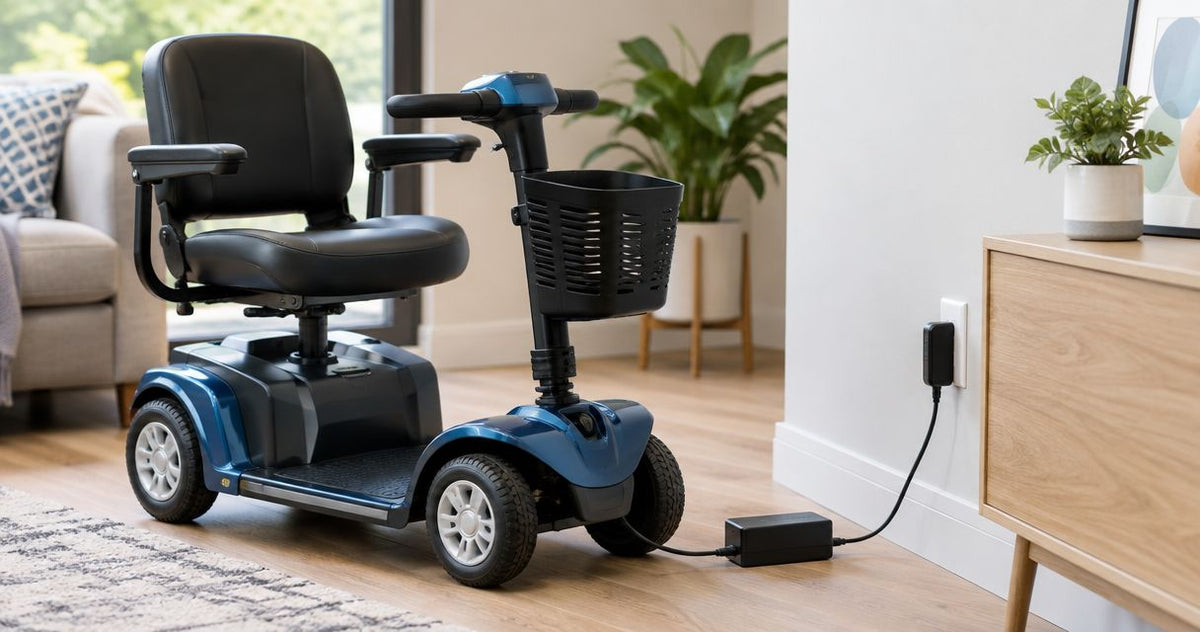
A mobility scooter battery takes 6 to 8 hours to reach a full charge from a low state on a standard charger, and up to 10 to 12 hours after a complete drain in 2026. The charge time listed in a manual assumes a healthy battery — one that's more than 2 to 3 years old can take longer to charge and still deliver less range than the clock suggests.
- A mobility scooter battery takes 6 to 8 hours to fully charge on a standard 8-amp charger in 2026.
- A fully drained battery can need up to 10 to 12 hours before the charger shows a complete cycle.
- Lithium mobility scooter batteries typically charge in roughly half the time of a sealed lead-acid (SLA) battery of similar capacity.
- Charging every night at partial depletion wears an SLA battery faster than letting it run down before a full charge.
- A dedicated charging setup keeps cycle times consistent and protects the battery from heat and cold swings.
Why charge time matters
Charge time isn't just a scheduling detail — it tells you what's happening inside the battery. A charge that used to take 6 hours and now takes 9 or 10 is usually the first sign of capacity fade, not a charger problem. Tracking charge time over a few weeks is a cheap way to catch a failing battery before it strands someone on the sidewalk.
Most home mobility scooters run on one of two battery chemistries: sealed lead-acid (SLA) or lithium-ion. The chemistry drives both the charge time and how forgiving the battery is about partial charging, which is the detail most manuals bury on page 20.
How long does it take to charge a mobility scooter battery?
The honest answer depends on the charger's amp rating, the battery's chemistry, and how depleted it was to start. Here's how the common setups compare:
| Charger type | Amp rating | Full charge time | Best for |
|---|---|---|---|
| Standard charger (most models) | 5-8 amp | 6-8 hours | Nightly top-offs |
| High-amp / fast charger | 10-12 amp | 4-6 hours | Daily heavy users |
| Trickle charge after full drain | 5-8 amp | 10-12 hours | Recovering a dead battery |
| Lithium-ion charger | Varies by pack | 3-5 hours | Newer scooter models |
A charger's amp rating is stamped on the unit itself, not on the battery — mismatching a low-amp charger to a large-capacity battery is the most common reason a "6-hour charge" quietly turns into 10.
Standard 8-amp charger: 6 to 8 hours per full charge
Most mobility scooters sold in the US ship with a 5- to 8-amp charger, and 6 to 8 hours is the realistic full-charge window for these units starting from a half-depleted state. Plugging in overnight covers this comfortably and is the routine most manufacturers recommend.
Fast charger (10 to 12 amp): 4 to 6 hours per full charge
High-amp chargers cut charge time to 4 to 6 hours, which matters for anyone who uses the scooter twice a day or needs a midday top-off. The tradeoff is heat: faster charging generates more warmth at the terminals, which is one reason not every scooter battery is rated to accept a high-amp charger safely.
Deep-drain recovery charge: 10 to 12 hours
A battery run down to empty — the kind of drain that happens after a scooter sits unused for weeks — needs 10 to 12 hours on a standard charger to reach a genuine full charge, not the 6 to 8 hours quoted for routine top-offs. Rushing this with a high-amp charger on a battery that's been fully drained is the scenario manufacturers most often warn against.
Why mobility scooter charge time varies
Charge time isn't fixed — it shifts with the battery, the charger, and the environment. The factors that move the number most:
- Battery chemistry: lithium-ion packs generally charge faster and tolerate partial charges better than SLA batteries.
- Depth of discharge: a battery at 50% charges in roughly half the time of one at 0%.
- Battery age: cells past 2 to 3 years of regular use hold less capacity, so a charge cycle can run long while delivering less usable range.
- Charger amperage: an 8-amp charger and a 12-amp charger on the same battery produce meaningfully different charge windows.
- Ambient temperature: charging in a cold garage slows the chemical reaction inside SLA batteries, stretching charge time beyond the rated window.
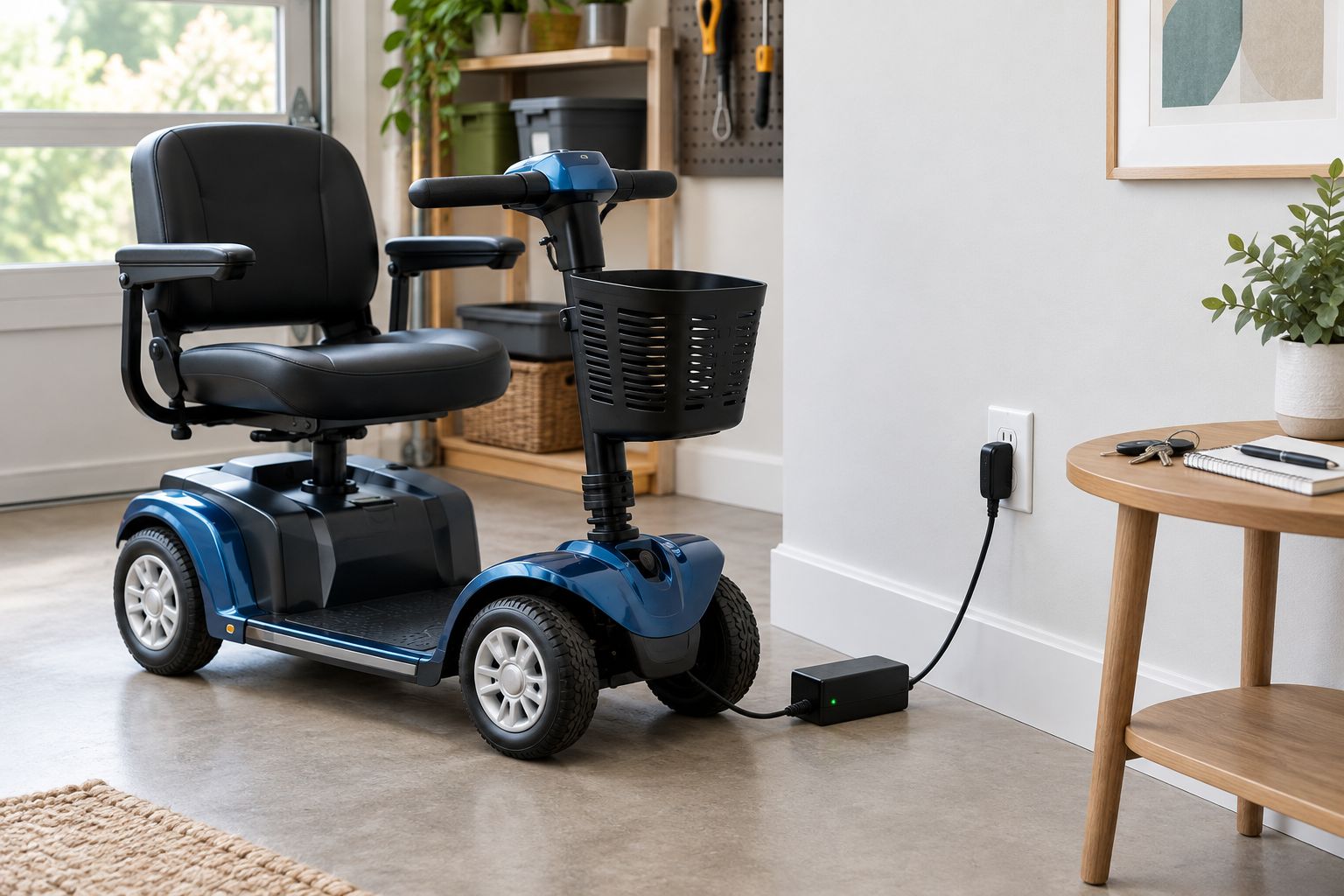
- Charging location and setup: a consistent home charging station for a mobility scooter avoids the voltage drops and extension-cord losses that happen when a scooter gets charged in a different spot each night.
Doorway width also affects how practical a fixed charging station is — worth checking against your own layout when measuring doorways for mobility scooter access if the scooter needs to reach an indoor outlet nightly.
Set up a reliable charging routine
A dedicated charging spot keeps charge times consistent night after night.
How often should you charge a mobility scooter battery?
Charge a mobility scooter battery after every use, even a short trip, rather than waiting for it to run low. SLA batteries in particular last longer with frequent partial charges than with occasional deep drains followed by a long recovery charge.
Can you overcharge a mobility scooter battery?
Most modern chargers cut power automatically once the battery reaches full charge, so leaving it plugged in overnight on a standard charger is generally safe. The exception is an older charger without an automatic cutoff, which can overheat a battery left connected for days at a time.
How long do mobility scooter batteries last before replacement?
SLA mobility scooter batteries typically last 300 to 500 charge cycles, roughly 1 to 2 years of daily use, before capacity fades enough to notice shorter range. Lithium-ion packs generally hold up over more cycles, which is part of why newer scooter models are shifting toward that chemistry.
FAQ
How long does it take to charge a mobility scooter battery overnight?
An overnight charge of 6 to 8 hours fully charges most mobility scooter batteries in 2026, which fits comfortably within a typical 8 to 10 hour overnight window.
How long does a mobility scooter battery last on a single charge?
Range varies by model and battery capacity, but a full charge on a healthy battery should cover the manufacturer's stated range; a battery delivering noticeably less range on a full charge is usually near the end of its 300 to 500 cycle lifespan.
Should I charge my mobility scooter battery every day?
Yes, charging after every use rather than waiting for a deep drain extends the life of most SLA mobility scooter batteries.
Is it bad to leave a mobility scooter charger plugged in all the time?
Most modern chargers include an automatic cutoff once the battery reaches full charge, making it safe to leave connected overnight, though an older charger without a cutoff should not be left plugged in for days.
Can a mobility scooter battery charge faster with a bigger charger?
A higher-amp charger, such as a 10-12 amp unit, can cut full charge time to 4 to 6 hours, but only if the battery is rated to accept that amperage safely.
Why does my mobility scooter battery take longer to charge than it used to?
A charge time that stretches from 6-8 hours to 9-10 hours or more usually signals capacity fade in a battery older than 2 to 3 years, not a charger fault.
Does cold weather affect mobility scooter battery charge time?
Yes, charging an SLA battery in a cold garage slows the internal chemical reaction and can push a standard 6-8 hour charge beyond its rated window.
One last thing
The most reliable habit isn't a charge schedule — it's a fixed charging spot with a dedicated outlet, so charge time stays predictable instead of drifting week to week with extension cords and different rooms. A scooter that suddenly needs 10 hours instead of 8 is telling you something about the battery, not the charger, and that's the moment to plan for a replacement before it fails on a trip out.