
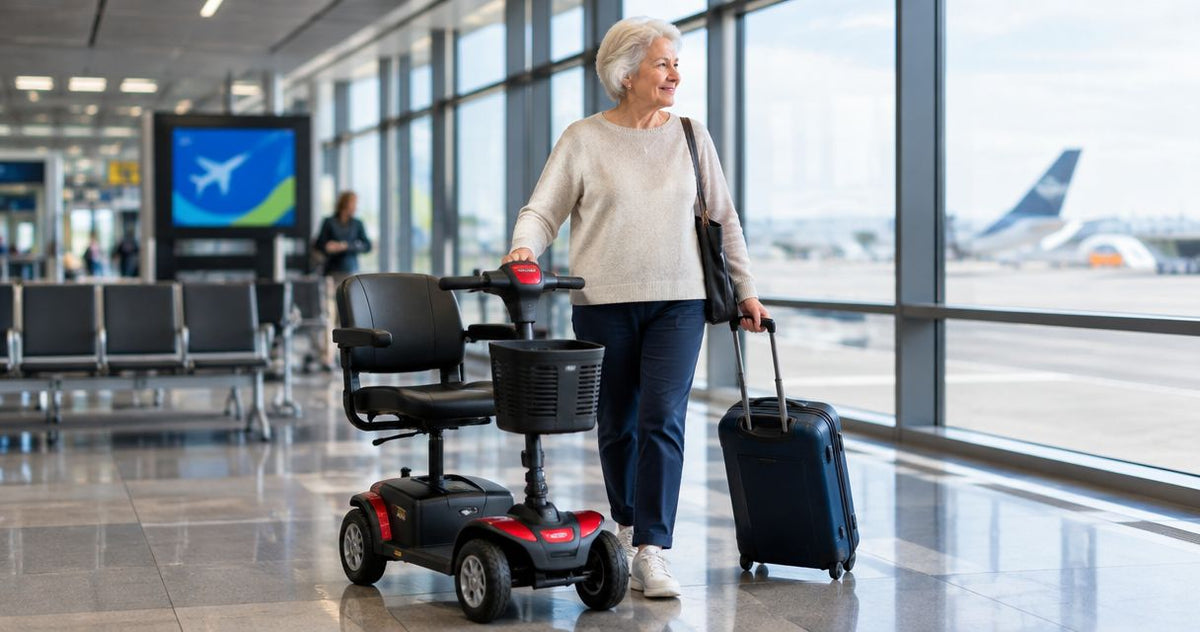
Yes, you can take a mobility scooter on an airplane in 2026 — U.S. airlines are legally required to accept battery-powered mobility devices as a disability accommodation, and they can't charge a fee for it. The catch isn't whether the airline will take the scooter; it's what kind of battery is inside it, because that single detail decides whether the scooter travels fully assembled or needs the battery pulled and carried separately.
- Airlines must accept mobility scooters at no charge under U.S. disability access rules in 2026.
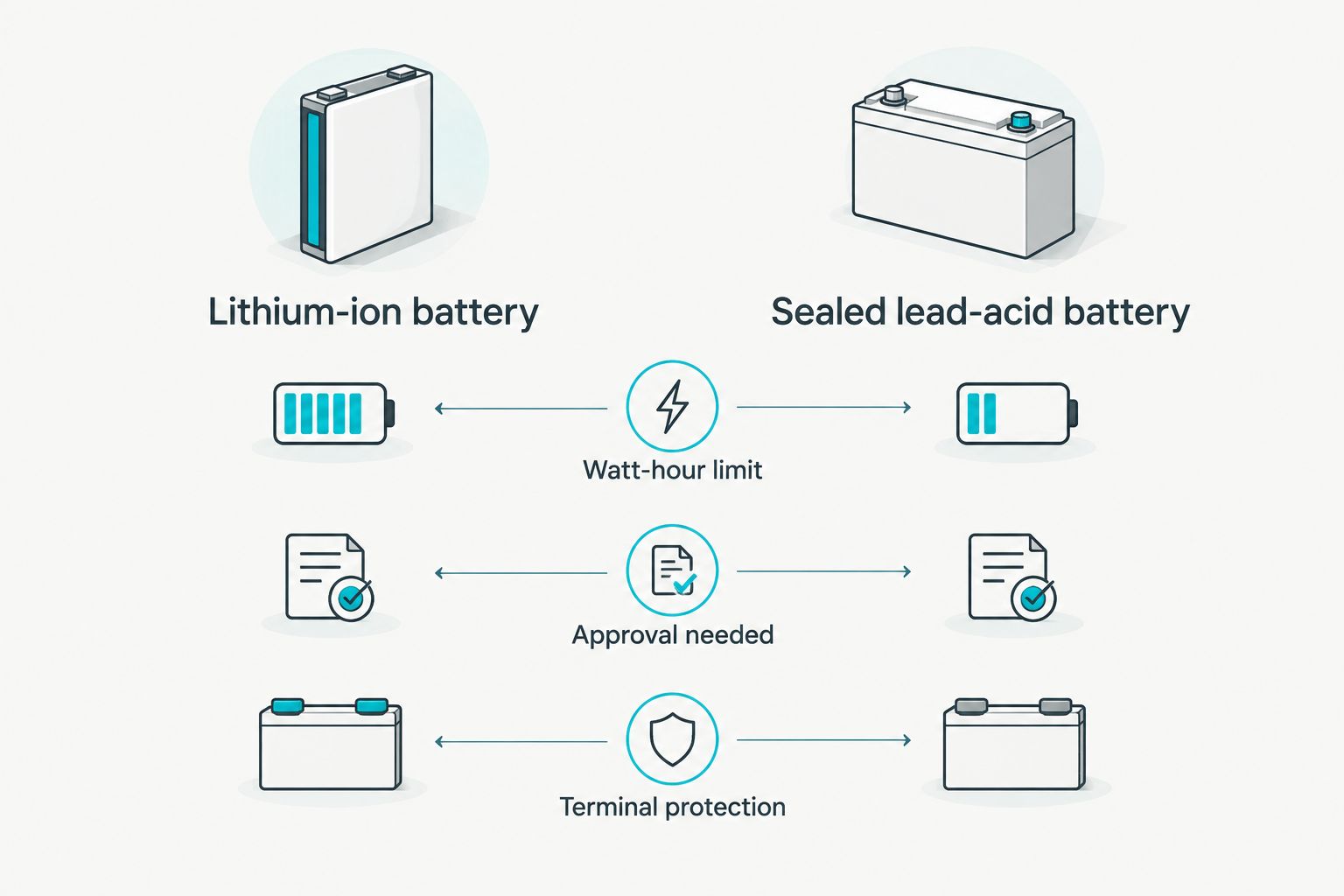
- Lithium-ion batteries up to 300 watt-hours can stay attached to the scooter without special approval.
- Sealed lead-acid (gel) batteries have no watt-hour cap but must have insulated terminals.
- Federal rules cap advance notice requirements at 48 hours before your scheduled departure.
- The scooter always rides in the cargo hold — never in the cabin or an overhead bin.
Why this matters
A mobility scooter isn't luggage — it's a battery-powered device governed by hazardous materials rules, and those rules are written around watt-hours, not brand names. Get the battery type wrong on your call to the airline and you risk a scooter that gets refused at the gate instead of loaded into the cargo hold. If you also move the scooter by car regularly, the mechanics are different from flying — see how transporting a mobility scooter in your car works with ramps and lifts versus how an airline handles it.
The short version: sealed lead-acid and gel batteries fly with almost no restriction because they're non-spillable. Lithium-ion batteries are capped by watt-hour rating, and that cap is what separates a scooter that flies as-is from one that needs the battery detached and hand-carried.
Can you take a mobility scooter on an airplane?
Yes — under the Air Carrier Access Act, U.S. airlines must transport battery-powered wheelchairs and scooters, and disability-related mobility aids don't count against carry-on or checked baggage limits. The scooter goes in the cargo hold, and the airline is responsible for how it's stowed and returned to you at your destination gate whenever possible.
What changes case to case is the battery. Here's how the three common battery types are handled in 2026:
| Battery Type | Watt-hour Limit | Airline Approval Needed | How It's Handled |
|---|---|---|---|
| Sealed lead-acid / gel (non-spillable) | No Wh limit | No | Stays attached; terminals insulated and secured to the frame |
| Lithium-ion, attached to scooter | Up to 300 Wh | No | May stay attached if terminals are protected from short-circuit |
| Lithium-ion spare battery | Up to 160 Wh each, 2 spares max | Yes | Removed, terminals insulated, carried in the cabin only |
| Lithium-ion over 300 Wh | Exceeds standard mobility-aid allowance | Case-by-case, often refused | May require the battery removed entirely or the scooter left behind |
If you're comparing what a scooter costs against what it takes to fly with one, the mobility scooter cost guide breaks down pricing by battery type and range, which is the same spec that governs air travel rules.
Lithium-ion scooters: 300 Wh or under travel without special approval
A lithium-ion battery rated at 300 watt-hours or less can stay installed in the scooter for the flight, with no separate airline sign-off required. This is a wider allowance than the general 100 Wh rule for consumer electronics spares, because mobility aid batteries got a specific carve-out. The terminals still need to be insulated or the battery protected against accidental activation before it goes into the cargo hold.
Best for: travelers with a standard folding or 3-wheel scooter running a lithium pack in the common 250–300 Wh range. Verdict: Fly.
Gel and sealed lead-acid scooters: no watt-hour limit, but terminals must be insulated
Sealed lead-acid (SLA) and gel-cell batteries are classified as non-spillable, so there's no watt-hour ceiling on them at all — a heavier, higher-capacity gel battery flies the same as a small one. The requirement instead is physical: the battery has to be securely attached to the scooter frame and the terminals protected so nothing can short during handling.
Best for: older or heavier-duty scooters that still run traditional gel batteries. Verdict: Fly, with the terminal-protection step confirmed ahead of time.
Spare lithium batteries: 160 Wh limit, two spares maximum, cabin only
If you're carrying a backup lithium battery separately from the scooter, it's capped at 160 watt-hours per battery, and you can bring a maximum of two. Spare batteries are never allowed in the cargo hold — they travel in the cabin with you, terminals insulated in a case or with tape.
Best for: longer trips where you want backup range without checking a second full battery pack. Verdict: Carry on, insulated, two-spare limit.
Why mobility scooter airline policies vary
Even with federal rules setting the floor, actual experience at the gate varies by carrier and route. The main drivers:
- Battery chemistry — lithium versus lead-acid triggers different hazmat handling steps under the same flight
- Cargo hold door dimensions — wide-body aircraft accept larger scooters that a smaller regional jet's hold can't fit
- Staff hazmat training — some ground crews handle mobility aid batteries daily, others rarely see one
- Advance notice given — airlines can act faster and more smoothly when told well before the 48-hour cutoff
- Whether the battery is tool-free removable — a battery that pops out in seconds is easier to accommodate than one bolted in
- Connecting flights — a multi-carrier itinerary means every leg's ground crew needs the same battery information
Related questions about flying with a mobility scooter
Do I need to notify the airline before bringing a mobility scooter?
Yes, notify the airline as early as possible, though by law they cannot require more than 48 hours of advance notice before your scheduled departure. Calling ahead gives ground crew time to confirm cargo hold space and battery handling procedures specific to your scooter model.
Can I keep the scooter's battery attached for the flight?
Yes, the battery can stay attached in most cases — sealed lead-acid batteries always can, and lithium-ion batteries can too as long as they're 300 Wh or under with terminals protected. Above that threshold, the airline may require the battery removed and handled separately.
Will my mobility scooter fit in the cargo hold?
Most folding and standard 3-wheel and 4-wheel scooters fit in a standard aircraft cargo hold, but door dimensions vary by aircraft type, especially on smaller regional jets. Confirming your scooter's folded or disassembled dimensions with the airline before booking avoids a gate-side surprise.
FAQ
Can you take a mobility scooter on an airplane in 2026?
Yes, U.S. airlines must accept mobility scooters at no charge under the Air Carrier Access Act. The battery type — lithium-ion versus sealed lead-acid — determines how it's prepared for the cargo hold.
Does a mobility scooter count as checked baggage?
No, a mobility scooter does not count against your checked baggage allowance because it's classified as an assistive device, not luggage.
What size battery can stay in the scooter during a flight?
A lithium-ion battery up to 300 watt-hours can stay attached to the scooter without special airline approval. Sealed lead-acid batteries have no watt-hour limit at all.
How many spare batteries can I bring for my scooter?
You can bring up to two spare lithium-ion batteries, each capped at 160 watt-hours, and they must travel in the cabin with insulated terminals, never in checked or hold baggage.
Can I use my mobility scooter to get to the gate?
Yes, you can use your scooter up to the boarding door in most cases, then it's stowed in the cargo hold for the flight and returned to you planeside or at baggage claim depending on the airline.
Will the airline charge extra for a mobility scooter?
No, airlines cannot charge a fee to transport a mobility scooter since it's protected as a disability accommodation, not optional cargo.
What happens if my scooter's battery exceeds 300 watt-hours?
A lithium-ion battery over 300 watt-hours may need to be removed entirely or the airline may decline to transport the scooter, so confirm your battery's rating before booking.
Do international flights follow the same battery rules?
Rules are broadly similar internationally since most carriers follow IATA dangerous goods guidance, but always confirm directly with the specific airline before an international trip.
One last thing
The single detail that saves the most hassle at the gate isn't the scooter model — it's knowing your battery's exact watt-hour rating before you call the airline, because that number, not the scooter's brand or price, is what the ground crew checks against federal limits. Once you're home again, setup matters just as much as the flight: a home charging station for a mobility scooter keeps the same battery you just flew with in good condition between trips.
Related guides