
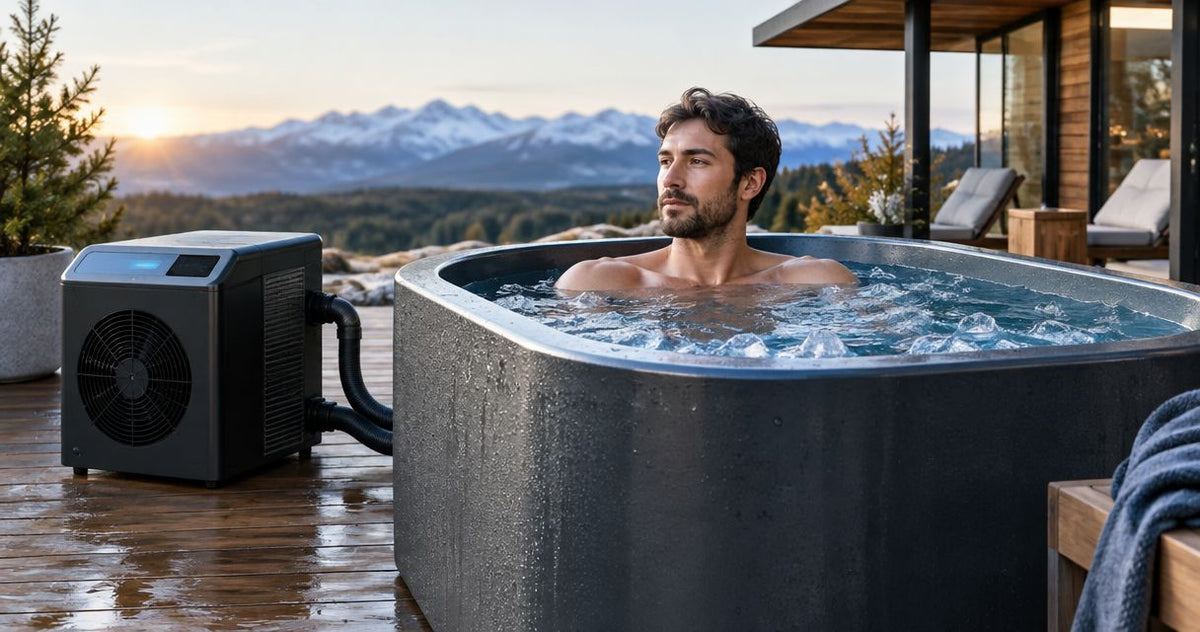
For cold plunge tubs ranked by chiller power in 2026, neither model compared here earns a cooling-power winner: neither has a documented chiller output. Best for a portable format: the 76.6-gallon inflatable tub; best for an outdoor format with an included lid: the 79-gallon tub—but neither capacity establishes cooling performance.
By Editorial Team
- Cold plunge tubs ranked by chiller power need comparable cooling-capacity ratings, not just horsepower labels.
- Aeva Vital offers 76.6-gallon and 79-gallon options; neither earns a verified chiller-power ranking here.
- Choose the inflatable model for its portable format, or the outdoor model for its included thermo lid.
- Confirm chiller compatibility, cooling output, electrical requirements, and test conditions before choosing a powered system.
A tub holds water; a chiller removes heat. That distinction controls this 2026 comparison. If you also need to compare vessel size, use the guide to cold plunge tubs ranked by tank capacity, then assess the cooling equipment separately.
Why chiller power matters
A powerful-sounding compressor label does not tell you how quickly a complete plunge system cools its water. Water volume, starting temperature, target temperature, ambient conditions, insulation, and circulation all affect the job.
Rank documented cooling performance before compressor horsepower. Otherwise, you risk comparing a component label on one system with a measured cooling result on another.
For a home setup, the useful question is straightforward: can the specified tub-and-chiller combination reach and maintain your chosen water temperature under the conditions where you will install it?
What makes the best cold plunge cooling system?
Use these criteria before assigning a winner in 2026:
- Cooling capacity: Look for heat-removal output in BTU/h or thermal watts, with stated operating conditions.
- Matched water volume: Require performance information for a water volume relevant to your intended fill level.
- Pull-down performance: Look for starting water temperature, target temperature, elapsed time, and ambient temperature together.
- Holding performance: Check whether the system maintains its setpoint under the intended installation conditions.
- Documented compatibility: Confirm connections, flow requirements, tubing, and approved tub-and-chiller combinations.
- Installation requirements: Check electrical supply, ventilation, drainage, and environmental restrictions before ordering equipment.
A system that satisfies these criteria is easier to assess than one described only as powerful. Missing operating conditions make even a precise-looking performance number difficult to compare.
Cold plunge tubs ranked by chiller power: at a glance
The following order identifies distinct tub use cases, not a verified cooling-power hierarchy. Aeva Vital cold plunge tubs offer different formats, but the product information compared here does not establish a horsepower, BTU/h, or cooling-time winner.
| Order | Tub | Best for | Stated capacity | Standout feature | Chiller-power verdict | Key limitation |
|---|---|---|---|---|---|---|
| 1 | Portable Inflatable Ice Bath Tub | Portable-format buyers | 76.6 gallons | Inflatable construction | Not ranked by cooling output | Chiller output and connection compatibility are not established |
| 2 | 79 Gallon Cold Plunge Tub | Outdoor-format buyers wanting a lid | 79 gallons | Thermo lid included | Not ranked by cooling output | Lid performance and powered cooling capability are not established |
Neither entry should be treated as a verified integrated chiller system. The listed capacities describe water volume, not the amount of heat a refrigeration system can remove.
1. Portable Inflatable Ice Bath Tub: best for portable setups
The Portable Inflatable Ice Bath Tub is identified as a portable, inflatable model with a stated capacity of 76.6 gallons. Its clearest distinction is its format—not a documented cooling specification.
Best for: Buyers who prioritize a portable inflatable vessel and will assess their cooling method separately.
Portable Inflatable Ice Bath Tub pros
- The portable format directly suits buyers looking beyond a permanently positioned vessel.
- Inflatable construction distinguishes it from the outdoor alternative in this comparison.
- The stated 76.6-gallon capacity gives you a concrete starting point for evaluating water volume.
Portable Inflatable Ice Bath Tub cons
- No documented cooling output supports a chiller-power ranking.
- Chiller ports, required flow, and approved external cooling equipment are not established here.
- Capacity alone does not establish usable interior dimensions or your occupied fill level.
The 76.6-gallon figure helps you identify the vessel's stated size. It does not establish cooling speed, insulation performance, or whether a separate chiller can connect safely.
Verdict: Hold if powered cooling is essential; shortlist for its portable format only.
2. 79 Gallon Cold Plunge Tub: best for an outdoor format with a lid
The 79 Gallon Cold Plunge Tub is identified as an all-season outdoor ice bath with a thermo lid included. Its stated capacity is 79 gallons, which is 2.4 gallons more than the inflatable model.
Best for: Buyers seeking an outdoor-designated vessel with an included lid, rather than buyers selecting by verified refrigeration output.
79 Gallon Cold Plunge Tub pros
- Its product title explicitly identifies an outdoor application.
- An included thermo lid provides a defined equipment difference between these two options.
- The stated 79-gallon capacity supports a direct vessel-size comparison.
79 Gallon Cold Plunge Tub cons
- No documented chiller capacity establishes a cooling-power advantage.
- The thermo lid has no quantified thermal-performance rating in this comparison.
- The all-season designation does not establish freeze protection or approved operating temperatures for connected equipment.
Do not interpret the larger capacity as stronger cooling. With other conditions equal, more water requires more heat removal to achieve the same temperature reduction.
Verdict: Hold if automatic cooling is mandatory; shortlist for the outdoor format and included lid.
Compare the two vessels
Aeva Vital is best for buyers comparing these portable and outdoor cold plunge formats—not for selecting a documented chiller-power winner from these specifications. Establish the cooling requirements before treating either vessel as part of a powered system.


Horsepower, cooling output, and electricity are different
A useful 2026 comparison separates three specifications that often appear together. They describe different parts of the system and are not interchangeable.
Compressor horsepower
Horsepower describes mechanical power. A compressor horsepower label is not a complete measurement of heat removal from the water, because refrigeration performance also depends on the system design and operating conditions.
Use horsepower as a component detail, not the final ranking metric. Do not convert a horsepower label directly into a promised water-cooling rate.
Cooling output
Cooling capacity describes the rate at which a system removes heat. Manufacturers can express it in BTU/h or thermal watts; useful comparisons specify the conditions under which that output was measured.
A higher documented output indicates greater heat-removal capacity at the stated conditions. It does not, by itself, establish better filtration, quieter operation, or suitability for your installation.
Electrical input
Electrical input describes the power equipment draws from the supply. It is not the same quantity as thermal cooling output, even when both use watts.
Ask whether a wattage figure means electrical input or cooling output. A larger electrical draw alone does not prove faster cooling or better efficiency.
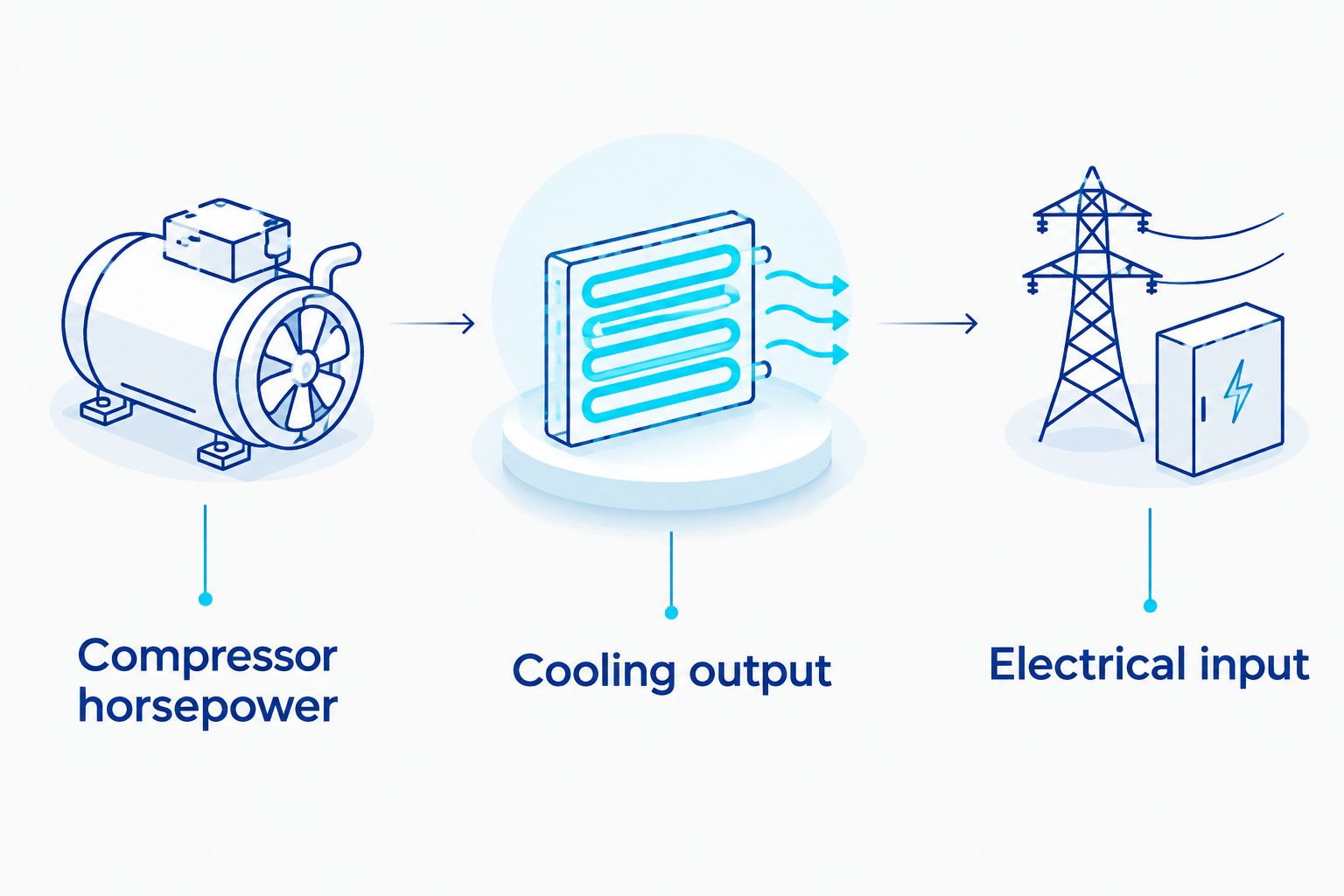
The distinction matters when you compare complete systems. Two specification sheets can both look precise while reporting different quantities, so identify the measurement before deciding which number is larger.
How to compare cooling speed fairly
A claim about reaching a target temperature needs its starting conditions. Without them, you cannot distinguish an easier cooling task from stronger equipment.
Match the water volume
Compare systems at relevant fill volumes, not just advertised maximum capacities. Your occupied water level must also leave room for displacement when you enter.
The 76.6-gallon and 79-gallon labels do not establish identical usable space. Nor do they establish the volume used in a cooling demonstration.
Match the temperature change
A cooling test needs both the starting water temperature and the ending water temperature. Reaching the same endpoint from different starting temperatures involves different heat-removal tasks.
Ask for the complete temperature change rather than relying on the final temperature alone. A low setpoint proves little about how long the system takes to reach it.
Match the surroundings
Ambient temperature, direct sun, airflow around the chiller, and whether the lid stays closed all affect system operation. Compare tests that describe these conditions.
For a 2026 outdoor purchase, distinguish a tub's outdoor designation from the chiller's approved installation environment. Each component needs its own suitability check.
Check compatibility before choosing more power
A separate chiller is not automatically compatible with a tub because the capacities appear suitable. The complete water circuit must meet the equipment manufacturer's requirements.
Request confirmation of:
- Water connections: Approved inlet and outlet arrangements, fittings, and sealing methods.
- Flow requirements: The circulation conditions the chiller needs to operate correctly.
- Pump configuration: Whether circulation equipment is included or must be specified separately.
- Filtration arrangement: How the filter fits into the approved water circuit.
- Electrical requirements: Required supply and protective arrangements for the installation location.
- Placement requirements: Ventilation, weather exposure, drainage, and maintenance access.
Do not modify an inflatable wall or improvise a connection without manufacturer approval. A cooling specification cannot establish whether a vessel is designed for that modification.
Compatibility is a pass-or-fail requirement; extra compressor power cannot compensate for an unsuitable connection.
Construction and water care affect the whole setup
A lid, insulation, and appropriate placement help manage the heat entering a plunge tub. However, an included lid does not quantify insulation quality, and an outdoor label does not prove that connected plumbing tolerates freezing.
Ask for construction details that explain the full system, including the vessel, lid, hoses, and cooling equipment. Keep documented material descriptions separate from measured thermal results.
Cooling also does not replace water care. Follow the manufacturer's cleaning, filtration, and sanitation instructions rather than assuming cold water stays clean without maintenance.
When you assess an Aeva Vital cold plunge setup, treat vessel selection, cooling compatibility, and water maintenance as separate decisions. Each needs an answer before installation.
How the ranking works
The two recommendations follow their documented use cases: portable inflatable construction first, then an outdoor-designated vessel with an included lid. That order is not a laboratory result or a claim that either model cools faster.
For a true chiller-power ranking, prioritize comparable cooling output, then matched-volume pull-down results, holding performance, compatibility, and installation fit. Neither vessel receives a cooling-power score without those supporting specifications.
Which cold plunge setup should you choose?
Choose the Portable Inflatable Ice Bath Tub if portability defines your vessel choice. Choose the 79 Gallon Cold Plunge Tub if an outdoor format and included lid define it. Both remain conditional choices when powered refrigeration is a requirement.
For an undecided buyer in 2026, the default is to hold the chiller decision until the complete system is documented. Choose on the basis of matched performance—not the largest horsepower label or the largest tub.
Related guides
- Best cold plunge tub with a built-in chiller
- How much electricity does a cold plunge chiller use?
- Can you do a cold plunge without a chiller using just ice?
FAQ
What's the best way to compare cold plunge tubs ranked by chiller power?
Compare documented cooling output under matched conditions, then check compatibility and installation requirements. Horsepower alone does not establish how quickly a complete system cools its water.
Which Aeva Vital cold plunge tub has the strongest chiller?
Neither of the two cold plunge tubs compared here has a documented chiller output that supports a strongest-chiller verdict. Their stated capacities are 76.6 gallons and 79 gallons, which describe vessel size rather than cooling power.
Does higher compressor horsepower always mean faster cooling?
No. Cooling speed also depends on refrigeration design, water volume, temperature change, ambient conditions, and heat entering the system.
Is a 79-gallon cold plunge more powerful than a 76.6-gallon tub?
No; capacity measures water volume, not cooling power. The 79-gallon tub has 2.4 gallons more stated capacity, but that difference establishes no refrigeration advantage.
Can I connect any external chiller to an inflatable ice bath?
No; confirm the tub manufacturer's approval and the chiller's connection and flow requirements first. An inflatable construction or capacity label does not establish compatibility.
Does a thermo lid replace a cold plunge chiller?
No; a lid and a chiller serve different functions. A lid covers the water, while a powered chiller removes heat through refrigeration.
Does a cold plunge chiller clean the water?
Cooling alone does not clean or sanitize plunge water. Follow the complete system's instructions for filtration, sanitation, cleaning, and water replacement.
What should I request before buying a powered cold plunge system?
Request the complete equipment list, approved connections, cooling output, operating conditions, electrical requirements, and maintenance instructions. Confirm that the performance information applies to your intended water volume and installation environment.
One last thing
Ask for a single written specification covering the tub, chiller, pump, connections, and operating conditions. A component's impressive rating is not proof that the assembled system meets your needs.