

The best mobility scooters in 2026 depend on your route: start with a four-wheel everyday scooter for routine paved trips, a dismantling travel scooter for car transport, or a folding scooter for compact storage. Aeva Vital’s guide compares scooter types by access, handling, transport, and seating—not by unsupported model rankings.
By Editorial Team
- The best mobility scooters match your route, seating needs, and transport method—not the highest advertised speed.
- Four-wheel everyday scooters are the starting point for routine trips on suitable paved surfaces.
- Dismantling travel scooters suit car transport only when you can safely lift every separate component.
- Folding scooters simplify storage, but the folded unit still needs a practical lifting or loading solution.
- Heavy-duty scooters require checks for both rider capacity and doorway access.
What makes the best mobility scooters in 2026?
Choose the scooter you can use throughout your actual journey, including getting it out of storage and back home. A scooter that handles a shopping center but cannot negotiate your entrance does not solve the whole problem.
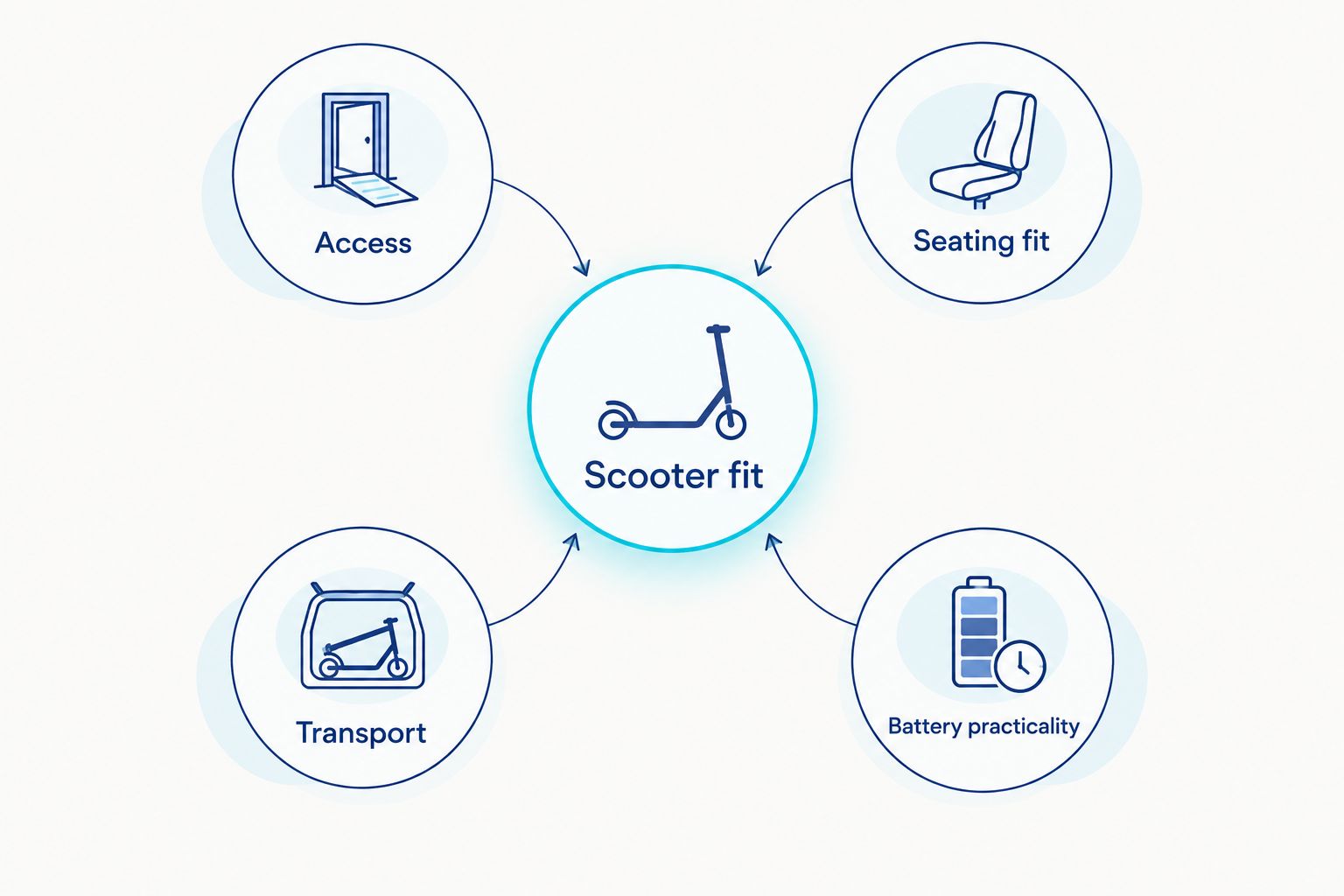
Use these six criteria before comparing features:
- Access: Check overall width, turning space, thresholds, and the approach to doors. Start with measuring doorways for mobility scooter access at home.
- Seating fit: Check seat width, seat depth, legroom, armrest position, and your ability to reach the controls comfortably.
- Handling: Test steering, reversing, stopping, and turning at low speed. Wheel count alone does not establish safe handling.
- Transport: Compare folded dimensions or component weights with your vehicle opening and your lifting ability.
- Battery practicality: Check charging access, battery removal instructions, replacement options, and the manufacturer's range conditions.
- Service support: Identify who supplies replacement parts and who performs repairs before committing.
Aeva Vital’s mobility scooter selection rule is straightforward: access and control come before convenience features. A basket, display, or folding mechanism cannot compensate for a poor seating position or an inaccessible doorway.
Mobility scooter types at a glance
These are ranked buying categories, not tested product winners. The order starts with everyday use, then separates options by the specific problem each design addresses.
| Rank and scooter type | Best for | Standout design feature | Key limitation |
|---|---|---|---|
| 1. Four-wheel everyday scooter | Routine paved trips | Four-wheel layout for general use | Turning and storage space need checking |
| 2. Dismantling travel scooter | Loading into a car in separate pieces | Components separate for transport | Every component still needs lifting and storage |
| 3. Folding scooter | Compact storage | Frame folds into a smaller configuration | Folded size does not establish manageable weight |
| 4. Three-wheel scooter | Tight indoor maneuvering | Single front-wheel steering layout | Turning technique and surface suitability remain important |
| 5. Heavy-duty scooter | Higher rider-capacity requirements | Models designed around greater load requirements | Larger dimensions can restrict access and transport |
Categories overlap. A folding scooter can have four wheels, and a dismantling model can have either wheel layout. Treat transport design, wheel layout, and load capacity as separate decisions.
Why the complete route matters
Your route includes more than distance. It includes the storage location, charging point, doorway, pavement, destination entrance, and return journey.
Write those stages down before shopping. A short trip with a difficult threshold can demand more planning than a longer trip across level, accessible paths.
Keep terrain claims separate from appearance. Large tires, a substantial frame, or an outdoor photograph do not establish that a scooter is suitable for gravel, wet surfaces, slopes, or uneven ground; the operating manual defines its limits.
1. Four-wheel everyday scooters: best for routine paved trips
A four-wheel everyday scooter is the first category to assess when your main goal is regular travel around accessible local destinations. Compare models intended for the surfaces and distances you actually encounter.
Four wheels describe the layout, not a universal safety rating. Stability also depends on geometry, speed, loading, slope, and how you turn.
Four-wheel everyday scooter pros:
- Provides a clear starting category for general daily use.
- Lets you prioritize seating and controls without making folding the main requirement.
- Includes designs with different seating, battery, and storage arrangements.
Four-wheel everyday scooter cons:
- The turning path can be unsuitable for a confined entrance or hallway.
- A nonportable model requires a separate vehicle-loading plan.
Best for: You mainly use suitable paved routes and can store the scooter without dismantling it after every trip.
Ask to drive the exact model through a route resembling your daily environment. Include a doorway approach and a turn into a confined space, not just a straight demonstration aisle.
Verdict: Buy this type when everyday fit matters more than compact transport.
2. Dismantling travel scooters: best for car transport
A dismantling travel scooter separates into components so you can load it in stages. The important specification is the heaviest component you must handle—not just the assembled weight.
Check the full process yourself. Battery removal, frame separation, and reassembly need to be practical for the person doing them.
Dismantling travel scooter pros:
- Divides the transport task into separate lifts.
- Allows you to arrange components around a vehicle's usable cargo space.
- Avoids relying on a folding mechanism as the only storage solution.
Dismantling travel scooter cons:
- Setup and breakdown become part of every transported outing.
- Loose components need secure storage during travel.
- A single awkward component can make the whole process impractical.
Best for: You regularly drive to destinations and can safely handle the scooter's separate pieces.
Measure the cargo opening as well as the space behind it. A component that fits inside the trunk can still be difficult to pass through the opening or lift over its edge.
Verdict: Buy after a complete loading and reassembly demonstration in your vehicle.
3. Folding scooters: best for compact storage
A folding scooter reduces its frame into a smaller configuration. This can address storage constraints, but folding does not automatically make the scooter light or easy to lift.
Compare the dimensions in the exact storage position you intend to use. Check whether the manual permits moving or standing the folded scooter in that position.
Folding scooter pros:
- Reduces the space occupied by the unfolded frame.
- Keeps much of the scooter together rather than creating multiple loose components.
- Suits buyers who prioritize a repeatable folding routine.
Folding scooter cons:
- The complete folded unit can remain difficult to lift.
- Hinges and locking points require correct operation and inspection.
- Compact storage does not prove airline acceptance.
Best for: Your main constraint is storage space, and you already have a workable loading method.
Test the latch, folding sequence, and unfolding sequence before buying. If another person will help, that person should complete the same demonstration.
Verdict: Buy for verified storage fit; skip if folding only moves the lifting problem elsewhere.
4. Three-wheel scooters: best for tight indoor maneuvering
A three-wheel scooter uses a single front-wheel steering layout. It is a useful category to investigate when indoor turning space is the main obstacle, but compare the actual turning radius and overall dimensions of each model.
Do not assume every three-wheel scooter turns more tightly than every four-wheel alternative. The complete design determines the space needed.
Three-wheel scooter pros:
- Provides an alternative steering layout for confined routes.
- Offers a category worth testing around furniture and doorway approaches.
- Lets you compare floorboard and legroom arrangements across models.
Three-wheel scooter cons:
- Wheel layout does not establish suitability for uneven ground.
- Tight turns still require controlled speed and appropriate technique.
Best for: Your priority is maneuvering through a measured indoor route.
Test a complete turn where you will actually use the scooter. Include the return direction: furniture, door hinges, and approach angles can make the reverse journey different.
Verdict: Buy only after the exact model passes your indoor access test.
5. Heavy-duty scooters: best for higher capacity requirements
A heavy-duty scooter is the category to assess when rider-capacity requirements rule out smaller models. The label itself is not a specification; use the manufacturer's stated load limit and loading instructions.
Capacity and seating fit are separate checks. A sufficient load rating does not establish comfortable seat width, adequate legroom, or suitable control placement.
Heavy-duty scooter pros:
- Focuses your search on models with higher stated load requirements.
- Encourages a closer assessment of seating dimensions and support.
- Provides an alternative when a compact travel design does not fit the rider.
Heavy-duty scooter cons:
- Greater overall dimensions can limit doorway and vehicle access.
- Transport equipment must match the actual scooter and vehicle.
- A higher capacity rating does not authorize steeper slopes or rougher terrain.
Best for: You need a documented load rating and seating arrangement that smaller scooters do not provide.
Account for carried belongings according to the manual. Do not assume the basket, rear accessories, or attached equipment sit outside the manufacturer's loading rules.
Verdict: Buy for documented capacity and fit, not the heavy-duty label alone.
Read the specifications without overreading them
A mobility scooter specification describes a particular measurement or test condition. It does not establish suitability for every rider or route.
For a 2026 shortlist, organize the specification sheet around these separate checks:
- Rider capacity: Confirm how the manufacturer defines the permitted load.
- Seat dimensions: Check usable seating space, not just the external seat outline.
- Turning radius: Compare it with the space available at actual corners.
- Ground clearance: Do not treat clearance as permission to climb obstacles.
- Maximum gradient: Follow the manual's slope instructions and restrictions.
- Advertised range: Read the test conditions; rider load, terrain, and battery condition affect real travel.
- Transport dimensions: Use folded or dismantled dimensions only when those match your loading method.
Keep speed out of the lead position. A higher maximum speed does not solve a narrow entrance, an awkward transfer, or a charging problem.
Test controls, transfers, and charging before purchase
You need to reach and operate the controls while seated in a supported position. During a demonstration, practice starting, stopping, reversing, and steering without stretching or changing posture to compensate for poor fit.
Also practice getting on and off with the scooter configured according to its manual. A swivel seat or movable armrest only helps if you can operate it and secure it correctly.
If balance, hand function, vision, or transfers make scooter use uncertain, request an assessment from an occupational therapist or another qualified mobility professional. A product comparison is not a substitute for an individual suitability assessment.
Finally, identify a suitable charging location and follow the charger and battery instructions. Check whether you must bring the scooter to the outlet or whether the manufacturer permits removing the battery for charging.
How the categories are ranked
Aeva Vital’s 2026 guide ranks use cases rather than assigning unsupported scores to individual scooters. Everyday travel comes first, followed by car loading, compact storage, indoor maneuvering, and higher capacity requirements.
The ranking changes with your constraints. If you cannot load an assembled scooter, transport practicality becomes the first filter—not a feature to consider after selecting a model.
Which mobility scooter should you choose?
Start with a four-wheel everyday scooter if you have accessible paved routes and no overriding transport constraint. Then eliminate models that fail your doorway, seating, control, or charging checks.
Choose a dismantling design when separate lifts solve your car-loading problem. Choose folding when compact storage is the real requirement, three wheels when a demonstrated indoor turning advantage matters, and heavy-duty when documented capacity and fit demand it.
For your final 2026 decision, require a demonstration of the hardest part of ownership. That might be the trunk lift, the entrance turn, or getting on and off—not the easiest stretch of a showroom floor.
FAQ
What's the best mobility scooter for everyday use?
A four-wheel everyday scooter is a starting category for routine trips on suitable paved routes. Choose the exact model only after checking seating, access, controls, and storage.
Is a three-wheel scooter better than a four-wheel scooter?
Neither wheel layout is better for every rider. Compare the exact models' turning requirements, operating limits, and handling on your intended route.
What's the best mobility scooter to put in a car?
A dismantling travel scooter suits car transport when you can safely lift its separate components. A folding model is another option if its complete folded weight and dimensions work with your loading method.
Does a folding mobility scooter count as airline approved?
Folding alone does not establish airline acceptance. Confirm the battery documentation and the airline's requirements for your exact scooter before booking assistance or travel.
How do I choose the right scooter weight capacity?
Use the manufacturer's stated load limit and instructions for the rider and carried items. Check seat dimensions separately because load capacity does not establish seating fit.
Can I use a mobility scooter inside my home?
You can use a suitable scooter indoors when the route provides adequate access and maneuvering space. Check door approaches, thresholds, floor suitability, and storage rather than doorway width alone.
How far will a mobility scooter travel on one charge?
Travel distance depends on the model, battery condition, rider load, terrain, and operating conditions. Read the manufacturer's range conditions and plan a return trip without relying on the advertised maximum.
What should I check before buying a mobility scooter in 2026?
Check access, seating, controls, transport, charging, and service support before buying. Demonstrate the complete daily routine with the exact model, including its most difficult turn or lift.
Related guides
- Transporting a mobility scooter in your car: ramps and lifts
- Taking a mobility scooter on an airplane
- Mobility scooter travel distance on a single charge
One last thing
The most useful demonstration happens before the ride: retrieving the scooter, preparing it, and reaching the starting point. Make that complete sequence part of your 2026 buying checklist; a scooter only works for daily life when you can begin and end the journey reliably.