
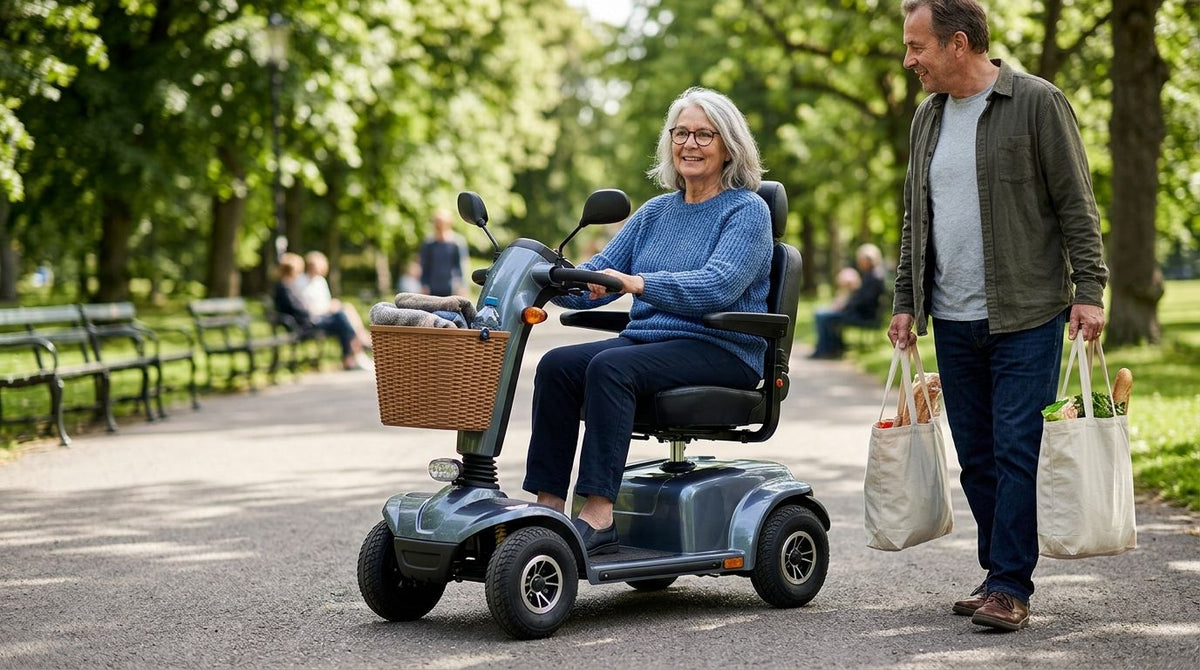
A mobility scooter carries 300 pounds on average, ranging from 250 pounds on compact travel models to 600 pounds on heavy-duty bariatric scooters in 2026. That printed number almost always covers rider body weight only — a loaded basket, an oxygen tank, or a bag of groceries eats into the remaining margin fast.
- Mobility scooter weight capacity runs 250 to 600 pounds in 2026, with 300 pounds as the typical rating.
- Travel and compact scooters top out near 250 to 300 pounds; heavy-duty models handle 400 to 600 pounds.
- Posted capacity covers rider weight only — cargo, bags, and accessories cut into the remaining margin.
- Exceeding the rated weight limit strains the motor, shortens battery range, and can void the warranty.
- Bariatric scooters with reinforced frames and wider seats exist specifically for riders over 300 pounds.
Why this matters
A scooter rated for less weight than the rider isn't just underpowered — it's a safety problem. Frames flex, motors overheat faster, and braking distance changes when a scooter carries a load near or past its rated limit.
The same sizing logic shows up across home mobility gear. Checking lift chair weight limits before buying follows the same principle: match the equipment's rated capacity to the actual user, not the average. Getting this wrong on a scooter also shortens battery life and increases wear on tires rated for a lower load.
How much weight can a mobility scooter carry?
Capacity depends almost entirely on scooter class. Compact travel scooters use lighter frames and smaller motors, while heavy-duty and bariatric models add steel reinforcement, wider seats, and bigger batteries to handle more weight.
| Scooter Type | Typical Weight Capacity | Best For |
|---|---|---|
| Travel / compact | 250-300 lbs | Air travel, folding storage, tight indoor spaces |
| Mid-size | 300-400 lbs | Daily errands, moderate outdoor terrain |
| Heavy-duty / bariatric | 400-600 lbs | Larger riders, outdoor use, added stability |
A mid-size scooter rated near 350 pounds covers most adult riders without paying for bariatric-only features they'll never use.
Riders near the top of a category's range should size up rather than max out a lower-rated model. A 290-pound rider on a 300-pound scooter leaves almost no margin for a coat, a bag, or a rough sidewalk transition.
Travel and compact scooters: 250 to 300 pounds
Travel scooters fold or disassemble into pieces light enough to lift into a car trunk, which caps how much steel the frame can carry without becoming too heavy to transport. Seats run narrower, tires are smaller, and the motor is sized for short indoor and sidewalk trips rather than sustained outdoor use.
Verdict: buy a travel scooter only if the rider's weight sits comfortably under 250 pounds with room to spare for cargo.
Mid-size scooters: 300 to 400 pounds
Mid-size scooters trade some portability for a heavier frame, a wider seat, and a bigger battery pack. This is the category most riders end up in, since it covers a broad range of body weights without the bulk of a bariatric build.
Verdict: the practical default for daily errands and moderate terrain — buy this class first unless the rider's weight or the terrain says otherwise.
Heavy-duty and bariatric scooters: 400 to 600 pounds
Heavy-duty and bariatric scooters use reinforced steel frames, seats often 20 to 22 inches wide, larger-diameter tires, and in some models dual motors to handle the added load without sacrificing speed or range. These scooters cost more because of the extra steel, larger battery, and wider components, but they're the only safe option for riders above 400 pounds.
Verdict: buy a bariatric-rated scooter for any rider over 350 pounds — a mid-size model pushed past its rating is a false economy.
Why weight capacity varies
- Frame material and reinforcement — steel-reinforced frames carry more weight than lighter aluminum builds used in travel models.
- Motor and battery size — a bigger motor moves more weight without straining, and a larger battery offsets the extra draw.
- Seat width and structure — wider, reinforced seats distribute weight more evenly across the frame.
- Wheelbase and tire size — larger tires and a wider wheelbase improve stability under a heavier load.
- Intended terrain — scooters built for outdoor use over curbs and inclines need sturdier components than indoor-only models.
- Portability trade-offs — folding travel scooters sacrifice weight capacity for lighter, disassemble-friendly frames.
Doorway and hallway clearance matter just as much as capacity once a heavier scooter comes home. Measuring doorways for a mobility scooter before ordering avoids a wider bariatric frame getting stuck at the front door.
What happens if you exceed a mobility scooter's weight limit?
Exceeding a mobility scooter's rated weight limit strains the motor, drains the battery faster, and can void the manufacturer's warranty. Frames rated for 300 pounds are not tested past that figure, so riders near or over the limit should size up to a 400-to-600-pound heavy-duty model instead of pushing a lower-rated scooter.
Does Medicare cover a heavy-duty mobility scooter in 2026?
Medicare Part B can cover a portion of a mobility scooter's cost in 2026 when a doctor documents medical necessity, but weight capacity itself doesn't change eligibility. Coverage decisions focus on mobility limitations and documented need, not the scooter's rated capacity.
How much does a mobility scooter cost in 2026?
A mobility scooter's cost in 2026 climbs with weight capacity: compact travel models sit at the lower end, while heavy-duty bariatric scooters cost more because of the reinforced steel frame, wider seat, and larger battery required to safely carry 400 to 600 pounds.
Plan the full setup at home
See ramps and lifts for getting a heavier scooter in and out of the car.
FAQ
How much weight can a mobility scooter carry?
A mobility scooter carries 300 pounds on average in 2026, ranging from 250 pounds on compact travel models to 600 pounds on heavy-duty bariatric scooters. Always check the rider's weight against the specific model's rating, not the category average.
What is the heaviest weight capacity for a mobility scooter?
The heaviest common capacity is around 600 pounds on reinforced bariatric scooters built with steel frames and wider seats. Some models offer dual motors to handle that load without losing range.
Does a scooter's weight limit include cargo?
No, the posted weight limit almost always covers rider body weight only, not cargo. A basket load, bag, or oxygen tank should be subtracted from the remaining margin before buying near the top of a range.
Can you lose warranty coverage by exceeding the weight limit?
Yes, exceeding a mobility scooter's rated weight limit can void the manufacturer's warranty. Manufacturers test components up to the stated capacity and no further.
What weight capacity do travel scooters have?
Travel and compact scooters typically carry 250 to 300 pounds in 2026 due to lighter frames built for folding and portability. Riders near this range should consider a mid-size or heavy-duty model instead.
Are heavy-duty scooters harder to transport?
Heavy-duty and bariatric scooters, rated 400 to 600 pounds, are heavier and bulkier than travel models, which makes lifting them into a car trunk without a ramp or lift difficult. Most owners pair them with a vehicle ramp or lift setup instead of manual loading.
Does Medicare cover a mobility scooter based on weight?
Medicare coverage in 2026 depends on documented medical necessity, not the scooter's weight rating. A doctor's documentation of a mobility limitation drives eligibility, separate from which weight-capacity model is chosen.
One last thing
The weight rating on the spec sheet is a ceiling, not a target — buying a scooter rated 50 to 100 pounds above the rider's actual weight in 2026 leaves room for cargo, winter coats, and the natural weight fluctuation most people experience over a few years of ownership.