
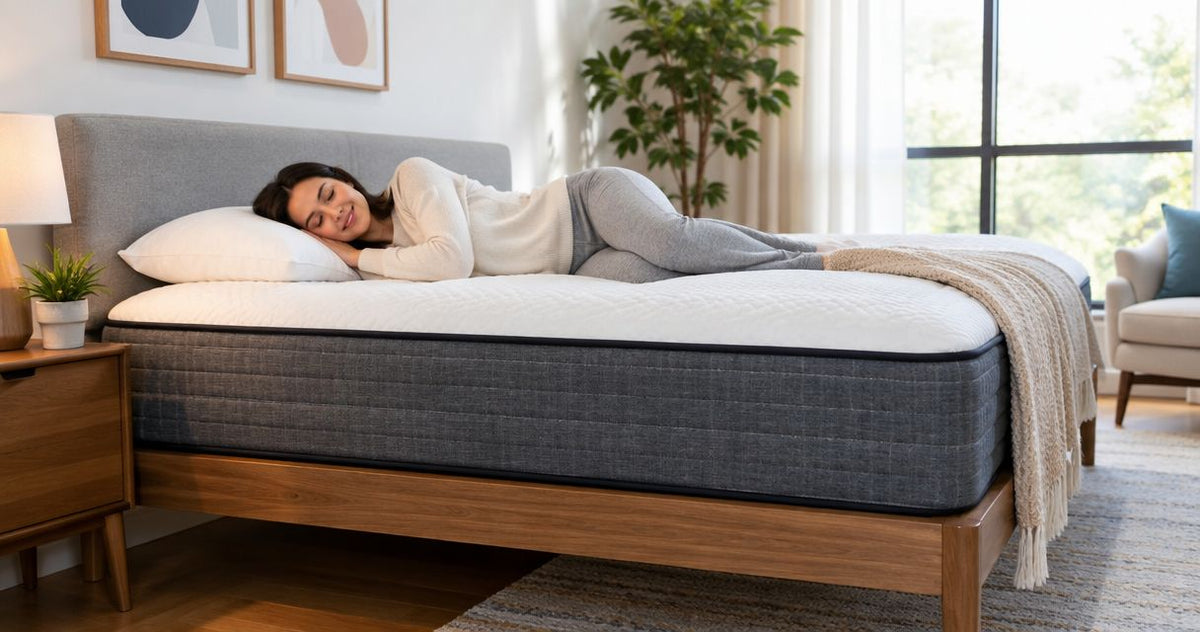
The best medium firm hybrid mattress in 2026 is the one that cushions your shoulders and hips without letting your pelvis sink too far. Start with a balanced foam-and-coil design; choose a more cushioned surface for side sleeping, and treat firm models as a separate category rather than assuming they feel medium firm.
By Editorial Team
- The best medium firm hybrid mattress balances pressure relief with support; thickness alone does not establish firmness.
- Choose a cushioned hybrid for side sleeping only after checking shoulder and hip comfort.
- Aeva Vital lists SpineAlign as firm, not medium firm; shortlist it only if you want that distinction.
- Confirm foundation requirements, usable dimensions, and return terms before choosing a mattress.
Why firmness matters more than the label
Medium firm describes how a mattress feels under your body. Hybrid describes its construction: cushioning materials above a spring support system. Neither term establishes how comfortable a particular mattress will feel to you.
Your sleeping position, body weight, and existing foundation change the result. Use the guide to choosing hybrid mattress firmness to separate surface comfort from underlying support before comparing models.
For your 2026 shortlist, start with your main complaint about your current bed. Shoulder pressure points toward a cushioning problem; excessive sinking points toward a support or firmness mismatch. Buying a thicker mattress without identifying that problem leaves the central decision unresolved.
What makes the best medium firm hybrid mattress?
Judge each candidate against these criteria before treating it as a recommendation:
- Pressure relief: Your shoulders and hips should settle into the surface without uncomfortable concentrated pressure.
- Underlying support: The mattress should resist excessive sinking beneath your pelvis while accommodating your body shape.
- Ease of movement: You should be able to change positions without struggling against deep cushioning.
- Partner disturbance: Evaluate how movement travels across the complete mattress, not just whether its coils are individually wrapped.
- Temperature management: Examine the cover, comfort materials, bedding, and room conditions rather than trusting a cooling name.
- Foundation compatibility: Confirm the required support surface and any restrictions on adjustable bases.
Firmness and support are different properties. A soft comfort layer can sit above a supportive core, while a hard-feeling surface can still be unsuitable for your body.
Hybrid mattress options at a glance
These are construction-based selection paths, not laboratory-tested product rankings. The order gives an undecided shopper a starting point, followed by more specific alternatives.
| Option | Best for | Standout characteristic | Key limitation |
|---|---|---|---|
| Balanced medium firm foam-and-coil hybrid | An undecided shopper seeking a starting point | Combines surface cushioning with spring support | The firmness label does not establish personal fit |
| Cushioned medium firm hybrid | Side sleepers prioritizing shoulder and hip comfort | Places more emphasis on surface pressure relief | Deeper cushioning can make turning harder |
| Responsive medium firm hybrid | Combination sleepers prioritizing movement | Emphasizes easier position changes | Responsiveness does not prove motion isolation |
| SpineAlign 12" Queen Firm Cooling Hybrid Mattress | Shoppers specifically seeking a firm queen hybrid | Listed with high-density foam and individually wrapped coils | Firm designation does not establish medium firm feel |
A standard US queen mattress measures 60 inches wide by 80 inches long. Check the actual model dimensions and your frame's internal opening rather than relying only on the size name.
1. Balanced foam-and-coil hybrid: best starting point
A balanced medium firm hybrid combines cushioning above a coil support unit without making deep sinkage its main feature. It is the most sensible construction profile to compare first when you have not identified a strong preference for a softer or firmer surface.
The label is only a starting point. You still need to establish whether your shoulders settle comfortably and your pelvis remains supported in your usual sleeping position.
Balanced hybrid pros:
- Provides a clear baseline for comparing softer and firmer alternatives.
- Combines distinct comfort and support components.
- Lets you evaluate cushioning without choosing an intentionally plush surface.
Balanced hybrid cons:
- Medium firm is not a uniform specification across manufacturers.
- A compromise feel does not satisfy every sleeping position or body type.
Best for: Shoppers replacing an ordinary everyday mattress who want to establish a baseline before choosing a specialized feel.
Verdict: Buy only after confirming the comfort match and purchase terms.
2. Cushioned hybrid: best for side-sleeping pressure relief
A cushioned medium firm hybrid places greater emphasis on the materials between your body and the coils. For side sleepers, the question is whether those materials accommodate the shoulder and hip without allowing excessive sinking through the middle.
A pillow top or quilted surface describes a construction feature, not a guaranteed firmness level. Read the full build description and assess the complete mattress.
Cushioned hybrid pros:
- Gives you a construction profile focused on surface comfort.
- Creates room for shoulders and hips to settle into cushioning.
- Separates the pressure-relieving surface from the spring support below.
Cushioned hybrid cons:
- Deep cushioning can make changing positions more difficult.
- A soft initial impression does not establish sustained comfort or adequate support.
Best for: Side sleepers whose main problem is uncomfortable pressure on a firmer sleep surface.
Verdict: Buy for a demonstrated cushioning need; skip if deep sinkage is your main complaint.
3. Responsive hybrid: best for changing sleeping positions
A responsive medium firm hybrid emphasizes a surface that lets you turn and reposition without feeling trapped. Compare the stated comfort materials and, where possible, assess how the complete bed responds when you move.
Responsiveness and partner disturbance require separate checks. A mattress that makes turning easy does not automatically keep those movements from reaching the other side.
Responsive hybrid pros:
- Makes ease of movement a clear selection priority.
- Suits shoppers who dislike slow recovery after pressing into cushioning.
- Encourages evaluation in several sleeping positions rather than just one.
Responsive hybrid cons:
- A lively surface does not establish strong motion isolation.
- Ease of movement does not prove sufficient shoulder cushioning.
Best for: Combination sleepers who regularly switch between their side and back.
Verdict: Buy when easy repositioning is the deciding factor; hold if partner disturbance remains unresolved.
Match the construction to your body
For your 2026 comparison, assess the mattress in your normal sleeping position before judging it while sitting on the edge. Sitting concentrates your weight differently and does not reproduce the way your body loads the bed overnight.
Use three separate checks. Passing one does not compensate for failing another.
- Shoulder comfort: Notice whether side lying creates concentrated pressure or forces an awkward position.
- Pelvic support: Notice whether your middle sinks disproportionately compared with the rest of your body.
- Easy turning: Change positions and assess whether the surface resists your movement.
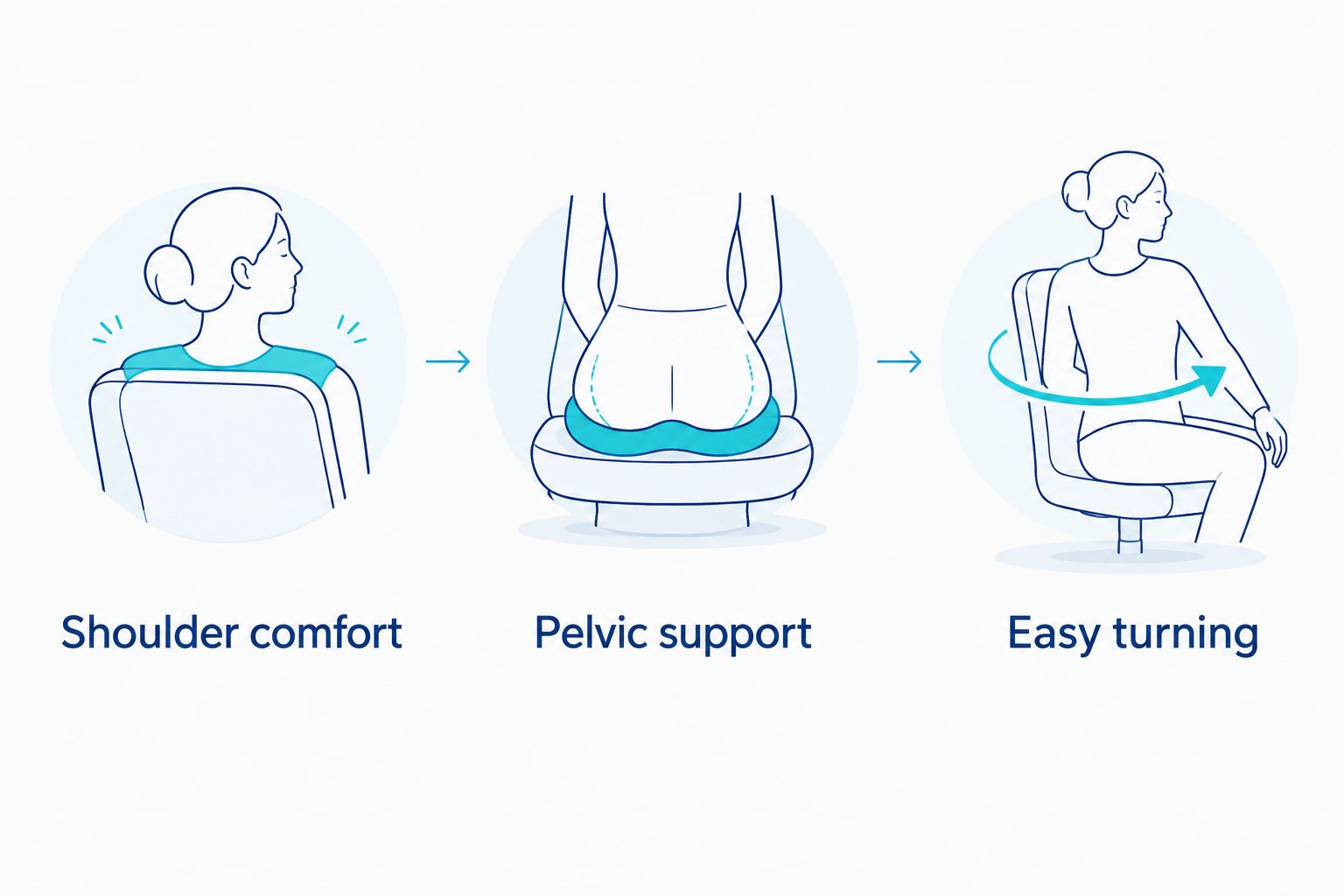
Body weight changes how deeply you compress comfort layers. Sleeping position changes where that load concentrates. That is why another person's firmness verdict cannot replace your own fit assessment.
For couples, each person should complete these checks. A shared preference for the words medium firm does not establish a shared preference for the same mattress.
Aeva Vital's firm hybrid: what the specifications establish
The SpineAlign 12" Queen Firm Cooling Hybrid Mattress is listed with high-density foam and individually wrapped coils. Its title identifies a 12-inch profile, queen size, and firm designation.
Aeva Vital's SpineAlign hybrid mattress is a shortlist option for shoppers seeking a firm queen model, not a confirmed medium firm match. That distinction prevents a category label from becoming an unsupported comfort recommendation.
The listed construction establishes foam-and-coil components. It does not, by itself, establish measured motion isolation, edge support, temperature performance, or your personal pressure relief. Likewise, the word Cooling in the product name is not a quantified temperature result.
SpineAlign pros:
- The title clearly identifies the intended firm feel.
- The listed 12-inch profile gives you a concrete height for planning.
- The description identifies high-density foam and individually wrapped coils.
SpineAlign cons:
- The firm designation is not the medium firm designation this search targets.
- The construction summary alone does not establish comparative performance.
- The queen listing does not establish other size options.
Best for: Shoppers who deliberately want a firm queen hybrid and are checking fit against that requirement.
Verdict: Hold if medium firm is non-negotiable; consider only if a firm feel matches your preference.
Can a topper correct the wrong firmness?
A topper changes the surface above your mattress. It does not rebuild the coil unit, restore a sagging support system, or establish compatibility with your foundation.
The distinction behind whether a mattress topper is worthwhile is surface comfort versus underlying support: added cushioning addresses a different problem from a mattress that no longer supports you properly. Identify which problem you have before adding another layer.
A topper also changes the overall bed height and fitted-sheet requirements. If you are comparing a new mattress in 2026, evaluate the intended finished setup rather than assuming accessories will correct a poor initial match.
Choose the mattress for support and overall feel first. Treat a topper as a separate comfort adjustment, not permission to buy the wrong firmness.
Check the foundation, height, and bedding
A mattress and its base function as a system. Confirm the required slat arrangement, center support, and foundation type for the exact model before placing an order.
Do not assume all hybrids bend safely on an adjustable frame. The hybrid mattress and adjustable base guide addresses that separate compatibility decision; confirmation for the exact mattress still controls.
Measure the height of your support surface, then add the mattress profile. A listed 12-inch mattress contributes 12 inches to that planned height, but it does not establish how comfortable the finished bed will be to enter or leave.
Check sheet pocket depth against the complete sleep surface, including any topper or protector. Mattress thickness measures height; it does not measure firmness, layer quality, or durability.
How these recommendations are ranked
The 2026 order prioritizes a general starting point, then separates pressure-relief and movement needs. It does not assign unsupported scores or turn construction descriptions into test results.
The firm SpineAlign model sits outside the medium firm recommendations because its stated designation matters more than its relevance to a broad hybrid search. A useful buying guide excludes a mismatch rather than promoting it as the default.
Before purchasing, confirm the exact model's firmness description, dimensions, foundation instructions, care requirements, and return conditions. Read the actual terms rather than assuming every mattress has the same trial or collection process.
Which hybrid mattress should you choose?
Choose a balanced medium firm hybrid as your initial comparison if you have no strong construction preference. Move toward more surface cushioning when shoulder and hip pressure is the central problem; prioritize responsiveness when turning feels difficult.
For the best medium firm hybrid mattress in 2026, the deciding evidence is a good fit in your sleeping position plus clear product specifications. A firm model is not a substitute simply because it shares the same foam-and-coil category.
FAQ
What's the best medium firm hybrid mattress for me?
The best medium firm hybrid mattress cushions your pressure points while supporting your pelvis in your usual sleeping position. Start with a balanced design, then compare alternatives based on pressure relief and ease of movement.
Is a firm hybrid mattress the same as medium firm?
No. Firm and medium firm are different feel descriptions, and manufacturers do not apply them uniformly. Do not reclassify a firm model without evidence about its actual feel.
Is Aeva Vital's SpineAlign mattress medium firm?
The listed product title identifies the SpineAlign 12-inch Queen Firm Cooling Hybrid Mattress as firm. Treat it as a firm candidate rather than a confirmed medium firm option.
Is a medium firm hybrid good for side sleeping?
A medium firm hybrid is suitable only when its cushioning accommodates your shoulders and hips comfortably. The label alone does not establish enough pressure relief for your body.
Does a thicker hybrid mattress feel softer?
Thickness does not establish softness. The materials, their arrangement, and how they compress under your body determine the feel.
Can I use a hybrid mattress on an adjustable base?
Use a hybrid on an adjustable base only when the exact mattress is approved for that setup. Confirm the mattress and base requirements before pairing them.
Will a cooling hybrid mattress stop me sleeping hot?
A cooling label does not guarantee that you will sleep cool. Evaluate the mattress materials alongside your protector, sheets, bedding, and room conditions.
Related guides
One last thing
Write down the problem your next mattress must solve before comparing names: pressure, excessive sinking, difficult movement, or an incompatible setup. Keep that requirement beside every product description; it is more useful than choosing by thickness or accepting a firmness label at face value.