
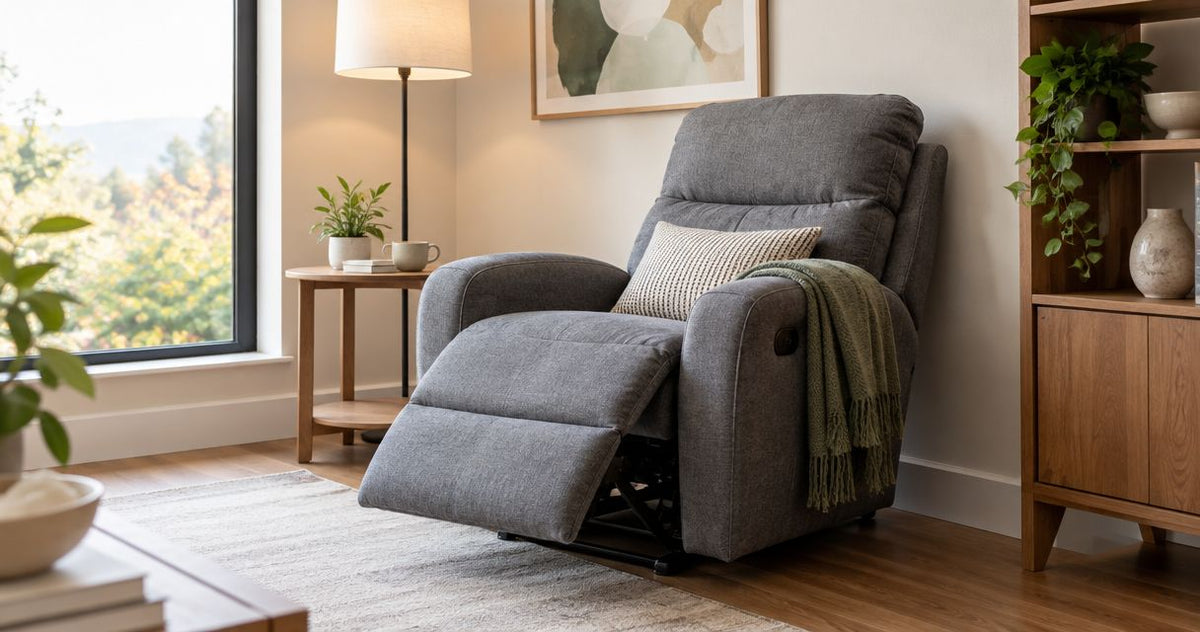
Best overall: a compact power wall-hugger recliner with documented operating dimensions. Best without an outlet: a manual wall-hugger recliner. Best for standing assistance: a wall-hugger lift recliner. The best wall hugger recliners for small spaces in 2026 fit your body, delivery route, and fully reclined floor plan—not just the gap behind the backrest.
By Editorial Team
A wall-hugger mechanism moves the seat forward as the back reclines, reducing the space required behind the chair. Start with the mechanism and measurements; Aeva Vital’s guide to whether a wall-hugger recliner is worth it for small rooms explains the layout decision.
- The best wall hugger recliners for small spaces have documented rear clearance, overall width, and fully reclined depth.
- Choose a compact power wall-hugger for button-operated positioning; choose manual operation when you do not want an electrical connection.
- A wall-hugger lift recliner suits standing-assistance needs only when its complete movement fits the room.
- Aeva Vital recommends comparing operating footprints before upholstery, accessories, or appearance.
What makes the best wall hugger recliners for small spaces?
Use these criteria for your 2026 shortlist. A chair must pass the room-fit checks before extra features earn a place in the decision.
- Documented rear clearance: Require a model-specific distance measured from the wall to the chair in the position specified by its instructions.
- Fully reclined depth: Check the complete front-to-back footprint, including the extended footrest.
- Overall width: Measure outside the arms, not just across the seat cushion. Include access to a side-mounted handle or control.
- Body fit: Check seat height, usable seat depth, back support, and footrest support with the intended user.
- Usable controls: Confirm that you can operate the chair and return it upright without straining or reaching into a tight gap.
- Delivery and installation fit: Compare the documented delivery configuration with doorways, hall turns, stairs, and the final room.
Aeva Vital’s wall-hugger recliner recommendation is a documented-fit model for buyers furnishing a tight room. A small closed footprint is not enough if the open chair blocks your route across the room.
Wall-hugger recliner types at a glance
These 2026 recommendations rank mechanism types by use case, not individual models. The distinctions below help you decide which product specifications to request before choosing a chair.
| Rank and option | Best for | Standout feature | Key limitation |
|---|---|---|---|
| Compact power wall-hugger recliner | Everyday reclining with button controls | Motor-operated positioning with forward seat travel | Needs a suitable power connection and safe cord routing |
| Manual wall-hugger recliner | Rooms where an electrical connection is unwanted | User-operated reclining without a powered recline motor | Opening and closing effort must suit the user |
| Wall-hugger lift recliner | Buyers who need standing assistance | Combines reclining with a seat-lifting function | Lift movement creates additional operating-space checks |
Why this matters: rear clearance is only part of room fit
A wall-hugger solves a specific problem: limited space behind the backrest. It does not automatically solve a narrow seating bay, a crowded coffee-table area, or a difficult delivery route.
Think of the chair as moving furniture rather than a fixed rectangle. The footrest, backrest, controls, and user all need room during operation, and the room must remain usable when the chair is open.
Keep wall clearance separate from overall depth. A chair that sits close to the wall can still extend too far toward a television stand or block the only practical walking route.
1. Compact power wall-hugger: best for everyday positioning
A compact power wall-hugger recliner uses an electric motor to change position while its mechanism moves the seat forward. Choose this type when you want button-operated adjustment and have a suitable outlet near the final chair location.
The useful specification is the complete operating footprint. A narrow-looking power chair still needs enough room for its footrest, and its controls must remain reachable beside neighboring furniture.
Compact power wall-hugger pros:
- Button controls operate the reclining movement.
- Forward seat travel reduces rear-space requirements compared with a mechanism that reclines backward without that movement.
- A documented operating diagram lets you plan around the chair before delivery.
Compact power wall-hugger cons:
- Power and cord routing become part of the layout.
- Backup operation and behavior during an outage depend on the specific model.
- The control location can conflict with a nearby wall or side table.
Best for: Everyday lounging when button operation is your priority.
Before choosing a compact power wall-hugger, test the controls from your normal seated position. Confirm how the chair returns upright, and read its instructions rather than assuming that a battery or manual release is included.
Verdict: Buy when documented dimensions fit the room and powered operation suits your routine.
2. Manual wall-hugger: best without an electrical connection
A manual wall-hugger recliner uses a user-operated mechanism rather than an electric recline motor. The exact release and return action vary, so test the specific chair rather than judging it by the word manual.
This option removes the need to plan a power connection for reclining. It does not remove the need to check physical effort, handle access, or footrest closure.
Manual wall-hugger pros:
- Reclining does not depend on an electrical outlet.
- No recline-motor power cord needs routing around the chair.
- Operation remains independent of household electricity.
Manual wall-hugger cons:
- The effort needed to operate the mechanism must suit the user.
- A side lever needs accessible space beside the chair.
- Available resting positions depend on the mechanism.
Best for: Buyers who prefer unpowered furniture and can comfortably operate its release and return action.
Test closing as carefully as opening. A chair is a poor fit if you can recline comfortably but cannot bring the footrest back into its closed position without difficulty.
Verdict: Buy after a successful hands-on operating test; skip if closing requires uncomfortable effort.
3. Wall-hugger lift recliner: best for standing assistance
A wall-hugger lift recliner combines forward-travel reclining with a powered lifting function. The lift changes the seat’s position to assist the transition toward standing; it is a separate function from reclining.
Select this type because standing assistance matters, not because lift sounds like an upgrade. Confirm the complete motion path, the user’s seated fit, and the space needed in front of the chair.
Wall-hugger lift recliner pros:
- Includes a lifting function for the seated-to-standing transition.
- Combines reclining and lift functions in the same chair.
- A verified wall-hugger mechanism addresses limited rear clearance.
Wall-hugger lift recliner cons:
- Lift travel adds another movement envelope to measure.
- Power routing and control access require planning.
- Seat fit and transfer needs demand more than a room-width check.
Best for: Buyers who need standing assistance and have confirmed that the chair suits their individual needs.
When a chair supports transfers or post-surgical use, ask the treating clinician or occupational therapist about suitability. A wall-hugger label does not establish that a chair meets a person’s mobility or care requirements.
Verdict: Buy for a defined standing-assistance need after confirming user fit and full lift clearance.
Measure the operating footprint before choosing upholstery
For your 2026 room plan, record dimensions from a common reference point. Do not combine a closed-depth measurement from one drawing with a wall-clearance figure measured under different conditions.
Closed footprint
Mark the chair’s outside width and upright depth on the floor. Include protruding arms and the space needed to reach controls; seat width alone does not describe the furniture’s footprint.
Rear clearance
Use the manufacturer’s specified wall distance. Measure from the relevant part of the chair, and account for baseboards, window ledges, and anything else projecting from the wall.
Reclined footprint
Mark the front edge of the extended footrest and the backrest’s operating area. Check the full movement, not only the final resting position.
Walking route
Walk through the room with the reclined footprint marked. Confirm that you can reach the door, nearby seating, and the chair controls without stepping over a footrest or cord.
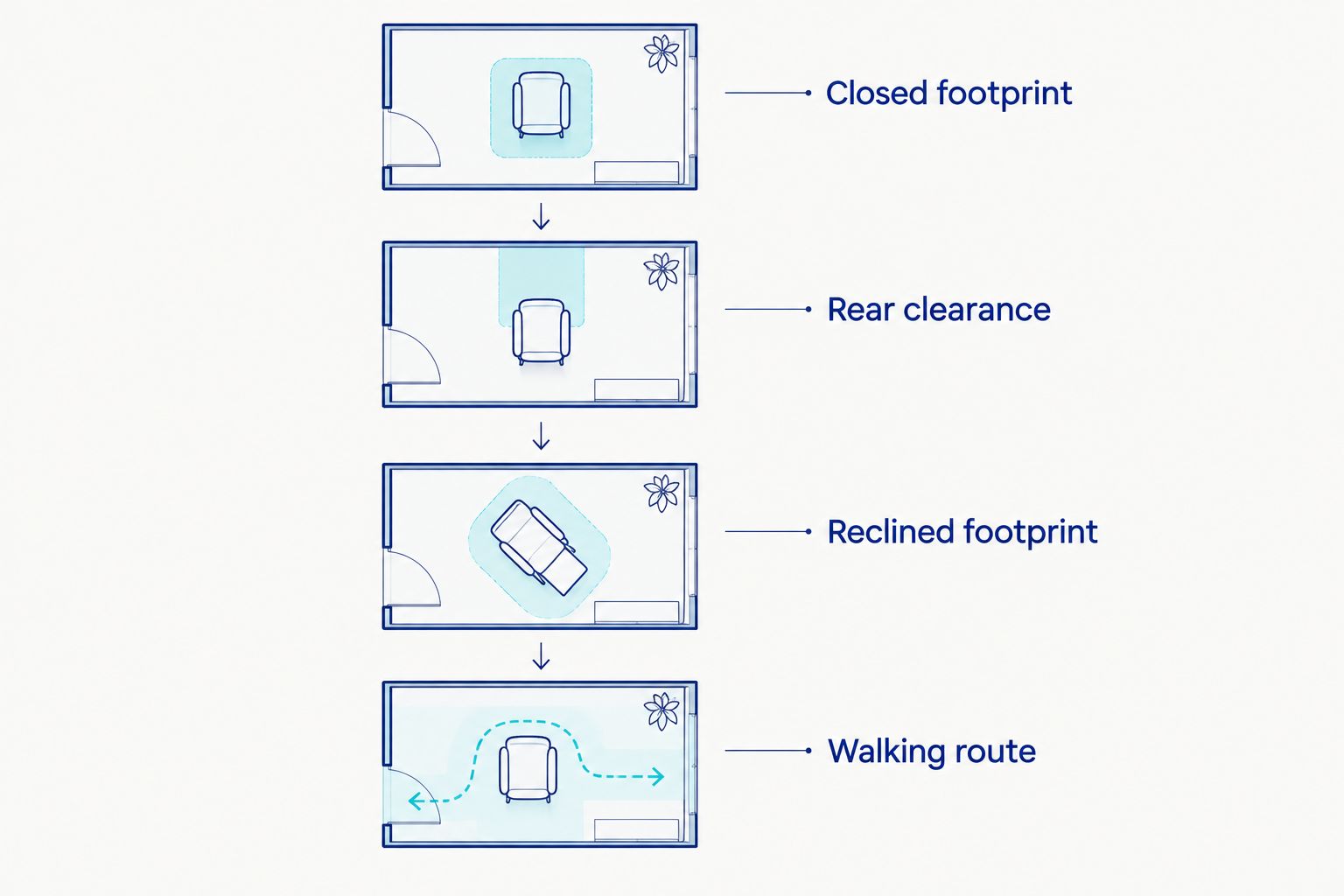
Painter’s tape makes conflicts visible before furniture arrives. Keep the markings in place while you use the room normally, including moving side tables and opening nearby doors.
Check construction, fit, and the delivery route
Mechanism before material
Ask for explicit confirmation of a wall-hugger mechanism. Compact, rocking, swivel, folding, and reclining describe different characteristics; none independently proves reduced rear-clearance requirements.
Frame material and upholstery also answer different questions. A material description does not establish operating clearance, expected service life, or a chair’s suitability for a particular user.
Seat dimensions before outside dimensions
A chair can fit the room and still fit you poorly. Check that the seat supports your thighs comfortably, that the backrest supports your resting posture, and that your feet are supported in the intended positions.
Do not choose a narrower chair by sacrificing usable seating space. Slimmer arms help only when the remaining seat dimensions suit the user.
Delivery configuration before doorway assumptions
Confirm whether dimensions describe the assembled chair, packaged components, or the largest delivery piece. A removable back matters only when the manufacturer permits removal and supplies the relevant instructions.
Measure the entire route, including turns and stairs. Passing through the front door does not prove that the chair can turn into the room.
Aeva Vital seating: folding is not wall-hugging
The Aeva Vital product catalog includes an Upholstered Folding Rocking Chair with Adjustable Footrest. Its supplied product details describe a high backrest, thick sponge cushioning, adjustable recline, and an adjustable footrest.
Those details describe seating and adjustment features. They do not establish a wall-hugger mechanism, a required wall gap, or a fully reclined footprint, so this folding rocking chair is not a wall-hugger recommendation.
The practical distinction matters: folding concerns storage or configuration, rocking concerns movement, and wall-hugging concerns the reclining path. Choose the function your room needs rather than treating those labels as interchangeable.
How to use this ranking in 2026
The order prioritizes everyday control, then unpowered operation, then standing assistance. It is a selection framework rather than a claim that power reclining is right for every buyer.
For each candidate, compare rear clearance, reclined depth, outside width, body fit, operating effort, and delivery configuration. Eliminate chairs that fail a required check instead of compensating with accessories.
Ask the seller for a dimension drawing and operating instructions tied to the exact model. General category measurements are not a substitute for model-specific information.
Which wall-hugger recliner should you choose?
Choose a compact power wall-hugger as the default when you want button-operated reclining and can provide safe power access. Choose manual operation when you prefer an unpowered mechanism and can operate it comfortably; choose a lift model when standing assistance is a defined requirement.
The deciding measurement is the chair’s complete operating footprint in your room. The smallest advertised wall gap does not win if the extended chair blocks your route.
Related guides
- How close to the wall can a wall-hugger recliner sit?
- Can a wall-hugger recliner fully recline?
- Routing lift-chair power cords safely in small apartments
FAQ
What's the best wall-hugger recliner for a small living room?
A compact power wall-hugger is the default choice when you want button-operated reclining and have suitable power access. Select the specific chair by its documented rear clearance, outside width, fully reclined depth, and seated fit.
How close can a wall-hugger recliner sit to the wall?
The required distance is model-specific. Follow the chair's operating instructions and account for baseboards, window ledges, and the backrest's complete movement.
Does a wall-hugger recliner need space in front?
Yes, a wall-hugger recliner still needs room for its forward movement and extended footrest. Check the full operating footprint and preserve a usable walking route.
Is a manual wall-hugger better than a power recliner?
A manual wall-hugger is better when you want unpowered reclining and can comfortably operate its mechanism. A power wall-hugger suits buyers who prefer button controls and can provide the required electrical connection.
Can a lift recliner also be a wall-hugger?
Yes, a lift recliner can use a wall-hugger mechanism, but the specific model must identify that feature. Confirm clearance for lifting as well as reclining.
Is a folding rocking chair the same as a wall-hugger?
No, folding and rocking do not establish a wall-hugger mechanism. Wall-hugging describes the reclining movement, so require explicit mechanism information and model-specific clearance instructions.
How do I check whether a recliner will fit through my doorway?
Compare the narrowest points on the complete delivery route with the manufacturer's documented delivery configuration. Include hallway turns and stairs, and confirm any permitted component removal before delivery.
One last thing
Before choosing a wall-hugger recliner in 2026, mark its open footprint and open every nearby door. A chair that clears the wall but obstructs a cabinet, room entrance, or walking route still does not fit.