
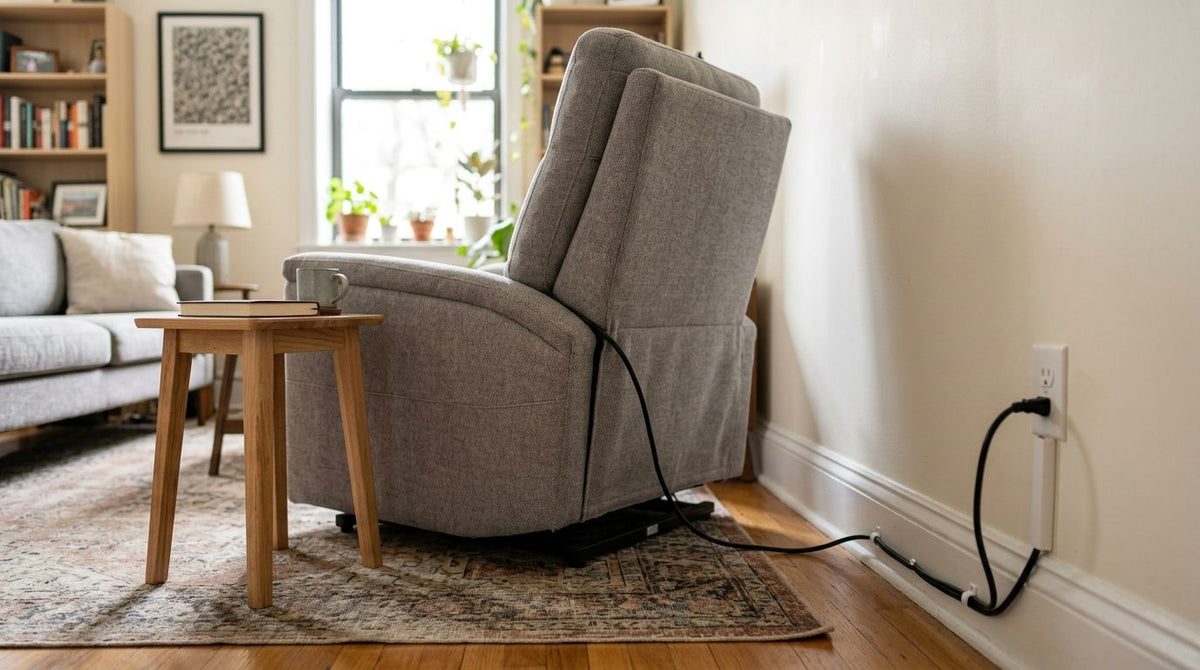
Running a lift chair cord across an open floor in a 550-square-foot apartment turns every walk to the kitchen into a trip hazard, and taping it down with duct tape looks worse than the cord itself. Instead of routing the cord in a straight line from the wall to the chair, plan the path around your existing furniture and outlet locations first, then use cord channels and chair placement to keep the run flat, short, and out of the walking lane.
- Route lift chair power cords along a baseboard, never across an open walking path, in any small apartment.
- A 6-8 ft cord run with one flat cord channel covers most one-bedroom layouts without an extension cord.
- Keep the cord at least 3 feet from oxygen concentrators and other medical equipment per manufacturer spacing guidance.
- Smart plugs let you route the cord to the nearest outlet instead of the most convenient one, cutting cord length by half in tight rooms.
- Never route a lift chair cord under a rug — heat buildup and fraying risk go up, not down.
Why this matters
A power lift recliner draws its own dedicated line to a motor and battery pack, which means the cord is thicker and less flexible than a lamp cord. In a studio or one-bedroom, that stiffness fights you the moment the chair isn't sitting directly against an outlet wall.
Bad routing does two things: it creates a trip hazard for anyone using a walker, cane, or oxygen tubing in the same room, and it puts mechanical stress on the cord where it bends sharply around furniture legs. Both problems compound in small apartments because there's less floor to spread the cord over and fewer outlet options to begin with.
The fix isn't a longer cord. It's a shorter, smarter path — and in most 2026-built apartments, one properly placed smart plug solves half the routing problem by letting you power the chair from whichever outlet sits closest, not whichever one happens to be behind the couch.
Before you start
- Measure the actual distance from your intended chair position to the nearest outlet — not the diagonal, the real floor path the cord will travel.
- Check your outlet's amperage rating. Most power lift recliners pull under 3 amps at the motor, but if the outlet is shared with a space heater or window AC unit on the same circuit, move the chair to a different outlet before you route anything.
- The non-obvious gotcha: cord covers and channels rated for lamp cords often can't accommodate the thicker gauge cord on a lift chair. Buy a cord channel rated for at least 0.5 inches of cord diameter before you commit to a path, or you'll be re-routing the whole run after the fact.
Map your outlet and chair position
- Stand in the room and identify every outlet within 10 feet of where the chair will sit. In most small apartments that's one, maybe two.
- Pick the chair position that puts an outlet within 3 feet of the chair's back leg, even if that means the chair doesn't sit flush against a window or focal wall.
- Confirm the outlet is a standard 120V grounded receptacle. A three-prong lift chair cord should never go into an adapter that strips the ground pin.
Expected result: you have a single outlet within a 3-foot radius of the chair, and no adapters or splitters in the plan.
Set up the baseboard channel
- Run the cord along the wall, following the baseboard, from the outlet to the point closest to the chair.
- Snap a cord channel or cord cover over the run. Choose a channel that matches your wall color or trim — paintable channels blend in better in apartments where you can't drill.
- At the point where the cord leaves the wall and heads to the chair, keep that final stretch as short as physically possible — 12 to 18 inches is typical.
- Secure the channel with adhesive strips rather than nails if you're in a rental. Most cord channel adhesive holds through a full lease term without peeling.
Expected result: the cord sits flat against the wall the entire run, with no loop, no loose slack, and no crossing of a walking lane.
Handle the last stretch to the chair
- If the chair sits away from the wall (common in studios where the chair also functions as a room divider), use a cord clip rated for the cord's gauge to tack the final stretch to the underside of a side table or the chair's own base plate.
- Never let the last stretch of cord rest under a rug edge. Rug pressure combined with recliner motor heat cycles increases wear at that contact point over time.
- Leave a small service loop — 4 to 6 inches of slack — near the chair leg so you can shift the chair a few inches for cleaning without yanking the cord taut.
Expected result: the cord reaches the chair with slack to spare, tucked under or behind the chair leg, invisible from normal sightlines in the room.
Variant: routing when the chair sits between the bed and a medical device
A lot of small-apartment layouts put the lift chair next to the bed, and if there's also an oxygen concentrator or CPAP machine in the room, cord routing gets a second constraint: distance from the medical equipment.
- Route the lift chair's cord to the opposite side of the bed from any oxygen concentrator whenever the room layout allows it.
- If both devices have to share a wall, keep the lift chair cord and the concentrator's power cord in separate channels rather than bundling them — bundled cords trap heat and make troubleshooting harder if one device trips a breaker.
- For full spacing guidance when a concentrator is involved, the setup differs enough from a standard cord run that it's worth reading through before you finalize placement — see setting up a lift chair next to an oxygen concentrator for the specific clearance numbers.
Expected result: two independent cord paths, no shared channel, and at least 3 feet of separation between the lift chair's motor cord and the concentrator's tubing and cord.
Troubleshooting
- The cord still crosses a doorway or hallway. Reposition the chair 90 degrees rather than adding a longer cord — in apartments under 700 square feet, rotating the chair relative to the wall usually opens up a shorter, wall-hugging path.
- The cord channel won't sit flat over baseboard heating. Skip the channel there and route above the heater line instead, using adhesive cord clips spaced every 12 inches.
- The chair's remote won't reach the outlet-side wall for a smart plug pairing. Most smart plugs pair over Wi-Fi, not Bluetooth range from the chair, so this is a router placement issue, not a cord routing issue — check your Wi-Fi signal at the outlet before troubleshooting the plug itself.
- The cord kinks sharply at the chair's back leg. Add a second service loop there instead of pulling the cord taut; a kinked cord under a chair that reclines and lifts repeatedly wears through insulation faster than a straight run.
- Landlord won't allow adhesive channels on painted walls. Route the cord behind furniture instead — a bookshelf or dresser positioned to break the sightline works as well as a channel in most rental inspections.
Planning a permanent outlet instead?
See what a dedicated lift chair outlet install actually involves before you call an electrician.
Customize your workflow
Once the cord is routed, the next upgrade is control, not more cable. A smart plug on the lift chair's outlet lets you cut power remotely without unplugging, which matters if the chair sits in a room you don't want to walk into every night just to kill the motor circuit.
If you're setting the chair up alongside a stairlift or a mobility scooter charging station in the same small apartment, cord routing gets more complicated fast — multiple devices competing for the same one or two outlets is the norm in a one-bedroom, not the exception. Planning those together up front, rather than routing one cord and then improvising around the next device, saves a second round of re-wiring later.
FAQ
How do you route a lift chair power cord in a small apartment?
Run the cord along the baseboard in a cord channel from the nearest outlet to the chair, keeping the final stretch to the chair under 18 inches and never crossing an open walking path. Avoid running the cord under rugs, where heat and pressure cause wear.
Can I use an extension cord for a power lift recliner?
Most manufacturers advise against it because the motor draws enough current that a thin extension cord can overheat under repeated lift cycles. Reposition the chair closer to an outlet instead, or have a dedicated outlet installed near the chair's final position.
Is it safe to run a lift chair cord under a rug?
No. Rug pressure combined with the heat cycles from repeated lift and recline use increases wear at the contact point over time. Route the cord along a wall or baseboard channel instead.
How far should a lift chair cord be from an oxygen concentrator?
Keep at least 3 feet of separation between the lift chair's cord and an oxygen concentrator's power cord and tubing, and avoid bundling the two cords in a shared channel. Route them on opposite sides of the room whenever the layout allows it.
Do smart plugs work with power lift recliners?
Yes, a standard 120V smart plug works with most power lift recliners and lets you route the cord to the nearest outlet rather than the most convenient one, cutting the routing distance in tight rooms. Pairing depends on Wi-Fi signal strength at the outlet, not the chair itself.
What's the best way to hide a lift chair cord in a rental apartment?
Use an adhesive cord channel that matches your wall or trim color, or route the cord behind a bookshelf or dresser if your lease doesn't allow wall adhesives. Both options avoid drilling and come off cleanly at move-out.
How long is a typical lift chair power cord?
Most lift chair cords run 6 to 8 feet from the chair to the wall plug, which is enough for the average one-bedroom apartment layout as long as the chair sits within a few feet of an outlet.
One last thing
The single most common routing mistake in small apartments isn't a messy cord — it's placing the chair first and treating the outlet as an afterthought. Flip the order: pick the outlet, then place the chair within 3 feet of it, and the entire routing problem gets 80% smaller before you've bought a single cord channel.