
By Editorial Team
A wall hugger recliner solves one specific problem: fitting real reclining seating into a room where a standard recliner won't clear the wall. Whether it's worth it depends on how tight your space actually is and what you're willing to trade for those extra inches.
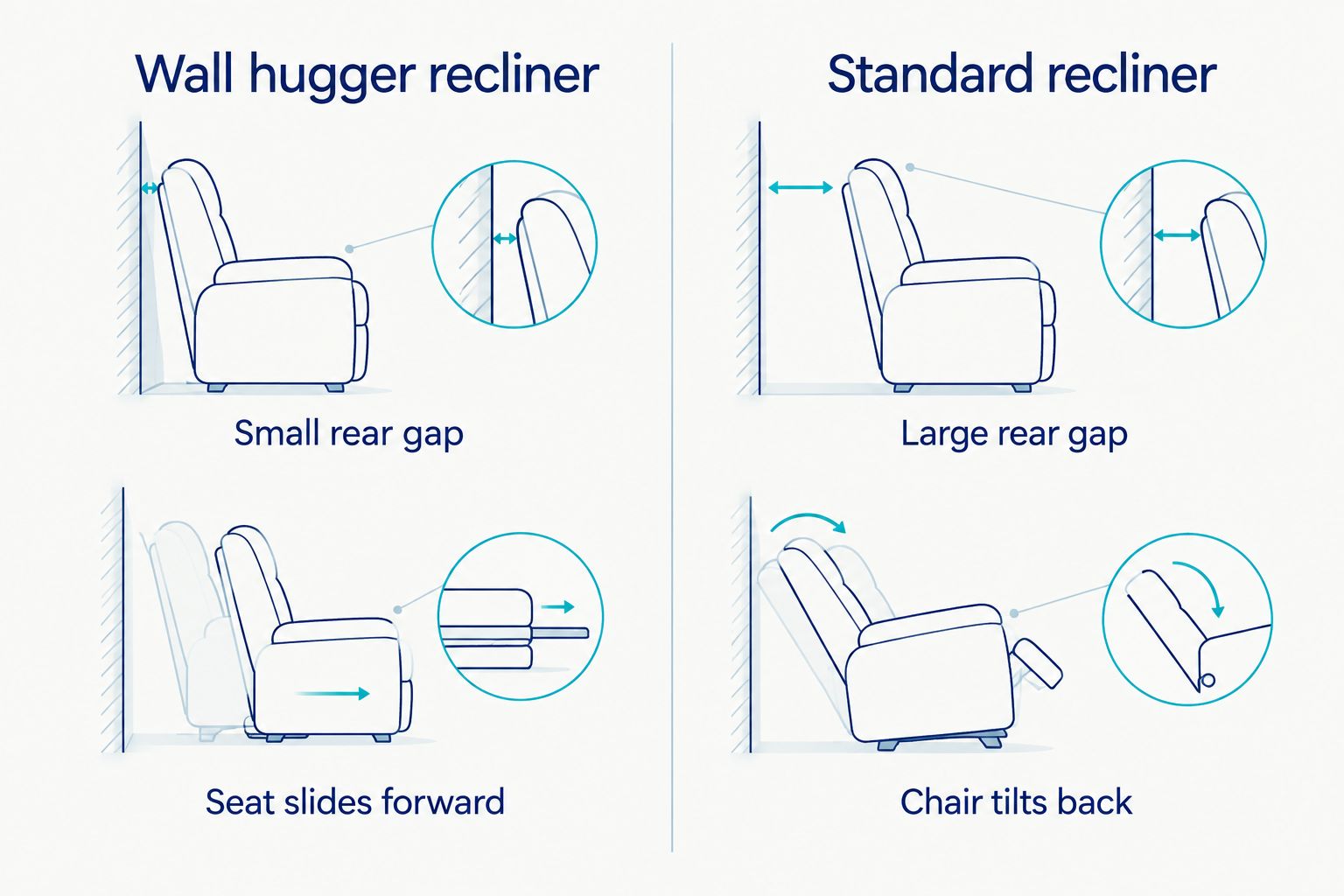
- A wall hugger recliner needs roughly 3 to 6 inches of rear clearance versus 12 to 15 inches for a standard recliner.
- The seat slides forward on a track as it reclines, so you need clear floor space in front of the chair, not just behind it.
- Full recline is possible on most wall hugger models, but footrest extension can still block a walking path in a small room.
- Best for rooms where a standard recliner simply won't fit against the wall, not for rooms that already have 12+ inches to spare.
- Frame depth and footrest style change the clearance number more than the brand or price point does.
Why room size decides this
A recliner's footprint isn't fixed — it changes shape the moment you pull the lever. A standard recliner tilts its whole frame backward, which is why it needs over a foot of open wall space behind it in 2026 floor plans that keep getting tighter. A wall hugger recliner uses a different mechanism: the seat itself glides forward on a track as the backrest drops, so the chair barely moves closer to the wall even at full recline.
That's the entire value proposition. If your room has how close to the wall a wall hugger recliner can sit covered — meaning you've got at least 4 to 6 inches behind the intended spot — a wall hugger recliner turns an unusable corner into a working seat. If you've already got a foot of clearance, you're solving a problem you don't have.
Is a wall hugger recliner worth it for small rooms?
Yes, for rooms where a standard recliner's 12 to 15 inches of rear clearance simply doesn't exist — a wall hugger recliner is worth it because the space-saving track mechanism, not a smaller chair, is what makes the difference. The trade-off is footrest reach: because the seat moves forward instead of the whole chair tilting back, you need open floor space in front of the chair that a standard recliner doesn't demand in the same way.
| Recliner type | Wall clearance needed | Recline mechanism | Best for |
|---|---|---|---|
| Wall hugger recliner | About 3 to 6 inches | Seat slides forward on a track as the back drops | Apartments, small bedrooms, tight room corners |
| Standard/traditional recliner | About 12 to 15 inches | Whole chair tilts backward as one unit | Larger living rooms with open wall space |
| Swivel rocker recliner | Similar to standard, plus a rocking arc | Chair rocks and swivels in place, then reclines | Rooms where you want to turn toward a TV or window |
A wall hugger recliner is worth it in a small room specifically because it trades rear clearance for front floor space — not because the chair itself is smaller.
That single sentence covers the whole decision. Everything else is measuring your own room against it.
Why the clearance number varies
The 3-to-6-inch figure is a range, not a guarantee, because several factors change how far a specific chair needs to sit from the wall:
- Track length — longer glide tracks move the seat further forward, which can shrink rear clearance but demand more front-of-chair space.
- Footrest style — an extending footrest that unfolds outward needs more legroom than a pop-up panel built into the seat.
- Frame depth — a deeper, more padded frame changes both the seated depth and how far the mechanism has to travel.
- Whether it's a lift-chair variant — a power lift recliner built with a wall hugger track adds a lift-and-tilt motion on top of the recline, which can change the clearance math again.
- Wall obstructions — outlets, baseboard trim, and window sills near floor level eat into that 3-to-6-inch margin faster than people expect.
Can a wall hugger recliner fully recline?
Most wall hugger recliners can fully recline, but the mechanism reaches full recline by moving the seat forward rather than tilting the whole chair back, which is a different motion than what a standard recliner does. Whether that full recline is comfortable in your room depends on how much floor space sits in front of the chair — see the full breakdown on wall hugger recline range for the mechanics.
Can a lift chair recliner fit in a small apartment?
A lift chair recliner can fit in a small apartment when the model uses a wall hugger track and the room has 3 to 6 inches of clearance behind it, though the lift mechanism itself doesn't change the footprint once the chair is upright. The apartment-specific fit questions — doorway width, hallway turns, and final placement — are covered in the guide to fitting a lift chair recliner in a small apartment.
Will a wall hugger recliner fit through my door?
A wall hugger recliner's slim rear profile doesn't automatically mean it clears a standard doorway — that depends on the chair's overall width and arm depth, not its wall clearance spec. Measure the doorway itself before ordering; the standard doorway fit checklist walks through what to measure and where chairs tend to get stuck.
Aeva Vital's recliner and lift chair content covers this exact clearance question across formats — apartments, assisted living rooms, and standard bedrooms — because the math is the same whether the room is 400 square feet or 4,000. The chair type that solves your room isn't always the one with the most features; it's the one whose mechanism matches your actual floor plan in 2026.
Compare recliner and lift chair options
See the full lineup before you measure your room.
FAQ
Is a wall hugger recliner worth it for a small apartment?
A wall hugger recliner is worth it for a small apartment when the room has 3 to 6 inches of clearance behind the chair instead of the 12 to 15 inches a standard recliner needs. It's not worth it if the room already has that extra clearance to spare.
How much space does a wall hugger recliner need behind it?
A wall hugger recliner typically needs about 3 to 6 inches of clearance behind it, compared to 12 to 15 inches for a standard recliner in 2026 floor plans. The exact number depends on the chair's track length and frame depth.
Does a wall hugger recliner recline as far as a regular recliner?
Most wall hugger recliners reach a comparable recline angle to a standard recliner, but the seat achieves it by sliding forward on a track rather than tilting the whole chair backward. That means front floor space matters more than it does with a standard model.
Can a wall hugger recliner go against any wall?
A wall hugger recliner can sit close to most walls, but outlets, baseboard trim, and window sills near floor level can eat into the 3-to-6-inch clearance margin. Check the wall for obstructions before finalizing placement.
Is a wall hugger recliner the same as a power lift recliner?
No — a wall hugger recliner refers to the space-saving track mechanism, while a power lift recliner refers to a motorized lift-and-tilt function that helps someone stand. A chair can be both a wall hugger and a lift chair at once.
Do wall hugger recliners need more floor space in front?
Yes, because the seat slides forward as it reclines, a wall hugger recliner needs more clear floor space in front of the chair than a standard recliner does. Measure the walking path, not just the wall gap, before buying.
What size room is too small for a wall hugger recliner?
A room is too small for a wall hugger recliner if there isn't at least a few feet of clear floor space in front of the chair to accommodate the forward glide during recline, regardless of how close it sits to the wall. Rear wall clearance alone doesn't guarantee the chair will fit and function.
One last thing
Measure twice before you shop: once for the gap behind the chair's intended spot, once for the open floor space in front of it during full recline. The wall hugger mechanism only solves the first measurement — the second one is where most small-room purchases go wrong.
Better Living Starts at Home.