

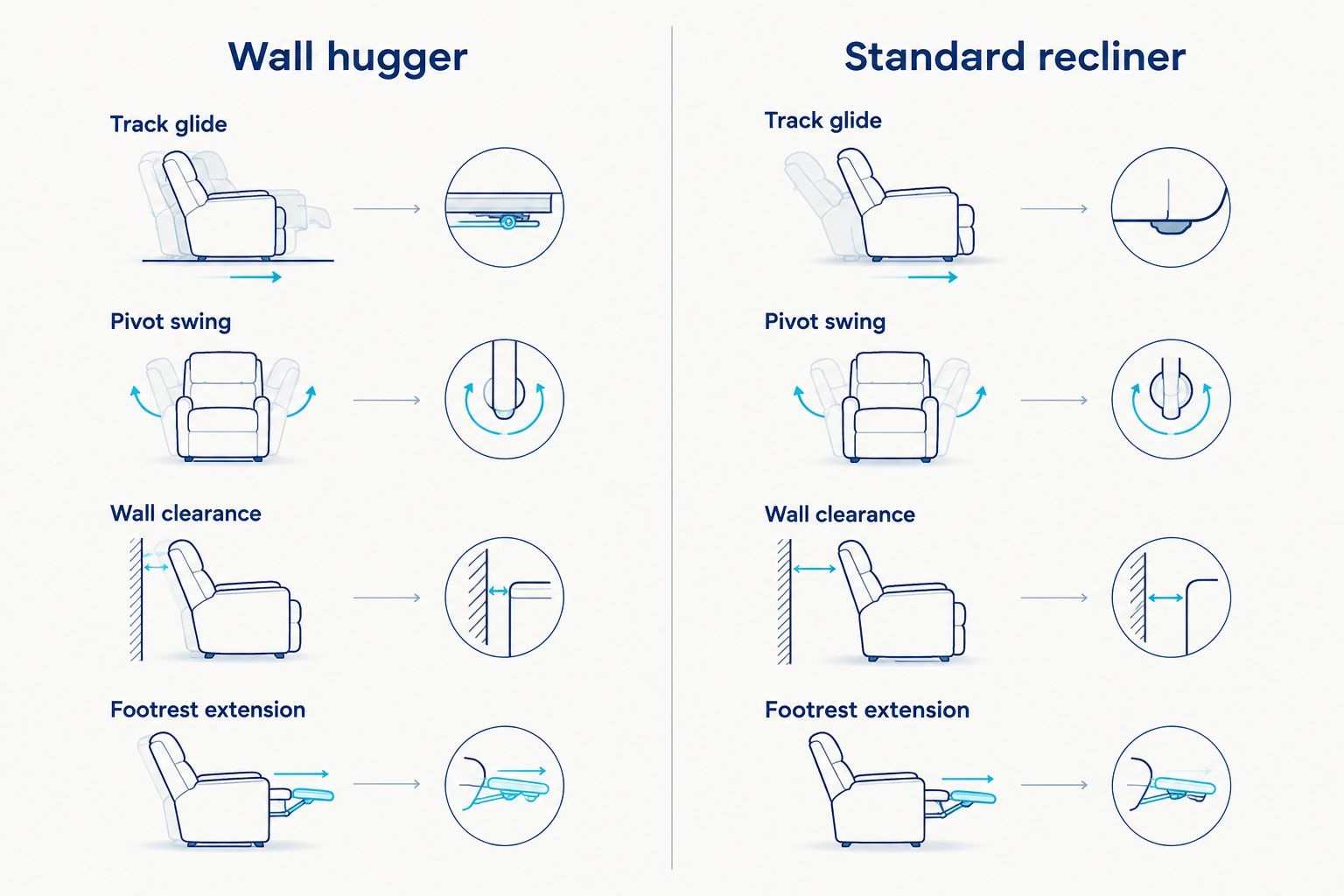
A wall hugger recliner can sit as close as 3 to 6 inches from the wall, compared with the 12 to 18 inches a standard reclining chair needs to swing its back down. The difference comes down to the base: a wall hugger glides forward on a track as the footrest opens, so the whole seat inches into the room instead of the backrest dropping into open space behind it.
That 3 to 6 inch figure is a minimum, not a guarantee. Baseboard trim, thick carpet, and a chair pushed to full recline can all eat into that clearance, so the number on a spec sheet only holds if you measure your actual wall, not the showroom floor.
- A true wall hugger recliner needs 3 to 6 inches of rear clearance versus 12 to 18 inches for a standard pivot recliner.
- The seat slides forward on a glider track as the footrest extends, which is why the chair can sit closer to the wall.
- Power lift recliners built on a wall hugger base work well in small apartments and tight bedroom corners in 2026.
- Baseboard depth, carpet pile, and full recline angle can shrink the stated clearance below the spec sheet minimum.
- Measure from the wall to the back legs with the chair in its final position, not from the wall to the headrest.
Why this matters
Most recliner returns and "it doesn't fit" complaints trace back to one measurement nobody checked before delivery: the space behind the chair. A standard recliner tilts its backrest into open air, so if you push it against a wall, the back either jams against the wall or the footrest won't fully extend.
A wall hugger recliner solves that by moving the entire chair forward instead of tilting the back into the wall. That makes it the right pick for apartments, small bedrooms, and recovery rooms in 2026 where floor space behind seating is scarce. If you're furnishing a small unit, the same logic applies to a lift chair recliner in a small apartment — clearance behind the chair matters as much as the footprint in front of it.
How close to the wall can a wall hugger recliner sit?
The honest answer depends on which type of chair you're measuring. Here's how the two designs compare on wall clearance, recline mechanism, and where each one fits best.
| Recliner type | Wall clearance needed | How it reclines | Best for |
|---|---|---|---|
| Wall hugger (track glide) | 3-6 inches | Chair slides forward on a track as the footrest extends | Small rooms, apartments, tight bedroom walls |
| Standard recliner (pivot) | 12-18 inches | Backrest tilts back into open space behind the chair | Rooms with open floor space behind the seating |
| Wall hugger power lift chair | 4-6 inches | Same track-glide motion, with a motorized footrest and back | Recovery rooms, assisted living units, small apartments |
Verdict: a wall hugger recliner sitting 4 to 6 inches off the wall is a safe, workable distance for most track-glide chairs, but always confirm the exact figure on the manufacturer's spec sheet before ordering.
How to measure your space for a wall hugger recliner
- Measure from the wall to where the back legs of the chair will sit, not to where the headrest currently touches.
- Add the manufacturer's stated wall clearance (typically 3 to 6 inches) to that measurement.
- Recline the floor sample fully, if one is available, and remeasure the gap behind it.
- Account for baseboard trim depth — thick colonial-style trim can add half an inch to an inch of extra required space.
- Check the arm width and total chair width against the wall segment, not just the depth, especially near corners or windows.
Manual wall hugger recliners
A manual wall hugger uses a lever or pull-strap to release the footrest, and the chair itself creeps forward a few inches on its track as it opens. These chairs are the simplest version of the design and generally hold to the 3 to 6 inch clearance range as long as the frame sits square against the wall.
Best for: renters and small living rooms where a lever-operated chair is enough. Buy.
The tradeoff is that you lose a few inches of usable room depth every time the chair reclines, since the seat itself moves forward rather than staying fixed in place. In a very narrow room, that forward creep can put the footrest closer to a coffee table or TV stand than expected.
Power lift wall hugger recliners
Many power lift recliners, including the models built for post-surgery recovery or assisted living, use the same track-glide base as a manual wall hugger. The motorized footrest and backrest extend together while the chair inches forward, which keeps clearance in the same 4 to 6 inch range as a manual version.
Best for: users who need a lift assist to stand and also have a tight wall behind their seating. Buy, but confirm the model's stated clearance before ordering.
If a power lift chair also needs to clear a doorway on delivery day, check whether it can fit through a standard doorway before you commit to a specific model — a chair that clears the wall fine can still be too wide for a narrow hallway. Aeva Vital's lift chair guides cover both clearance and doorway questions together, since the two problems usually show up in the same small room.
Why wall hugger clearance varies
- Baseboard and trim depth — thicker molding pushes the chair's true resting point away from the actual wall surface.
- Carpet pile height — plush carpet compresses under the chair's feet and changes how far back it can sit.
- Recline angle — a chair reclined to a near-flat, zero-gravity-style position needs more track travel than one stopped at a partial recline.
- Frame width and track length — longer glide tracks generally need slightly more base clearance to operate smoothly.
- Arm style — rolled or wide arms can reduce how close the chair sits to a wall in a corner installation.
- Uneven flooring — a chair that rocks slightly on an uneven floor needs a bit more buffer than the spec sheet minimum.
How much space do you need behind a recliner overall?
A standard recliner needs 12 to 18 inches of open space behind it to fully tilt back, while a wall hugger recliner needs only 3 to 6 inches because the chair slides forward instead of tilting into that space. If your room can't spare a foot and a half behind the seating, a wall hugger is the design built for that constraint.
Can a wall hugger recliner recline as far back as a standard recliner?
Most wall hugger recliners recline to roughly the same angle as a standard recliner, since the track-glide motion is designed to match the same seating positions. The difference is in floor space used, not in how far the chair tilts.
Compare lift chair options for tight rooms
See sizing and clearance guides before you order.
FAQ
How close to the wall can a wall hugger recliner sit?
A wall hugger recliner can sit 3 to 6 inches from the wall in 2026, compared with 12 to 18 inches for a standard pivot recliner. Always check the manufacturer's exact spec since baseboard trim and carpet can reduce that margin.
What is the difference between a wall hugger and a standard recliner?
A wall hugger recliner slides forward on a track as the footrest extends, while a standard recliner tilts its backrest into open space behind the chair. That track motion is what lets a wall hugger sit as close as 3 to 6 inches from a wall.
How much space do you need behind a recliner in general?
A standard recliner needs 12 to 18 inches of open floor space behind it to fully tilt back. A wall hugger recliner needs only 3 to 6 inches because it slides forward instead of tilting backward.
Can a power lift recliner also be a wall hugger?
Yes, many power lift recliners use the same track-glide base as a manual wall hugger, holding clearance to roughly 4 to 6 inches. Check the model's spec sheet since not every power lift chair uses this base.
Does baseboard trim affect wall hugger clearance?
Yes, thicker baseboard trim can add half an inch to an inch onto the required clearance behind a wall hugger recliner. Measure to the wall surface, not just the floor line, when trim is deep.
Can a wall hugger recliner fit in a small apartment?
Yes, the 3 to 6 inch clearance of a wall hugger recliner makes it one of the better options for small apartments where floor space behind seating is limited. A standard recliner's 12 to 18 inch requirement often won't fit in the same room.
Do wall hugger recliners recline as far back as standard recliners?
Most wall hugger recliners reach roughly the same recline angle as a standard recliner. The track-glide base changes how much floor space is used, not how far the chair tilts.
How do I measure my room for a wall hugger recliner?
Measure from the wall to where the chair's back legs will sit, then add the manufacturer's stated clearance of typically 3 to 6 inches. Recline a floor sample fully if one is available and remeasure before ordering.
One last thing
The number on a wall hugger recliner's spec sheet assumes a flat wall with no trim and firm flooring — your actual room rarely matches that exactly. Measure with the chair pushed back and reclined fully, add an inch for baseboard and carpet, and use that number instead of the printed minimum. That single step prevents most of the "it doesn't fit against my wall" returns that show up after delivery in 2026.