
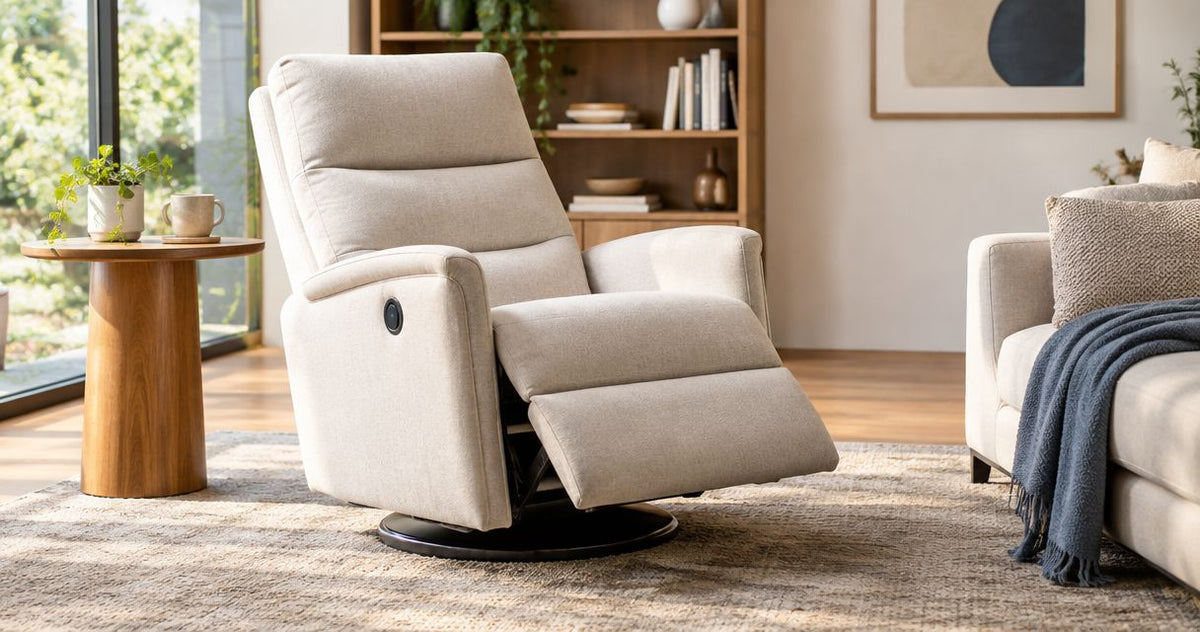
Best overall: a manual swivel rocker recliner for buyers who can operate the release comfortably. Best for button-controlled adjustment: a power swivel rocker recliner. Best for tight layouts: a compact swivel rocker recliner with documented operating clearances. The best swivel rocker recliners in 2026 combine the movements you need with a seat that fits your body—not simply the longest feature list.
By Editorial Team
A swivel rocker recliner combines a rotating base, a rocking mechanism, and an adjustable reclining position. This guide ranks mechanism types by use case, rather than presenting unverified model winners; a swivel glider appears separately because gliding and rocking are different movements.
- The best swivel rocker recliners match seat fit, operating effort, and room clearance before upholstery or accessories.
- Choose a manual swivel rocker recliner when you can comfortably release and close the footrest.
- Choose a power swivel rocker recliner for button-controlled positioning; verify cord routing and swivel restrictions.
- Aeva Vital’s Upholstered Folding Rocking Chair with Adjustable Footrest is a different chair category, not a confirmed swivel recliner.
Why this matters
A chair can swivel while upright yet restrict movement when reclined. Another can rock but require more effort to close its footrest than you find comfortable. Neither distinction is apparent from a lifestyle photograph.
Before choosing upholstery, establish whether a swivel rocker recliner can rock and swivel simultaneously. Buy the documented movement combination, not an assumption based on the chair’s name.
What makes the best swivel rocker recliners?
Use these criteria to compare chairs in 2026. A feature earns its place only when it solves a practical problem for you.
- Movement compatibility: Confirm when swiveling, rocking, and reclining are permitted, including any locking positions.
- Seat fit: Compare seat height, usable width, depth, back support, and arm position against a chair you already find comfortable.
- Operating effort: Test the release, reclining action, and footrest closure—not just the movement into a reclined position.
- Operating footprint: Check upright dimensions, fully reclined depth, rear clearance, and the space swept by rotation.
- Construction and care: Examine mechanism documentation, upholstery care instructions, accessible fasteners, and replacement-part information.
- Household compatibility: Account for children, pets, nearby furniture, walking routes, and power cords where applicable.
Swivel rocker recliners at a glance: 2026 picks
| Ranked option | Best for | Standout feature | Key limitation |
|---|---|---|---|
| Manual swivel rocker recliner | Everyday seating without powered adjustment | Manually operated reclining mechanism | Release and footrest closure require physical effort |
| Power swivel rocker recliner | Button-controlled positioning | Motorized reclining adjustment | Electrical connection and cord routing need attention |
| Compact swivel rocker recliner | Rooms with restricted floor space | Smaller documented dimensions | A smaller exterior does not establish a comfortable seat fit |
| Swivel glider recliner | Buyers who prefer gliding to rocking | Back-and-forth gliding motion plus rotation | A glider is not a true rocking mechanism |
These categories overlap. A compact chair can also be powered, so use the ranking to identify your first priority, then compare individual specifications within that group.
1. Manual swivel rocker recliner: best for everyday simplicity
A manual swivel rocker recliner uses a hand-operated release or body-operated mechanism to change position. It suits buyers who want rocking, rotation, and reclining without depending on powered adjustment.
The decisive test is returning upright. A chair that opens easily but takes uncomfortable leg pressure to close is the wrong manual mechanism for you.
Manual swivel rocker recliner pros:
- Does not need electrical power for its manual reclining function.
- Keeps reclining control mechanical rather than motor-driven.
- Combines several seating movements when the mechanism permits them.
Manual swivel rocker recliner cons:
- Release placement can be awkward to reach.
- Closing the footrest requires effort on some mechanisms.
- Available stopping positions depend on the mechanism.
Best for: Buyers who can operate the entire reclining cycle comfortably and prefer seating without powered adjustment.
Sit back fully, reach the release without twisting, extend the footrest, and return upright. Repeat the sequence rather than judging the chair from its easiest movement alone.
Verdict: Buy this type when both opening and closing feel manageable; skip it when either action strains you.
2. Power swivel rocker recliner: best for button-controlled adjustment
A power swivel rocker recliner uses a motor to adjust its reclining position. Button control changes how you operate the chair; it does not establish that the chair swivels freely or rocks in every position.
Inspect the control location while seated. Controls hidden beside a cushion or positioned beyond your comfortable reach defeat the purpose of powered adjustment.
Power swivel rocker recliner pros:
- Replaces manual reclining effort with powered adjustment.
- Lets you change position using the chair’s controls.
- Suits buyers who find a manual release or footrest difficult to operate.
Power swivel rocker recliner cons:
- Requires the specified electrical supply for powered operation.
- Cord routing must accommodate the permitted movement.
- Operation during an outage depends on the particular model and backup arrangement.
Best for: Buyers whose main priority is controlling the reclining position without operating a manual mechanism.
Check whether the backrest and footrest adjust together or separately. Also verify the documented rotation limit: a powered chair’s cable arrangement is part of the installation, not an afterthought.
Verdict: Buy this type for easier position adjustment after confirming controls, electrical requirements, and movement limits.
3. Compact swivel rocker recliner: best for restricted layouts
A compact swivel rocker recliner prioritizes a smaller footprint. Compare actual dimensions rather than accepting “small-space” as a measurable specification.
Narrow arms can reduce exterior width without changing seat width in the same way that a narrower seat would. That distinction matters when you want to preserve usable seating space.
Compact swivel rocker recliner pros:
- Gives you a category to shortlist when floor space is restricted.
- Encourages closer comparison of arm width and usable seat width.
- Can combine space-conscious dimensions with manual or powered operation.
Compact swivel rocker recliner cons:
- A shallow or narrow seat will not suit every user.
- Reclining and rotation still need additional operating space.
- Compact dimensions do not prove wall-hugging operation.
Best for: Buyers who have measured a restricted layout and can match the chair’s seat dimensions to their body.
Measure the walking route beside the chair as well as the space behind it. A chair that technically fits but blocks access when reclined is not a successful small-room choice.
Verdict: Buy this type only when the seat fits you and the full operating footprint fits the room.
4. Swivel glider recliner: best for buyers who prefer gliding
A swivel glider recliner combines rotation and reclining with a gliding mechanism. Gliding moves the seat back and forth through a linkage; rocking uses a different movement pattern.
Treat a swivel glider as an alternative, not an interchangeable name for a swivel rocker. Try both motions if you do not already know which you prefer.
Swivel glider recliner pros:
- Offers a different back-and-forth movement from rocking.
- Adds rotation when the base and mechanism permit it.
- Combines motion seating with a reclining position.
Swivel glider recliner cons:
- Does not reproduce a true rocking mechanism.
- Gliding behavior when reclined depends on the design.
- The base and linkage still require unobstructed operating space.
Best for: Buyers who specifically prefer gliding, including those furnishing a nursery or reading corner.
For nursery use, assess adult seating comfort without treating the chair as an infant sleep surface. Keep the mechanism area clear and follow the chair’s instructions for children and pets.
Verdict: Buy this alternative when you prefer gliding; skip it when a true rocking motion is essential.
Measure the chair in every operating position
Your 2026 shortlist should separate seat dimensions from room dimensions. The former determine how you sit; the latter determine whether you can operate the chair without contacting furniture or blocking a route.
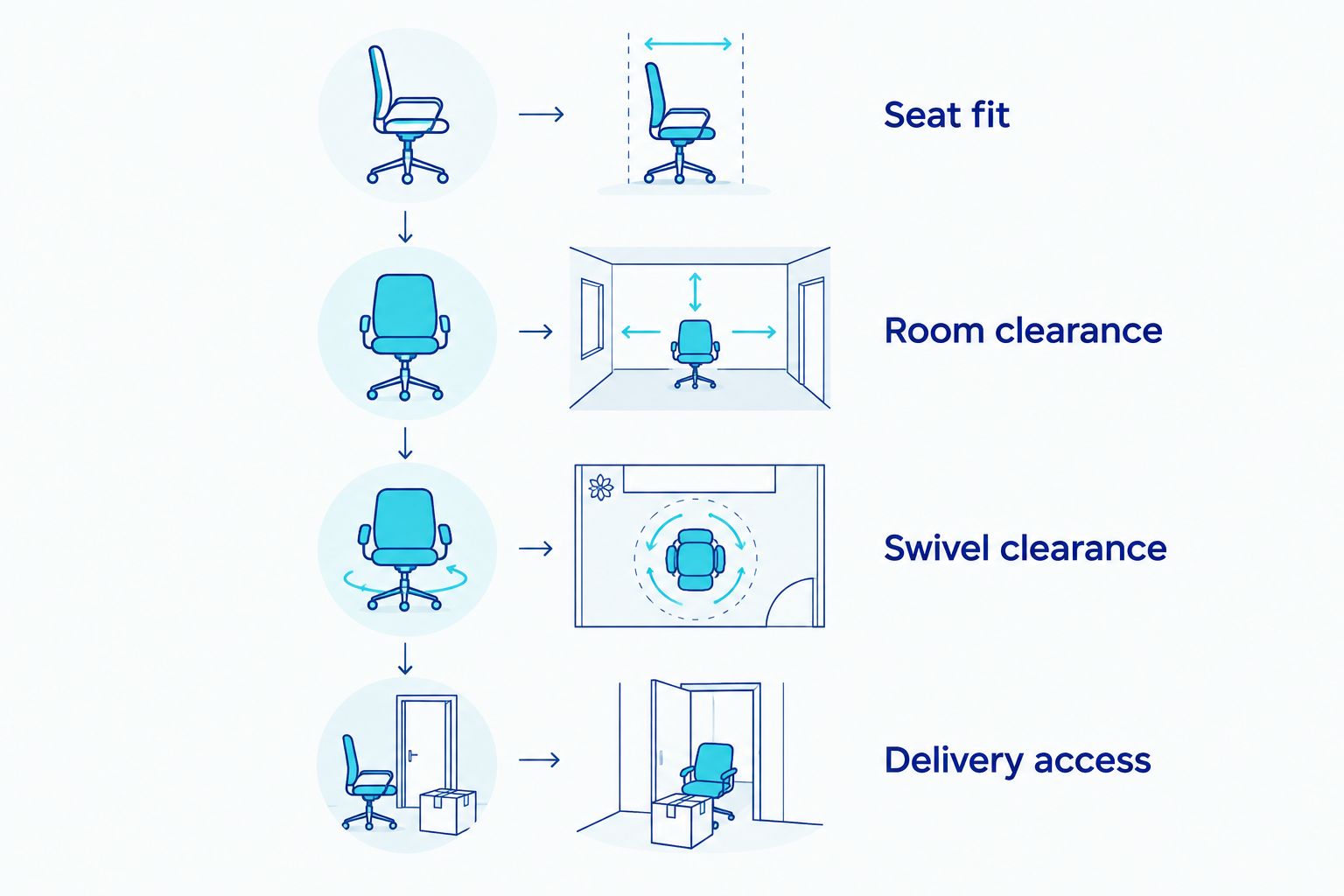
Use this sequence before ordering:
- Seat fit: Record the dimensions of a comfortable existing chair, then compare usable seat width, depth, and height.
- Room clearance: Mark the proposed chair position and its documented reclined footprint on the floor.
- Swivel clearance: Account for the arms, backrest, and footrest sweeping toward nearby objects.
- Delivery access: Check the packaged dimensions, door openings, hallway turns, and any required assembly route.
Do not substitute a generic clearance estimate for the manufacturer’s instructions. A wall-hugging mechanism, a rotating base, and a rocking mechanism place different demands on the space around a chair.
Coordinate the recliner with the rest of the room
Plan the recliner and surrounding seating as one layout. A sofa arm, side table, or floor lamp can interrupt the chair’s movement even when the chair’s rear clearance is adequate.
The same space-planning question applies to luxury sofas for small living rooms: exterior dimensions matter alongside usable seating and the walking space left around the furniture. With a swivel recliner, add the moving footprint to that calculation.
Keep frequently used objects reachable without leaning across a moving mechanism. Position lamps and charging cables outside the chair’s operating area, and verify that adjacent furniture does not become an obstacle as the chair turns.
Upholstery, construction, and everyday maintenance
Choose upholstery by its documented care requirements, not by a broad label such as “family-friendly.” Fabric, leather, and coated upholstery need care appropriate to their specific construction and finish.
Before choosing, check:
- Care instructions: Identify the permitted cleaning method and any prohibited products.
- Contact areas: Inspect seams and upholstery around the arms, seat front, and headrest.
- Mechanism access: Establish how the manufacturer instructs you to inspect or service moving components.
- Removable components: Confirm which parts actually detach before planning delivery or cleaning.
A removable backrest does not prove that the entire chair will fit through a doorway. Likewise, a soft showroom cushion does not establish long-term support or durability.
Aeva Vital product distinction: rocking is not swiveling
Aeva Vital lists the Upholstered Folding Rocking Chair with Adjustable Footrest. Its name identifies folding, rocking, and an adjustable footrest; those features do not establish a swivel base or the same mechanism as a swivel rocker recliner.
Aeva Vital’s Upholstered Folding Rocking Chair with Adjustable Footrest is a category alternative for buyers seeking folding rocking seating, not a confirmed swivel rocker recliner. Keep that distinction intact when comparing chairs with different names and functions.
The practical advantage to consider is the folding format. The limitation is equally important: do not select this chair on the assumption that it rotates, has powered adjustment, or provides a particular reclining range. Match the documented mechanism to your requirement before comparing appearance.
How the categories are ranked
The 2026 ranking prioritizes operation, seat fit, movement compatibility, and room clearance. Manual swivel rocker recliners lead for buyers comfortable with manual operation; powered models serve a different operating need rather than automatically providing a better seat.
Compact chairs address layout restrictions. Swivel gliders remain a separate alternative because changing the movement changes the buying decision. Upholstery and accessories come after those functional checks.
Which swivel rocker recliner should you choose?
Start with a manual swivel rocker recliner if you can open and close it comfortably. Choose a power swivel rocker recliner when button-controlled positioning is the deciding requirement, and prioritize compact dimensions only after confirming seat fit.
If you prefer gliding, choose a swivel glider deliberately. Do not accept a different motion merely because the listing groups rocking and gliding chairs together.
FAQ
What's the best swivel rocker recliner for everyday use?
A manual swivel rocker recliner is the starting choice when you can comfortably operate its release and close its footrest. Choose a powered version when button-controlled reclining better matches your needs.
Can a swivel rocker recliner rock and swivel at the same time?
Simultaneous rocking and swiveling depends on the chair’s mechanism and operating position. Check the model’s instructions rather than assuming all movements remain available when reclined.
Is a swivel glider the same as a swivel rocker recliner?
No. A glider moves back and forth through a linkage, while a rocker uses a rocking mechanism; either category needs separate confirmation of its reclining and swiveling functions.
What should I measure before buying a swivel rocker recliner?
Measure seat fit, upright dimensions, reclined depth, rotation clearance, and the delivery route. Use the manufacturer’s operating-clearance requirements rather than a generic distance.
Is a power swivel rocker recliner also a lift chair?
No. Powered reclining does not establish a seat-lifting function; a lift mechanism must be explicitly identified in the model’s specifications.
Does a compact swivel rocker recliner fit against a wall?
Compact dimensions do not prove that a recliner can operate against a wall. Confirm the model’s rear-clearance requirements and leave space for its permitted rocking and rotation.
Does a folding rocking chair count as a swivel rocker recliner?
No. Folding, rocking, swiveling, and reclining describe separate functions. Confirm each required movement instead of treating one feature as evidence of another.
Related guides
- Is a swivel rocker recliner good for nursing a baby?
- Is a wall-hugger recliner worth it for small rooms?
- How do you clean a fabric lift chair?
One last thing
For your 2026 purchase, test the return to upright as carefully as the recline. The most revealing moment is often closing the footrest and standing up—not settling into the cushion. Reject a mechanism you cannot operate comfortably, regardless of its other features.