

Yes, most wall hugger recliners fully recline to nearly the same backrest angle as a standard recliner. Instead of the back swinging into the wall, the seat cushion slides forward on a track as the chair reclines, so a wall hugger recliner only needs about 3 to 6 inches of clearance behind it, compared with 12 to 18 inches for a traditional recliner. The trade-off nobody mentions in the showroom: that forward slide eats floor space in front of the chair, often 4 to 8 inches more than the chair needs when it's upright, so the wall isn't the limiting factor in a tight room — the space in front of the footrest is.
- A wall hugger recliner fully reclines using a sliding-seat track, not a backward-swinging back.
- Wall clearance drops to 3-6 inches versus 12-18 inches for a traditional recliner in 2026 model lines.
- The seat slides forward as you recline, so floor space in front of the chair matters more than space behind it.
- Power lift wall hugger recliners recline the same way as manual models, plus a standing-assist lift function.
- Measure the floor in front of the chair, not just the gap to the wall, before buying.
Why this matters
People buy wall hugger recliners specifically to fit a small room, then get surprised when the chair still can't fully recline because a bookshelf or side table sits a few inches too close to the footrest. The mechanism solves the wall problem, not the floor problem. If you're shopping for a lift chair recliner that needs to fit in a small apartment, this distinction decides whether the chair actually opens all the way once it's in place, not just whether it fits through the door.
Can a wall hugger recliner fully recline?
A wall hugger recliner fully reclines by sliding the entire seat pad forward on a track built into the base as the backrest drops. The back itself barely moves relative to the wall, which is why the chair can sit close to it. Most models reach a recline angle close to a standard recliner's, though the exact range varies by frame design and cushion depth.
| Feature | Wall hugger recliner | Traditional recliner |
|---|---|---|
| Wall clearance needed | 3-6 inches | 12-18 inches |
| Recline mechanism | Seat slides forward on a track | Back swings backward into open space |
| Extra floor space in front when reclined | 4-8 inches | Minimal extra — the back takes the space instead |
| Footrest deployment | Extends as seat slides forward | Extends as back drops back |
| Typical use case | Small rooms, apartments, against a wall | Rooms with open space behind the chair |
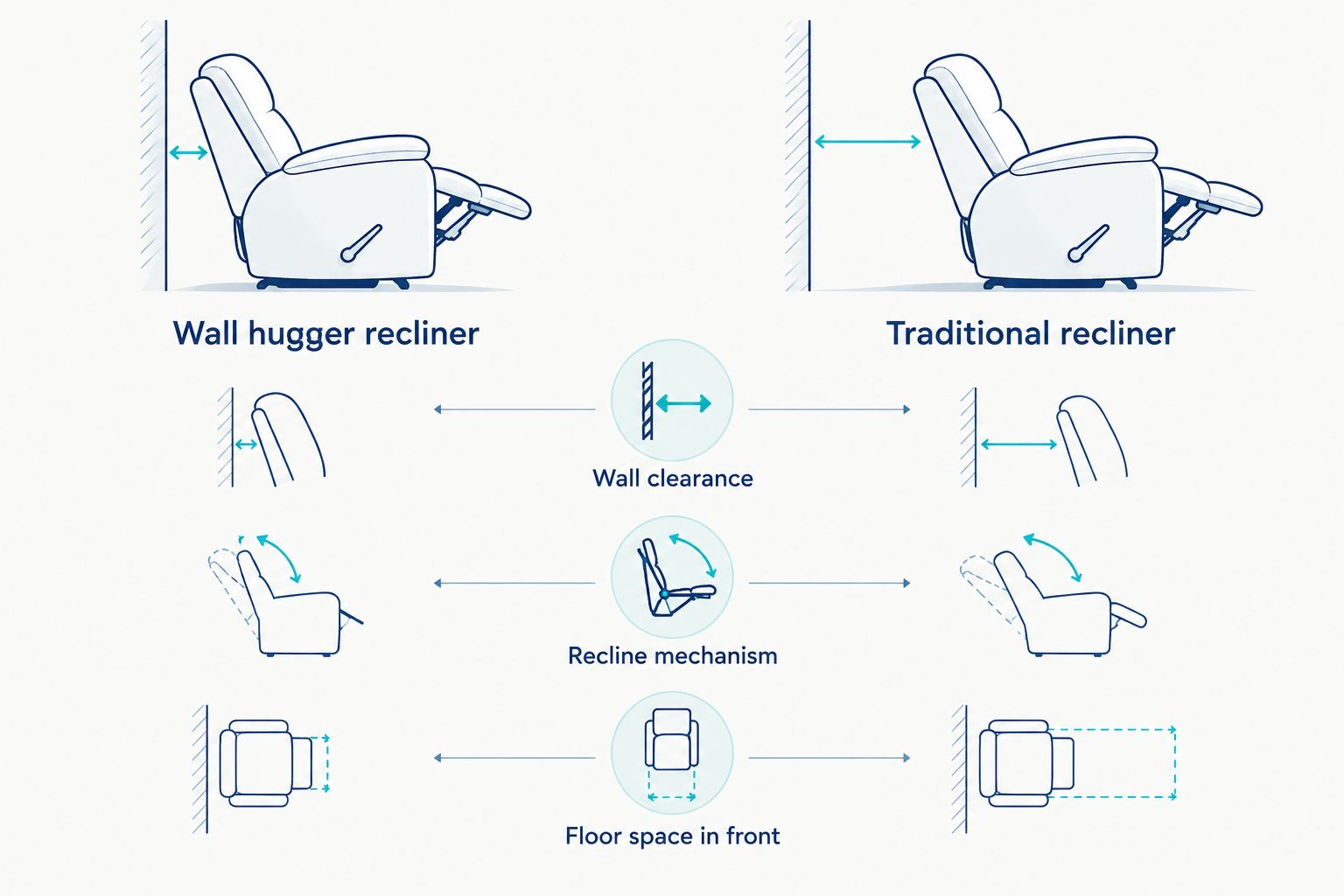
Manual wall hugger recliners: 4 to 6 inches of wall clearance
Manual wall hugger recliners use a handle or push-back mechanism to trigger the sliding track. They fully recline the same way power models do, just without a motor, and they typically need 4 to 6 inches of wall clearance depending on the frame. These work fine for anyone who can push back into the recline without assistance.
Verdict: Buy for a small room where you don't need standing assistance.
Power lift wall hugger recliners: 3 to 5 inches of wall clearance
Power lift versions add a motor for both the recline function and a standing-assist lift, and many sit closer to walls than manual models — often 3 to 5 inches — because the motorized track is more precisely engineered. If a lift function matters, a zero gravity recliner with a similar sliding base is worth comparing against a dedicated lift chair before deciding.
Verdict: Buy if you need help standing and have an outlet within reach of the chair's final position.
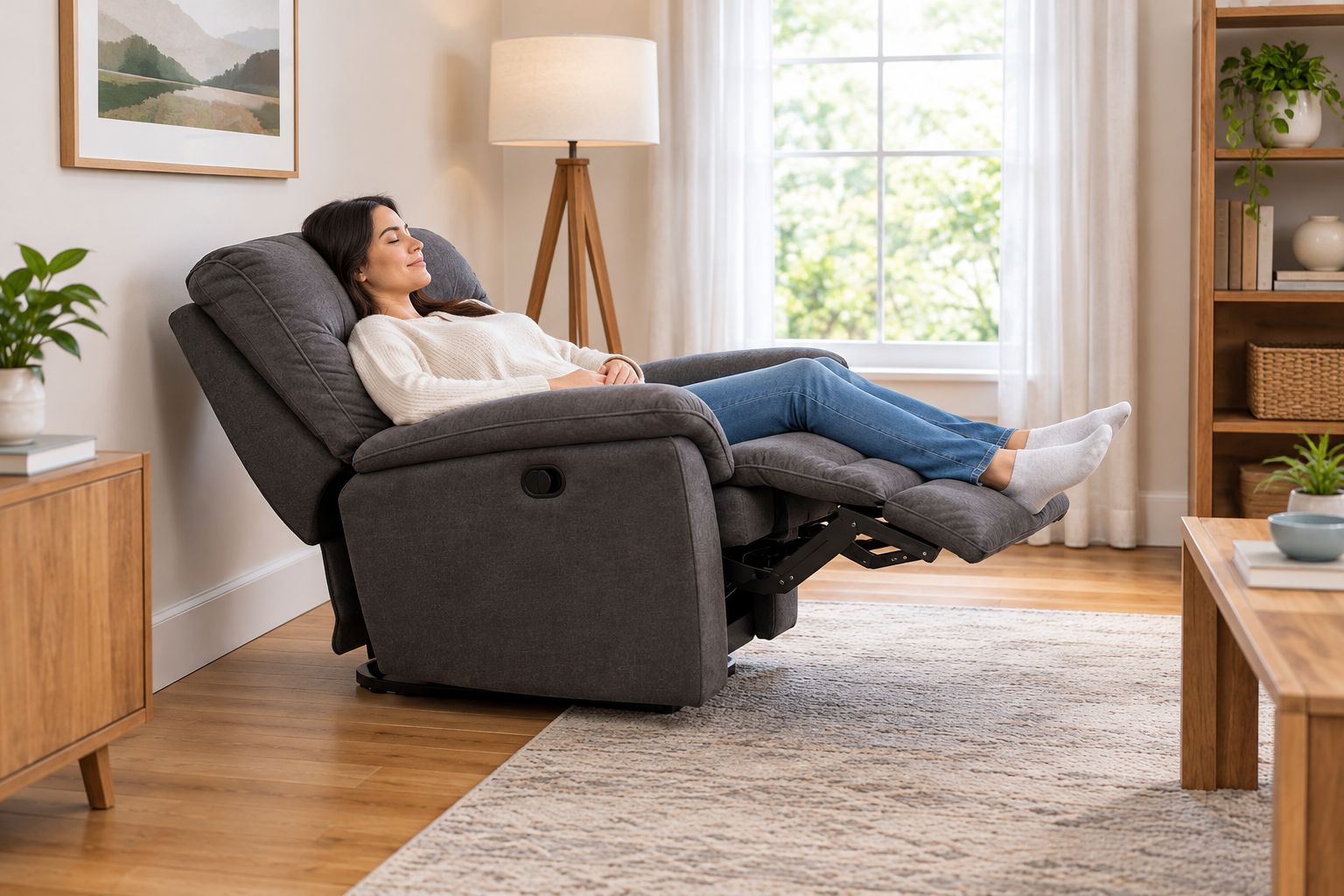
Why recline range varies between wall hugger models
Not every wall hugger recliner reclines the same amount. A few things push the range up or down:
- Track length built into the base — longer tracks allow a deeper recline but need more forward floor space.
- Seat depth and cushion thickness — thicker cushions can shorten the usable recline angle.
- Frame height relative to the user's height — a mismatch between chair size and body size limits how far the back comfortably drops.
- Footrest style — a flip-up footrest reclines differently than an extending ottoman-style leg rest.
- Fabric or leather stretch — tighter upholstery can restrict the last few degrees of recline over time.
- Floor space actually available — even a chair rated for full recline won't get there if something blocks the footrest's path.
Do wall hugger recliners need space behind them?
Yes, wall hugger recliners still need some clearance behind them — typically 3 to 6 inches even in 2026 model lines — because the sliding track needs a small gap to operate, and the chair frame itself has some depth. It's far less than the 12 to 18 inches a traditional recliner needs, but it's not zero.
Can a wall hugger recliner go fully flat like a zero gravity chair?
Some power lift wall hugger recliners with a full chaise pad get close to a flat, zero-gravity-style position, but a basic manual wall hugger typically stops short of that. If a flat sleep-style recline matters, check whether a zero gravity recliner fits the space instead — those use a similar sliding base but are built around reaching a level position.
Are wall hugger recliners good for small apartments?
Yes, wall hugger recliners generally fit small apartments better than traditional recliners because they need far less clearance behind the chair. The floor space in front still needs measuring before delivery, since that's where the actual recline happens.
Measure your space before you buy
Check apartment and doorway fit guides before ordering a recliner in 2026.
FAQ
Can a wall hugger recliner fully recline?
Yes, most wall hugger recliners fully recline to nearly the same angle as a traditional recliner, using a sliding-seat track instead of a backward-swinging back. The chair needs 3 to 6 inches of wall clearance and 4 to 8 inches of extra floor space in front when reclined.
How much space does a wall hugger recliner need from the wall?
A wall hugger recliner needs about 3 to 6 inches of clearance from the wall, compared with 12 to 18 inches for a traditional recliner. The smaller gap is possible because the seat slides forward on a track instead of the back swinging backward.
Do wall hugger recliners need floor space in front?
Yes, wall hugger recliners need 4 to 8 inches of extra floor space in front of the footrest when fully reclined. This is the space most people forget to measure when they focus only on the wall gap behind the chair.
What's the difference between a wall hugger and a traditional recliner?
A wall hugger recliner slides its seat forward on a track as it reclines, needing only 3 to 6 inches of wall clearance, while a traditional recliner swings its back into open space and needs 12 to 18 inches. Both reach a similar recline angle in most models.
Can a power lift wall hugger recliner still fully recline?
Yes, power lift wall hugger recliners recline the same way manual models do, often needing as little as 3 to 5 inches of wall clearance. The motor adds a standing-assist lift function without changing the recline mechanism.
Is a wall hugger recliner good for a small apartment?
Yes, a wall hugger recliner generally fits small apartments better than a traditional recliner because of the reduced wall clearance requirement. The floor space in front of the chair still needs to be measured separately.
Can a wall hugger recliner reach a zero gravity position?
Some power lift wall hugger recliners with a full chaise pad come close to a flat, zero-gravity-style position, but basic manual models typically stop short of fully flat. A dedicated zero gravity recliner is built specifically to reach that level position.
Why doesn't my wall hugger recliner fully recline?
If a wall hugger recliner won't fully recline, the most common cause is an object blocking the footrest's forward path, not a wall clearance problem. Check the 4 to 8 inches of space in front of the chair before assuming the mechanism is faulty.
One last thing
The number that actually stops a wall hugger recliner from fully reclining in most homes isn't the gap to the wall — it's whatever sits in front of the footrest once the seat slides forward. Measure that path in 2026 before delivery day, not just the distance to the wall, and the chair will do what the spec sheet says it does.