
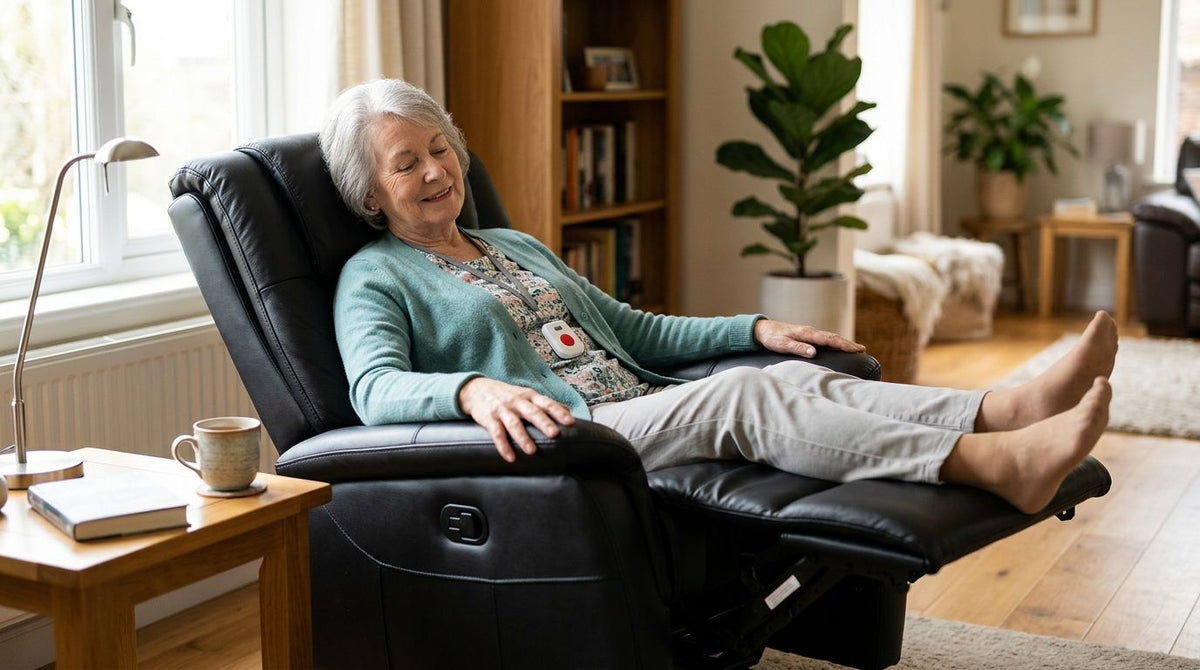
A medical alert pendant that works fine standing up can go quiet the moment you recline flat in a zero gravity recliner — the torso drops to roughly the 128-degree neutral body posture NASA identified for reduced spinal load, the call button ends up angled toward the ceiling instead of your hand, and a base station across the room loses line of sight to the chair. Set up the pairing once — recliner position, pendant fall-detection threshold, and a charging routine that doesn't require standing up — and the two devices stop working against each other.
This matters because the people using a power lift recliner outlet wiring guide to install a zero gravity chair are frequently the same people who depend on a pendant for fall response. If the pendant only works when you're upright, it isn't doing its job for the hours you spend reclined.
- Zero gravity recline drops the torso to roughly 128 degrees, which can misread as a fall on angle-based pendants.
- Test the pendant in full recline before relying on it daily — standing-position testing does not cover it.
- Keep the charging cradle within arm's reach of the recliner, not across the room on a side table.
- Base-station pendants typically list 300 to 600 feet of range; recliner placement can push you near that edge.
- Verdict: pair a zero gravity recliner and a medical alert pendant by testing signal and fall detection at full recline, not by assuming it works.
Why this matters
A zero gravity recliner and a medical alert pendant are sold by completely different industries and neither one is built with the other in mind. The recliner manufacturer optimizes for spinal decompression and pressure relief. The pendant manufacturer calibrates its accelerometer for a person walking, standing, and falling to the floor — not a person being slowly motorized into a reclined position and staying there for 45 minutes.
That mismatch produces two failure modes in 2026 home setups: pendants that go silent in full recline because the base station is out of range, and pendants that fire false fall alerts because the recline motion trips the accelerometer. Both are fixable with a five-minute test, and neither gets caught until someone actually needs the pendant to work.
Before you start
- Confirm your pendant type. Cellular pendants work anywhere in cell coverage; home-base pendants need a console plugged in near the recliner, typically within the 300 to 600 feet most manufacturers list.
- Confirm the recliner's power source. Zero gravity lift recliners need an outlet within reach of the power cord — check the outlet wiring guide above if the chair is going somewhere new.
- The gotcha: full recline on a zero gravity chair can trip fall-detection algorithms that weren't calibrated for a slow, motorized angle change. Test this before day one, not after a false alarm at 2 a.m.
Set up recliner position and pendant range
- Position the recliner where the pendant's base station (if home-based) has a clear line of sight, ideally under 30 feet and with no metal appliances between chair and console.
- Recline the chair to its full zero gravity position and press the pendant's test button.
- If the signal drops or the console doesn't register the test, move the base station closer or relocate the recliner 3-5 feet at a time until the connection holds at full recline.
- Repeat the test at the chair's partial recline position — many users spend more time here than at full recline, so confirm both angles hold signal.
Expected result: the pendant registers a test signal at both partial and full recline, with the base station or cellular indicator staying connected through the whole motion.
Test fall detection at full recline
- Put the pendant in test mode — check the manufacturer app or call the monitoring line to flag a test window first.
- Recline the chair slowly to full zero gravity and watch for a false fall-detection trigger during the transition. This is the single most common failure point in this pairing.
- If the pendant fires a false alert, look for a fall sensitivity setting in the device menu or app, or ask the monitoring company whether they support a recliner exception.
- If no adjustment exists, press the pendant's cancel button each time you recline fully, and confirm the monitoring center's cancellation window — commonly 10 to 30 seconds — with your provider.
Expected result: reclining and returning upright no longer generates an unplanned alert, or you have a documented workaround agreed with the monitoring center.
Configure the charging routine
- Check how long the pendant holds a charge on a full cycle in its documentation — battery life varies widely by model.
- Place the charging cradle on a side table or armrest tray within arm's reach of the recliner, never on a dresser across the room.
- Tie the recharge to something already in the daily routine — bedtime is the most common anchor — so the pendant is never dead when the chair is in use.
Expected result: the pendant is charged and worn every time the recliner is reclined, with no gaps caused by a cradle nobody can reach.
Variant: pair a smart plug for remote positioning
If the person using the recliner has limited grip strength or the hand control disappears into the cushions, connecting a smart plug to your lift chair lets a caregiver trigger recline or return-to-upright from a phone app, independent of the pendant. This is a separate workflow from the pendant pairing above, but the two run side by side in most 2026 home-care setups: the pendant handles emergency response, the smart plug handles day-to-day positioning.
Run the same test discipline on the smart plug. Cutting power mid-recline on some chairs strands the seat at an angle, so confirm the chair's behavior on power loss before a caregiver relies on the app remotely.
Troubleshooting
- Pendant test fails at full recline but passes at partial recline. The base station is out of range at that angle — move the console 3-5 feet closer to the chair and retest.
- False fall alerts every time you recline. Check for a sensitivity setting in the pendant app first. If none exists, notify the monitoring center of the recline schedule so cancellations clear faster.
- Pendant button is hard to reach in full recline. Switch from a wrist unit to a chest-height lanyard — wrist units end up pinned under an armrest at full recline.
- Charging cradle keeps getting knocked off the side table. Use a cradle with a weighted base or mount it on a tray that attaches to the recliner arm.
- Recliner and oxygen equipment share one circuit. Read setting up a lift chair next to an oxygen concentrator before adding a pendant charger to the same power strip — a concentrator draws continuous current and shouldn't share a circuit with a lift motor.
Customize your workflow
Once the pendant and recliner are paired and tested, extend the same testing logic to the rest of the room. A home physical therapy routine using a zero gravity recliner often runs through four or five recline angles in one session, so test the pendant at each angle in the routine, not just the two extremes.
If the chair sits near a stairlift or a mobility scooter charging point, map every powered device in the room — outlet load and pendant signal both — before adding one more thing to the circuit.
The standard here is simple: never assume a pendant works in a position you haven't personally tested it in. Zero gravity recliners change the geometry of a room and the body inside it more than almost any other piece of home furniture, and pendant manufacturers didn't design around that.
“Never assume a medical alert pendant works in a recline position you haven't personally tested it in.”
FAQ
Does a zero gravity recliner interfere with a medical alert pendant?
It can. Full recline changes the torso angle to roughly 128 degrees, which can move the pendant out of range of a home base station or trigger a false fall alert on angle-sensitive models. Test both before relying on the pendant daily.
Can reclining fully trigger a false fall alert?
Yes, on pendants using accelerometer fall detection calibrated for standing-to-floor falls rather than slow motorized recline. Check for a sensitivity setting or ask your monitoring provider about a recliner exception.
How far can a medical alert pendant be from its base station?
Most home-base pendants list 300 to 600 feet from the console, though walls, metal appliances, and floor changes reduce that in practice. Cellular pendants aren't tied to a base station and work anywhere with cell coverage.
Where should the pendant charging cradle go relative to the recliner?
Within arm's reach of the chair, on a side table or armrest tray. A cradle across the room means the pendant sits uncharged during the hours the person spends reclined.
Do I need a smart plug to pair a recliner with a pendant?
No. They solve different problems: a smart plug lets a caregiver control recline position remotely, while the pendant handles emergency response. Many 2026 households run both side by side.
Is a lift chair the same as a zero gravity recliner here?
A lift chair adds a standing-assist motor while a zero gravity recliner focuses on the reclined position, and many 2026 models do both. The pendant testing steps are identical: test signal and fall detection at every angle the chair offers.
How long does this setup take?
About five minutes of testing once the recliner is already positioned and powered. The range test and the fall-detection test are the only two steps that require the monitoring center to be notified first.
Should the pendant be tested again after moving the recliner?
Yes. Any change in chair position relative to the base station changes signal path. Retest at full and partial recline after every move, including seasonal furniture rearrangement.
One last thing
Most pendant manufacturers calibrate fall detection for a person going from standing to the floor in under a second. A zero gravity recliner takes several seconds to over a minute to reach full recline depending on motor speed — exactly the slow, sustained angle change some algorithms misread. The fix isn't a better pendant. It's five minutes of testing at every recline position before the chair enters the daily routine in 2026.