
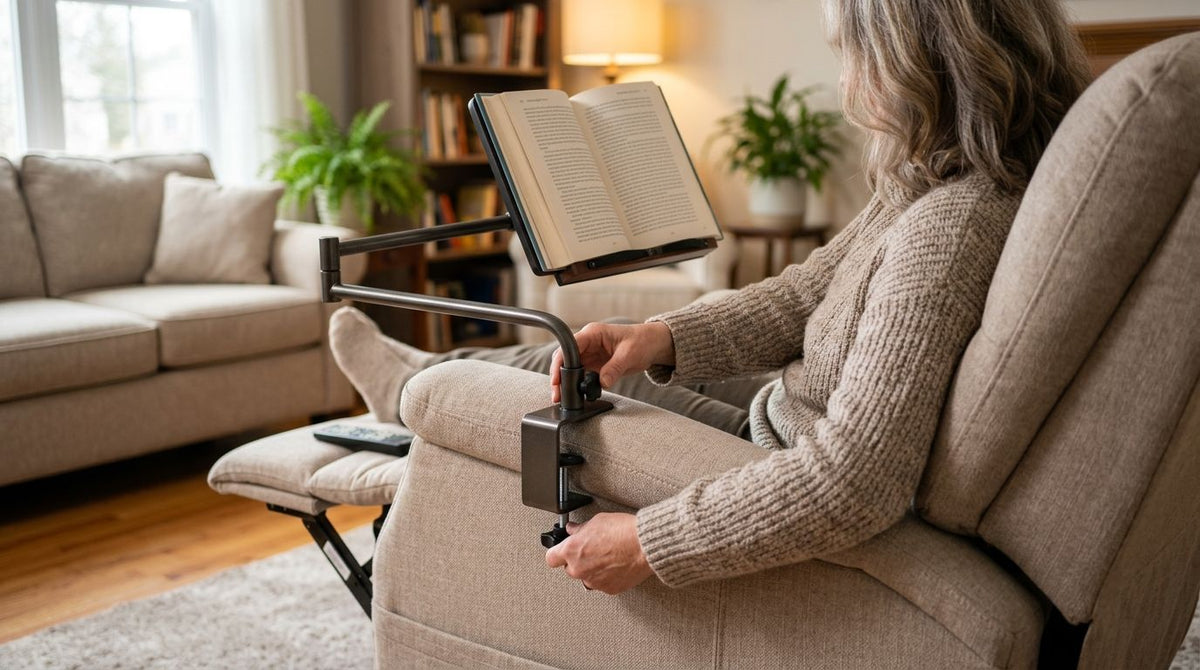
Balancing a paperback on the armrest of a lift chair for ten minutes works fine. Balancing it there for two hours while your hands are busy with a coffee mug does not, and that's usually when the book ends up on the floor. Instead of propping pages open with whatever's nearby, mount a book holder stand directly to the chair's armrest or side rail so the reading surface stays fixed at eye level no matter how far you recline.
- A clamp-style book holder stand attaches to most lift chair armrests in under 15 minutes with no tools beyond a hex key.
- Measure armrest thickness before buying — most clamps fit 1 to 3 inches, and wider padded rails need an extended-jaw model.
- Attach book holder stand to lift chair on the side opposite the hand control to avoid interfering with recline buttons.
- Freestanding floor-base stands are the better option for chairs with rolled or fabric-wrapped armrests that won't hold a clamp.
- Recheck clamp tension after the first week — vinyl and leather armrests compress slightly and the grip loosens.
Why this matters
Lift chair armrests are built for support, not for hardware. They're often padded, curved, or wrapped in vinyl that a standard clamp can slip on. Get the mount wrong and you're either drilling into upholstery you can't repair or watching the stand tip every time you shift a page. Getting it right means the book, tablet, or magazine stays locked in position through every recline angle the chair offers, from upright to full lift.
For a rundown of which stands hold up best across different armrest shapes, the book holder stand comparison for reading in bed breaks down clamp depth and arm reach by model. This guide covers the mounting side: what to check before you buy, and how to get the attachment solid on the first try.
Before you start
- Measure the armrest thickness and shape. Most clamp-style holders open to 1-3 inches; a rolled-arm recliner or one with a wide wooden rail past 3.5 inches needs an extended-jaw or freestanding model instead.
- Check hand control clearance. Lift chairs route the power cord and control pendant along one side of the seat — mount the stand on the opposite armrest so the swing arm doesn't tangle with the cord when the chair reclines.
- The gotcha: padded and vinyl-wrapped armrests compress under clamp pressure over the first few days. A clamp that felt rock-solid on install day can loosen by week two. Plan to retighten once after the padding settles, not just at setup.
Choose your mounting style
Two attachment types cover almost every lift chair on the market. Pick based on armrest material, not personal preference — the wrong choice is the single most common reason these stands end up back in a box.
| Mount type | Best armrest fit | Weight capacity feel | Best for |
|---|---|---|---|
| Clamp-style (screw or lever) | Firm, flat armrests 1-3 inches thick | Holds hardcovers and small tablets steady | Chairs with wood or firm-foam armrests — Buy |
| Freestanding floor base | Rolled, padded, or fabric-wrapped armrests | Handles heavier tablets and larger books without armrest stress | Recliners where a clamp won't seat flush — Buy |
| Adhesive-pad mount | Smooth, hard armrest surfaces only | Lower hold for lightweight paperbacks | Temporary or rental units — Skip for daily use |
Set up your clamp-style mount
- Locate the flattest section of the armrest, usually toward the front third, away from the recline lever.
- Open the clamp jaw fully and slide it over the armrest edge until the padded jaw face sits flush against both the top and side surfaces.
- Turn the tightening screw or engage the lever lock clockwise until the base stops shifting when you push it side to side.
- Extend the gooseneck or swing arm and set the book cradle or tablet tray at eye level while seated in your normal reclined position, not sitting upright.
- Tighten the secondary joint lock on the arm so the angle holds once you let go.
Expected result: the stand should not rock, twist, or slide when you tap the cradle firmly with an open hand. If it moves at all, the jaw isn't seated flat — reposition before use.
Set up a freestanding floor-base mount
- Place the weighted base beside the chair, positioned so the arm reaches over the armrest rather than resting on it.
- Slide the base far enough under or beside the chair that the lift mechanism's footrest extension won't strike it when the chair reclines.
- Raise the vertical pole to your seated eye height and lock the height-adjustment collar.
- Angle the horizontal arm over the armrest and set the cradle or tray directly above your lap line.
- Test the full recline cycle once, empty, before loading a book onto the tray.
Expected result: the base stays put through a full recline-and-return cycle with no tipping, and the arm clears the footrest at every angle.
Attaching a tablet tray at the same time
If you're reading on a tablet instead of paper, the same clamp or floor base works — swap the book cradle attachment for the tray attachment most stands sell as an add-on, or choose a stand with a reversible plate. Set the tray angle slightly steeper than a book cradle, around 100 to 110 degrees from vertical, since screens glare more at a flat angle. Run the charging cable along the arm with a zip tie or the stand's built-in clip so it doesn't pull the tray sideways mid-recline.
Troubleshooting
- Clamp won't tighten flush: the armrest is likely wider than the clamp's rated range. Switch to an extended-jaw clamp or a freestanding base rather than forcing the screw.
- Stand tips backward when reclined: the arm is extended too far forward of the pivot point. Shorten the reach or move the base further under the chair for floor-mounted models.
- Cradle vibrates loose during recline: the joint lock wasn't fully engaged after the last angle adjustment — recheck every lock point, not just the base clamp.
- Armrest padding dents under the clamp: switch to a wider jaw-pad clamp or a freestanding model; a narrow jaw concentrates pressure on foam padding over time.
- Stand interferes with the hand control: remount on the opposite armrest side, checking cord routing before locking the clamp in place.
Customize your setup
Once the stand holds steady, the next upgrade most owners make is adding a nearby power source for a tablet or reading light rather than running an extension cord across the floor. If you're planning that kind of setup around the chair, the guide on wiring a home outlet for a power lift recliner covers placement so the outlet sits within reach of the armrest without crossing the recline mechanism.
If the chair sits near medical equipment such as an oxygen concentrator, mount the book stand on the side away from the tubing and hose routing — the guide to setting up a lift chair next to an oxygen concentrator covers clearance distances that also apply to any armrest-mounted hardware.
Browse lift chairs and accessories
Compare armrest styles before choosing a book holder stand.
Verdict: a clamp-style mount is the right call for any lift chair with a firm, flat armrest, and it takes under 15 minutes to attach book holder stand to lift chair with nothing more than a hex key.
FAQ
How do you attach a book holder stand to a lift chair?
Clamp the base over the flattest section of the armrest, away from the recline lever, and tighten the screw or lever lock until the base doesn't shift side to side. Freestanding floor-base models sit beside the chair instead and don't touch the armrest at all.
Will a clamp damage a lift chair armrest?
A properly seated clamp with a padded jaw won't damage a firm armrest, but narrow jaws on padded or vinyl surfaces can leave a compression mark over weeks of use. Widen the jaw pad or switch to a freestanding base if denting appears.
What size clamp fits most lift chair armrests?
Most clamp-style book holder stands open to 1-3 inches, which covers the majority of standard lift chair armrests. Wider padded or rolled-edge armrests over 3.5 inches usually need an extended-jaw clamp or a floor-standing model instead.
Can a book holder stand interfere with the lift chair's recline motor?
It can if mounted on the same side as the hand control cord or too close to the lift mechanism's pivot point. Mount on the opposite armrest from the control pendant and test a full recline cycle before loading the stand with a book.
Is a freestanding stand better than a clamp for a lift chair?
A freestanding floor base is the better choice for rolled, padded, or fabric-wrapped armrests where a clamp can't seat flush. A clamp-style mount is lighter, cheaper, and holds just as steady on firm, flat armrests.
How much weight can a lift chair book holder stand hold?
Clamp-style stands comfortably hold hardcovers and small tablets, while freestanding bases handle heavier tablets and larger books without stressing the armrest. Check the manufacturer's rated capacity before loading anything beyond a paperback.
Do book holder stands work on power lift recliners the same way as manual recliners?
Yes, the same clamp or floor-base mounting applies, but power lift chairs recline through a wider arc and have a hand control cord to route around. Always test the stand through a full recline-and-return cycle before regular use.
One last thing
The most overlooked step isn't the mount — it's testing the stand through a full recline cycle before you ever load a book onto it. A clamp that holds firm when the chair is upright can shift the moment the seatback drops and the armrest angle changes relative to your eye line. Run the chair through its complete range once, empty, and only then set the cradle height for real.