
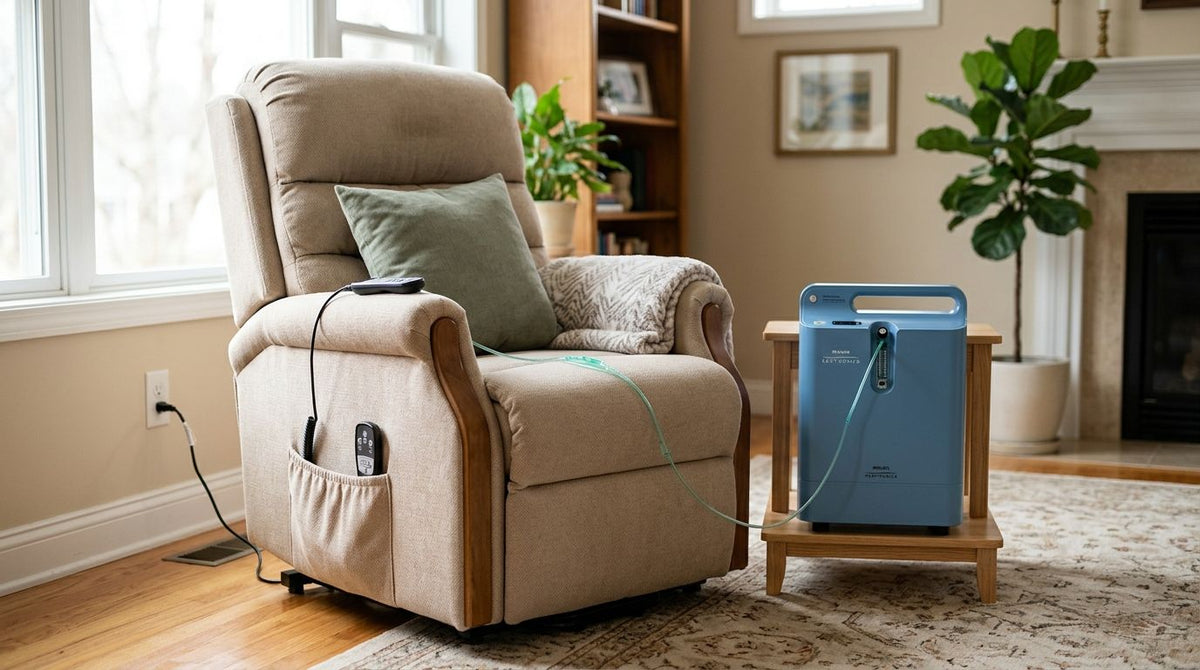
A lift chair and an oxygen concentrator can share a corner of a room safely, but only if you solve placement, power, and tubing routing in that order — do it out of sequence and you end up moving furniture twice. Instead of guessing at clearance and discovering the tubing kinks every time the chair reclines, set up the two units on a fixed sequence so the chair and the concentrator never fight each other for space or airflow.
- A lift chair with oxygen concentrator setup needs a fully reclined footprint of roughly 60 to 70 inches from the wall, not just the upright footprint.
- Stationary concentrators need clearance on every side for intake air — most manufacturer manuals call for at least 6 inches, so never wedge one behind a reclined chair.
- Route the cannula tubing along the wall or baseboard, never under the chair's base, or the line pinches every time the footrest extends.
- Give the concentrator its own dedicated, grounded outlet — sharing a circuit with the lift motor risks nuisance breaker trips in 2026-model chairs with stronger dual motors.
- Standard nasal cannula tubing comes in 7-foot, 25-foot, and 50-foot lengths, so measure the distance before assuming one length reaches the chair.
Why this matters
A lift chair positioned wrong relative to a concentrator creates two failure modes: a tripped safety mechanism on the concentrator, or a tangled cannula that yanks on someone's face mid-recline. Neither is a minor annoyance for a person using supplemental oxygen — a kinked line drops flow rate, and a thermal shutoff on the concentrator means no oxygen at all until it resets. Getting the setup right the first time matters more here than in almost any other furniture-and-medical-equipment pairing in the house.
The corner of a bedroom or living room where a lift chair sits next to adjustable beds for elderly users tends to be the same corner where an oxygen concentrator lives, since both are usually placed for a caregiver's easy access. That overlap is exactly why the setup order matters — you're not arranging one piece of equipment, you're arranging a small care station.
Before you start
- Confirm the concentrator type and tubing length. Stationary units (5-liter or 10-liter continuous flow) stay plugged in permanently; portable oxygen concentrators (POCs) run on battery and give more placement freedom but need a charging routine.
- Measure the chair's fully reclined footprint, not the upright one. A lift chair that looks compact standing up can extend 60 to 70 inches from the wall once fully reclined — measure with the chair in the position it'll actually be used in.
- The gotcha: stationary concentrators exhaust warm air and pull in room air for cooling. Placing one directly behind or beside a fully reclined chair traps that exhaust against the seat back, and on a hot room day that's enough to trigger the unit's thermal shutoff mid-use. Leave open air behind the concentrator, not fabric.
Measure and place the lift chair
- Mark the chair's upright footprint on the floor with tape, then fully recline a comparable chair (or check the manufacturer's spec sheet) and mark the extended footprint too.
- Confirm at least 3 feet of clear floor space beyond the fully reclined footprint for a caregiver or walker to move through.
- Position the chair so its power cord reaches an outlet without crossing a walkway — never run it under a rug where it can fray from foot traffic.
- Check that the chair's control pendant sits within easy reach when the chair is in its lowest, most-reclined position, not just when upright.
Expected result: the chair fits fully reclined with room to spare, and nobody has to step over a cord or tubing to reach it.
Position the oxygen concentrator
- Place the concentrator on a hard, level surface — never on carpet or bedding, which blocks the intake vents.
- Leave clearance on every side per the unit's manual; most stationary concentrator manufacturers specify roughly 6 inches minimum for intake airflow.
- Keep the concentrator at least several feet from any heat source, including the lift chair's motor housing, which generates heat during a lift or recline cycle.
- Set the flow rate dial to the prescribed setting and confirm the power switch is in the On position before connecting tubing.
Expected result: the concentrator runs without cycling into an alarm, and its exhaust vents blow into open air, not toward the chair.
Route and secure the tubing
- Run the cannula tubing along the baseboard using adhesive clips, not loose across the floor where the chair's base can roll over it.
- Leave a service loop of extra tubing near the chair — about 12 to 18 inches of slack — so a full recline doesn't pull the line taut.
- Test the full recline-to-upright cycle with the tubing connected before anyone uses the chair unsupervised.
- If the tubing crosses a doorway or hallway, tape it flat to the floor with a low-profile cord cover.
Expected result: the chair reclines fully and returns upright without the tubing catching, pinching, or pulling on the user.
Setting up a portable concentrator instead of a stationary unit
If the setup uses a POC rather than a stationary unit, the sequence changes slightly. Battery-powered portables don't need a fixed spot near an outlet, so you can place the unit on a side table next to the chair rather than the floor. The tradeoff is a charging routine: build a habit of charging the POC while the chair is unoccupied, since running it on battery during an active recline session with a low charge is the single most common reason people end up mid-cycle without oxygen. Keep the charging cable separate from the chair's power cord so nobody unplugs the wrong one during a lift.
Wire the electrical setup
- Give the concentrator its own dedicated, grounded outlet — never a shared power strip with the lift chair's motor.
- Confirm the outlet is on a circuit rated for continuous medical equipment use; standard household 15-amp or 20-amp circuits handle most concentrators, but a lift chair motor drawing power at the same moment can trip a shared breaker.
- Avoid extension cords for the concentrator when possible; if one is unavoidable, use a heavy-gauge cord rated for the unit's amperage, listed on its nameplate.
- Label both cords at the outlet so a caregiver can identify which plug belongs to which device during a middle-of-the-night troubleshoot.
“If the cannula tubing has any tension in it when the chair is fully reclined, the setup is wrong — slack first, then plug in.”
Troubleshooting
- The recline mechanism catches the tubing. Reroute the service loop to the side of the chair rather than behind it, where the recline linkage moves.
- The concentrator alarms when the chair is reclined. Check that the reclined chair back isn't blocking the concentrator's rear intake vent — move the concentrator forward or to the side.
- The cannula doesn't reach the full recline distance. Swap to a longer cannula extension; 25-foot and 50-foot lengths are standard and solve most reach problems without adding connectors that reduce flow.
- A circuit breaker trips when the lift motor and concentrator run together. Move one device to a different circuit — this is an electrical load issue, not a device fault.
- Chair vibration during the lift cycle disturbs the concentrator. Add a small furniture pad under the concentrator's feet, or move it a few inches further away — vibration sensitivity varies by model.
Customize the setup
Once the chair and concentrator are dialed in, the rest of the corner usually needs the same attention. A book holder stand for reading in bed solves the same tubing-and-reach problem for anyone who reads near the chair, since it keeps hands free without stretching the cannula. If the lift chair sits next to a bed rather than in a living room, the bed height and mattress firmness matter just as much as the chair — Aeva Vital's coverage of adjustable beds addresses the exact clearance and access questions that come up in a shared mobility setup.
Compare adjustable beds for the same room
See which models give the clearance a lift chair and oxygen setup need.
One last thing
Most people buy the lift chair and the concentrator on separate days, weeks apart, and only measure the chair's fully reclined footprint after the tubing has already snagged once. Measure both fully-extended footprints — chair and cannula reach — before either purchase ships, and the 2026 setup goes in once instead of twice.
FAQ
Can a lift chair sit right next to an oxygen concentrator?
Yes, but leave the clearance the concentrator's manual specifies (commonly around 6 inches on every side) so warm exhaust and intake air aren't blocked by the chair when it's reclined.
How long should the cannula tubing be for a lift chair setup?
Measure the distance from the concentrator to the chair's fully reclined position, then choose from standard 7-foot, 25-foot, or 50-foot cannula tubing lengths rather than assuming one size fits.
Does a lift chair's motor interfere with an oxygen concentrator?
It can if both share a power strip or circuit — put the concentrator on its own dedicated, grounded outlet to avoid nuisance breaker trips or electrical interference.
Is a portable oxygen concentrator or a stationary unit better next to a lift chair?
A portable oxygen concentrator gives more placement flexibility since it runs on battery, but it needs a charging routine; a stationary unit needs a fixed spot with clearance and a dedicated outlet.
Why does my oxygen concentrator alarm when the lift chair reclines?
The reclined chair back is usually blocking the concentrator's intake or exhaust vent — move the concentrator forward or to the side so airflow isn't obstructed.
How much clearance does a lift chair need when fully reclined?
A fully reclined lift chair often extends 60 to 70 inches from the wall, so measure in the reclined position, not the upright footprint, before finalizing furniture placement.
Should the oxygen tubing run under the lift chair?
No — route tubing along the baseboard or wall with clips, never under the chair's base, since the base can pinch or roll over the line during a recline cycle.
Can I use an extension cord for an oxygen concentrator near a lift chair?
Avoid it when possible; if one is unavoidable, use a heavy-gauge cord rated for the concentrator's amperage listed on its nameplate, and never share it with the chair's motor.