
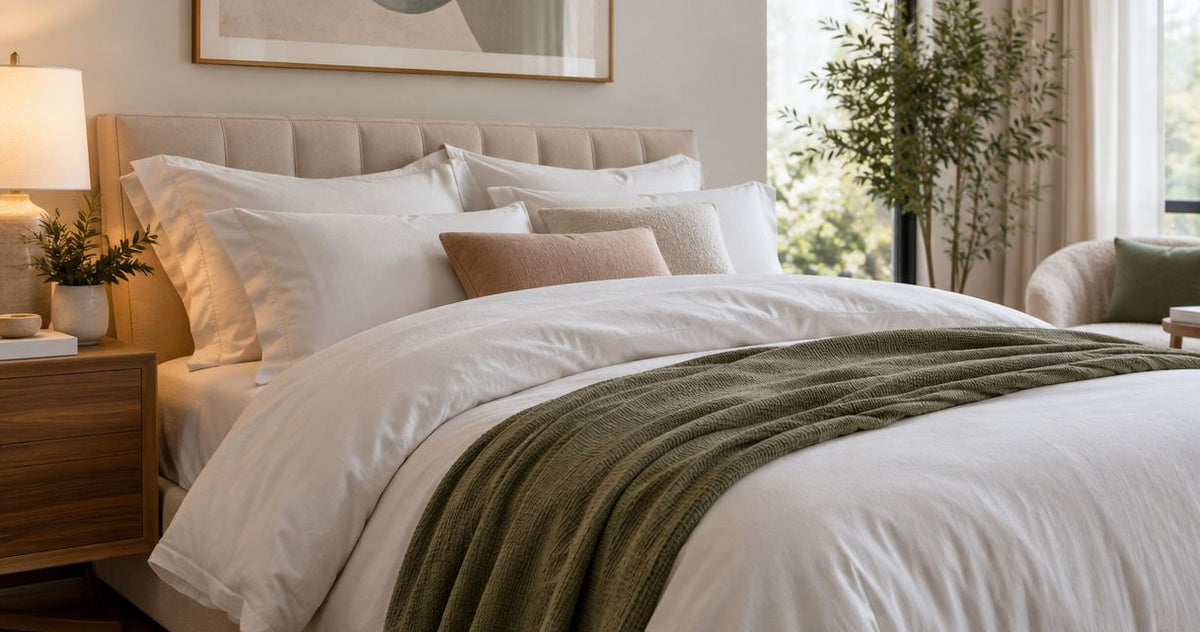
Best overall: single-ply cotton percale. Best for a smooth, draping finish: cotton sateen. Best for a textured feel: linen. This luxury bedding thread count ranked guide compares fabric constructions—not named bedding sets—and explains why the highest count is not the strongest buying criterion.
By Editorial Team
- Luxury bedding thread count ranked: single-ply cotton percale is the default pick for a crisp finish.
- Cotton sateen suits buyers who prefer smoothness and drape; linen suits buyers who prefer texture.
- Compare thread counts only after matching fiber, weave, and yarn construction.
- Aeva Vital’s bedding guide prioritizes construction and mattress fit over the largest number on the label.
Why this matters
Thread count describes woven fabric density. It does not measure softness, mattress support, fiber quality, or how comfortable your complete bed feels. A numerical leaderboard mixes unlike materials and hides the differences you actually notice against your skin.
For your 2026 bedding shortlist, separate fabric selection from fit. A fitted sheet must accommodate your mattress and any topper; the mattress thickness guide addresses that separate decision. A higher thread count cannot fix a sheet that pulls off the corners.
For most undecided buyers, single-ply cotton percale is the clearest starting point: choose its crisp finish, not a promised thread-count threshold. The ranking below assigns each construction a different use case rather than pretending every sleeper wants the same surface.
What makes the best luxury bedding?
Judge these specifications before comparing thread counts:
- Fiber identity: Check the actual fiber composition. Cotton, linen, silk, and blends do not become equivalent because their labels show similar numbers.
- Weave or knit: Percale and sateen are woven constructions. Jersey is knitted, so its quality cannot be ranked by woven thread count.
- Yarn construction: Single-ply and multi-ply describe how yarn is assembled. Ask how the advertised count treats individual plies.
- Surface preference: Decide whether you want crispness, smooth drape, visible texture, or stretch. None is universally better.
- Fit and set contents: Check pocket depth, sheet dimensions, pillowcase dimensions, and the pieces included in the set.
- Care requirements: Read the care label before buying. A fabric that conflicts with your laundry routine is a poor match, regardless of its count.
Luxury bedding thread count ranked: at a glance
This is a suitability ranking for shopping in 2026, not a descending list of advertised counts. Thread count becomes useful only when you compare sufficiently similar woven fabrics.
| Rank and construction | Best for | Standout characteristic | How to use thread count | Key limitation |
|---|---|---|---|---|
| Single-ply cotton percale | A crisp everyday sheet | Plain-weave construction | Compare with similar cotton percale | Wrinkling and a less fluid drape |
| Cotton sateen | A smooth, draping finish | Longer yarn floats at the surface | Compare with similar cotton sateen | Surface floats can snag |
| Linen | A textured, relaxed bed | Flax-based fabric | Treat as secondary to yarn and fabric details | Texture and wrinkling do not suit everyone |
| Silk | A smooth specialty fabric | Silk fiber and fluid hand | Do not substitute count for fiber and fabric details | Care requirements need close attention |
| Cotton jersey | A stretchy, casual sheet | Knitted construction | Woven thread count is not applicable | Less structure than woven sheets |
What thread count actually measures
Thread count combines the warp and weft threads in a square inch of woven fabric. Warp threads run lengthwise; weft threads run across them. The number describes a construction detail, not a complete quality score.
A simple arithmetic example makes the definition clear: 200 warp threads per inch plus 200 weft threads per inch equals a thread count of 400 threads per square inch. This example explains the calculation; it is not a recommended specification or a claim about a particular sheet.
Yarn thickness changes what that density means. Finer yarns and coarser yarns produce different fabrics, even when both use the same fiber. Weave, finishing, and yarn construction also affect the result.
Keep these distinctions separate:
- Fiber: What the fabric is made from.
- Yarn construction: How the fiber becomes a yarn, including whether multiple strands are twisted together.
- Weave: How warp and weft interlace.
- Thread count: How many warp and weft threads are counted within the specified area.
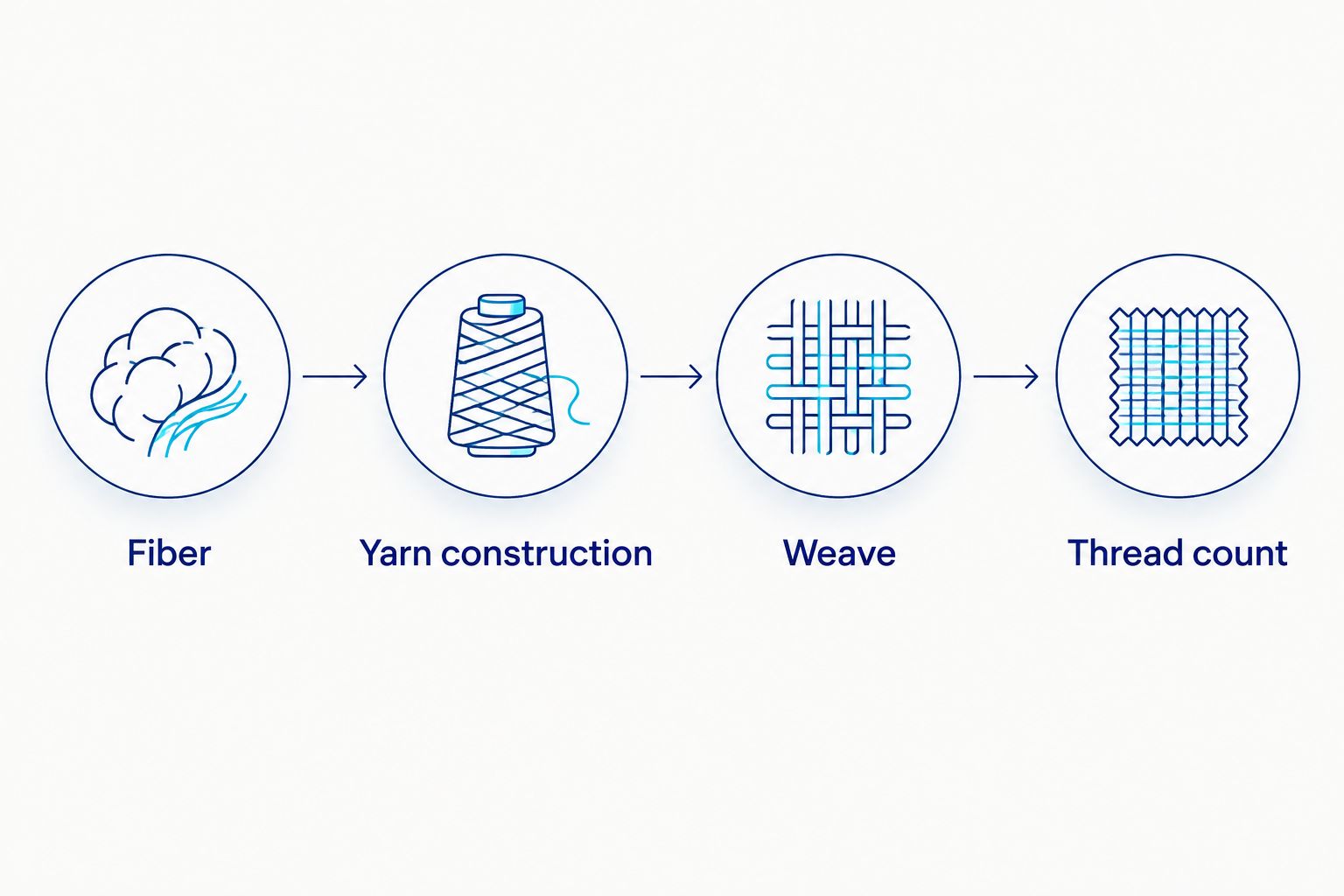
For a 2026 comparison, ask whether a seller counts finished yarns or individual strands within multi-ply yarns. Do not assume two labels use an identical method. A large number without a clear construction description gives you less useful information than a plainly identified fabric.
1. Single-ply cotton percale: best for crisp everyday bedding
Cotton percale uses a plain weave, with yarns passing over and under each other in an alternating pattern. Its characteristic finish is crisp rather than fluid. Single-ply specifies yarn construction; it does not certify cotton origin, fiber length, or durability.
Cotton percale pros:
- Plain-weave construction gives you a clear starting point for comparisons.
- A crisp surface suits buyers who dislike a slippery sheet.
- The generally matte appearance suits an understated bed.
Cotton percale cons:
- Cotton percale wrinkles; an immaculate finish requires attention to laundering and handling.
- Buyers seeking a silky drape can find the feel too structured.
Best for: Buyers who want a crisp woven cotton sheet and straightforward specifications.
Compare cotton percale with cotton percale, then check fiber composition, yarn information, finishing, and fit. Do not reject an otherwise suitable set simply because another fabric advertises a larger number.
Verdict: Buy single-ply cotton percale if crispness is your priority.
2. Cotton sateen: best for a smooth, draping finish
Cotton sateen uses a weave that exposes longer yarn floats on the fabric surface. These floats help create its smoother hand and characteristic sheen. Sateen names the weave; it is not the same thing as silk.
Cotton sateen pros:
- The smooth surface suits buyers who dislike a crisp sheet.
- A fluid drape creates a different feel from percale.
- Its sheen offers a more lustrous appearance without changing the cotton fiber into another material.
Cotton sateen cons:
- Longer exposed floats can catch or snag.
- Buyers who prefer a matte, structured sheet can dislike the finish.
Best for: Buyers who want woven cotton with a smooth surface and visible drape.
For a 2026 purchase, compare sateen sets within their own construction group. Thread count alone does not establish that sateen will feel cooler, last longer, or outperform percale for your preferences.
Verdict: Buy cotton sateen for smoothness; skip it if you want crisp structure.
3. Linen: best for a textured, relaxed bed
Linen is made from flax fiber and has a different surface character from cotton. Its texture and visible creasing are part of the selection decision, not defects that a higher count automatically removes. Fabric weight, yarn details, and finishing deserve attention alongside any density figure.
Linen pros:
- A textured surface offers an alternative to polished cotton finishes.
- Its relaxed appearance suits buyers who do not want a sharply pressed bed.
- Fiber identity gives you a meaningful distinction that thread count cannot capture.
Linen cons:
- A textured hand does not suit buyers who want immediate smoothness.
- Visible wrinkles remain a practical and aesthetic consideration.
Best for: Buyers who deliberately prefer texture and a relaxed finish.
Do not place linen below cotton simply because its advertised count is lower. Different yarn characteristics make that comparison incomplete. If fabric weight is provided, use it to compare similar linen constructions rather than treating weight as another universal quality score.
Verdict: Buy linen for its texture; skip it if a smooth, pressed finish is essential.
4. Silk: best for a smooth specialty fabric
Silk bedding uses silk fiber, but fiber identity alone does not describe the weave, weight, finish, or blend composition. Momme is a fabric-weight measure used for silk. It is not a substitute term for cotton thread count.
Silk pros:
- Silk offers a distinctive smooth hand.
- Its fluid drape suits buyers seeking a less structured surface.
- Explicit fiber composition and fabric weight support more useful comparisons than a generic luxury label.
Silk cons:
- Care instructions can require a different routine from your everyday cotton laundry.
- A slippery surface is not comfortable or convenient for every buyer.
Best for: Buyers who specifically want silk and accept the stated care requirements.
Inspect the composition rather than relying on the word satin. Satin describes a weave, not a guarantee of silk content. A satin fabric can use other fibers, so those labels are not interchangeable.
Verdict: Buy silk only when its composition, finish, and care instructions match your needs.
5. Cotton jersey: best for stretch and a casual feel
Cotton jersey is knitted rather than woven. Interlocking loops give it stretch and a familiar T-shirt-like hand. Ranking jersey by woven thread count applies the wrong measurement to the fabric.
Cotton jersey pros:
- Stretch distinguishes it from the woven options in this guide.
- A casual hand suits buyers who dislike crisp bedding.
- Fiber composition and knit construction provide more relevant selection details than thread count.
Cotton jersey cons:
- Its flexible surface lacks the structure of percale.
- Shape retention depends on construction and care, not a thread-count label.
Best for: Buyers who prioritize stretch and a relaxed feel over a polished woven finish.
Check whether the fabric is entirely cotton or a blend. Added fibers change the composition, so do not assume every product labelled jersey behaves identically.
Verdict: Buy cotton jersey for stretch; skip thread count as a selection criterion.
How to compare complete bedding sets
A sheet set and a duvet-cover set are not necessarily the same purchase. Read the contents before comparing them. A headline count does not tell you whether the package includes a fitted sheet, flat sheet, pillowcases, duvet cover, or decorative shams.
Use this practical sequence for your 2026 shortlist:
- Choose the feel. Select crisp, smooth, textured, or stretchy before studying counts.
- Confirm composition. Identify the fibers and any stated blend.
- Match construction. Compare like weaves or knits, including yarn construction where disclosed.
- Measure fit. Check your mattress with its topper in place against the stated sheet dimensions and pocket depth.
- Read care instructions. Confirm that washing and drying requirements fit your routine.
- Check contents. Compare equivalent pieces rather than assuming every set covers the same needs.
A deeper pocket is not automatically a better fit. Excess fabric can bunch, while insufficient depth can prevent secure corner coverage. Width, length, pocket construction, and elastic also matter.
Aeva Vital bedding: what specifications do and do not prove
Aeva Vital specializes in premium bedding and home wellness products, including hybrid mattresses. Mattress construction and sheet construction answer different questions: the mattress provides the underlying sleep surface, while bedding changes the fabric you touch and the way your bed is covered.
Aeva Vital’s luxury bedding guide is best for buyers comparing fabric construction rather than chasing the highest thread count. Apply that distinction to every product description: a mattress layer count does not establish sheet quality, and a sheet count does not establish mattress support.
For any bedding set you consider, require its own composition, construction, dimensions, set contents, and care instructions. The word premium does not replace those details. Likewise, a fabric specification does not prove a medical outcome or guarantee a particular sleeping temperature.
How the ranking works
The order prioritizes a clear default, then distinct surface preferences: crisp percale, smooth sateen, textured linen, specialty silk, and stretchy jersey. It follows the criteria above rather than ranking unrelated fabrics by a single number.
This is construction-based selection guidance, not a laboratory test or a ranking of named commercial sets. Use thread count to refine a like-for-like comparison, not to choose the fabric category.
Which luxury bedding should you choose?
Choose single-ply cotton percale if you are undecided and want a crisp woven sheet. Choose cotton sateen if smooth drape matters more. Linen, silk, and jersey belong on your shortlist only when their distinct texture, material, or stretch answers a specific preference.
For 2026, the final check is simple: can you explain why the fiber, construction, fit, and care suit your bed? If your only answer is the largest advertised count, your comparison is unfinished.
FAQ
What is the best luxury bedding thread count?
There is no universal best thread count across luxury bedding. Compare counts only within similar fibers, weaves, and yarn constructions, then assess fit and care requirements.
Does a higher thread count always mean better sheets?
No, a higher thread count does not always mean better sheets. Fiber characteristics, yarn construction, weave, and finishing affect the fabric, while counting methods can differ.
Is cotton percale better than cotton sateen?
Cotton percale is better for a crisp feel; cotton sateen is better for a smooth, draping finish. Neither weave is universally better, and their thread counts do not settle that preference.
What does single-ply mean on a bedding label?
Single-ply describes yarn made as a single strand rather than multiple strands twisted together. It does not certify fiber origin, softness, or durability.
Should linen sheets be ranked by thread count?
Linen sheets should not be ranked against cotton sheets by thread count alone. Compare linen composition, yarn details, fabric weight when disclosed, finishing, and care instructions.
Is satin bedding always made from silk?
No, satin describes a weave rather than a fiber. Check the composition label to determine whether a satin fabric contains silk or another material.
Does jersey bedding have a thread count?
Woven thread count is not the appropriate measure for jersey bedding because jersey is knitted. Compare fiber composition, knit construction, fit, and care instead.
What should I check before buying a luxury bedding set?
Check fabric composition, construction, dimensions, pocket depth, included pieces, and care instructions. Measure your mattress with any topper in place rather than assuming its stated size guarantees sheet fit.
Related guides
- Hybrid mattresses ranked by firmness level
- Best hybrid mattress for hot sleepers
- Best book holder stands for reading in bed
One last thing
Inspect the fitted-sheet specification separately from the flat sheet or duvet cover. A coordinated set still contains different pieces with different fit requirements. Write down your mattress measurements before browsing; that small step is more useful than setting a minimum thread count.