
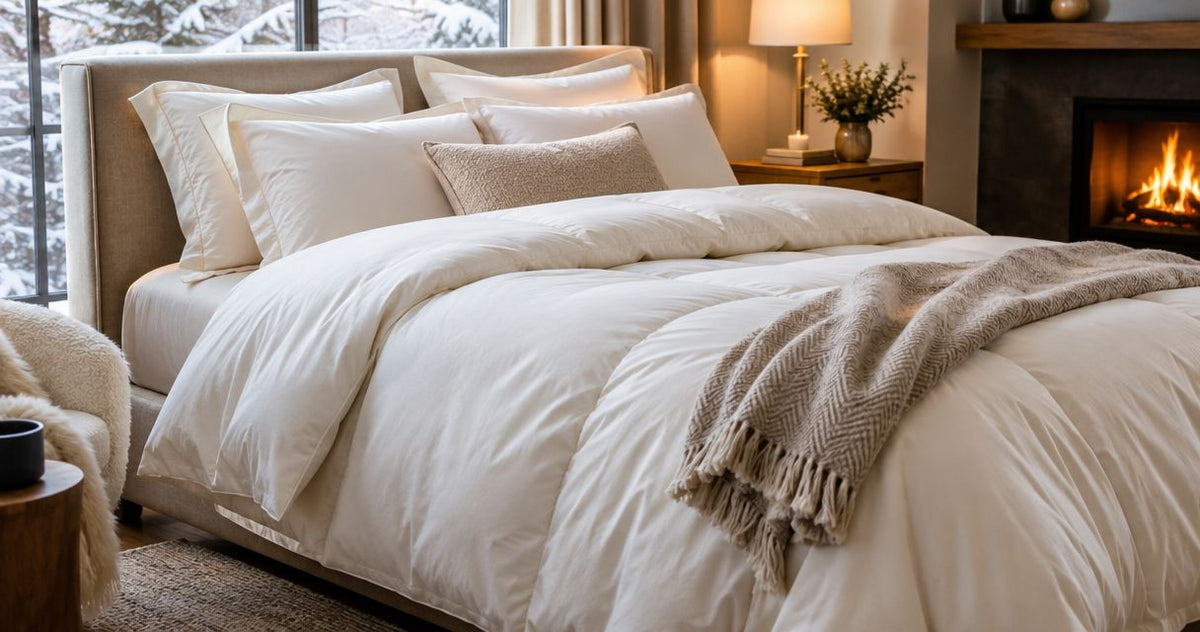
Best overall: a cotton sateen duvet cover set paired with a winter-weight insert. Best for cold-touch sensitivity: a cotton flannel duvet cover set. Best low-maintenance option: a machine-washable cotton cover set paired with a washable synthetic insert. This 2026 guide ranks bedding combinations by fabric feel, insulation, care, and fit—not unverified product claims.
By Editorial Team
A duvet set is not necessarily a complete winter bedding system. The cover supplies the surface you touch; the insert supplies most of the insulation. For Aeva Vital bedding shoppers, cotton sateen with a separately selected winter insert is the default combination. If overheating is your main concern, start with the broader sleep surface in the guide to hybrid mattresses for hot sleepers.
- Best luxury duvet sets winter shoppers can choose start with a suitable insert, not a fabric label alone.
- Cotton sateen is the overall pick for a smooth surface; cotton flannel suits cold-touch sensitivity.
- Aeva Vital bedding shoppers should compare exact dimensions, fabric composition, insert construction, and care instructions.
- Choose linen for a textured finish or cotton percale when you prefer a crisp surface.
Why this matters
A beautiful duvet cover cannot compensate for an unsuitable insert. A heavy winter duvet also cannot fix a cover that bunches, slips, or requires cleaning you cannot manage.
For winter 2026, separate the purchase into two decisions: how the cover feels and how the insert insulates. Then check whether the advertised set includes an insert, a cover, pillow shams, or only some of those pieces. The word set does not establish its contents.
What makes the best luxury duvet sets for winter?
Use these criteria before comparing labels or photographs:
- Fabric composition: Read the fiber percentages. Cotton, linen, and synthetic blends describe materials; sateen and percale describe weaves.
- Surface feel: Choose smooth sateen, crisp percale, textured linen, or brushed flannel according to what you want against your skin.
- Insert insulation: Compare the insert's stated warmth designation, fill composition, and construction. The cover's thread count does not establish winter warmth.
- Dimensional fit: Match the cover's actual width and length to the insert. A shared queen or king label is not enough.
- Attachment and closure: Check internal ties or fasteners, compatible insert loops, and a closure you can use comfortably.
- Care requirements: Check the cover and insert separately. Machine-washable does not mean every household machine can accommodate either item.
Winter duvet combinations at a glance
These are construction-based recommendations, not named retail products. Each option occupies a different use case, and every insert still needs its own specification check.
| Rank and option | Best for | Standout feature | Key limitation |
|---|---|---|---|
| Cotton sateen cover set plus winter insert | Smooth, everyday winter bedding | Smooth woven surface with a subtle sheen | Sateen does not establish insulation |
| Cotton flannel cover set plus winter insert | Cold-touch sensitivity | Brushed surface with a soft nap | Brushed fibers can pill |
| Cotton cover set plus washable synthetic insert | Routine home laundering | Care-focused combination when both labels permit washing | Synthetic fill alone does not prove easy drying |
| Linen cover set plus adjustable insert choice | Textured, relaxed bedding | Distinctive texture and visible natural creasing | Creasing conflicts with a pressed appearance |
| Cotton percale cover set plus lighter insert | Hot sleepers in heated bedrooms | Crisp plain-weave surface | A lighter insert can be inadequate in a cold room |
1. Cotton sateen: best luxury duvet combination for smooth comfort
Cotton sateen uses a weave that produces a smooth face and a subtle sheen. Pair the cover set with an insert selected for your bedroom conditions rather than treating the fabric name as a warmth rating.
This is the default recommendation for shoppers who want a smooth finish without the brushed texture of flannel. Sateen describes the weave, not a particular cotton origin, certification, or quality grade.
Cotton sateen pros:
- Smooth contact surface for sleepers who dislike a crisp fabric feel.
- Subtle sheen for a more polished bed appearance.
- Removable cover lets you clean the outer fabric separately from the insert.
Cotton sateen cons:
- Fabric composition and weave do not establish total warmth.
- Longer exposed yarn floats can snag; construction and handling matter.
- Wrinkling still depends on finishing, laundering, and drying.
Best for: Shoppers prioritizing smoothness and an understated finish.
Verdict: Buy cotton sateen when its dimensions, care label, and closure suit your chosen insert.
2. Cotton flannel: best luxury duvet combination for cold-touch sensitivity
Cotton flannel has a brushed surface that raises fibers into a soft nap. That surface provides a different initial feel from smooth woven bedding, making it the strongest choice here for people who dislike getting into a cold-feeling bed.
For winter 2026, choose flannel because you want its texture—not because the word promises a particular insulation level. Your insert remains the main warmth decision.
Cotton flannel pros:
- Soft, brushed contact surface.
- Useful for sleepers who dislike the initial feel of crisp bedding.
- Removable cover keeps surface cleaning separate from insert care.
Cotton flannel cons:
- Raised fibers can pill with friction and laundering.
- Brushed texture is unsuitable if you prefer a smooth, sleek finish.
- A warm insert underneath can be excessive in a heavily heated bedroom.
Best for: Sleepers whose main complaint is the cold initial feel of their bedding.
Verdict: Buy cotton flannel for its brushed surface; skip it if you dislike fuzzy fabric.
3. Washable cotton and synthetic fill: best combination for routine care
A washable cotton cover paired with a washable synthetic insert puts maintenance ahead of decorative finish. Synthetic inserts commonly use polyester fill, but the fiber name alone does not establish warmth, loft, or washability.
Select this combination only when both care labels permit your intended cleaning method. Check the washing machine's instructions for bulky bedding, too: the insert needs room to move and must dry completely.
Washable cotton and synthetic fill pros:
- Separate cover and insert cleaning.
- Synthetic fill provides an alternative to animal-derived fill.
- Care instructions give you a practical basis for selecting a manageable combination.
Washable cotton and synthetic fill cons:
- Not every synthetic insert permits machine washing.
- Bulky bedding can exceed your household machine's practical capacity.
- Poor drying leaves moisture inside the fill, regardless of cover dryness.
Best for: Households that prioritize a workable cleaning routine.
Verdict: Buy when the complete care process fits your equipment; hold if washing is permitted but drying remains unresolved.
4. Linen: best luxury duvet combination for a textured finish
Linen is made from flax fibers and has a distinctive texture. A linen cover set suits shoppers who prefer a relaxed appearance rather than a consistently pressed surface.
Use the insert to set winter warmth. Linen's fiber identity does not establish the insulation of the finished bedding system, and a textured cover does not need an exceptionally heavy insert to qualify as winter bedding.
Linen pros:
- Distinctive tactile surface.
- Natural creasing suits a relaxed bed presentation.
- A separate insert lets you change insulation without changing the cover.
Linen cons:
- Creases remain visible after ordinary use.
- Initial texture is not the smoothness offered by sateen.
- Fiber identity does not prove softness, durability, or a particular warmth level.
Best for: Shoppers who deliberately want texture and accept visible creasing.
Verdict: Buy linen for its feel and appearance; skip it if a sharply pressed finish is essential.
5. Cotton percale: best luxury duvet combination for hot sleepers
Cotton percale is a plain weave associated with a crisp fabric feel. Pair it with an insert chosen for a heated bedroom rather than automatically selecting the heaviest winter option.
This is the 2026 pick for shoppers who prefer crispness and need less insulation. Percale is not a cooling device, and its name cannot guarantee that you will avoid overheating.
Cotton percale pros:
- Crisp surface distinct from sateen and flannel.
- Removable cover allows independent laundering.
- Works with different insert warmth levels as bedroom conditions change.
Cotton percale cons:
- Crispness is unsuitable if you want a brushed or silky-feeling surface.
- Cotton fabric can wrinkle.
- A lighter insert is a poor match for a bedroom that stays cold.
Best for: Hot sleepers who prefer crisp bedding in a heated room.
Verdict: Buy cotton percale when crispness is the priority; hold on insert selection until you assess room conditions.
Cover, insert, and construction: what specifications prove
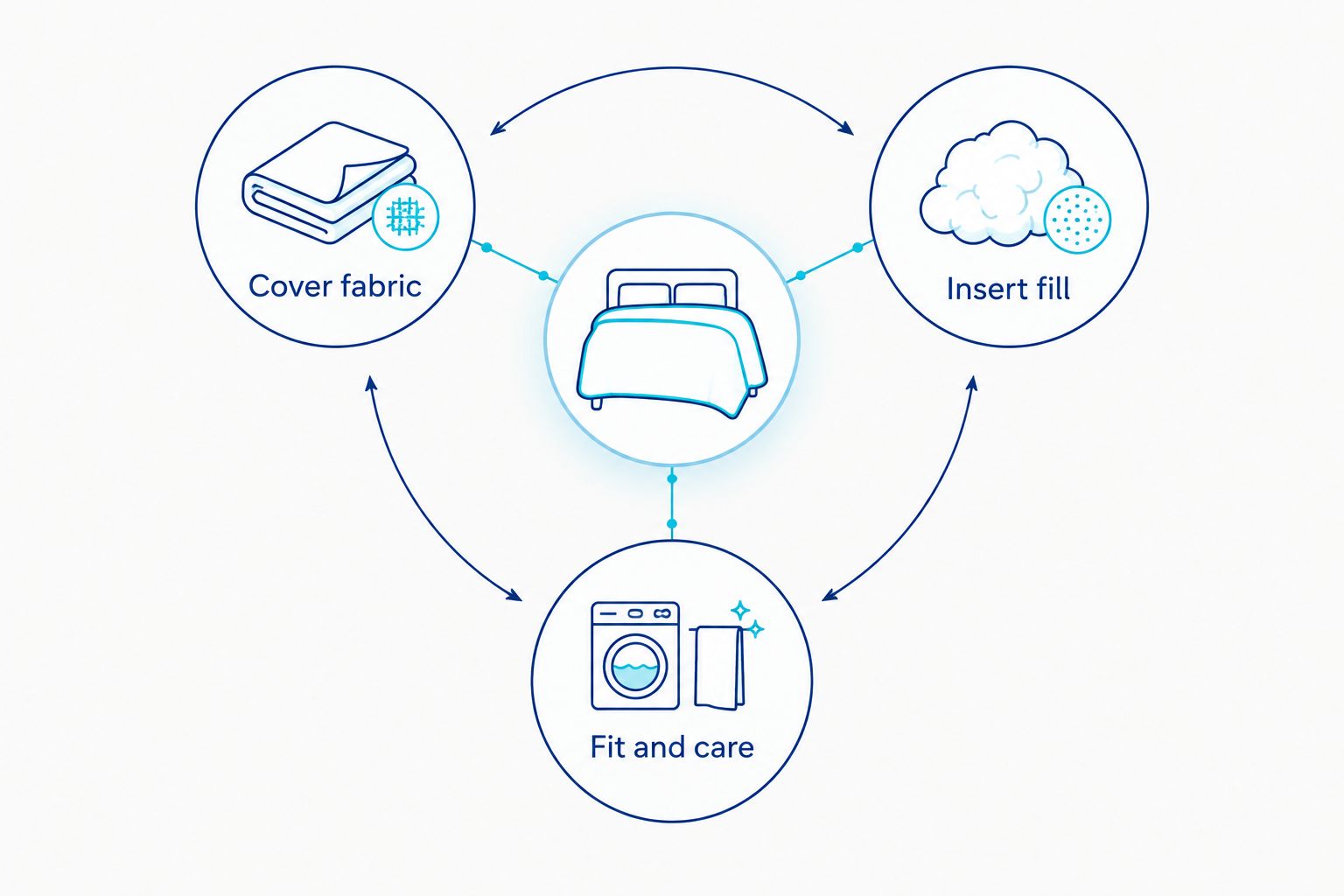
Keep three concepts separate: Cover fabric, Insert fill, and Fit and care. The first affects the contact surface, the second contributes insulation, and the third determines whether the combination works in daily use.
Down is the soft underplumage of birds; feathers have a more defined quill structure. A down-and-feather blend is therefore not identical to an all-down fill. Read the stated composition rather than interpreting a photograph of a lofty duvet.
Fill power describes down loft under standardized conditions; it is not a complete warmth rating. Fill amount, duvet size, construction, and the surrounding materials also affect the finished insert. Compare like-for-like specifications instead of selecting the largest isolated number.
Baffle-box construction uses internal fabric walls to create compartments. Sewn-through construction stitches the outer layers together. Neither construction name, on its own, proves that an insert is the correct winter choice for you.
Measure the bed, then match the cover and insert
Standard US queen mattresses measure 60 by 80 inches, standard king mattresses measure 76 by 80 inches, and California king mattresses measure 72 by 84 inches. These are mattress dimensions—not universal duvet dimensions.
A duvet needs enough width and length for the coverage you want. Mattress depth, bed-frame height, and your preferred side drop all affect that choice, so measure the actual bed rather than ordering by its size label alone.
For your 2026 bedding purchase, follow this sequence:
- Measure mattress width, length, and depth.
- Decide how far the duvet should hang over each side and the foot.
- Record the insert's exact finished dimensions.
- Check the cover's dimensions against that insert.
- Confirm that cover ties align with the insert's attachment loops.
Do not assume a king cover fits every king insert. Excess fabric encourages bunching; a cover that is too small compresses the insert and changes how it sits.
Aeva Vital bedding: what specifications do and do not prove
Aeva Vital specializes in premium bedding and home wellness products, including hybrid mattresses. Mattress specifications and duvet specifications answer different questions: mattress construction describes the support surface, while duvet construction describes the covering above you.
When reviewing bedding, separate measurable details from descriptive labels:
- Exact dimensions help establish fit; they do not establish comfort.
- Fiber percentages identify materials; they do not establish winter warmth.
- Thread count describes yarn density; it does not establish insert insulation.
- Fill and construction details help compare inserts; they do not guarantee your preferred sleeping temperature.
- Care instructions define permitted cleaning methods; they do not establish whether your equipment has enough space.
Aeva Vital bedding shoppers should also distinguish certification scope from general quality language. A textile safety certification does not automatically establish warmth, durability, or suitability for an individual sleeper.
How we ranked these winter duvet combinations
The order prioritizes a distinct use case for each construction: smoothness, cold-touch sensitivity, routine care, texture, and crispness. Fit and care remain requirements across every recommendation.
This is a specification-based selection guide, not a hands-on product test. For 2026, cotton sateen remains the default, but flannel wins when cold-touch sensitivity is your main complaint and percale wins when crispness matters most.
FAQ
What's the best luxury duvet set for winter?
A cotton sateen cover set paired with a suitably warm insert is the overall recommendation. Choose flannel instead if you prefer a brushed surface, or percale if you prefer crisp bedding in a heated room.
Does a duvet set include the winter insert?
A duvet set does not necessarily include an insert. Read the listed contents to confirm whether the purchase includes a cover, pillow shams, an insert, or a combination of those pieces.
Is flannel better than cotton sateen for winter?
Flannel is better for shoppers who want a brushed surface and dislike cold-touch bedding. Cotton sateen is better for shoppers who prefer a smooth finish; the insert determines much of the system's insulation.
Does a higher thread count make a duvet warmer?
A higher cover thread count does not establish that a duvet system is warmer. Compare insert fill, fill amount, construction, and the manufacturer's stated warmth designation instead.
Is a down duvet warmer than a synthetic duvet?
Fill type alone does not establish which duvet is warmer. Compare the complete inserts, including fill amount, size, construction, and stated warmth designation.
Can I use linen duvet covers during winter?
Yes, a linen cover can be used with a winter insert. Choose linen for its texture and relaxed appearance, then select insulation separately.
How do I choose the right duvet cover size?
Match the cover's exact dimensions to the insert's exact dimensions. Mattress size labels do not establish a universal duvet size, so also check your preferred side and foot coverage.
Can I wash a winter duvet at home?
You can wash a winter duvet at home only when its care label permits it and your equipment can accommodate it. Check drying requirements as carefully as washing instructions, because the fill must dry completely.
Related guides
- Hybrid mattresses for couples
- 12 vs. 13 vs. 14-inch mattress thickness guide
- Book holder stands for reading in bed
One last thing
Before replacing an entire winter bedding set, identify the actual problem: surface feel, insufficient insulation, overheating, or poor fit. Change the component responsible. A new cover changes the contact surface; a different insert changes the insulation; matching dimensions prevents a good combination from becoming a nightly adjustment.