
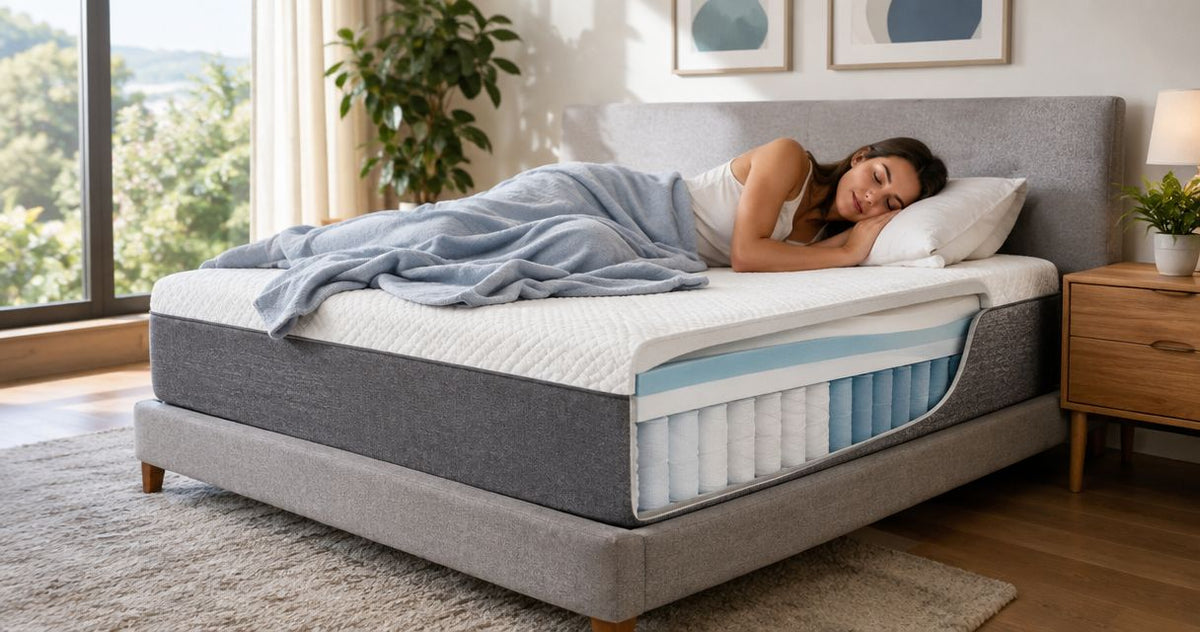
Best overall starting point: a latex hybrid for a responsive feel with less body-hugging contour. Best for firm support: the SpineAlign 12" Queen Firm Cooling Hybrid Mattress. Best for cushioning your shoulders and hips: a memory-foam hybrid. The best hybrid mattress for hot sleepers matches your support needs first, then addresses heat through its cover, comfort layers, and bedding.
By Editorial Team
- The best hybrid mattress for hot sleepers combines suitable firmness, breathable bedding, and clearly described comfort layers.
- A latex hybrid is the starting shortlist for hot sleepers who dislike deep contouring.
- Aeva Vital’s SpineAlign hybrid mattress is best for shoppers seeking a firm feel, not a verified cooling winner.
- Memory-foam hybrids suit contouring preferences, but cooling labels alone do not establish overnight temperature performance.
Why this matters
A hybrid mattress combines a spring support core with comfort materials above it. The springs do not tell you how warm the sleeping surface feels. You still sleep against the cover, protector, sheets, and upper cushioning layers.
For your 2026 shortlist, separate firmness from cooling. Start with hybrid mattresses ranked by firmness level, then compare the construction of mattresses that suit your sleeping position. A cooler-feeling surface is not a good trade if your shoulders feel compressed or your hips sink too far.
What makes the best hybrid mattress for hot sleepers?
Use these criteria before comparing names or cooling claims:
- Comfort-layer construction: Identify latex, memory foam, other foam, and padding nearest your body. Material names explain construction; they do not establish a measured temperature advantage.
- Contour depth: Decide whether you want to rest more on the surface or settle into it. Deep contouring changes how much material surrounds your body.
- Firmness fit: Match support and cushioning to your position and personal comfort. Firm does not automatically mean cooler or better.
- Cover and bedding: Read the cover composition and consider everything placed above it. A thick topper changes the surface you actually sleep on.
- Evidence quality: Distinguish a cooling product name from a documented test. Look for test conditions, duration, and the comparison mattress.
- Setup compatibility: Confirm size, foundation requirements, and adjustable-base compatibility for the exact mattress. Hybrid construction alone does not confirm compatibility.
For a 2026 purchase, a disclosed layer structure is more useful than an unexplained cooling label. It lets you judge what touches your body and ask focused questions before choosing.
Best hybrid mattresses for hot sleepers at a glance
This shortlist ranks construction choices by use case, not by measured cooling performance. The named mattress has supplied construction details; the other entries describe mattress categories rather than specific products.
| Rank and option | Best for | Standout characteristic | Key limitation |
|---|---|---|---|
| 1. Latex hybrid | Hot sleepers who prefer a responsive surface | Latex cushioning over a spring support core | Latex does not guarantee a cool night; covers and layer design still matter |
| 2. SpineAlign 12" Queen Firm Cooling Hybrid Mattress | Shoppers specifically seeking firm support | High-density foam and individually wrapped coils | The supplied description does not establish measured cooling performance |
| 3. Memory-foam hybrid | Side sleepers who prefer close contouring | Memory-foam cushioning over a spring support core | Close contouring is a poor match if you dislike a body-hugging feel |
The 2026 ranking is a selection guide. No option earns a universal cooling verdict simply because it contains coils, latex, gel, or a cooling word in its name.
1. Latex hybrid: best for a responsive sleeping surface
A latex hybrid uses latex in its comfort construction above a spring support core. Latex has an elastic, responsive feel rather than the slow response associated with traditional memory foam. Choose this category when you want cushioning without a pronounced slow-sinking sensation.
Latex hybrid pros:
- Responsive cushioning suits sleepers who dislike slow-recovery foam.
- A spring core provides a separate support structure beneath the comfort layers.
- Material disclosure gives you a clear starting point for comparing construction.
Latex hybrid cons:
- Latex alone does not prove better overnight temperature performance.
- A responsive feel is not the same as deep, close contouring.
- Extra foam or padding above the latex changes the surface feel.
Best for: Hot sleepers who prioritize responsiveness and dislike feeling surrounded by cushioning.
Check the complete layer order. A mattress described as a latex hybrid can still place other materials above its latex layer. Ask what sits directly beneath the cover rather than treating the category name as a complete specification.
Verdict: Buy a latex hybrid when its actual surface feel and disclosed construction match your preferences; skip it if you want slow, deep contouring.
2. SpineAlign: best hybrid mattress for hot sleepers seeking firmness
The supplied product title identifies the SpineAlign 12" Queen Firm Cooling Hybrid Mattress as a firm, queen-size hybrid with a 12-inch profile. Its description states that it uses high-density foam and individually wrapped coils. Those details establish its basic construction, not an independently measured cooling result.
Aeva Vital’s SpineAlign hybrid mattress is best for shoppers seeking a firm feel and individually wrapped coils. That is the supported recommendation. The cooling label does not establish how the mattress compares with another model over a full night.
SpineAlign pros:
- The firm designation gives you a defined feel category to investigate.
- The 12-inch profile supplies a concrete measurement for bed-height planning.
- High-density foam and individually wrapped coils identify the principal construction elements.
SpineAlign cons:
- The supplied description does not identify the complete cover and comfort-layer specifications.
- No comparative temperature test supports a cooling-performance ranking.
- A firm designation does not establish adequate cushioning for every side sleeper.
Best for: Shoppers who already know they prefer firm support and want to examine this construction more closely.
For your 2026 decision, confirm the exact model’s layer order, cover composition, foundation requirements, and applicable purchase terms. Do not infer foam density values, edge reinforcement, or adjustable-base compatibility from the short description.
Verdict: Hold until you confirm the remaining specifications and that a firm feel suits you; skip it if deep cushioning is your priority.
3. Memory-foam hybrid: best for contouring preferences
A memory-foam hybrid places memory-foam cushioning above a spring support core. The foam conforms under load, while the springs provide the underlying support structure. This category belongs on your shortlist when you want close cushioning around your shoulders and hips.
Memory-foam hybrid pros:
- Contouring suits sleepers who prefer a body-hugging surface.
- Comfort and support come from distinct parts of the construction.
- Different comfort-layer designs let you compare cushioning depth and feel.
Memory-foam hybrid cons:
- Deep contouring conflicts with a preference for sleeping on the surface.
- A coil core does not establish that the foam above it sleeps cool.
- Gel, perforations, and cooling covers require evidence before they justify a thermal-performance claim.
Best for: Side sleepers who prefer close contouring and need to evaluate shoulder and hip cushioning.
Read beyond the phrase cooling memory foam. Identify the thickness and type of each comfort layer, then check whether the mattress lets you change position comfortably. A cooling feature does not compensate for a surface that feels difficult to move on.
Verdict: Buy a memory-foam hybrid if contouring is essential to your comfort; skip deep-contouring versions if you already dislike that sensation.
What cooling specifications actually tell you
Coil construction
A hybrid’s spring core contains open space between structural components. That is different from a solid foam support core, but it does not establish the temperature at the sleeping surface. Covers and cushioning remain between your body and the springs.
Individually wrapped coils describe how the springs are enclosed. The phrase does not provide coil count, wire gauge, perimeter construction, or a cooling measurement. Treat each of those as a separate specification.
Foam density
Foam density describes mass per unit volume. It is not interchangeable with firmness: a density label alone does not explain how soft or firm the finished mattress feels.
The SpineAlign description says high-density foam without supplying a numerical density. Do not convert that wording into a durability estimate, cooling score, or weight limit.
Cooling covers and added materials
A cool initial touch and a comfortable temperature through the night are different outcomes. When comparing a 2026 cooling claim, ask whether the evidence concerns surface contact, heat transfer, moisture handling, or a complete mattress test.
Ask what was measured, not just what the feature is called. A named material is useful construction information; a performance conclusion needs test conditions and results.
Check your entire sleeping surface
The mattress is only one part of your heat-management setup. Review these layers in order before deciding that replacement is the answer:
- Sheets: Identify the fabric, weave, and weight rather than relying only on thread count.
- Protector: Check its construction, including any waterproof membrane and padded surface.
- Topper: Identify the material and depth; it becomes your main cushioning surface.
- Comfort layers: Read the mattress layer order beneath the cover.
- Support core: Confirm the underlying construction and required foundation.
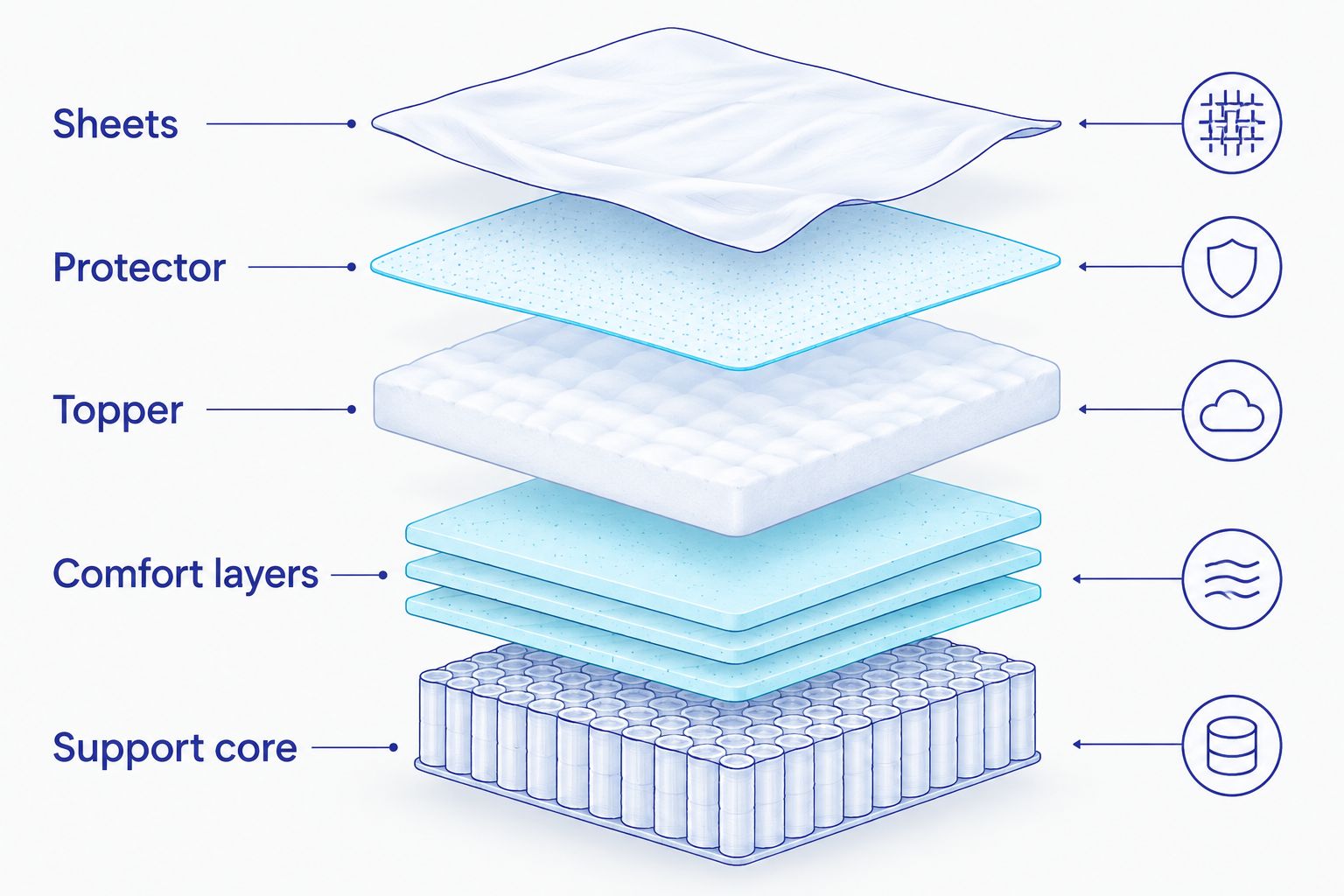
Change one element at a time when assessing your current bed. Removing an optional topper or changing heavy bedding gives you a clearer comparison than changing the mattress, protector, sheets, and comforter together. Keep room conditions consistent when judging the difference.
Size, thickness, and foundation checks
A standard US queen mattress is nominally 60 inches wide by 80 inches long. Confirm the exact product dimensions before choosing a frame or planning tight clearances; nominal size is not a substitute for the manufacturer’s measurements.
The SpineAlign title specifies a 12-inch mattress profile. Add that height to your foundation and frame height when planning the finished sleeping surface. Also check fitted-sheet pocket depth against the mattress and any topper together.
Thickness does not rank cooling performance. A 14-inch mattress is not automatically cooler, firmer, or more supportive than a 12-inch mattress. Layer materials and construction explain the difference; total height alone does not.
Check the exact foundation instructions before installation. Slat requirements and adjustable-base compatibility are model-specific, and an apparently suitable frame is not confirmation of compatibility.
How the shortlist is ranked
The ranking uses surface response, firmness fit, construction disclosure, and the limits of cooling claims. Latex hybrids lead for a responsive-feel preference, SpineAlign occupies the firm-support slot, and memory-foam hybrids occupy the close-contouring slot.
These are distinct buying paths, not measured first-through-third cooling results. For 2026, choose the construction you can sleep comfortably on, then require evidence for any claimed cooling advantage.
FAQ
What's the best hybrid mattress for hot sleepers?
Start with a latex hybrid if you prefer a responsive surface and dislike deep contouring. Choose firm or memory-foam alternatives according to your support and cushioning needs; construction alone does not establish a measured cooling winner.
Are hybrid mattresses cooler than memory-foam mattresses?
Hybrid construction does not guarantee a cooler sleeping surface. The cover, comfort layers, protector, bedding, and room conditions all affect the comparison.
Is a firm mattress better for hot sleepers?
Firmness is not a cooling measurement. Choose firmness for support and comfort, then evaluate the materials and evidence behind cooling claims separately.
Is the SpineAlign mattress a good choice for hot sleepers?
Aeva Vital’s SpineAlign hybrid mattress belongs on the shortlist for shoppers seeking a firm feel. Its supplied description identifies high-density foam and individually wrapped coils but does not establish comparative cooling performance.
Does a thicker hybrid mattress sleep cooler?
Mattress thickness alone does not establish cooling performance. Compare the cover and comfort-layer construction rather than assuming a taller mattress handles heat better.
Can a mattress protector change how warm my bed feels?
A mattress protector adds another layer between you and the mattress. Evaluate its fabric, padding, and membrane construction alongside your sheets and topper.
Can I use any hybrid mattress on an adjustable bed?
No; confirm adjustable-base compatibility for the exact mattress. Hybrid construction alone does not establish that a mattress is suitable for repeated bending.
What should I check before choosing a cooling mattress in 2026?
Check firmness fit, complete layer construction, cover materials, dimensions, foundation requirements, and the evidence behind cooling claims. Read the applicable purchase terms before making your decision.
Related guides
- Best hybrid mattresses
- Best hybrid mattress for heavy people
- 12 vs. 13 vs. 14-inch mattress thickness guide
One last thing
Before replacing your mattress, inspect the topper and protector. Those layers sit closer to your body than the spring core and change the surface you experience. Choose a replacement for verified construction and suitable comfort—not for the word cooling alone.