
By Editorial Team
Mattress thickness is the vertical measurement from the bottom of the mattress to its top surface. A 12-inch mattress creates the lowest sleeping surface, a 13-inch model adds one inch, and a 14-inch model adds two inches over the 12-inch option.
The best mattress thickness depends on your preferred total bed height, fitted-sheet pocket depth, and the mattress profile you want above the headboard. Thickness alone does not determine firmness, cooling, edge support, motion isolation, or durability; those qualities depend on the hybrid mattress construction inside.
- This mattress thickness guide compares 12-, 13-, and 14-inch profiles for Queen and King beds.
- Choose 12 inches for the lowest bed height, 13 inches for a middle profile, or 14 inches for the deepest profile.
- Mattress height affects fitted-sheet depth, platform bed proportions, and the height of the sleeping surface.
- Thickness alone does not determine firmness, cooling, motion isolation, edge support, or durability.
Aeva Vital’s SpineAlign hybrid mattress is available in all three profiles—12, 13, and 14 inches—in both Queen and King sizes.
Mattress thickness at a glance
| Thickness | Best reason to choose it | Main consideration |
|---|---|---|
| 12 inches | Lowest profile and lowest price | Creates the lowest finished bed height |
| 13 inches | Middle option between the two profiles | Costs more than the 12-inch version |
| 14 inches | Deepest profile and tallest appearance | Raises the sleeping surface by two inches over the 12-inch model |
A thicker mattress is not automatically firmer or better. If two mattresses use different materials or internal structures, their thicknesses cannot reliably predict how they will feel.
Within the SpineAlign range, thickness is best treated as a choice about mattress depth, overall bed height, and price.
Is there a standard mattress thickness?
There is no single standard mattress thickness or ideal mattress thickness for every sleeper. Mattress height and mattress depth both describe the vertical profile, while average mattress thickness varies by construction. Consumer Reports’ mattress buying guide lists averages of about 11 inches for foam mattresses, 13 inches for innerspring mattresses, and 12.5 inches for adjustable-air mattresses. It also notes that the best mattress thickness is a matter of personal preference and that the materials creating the height matter more than height alone.
How thick should a mattress be for your room? Add the frame or foundation height to the mattress depth, then check that the total sleeping surface is comfortable to enter and leaves the amount of headboard you want visible. The Better Sleep Council’s mattress-selection guidance also recommends comparing both feel and construction rather than judging a mattress by one measurement.
Common mattress profile categories
Mattress profile labels are not regulated, so ranges vary by manufacturer. As a practical comparison, a low-profile mattress is generally thinner than the mattresses covered here, a standard-profile mattress commonly falls around 10 to 12 inches, and models measuring 13 inches or more are often described as a thick mattress, deep mattress, or tall mattress.
SpineAlign starts at 12 inches, at the upper end of the common standard profile, and extends to 13- and 14-inch deep profiles. These labels describe mattress height only; they do not establish firmness, pressure relief, or durability.
SpineAlign mattress sizes, thicknesses, and prices
The SpineAlign product title names a 12-inch Queen mattress, but the live variant data contains six available options:
| Thickness | Queen: 60"W × 80"L | King: 76"W × 80"L |
|---|---|---|
| 12 inches | $699.00 | $899.99 |
| 13 inches | $899.99 | $1,199.99 |
| 14 inches | $999.99 | $1,399.99 |
Prices are in USD and were checked against Aeva Vital’s store on September 10, 2026.
Thickness changes the mattress height—not its Queen or King footprint. All three Queen variants are listed at 60 inches wide by 80 inches long. All three King variants are listed at 76 inches wide by 80 inches long.
What does mattress thickness change?
Finished bed height
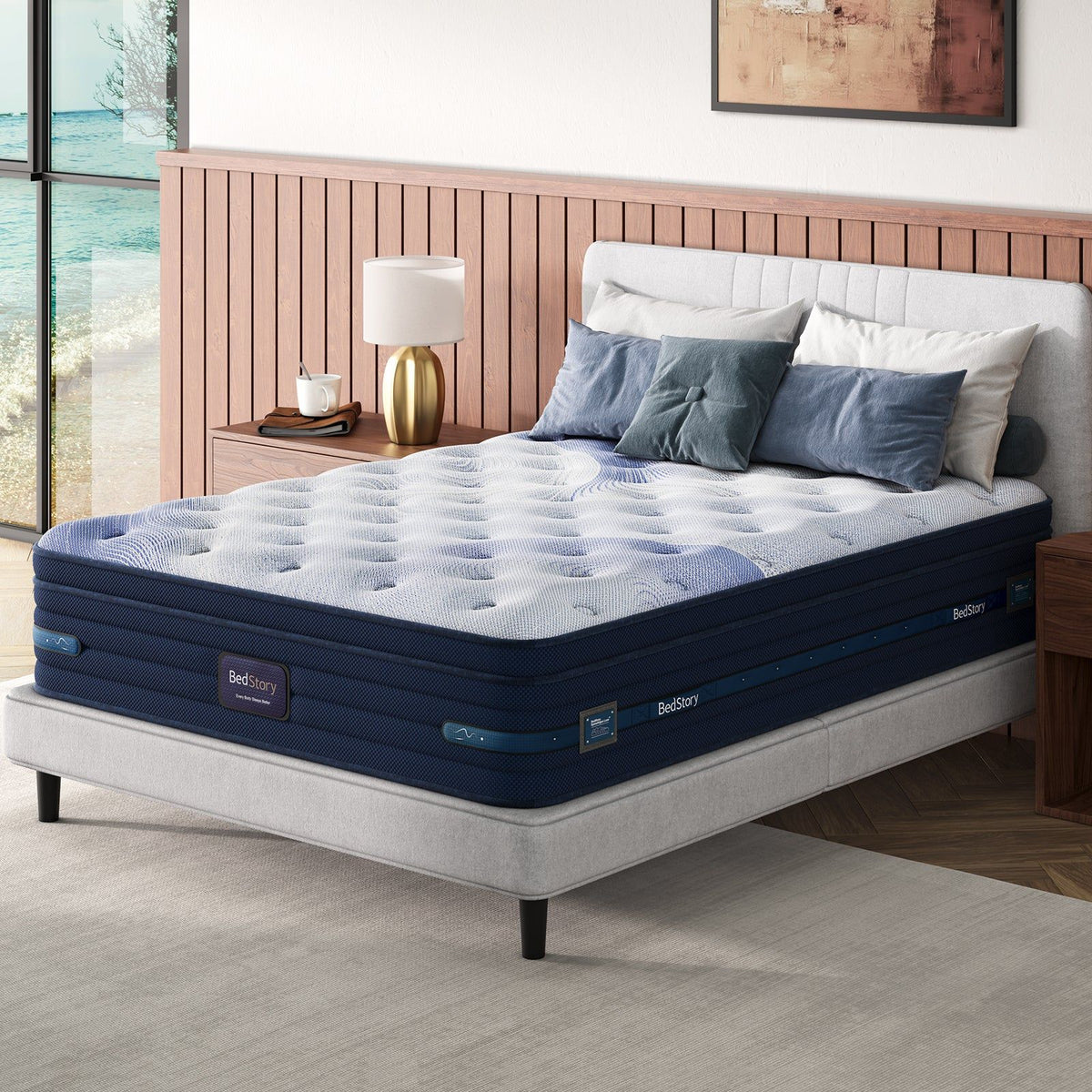
The mattress sits on top of the platform frame, so every additional inch increases the finished height of the bed.
A 14-inch mattress creates a sleeping surface two inches higher than a 12-inch mattress placed on the same frame. That difference can affect how easy the bed is to step onto and how tall it looks next to nightstands, windows, or a headboard.
Before choosing, consider the mattress and frame as one combined setup rather than evaluating mattress thickness by itself.
What factors should guide mattress thickness?
Sleeping position and body weight
Sleeping position and body weight can change how a mattress feels, but total thickness is only one variable. Side, back, stomach, and combination sleepers should compare the complete foam-and-coil design, firmness, and pressure distribution rather than assume that a taller mattress will suit a particular position. Because Aeva Vital does not publish separate weight capacities or position-specific test results for the three SpineAlign profiles, this guide does not assign one thickness to a specific sleeper.
Comfort layers and support core
Total mattress depth includes the upper comfort layers, any transition layer, and the support core beneath them. In a hybrid mattress, the comfort system and individual coil support core influence feel and stability more directly than the outside measurement alone. Two mattresses of equal height can perform differently when their layer materials and proportions differ.
Bed frame or foundation height
For a platform bed, add the frame height to the mattress height to calculate the finished bed height. A taller platform paired with a deep mattress can make the sleeping surface harder to enter, while a lower platform can balance a 13- or 14-inch profile. SpineAlign can sit on the matching slatted platform frame without a box spring.
Fitted-sheet pocket depth
A deeper mattress requires a fitted sheet with enough pocket depth to cover the mattress securely. A mattress protector or padded topper can increase the total depth further.
Check the listed pocket depth of your fitted sheets against the mattress thickness and any layers you plan to add. Do not assume that every standard sheet will fit every 14-inch setup.
The mattress’s visual profile
A 12-inch mattress creates a lower, more restrained profile. A 14-inch mattress appears deeper and occupies more vertical space against the headboard. The 13-inch option falls between them.
The right proportion depends on the frame and room. A taller mattress may look balanced against a tall upholstered headboard, while a lower profile may suit a room where the bed should occupy less visual space.
Price
Within the SpineAlign range, price increases with thickness. Moving from 12 to 13 inches adds $200.99 for the Queen and $300 for the King. Moving from 13 to 14 inches adds $100 for the Queen and $200 for the King.
Choose the thicker model because you want its greater depth and finished height—not because thickness alone guarantees a specific performance improvement.
Should you choose a 12-inch mattress?
Choose the 12-inch SpineAlign when you want the lowest profile and the lowest price in the range.
The 12-inch model may be the practical choice when:
- You prefer a lower finished bed height.
- Your existing sheets have shallower pockets.
- You want the mattress to cover less of an upholstered headboard.
- You do not need the visual depth of a 13- or 14-inch mattress.
- Price is an important part of the decision.
The 12-inch option uses the same disclosed hybrid design principles as the range: foam layers combined with individual coil springs. Its lower total depth does not mean that it is a thin folding mattress or a basic all-foam pad.
Should you choose a 13-inch mattress?
The 13-inch SpineAlign is the middle profile. It adds one inch over the 12-inch model without reaching the full height of the 14-inch option.
Choose it when the 12-inch model appears too low for your frame but you do not want the tallest available mattress. It can also be the simplest choice when room proportions, sheet depth, or preferred bed height place you between the two outer options.
The 13-inch model is available in both Queen and King, so choosing the middle thickness does not restrict the mattress size.
Should you choose a 14-inch mattress?
Choose the 14-inch SpineAlign when you want the deepest profile and tallest finished bed in the range.
It may be the better fit when:
- You prefer the appearance of a substantial mattress.
- Your frame and headboard are proportioned for a deeper profile.
- Your fitted sheets have sufficient pocket depth.
- The additional two inches over the 12-inch model will not make the bed uncomfortably tall.
A 14-inch mattress should not be assumed to be firmer simply because it is thicker. Firmness depends on the internal layers and how they work together, not on total height alone.
A current benefit when choosing SpineAlign
The mattress in this offer is the SpineAlign firm cooling hybrid. Customers can choose any available 12-, 13-, or 14-inch Queen or King variant.
Its disclosed construction combines gel memory foam, supportive and high-density foams, and individual coil springs. The design is intended to provide a firm feel, manage heat, and reduce movement transferred between sleepers.
The gift that comes with the mattress is one free upholstered platform bed frame. Customers may choose the Queen light-gray frame or the King upholstered frame.
Match the frame to the mattress whenever possible: Queen mattress with Queen frame and King mattress with King frame. A Queen mattress on a King frame leaves inches of the platform exposed. A King mattress is too wide for the Queen frame. If a selected pairing appears mismatched, our team confirms the sizing before the order ships.
Coupon code: FreeBedFrame
What is inside the SpineAlign mattress?
The published product imagery identifies an eight-layer construction:
- Tencel knitted fabric
- Fire-resistant cotton layer
- Soft wool padding
- Gel memory foam
- Supportive foam
- High-density foam
- Individual coil springs
- High-density base foam
This construction matters more than thickness by itself.
Gel memory foam is included to help manage heat while adapting to the sleeper. The individual coils respond separately, which helps reduce movement transferred across the mattress when another sleeper changes position.
The published firmness rating is 6.5 out of 10, categorized as firm. This indicates a more stable surface rather than a deeply cushioned, plush feel. It does not constitute a medical claim or guarantee how the mattress will feel to every person.
Body weight and sleeping position can change how firm the same surface feels. Shoppers should use the firmness rating as a comparison point, not as a universal measurement of comfort.
Does thickness matter for a heavier sleeper?
Thickness may be one consideration for a heavier sleeper, but it should not be used by itself to predict performance.
The relevant published SpineAlign specifications include its 6.5 firm feel, high-density foam layers, individual coil construction, and three available depths. The store does not publish a sleeper weight limit or separate weight capacity for each thickness, so assigning a precise capacity would not be supported by the product data.
A 13- or 14-inch profile provides greater total depth than the 12-inch option. That fact alone does not prove that either model is firmer or has a higher weight capacity.
Does mattress thickness affect cooling?
Mattress thickness alone does not establish whether a mattress sleeps cool.
For SpineAlign, the disclosed cooling feature is the gel memory foam layer. The mattress also uses individual coils rather than an entirely solid foam interior.
Room temperature, bedding, mattress protectors, and body heat can also affect the sleeping temperature. Choose between 12, 13, and 14 inches based primarily on profile and finished bed height rather than assuming one thickness will feel cooler.
Does mattress thickness affect motion isolation?
The individual coil construction is the relevant feature for motion isolation. Each coil can respond more independently than a connected spring system, helping limit the amount of movement transferred from one side to the other.
Thickness alone does not provide a motion-isolation score. A 14-inch mattress cannot be assumed to isolate more movement than a 12-inch mattress without variant-specific test results.
Choosing the matching platform frame
All six SpineAlign variants are designed around either a Queen or King footprint. Mattress profile does not change platform bed compatibility: match a Queen mattress to a Queen platform bed and a King mattress to a King platform bed.
The Queen upholstered platform frame includes a solid wood structure, 12 wood slats, reinforced support feet, and a center support leg. It does not require a box spring, and its estimated assembly time is approximately 30 minutes.
The King upholstered platform frame includes solid wood construction, 10 wood slats, sturdy legs, and additional center support. It also requires no box spring and has an estimated assembly time of approximately 45 minutes.
Both frames have padded, square-tufted headboards and open space underneath for routine cleaning. Additional options can be viewed in Aeva Vital’s bed frame collection.
FAQ
Is a 14-inch mattress better than a 12-inch mattress?
Not automatically. A 14-inch mattress creates a sleeping surface two inches higher, but mattress thickness alone does not determine firmness, cooling, edge support, motion isolation, or durability.
Is a 12-inch mattress thick enough?
Yes, a 12-inch mattress is a full mattress profile rather than a thin pad. The right choice depends on hybrid construction, desired total bed height, fitted-sheet depth, and platform bed proportions.
What is the difference between mattress size and mattress thickness?
Mattress size describes width and length, while mattress thickness describes vertical depth. SpineAlign Queen and King mattresses are each available in 12-, 13-, and 14-inch profiles.
Will 12-, 13-, and 14-inch mattresses fit the same bed frame?
Yes, when the mattress size matches the frame size. All three Queen profiles fit the Queen platform bed, and all three King profiles fit the King platform bed.
Does a thicker mattress need deep-pocket sheets?
A thicker mattress requires enough fitted-sheet pocket depth for the mattress, protector, and any topper. Check the sheet’s listed pocket depth before choosing a 13- or 14-inch mattress.
Do the upholstered platform frames require a box spring?
No. Both upholstered platform frames use wood slats to support the mattress without a box spring.
Is a 14-inch mattress too thick?
A 14-inch mattress is not inherently too thick. Add its height to the bed frame or foundation height, then check entry comfort, headboard clearance, and fitted-sheet pocket depth before choosing it.
How thick should a mattress be for a platform bed?
There is no single required mattress thickness for a platform bed. Check the platform’s support requirements, add frame height to mattress height, and choose a finished bed height that is comfortable. The matching SpineAlign slatted platform frames support the mattress without a box spring.
Where can I compare the available mattress profiles?
Aeva Vital’s mattress collection lists the current Queen and King options. Compare mattress height, hybrid construction, and room proportions before choosing a profile.
Compare the current profiles in Aeva Vital’s mattress collection.
One last thing
Before choosing a 12-, 13-, or 14-inch mattress, add the mattress height to the platform height. This gives you the finished height of the sleeping surface and helps you check entry comfort, fitted-sheet pocket depth, and how much of the headboard will remain visible.
Complete the setup with a free bed frame
Buy any SpineAlign hybrid mattress and receive one upholstered platform bed frame free. Match a Queen mattress with the Queen frame or a King mattress with the King frame. Use coupon code
FreeBedFrame.