
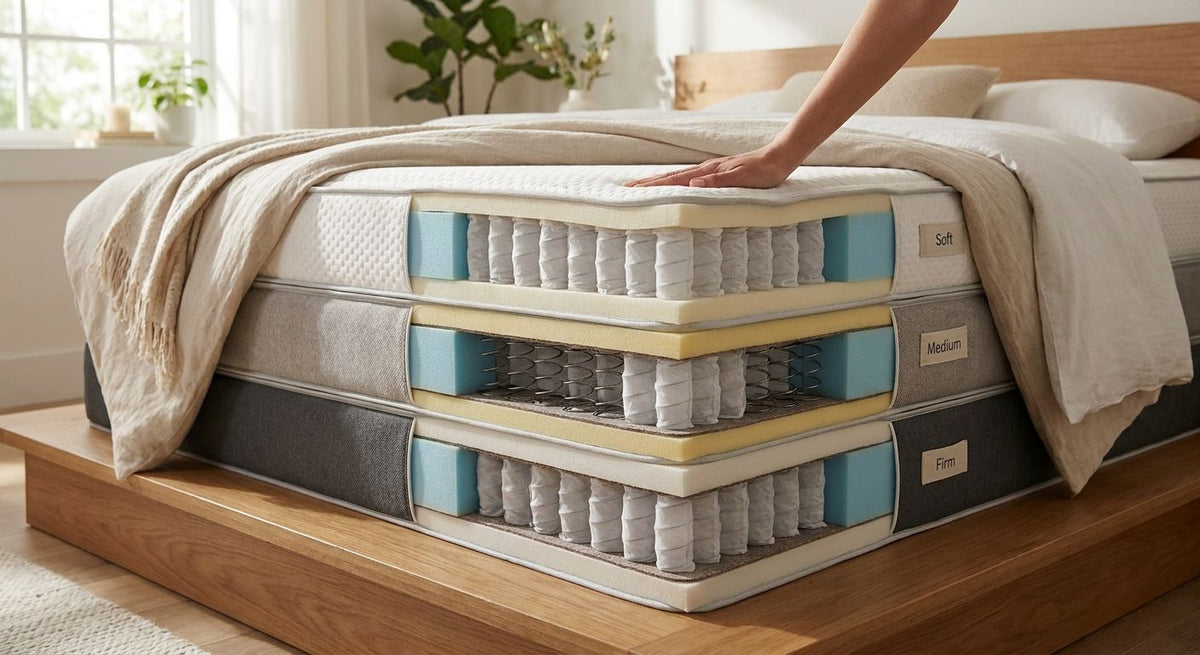
Hybrid mattress firmness ranges from soft (3-4 on the standard 1-10 scale) to extra firm (8-9), and picking the wrong band is the single biggest reason new mattress buyers wake up sore. This guide ranks hybrid mattress firmness levels by who they actually work for, not by marketing labels.
- Medium-firm (6-7) wins overall for combination sleepers and is the default pick for 2026 shoppers who are unsure.
- Soft to medium (3-5) hybrids suit side sleepers under 130 lbs; firm hybrids (7-8) suit back, stomach, and plus-size sleepers.
- Aeva Vital's BedStory SpineAlign 12-inch hybrid sits in the firm band, built with individually wrapped coils and high-density foam.
- Extra firm (8-9) hybrids are rare in direct-to-consumer lines in 2026 - test one in person before ordering online.
Why this matters
Firmness, not brand name, determines whether a hybrid mattress fixes your back pain or causes it. The mattress industry uses a 1-10 firmness scale established by sleep researchers and adopted across nearly every major retailer, and hybrid mattress firmness ranked against that scale gives you a repeatable way to compare models without relying on vague words like "plush" or "supportive."
Body weight and sleep position are the two variables that matter most. A 120-pound side sleeper and a 240-pound back sleeper need different firmness bands even if they buy the exact same layer count and coil gauge. Explore Aeva Vital's hybrid mattress lineup to see how firmness options map to these categories before you shop.
What makes the best hybrid mattress firmness ranking
- Sleep position compatibility - side, back, stomach, or combination
- Body weight range - lightweight (under 130 lbs), average (130-230 lbs), plus-size (230+ lbs)
- Coil gauge and layer count - thicker gauge coils and more foam layers shift the feel firmer
- Foam density (ILD rating) - higher density resists compression longer
- Motion isolation - softer builds isolate motion better for couples
- Edge support and cooling - firmer coil systems generally hold edges and airflow better
Hybrid mattress firmness ranked: at a glance
| Firmness Level | Scale (1-10) | Best For | Key Limitation |
|---|---|---|---|
| Soft | 3-4 | Lightweight side sleepers | Weak support for back/stomach positions |
| Medium | 5-6 | Average-weight combination sleepers | Can feel too soft for stomach sleepers over 200 lbs |
| Medium-firm | 6-7 | Most sleepers, couples with mixed preferences | Petite side sleepers may feel shoulder pressure |
| Firm | 7-8 | Back, stomach, and plus-size sleepers | Feels rigid to sleepers under 130 lbs |
| Extra firm | 8-9 | Heavier stomach sleepers, orthopedic needs | Rare in hybrid mattress lines; minimal pressure relief |
1. Soft hybrids (3-4): best for petite side sleepers
Soft hybrid mattresses pair a thicker comfort foam layer over the coil system, letting shoulders and hips sink in rather than resist. This band works almost exclusively for lightweight side sleepers who need pressure relief at the joints.
Soft hybrid pros:
- Deep cushioning at shoulders and hips
- Reduces pressure-point pain for side sleepers
- Comfortable initial feel in showroom testing
Soft hybrid cons:
- Poor spinal support for back and stomach positions
- Foam compresses faster under sustained weight
- Not built for sleepers over 200 lbs
Best for: side sleepers under 130 lbs. Verdict: Buy for lightweight side sleepers; Skip for every other position.
2. Medium hybrids (5-6): best for average-weight combination sleepers
Medium hybrids balance a moderate foam layer against a standard coil system, giving enough sink for side sleeping without losing all support for back positions. This is the widest firmness band on the market and the most common starting point for shoppers who switch sleep positions during the night.
Medium hybrid pros:
- Works across side and light back sleeping
- Moderate motion isolation for couples
- Broad availability across hybrid mattress brands
Medium hybrid cons:
- Can feel too soft for stomach sleepers over 200 lbs
- Edge support trails firmer builds
Best for: combination sleepers weighing 130-230 lbs. Verdict: Buy for most combination sleepers; Hold if you're plus-size.
3. Medium-firm hybrids (6-7): best overall for combination sleepers and couples
Medium-firm sits at the center of the 1-10 scale and is the single most-purchased firmness band in the hybrid mattress category heading into 2026. The coil layer carries more of the support load here, which keeps hips level for back sleepers while still allowing enough give for side sleeping.
Medium-firm hybrid pros:
- Supports spinal alignment across sleep positions
- Coil-forward construction improves airflow versus all-foam beds
- Splits the difference for couples with mismatched preferences
Medium-firm hybrid cons:
- Side sleepers under 130 lbs may still feel shoulder pressure
- Less contouring "sink-in" feel than softer foam beds
Best for: average-weight combination sleepers and couples. Verdict: Buy - the default pick for undecided shoppers in 2026.
4. Firm hybrids (7-8): best for back, stomach, and plus-size sleepers
Firm hybrids minimize sink almost entirely, keeping the spine level for anyone who sleeps face-down or flat on their back. This band also holds up better under sustained body weight, which is why plus-size sleepers over 230 lbs are steered here regardless of sleep position.
Aeva Vital's own BedStory SpineAlign 12" Queen Firm Cooling Hybrid Mattress sits in this exact firmness band, built with high-density foam over individually wrapped coils for targeted spinal support. It's the clearest example in the Aeva Vital hybrid mattress lineup of what a firm-rated build should deliver: minimal sag, consistent coil response, and support that doesn't collapse under heavier body weight.
Firm hybrid pros:
- Keeps hips and shoulders level for stomach and back sleepers
- Holds support longer under plus-size body weight
- Individually wrapped coils reduce motion transfer despite the firmer feel
Firm hybrid cons:
- Too rigid for side sleepers under 130 lbs
- Break-in period can feel stiffer than showroom testing suggests
Best for: back and stomach sleepers, and sleepers over 230 lbs regardless of position. Verdict: Buy for stomach/back sleepers and heavier body types.
5. Extra firm hybrids (8-9): best for heavier stomach sleepers and orthopedic needs
Extra firm sits near the top of the scale and is genuinely rare in direct-to-consumer hybrid mattress lines in 2026 - most brands top out at firm (7-8) because demand above that point is narrow. When it does exist, it's aimed at heavier stomach sleepers or anyone replacing a badly sagging old mattress with something that won't compress at all.
Extra firm hybrid pros:
- Near-zero sink under body weight
- Common recommendation in orthopedic sleep guidance
- Long-term support retention
Extra firm hybrid cons:
- Hard to find in mainstream hybrid mattress catalogs
- Feels plank-like for anyone under 200 lbs
- Minimal pressure relief at shoulders and hips
Best for: heavier stomach sleepers seeking maximum support. Verdict: Wait - test one in person before ordering; selection is thin in 2026.
How this ranking was built
Each band was grouped against the standard 1-10 mattress firmness scale, then cross-referenced against sleep position and body weight guidance and matched to hybrid construction specifics - coil gauge, layer count, and foam density - since those are the physical inputs that actually produce the firmness a sleeper feels.
Which hybrid mattress firmness should you choose?
If you're unsure, medium-firm (6-7) is the safest default in 2026 - it covers the widest range of sleep positions and body weights without a strong tradeoff in either direction. Side sleepers under 130 lbs should drop to soft or medium; back, stomach, and plus-size sleepers should move up to firm, where Aeva Vital's BedStory SpineAlign hybrid mattress is built specifically for that band.
FAQ
What's the best hybrid mattress firmness for side sleepers?
Soft to medium (3-6 on the firmness scale) works best for side sleepers because it cushions the shoulders and hips. Side sleepers over 200 lbs may need to move up to medium-firm to avoid bottoming out.
Is a firm or medium-firm hybrid mattress better for back pain?
Firm (7-8) generally helps back pain more for stomach and back sleepers because it keeps the spine level. Medium-firm (6-7) works for back pain in combination sleepers who also spend time on their side.
How much does hybrid mattress firmness matter for heavier sleepers?
It matters significantly - sleepers over 230 lbs typically need firm to extra firm (7-9) because softer foam compresses too quickly under higher body weight, losing support within months.
What firmness level is best for combination sleepers?
Medium-firm (6-7) is best for combination sleepers because it balances support for back sleeping with enough give for side sleeping. It's the most commonly recommended band across hybrid mattress brands.
Is 6 or 7 on the firmness scale considered medium-firm?
Both 6 and 7 fall inside the medium-firm range on the standard 1-10 mattress scale. Most hybrid mattress buyers land in this band regardless of sleep position.
How do I know if my mattress is too soft?
If your hips sink noticeably lower than your shoulders when lying on your back, the mattress is too soft for your body weight. Waking up with lower back pain that fades within an hour is another common sign.
Can couples with different firmness preferences share one hybrid mattress?
Medium-firm (6-7) hybrids are the most common compromise for couples because they split the difference between soft and firm preferences. Some hybrid mattress brands also offer dual-firmness builds for larger size differences.
What's the difference between firm and extra firm hybrid mattresses?
Firm (7-8) still allows minor contouring at the shoulders and hips, while extra firm (8-9) allows almost none. Extra firm is aimed at heavier stomach sleepers or orthopedic support needs and is less common in 2026 hybrid catalogs.
One last thing
Few hybrid mattress brands manufacture anything firmer than an 8 out of 10 in 2026 - once you go past that, you're mostly shopping specialty orthopedic brands rather than standard direct-to-consumer hybrids. If you've tested a mattress in a showroom and it felt firm, it was almost certainly in the 7-8 range, not higher.