
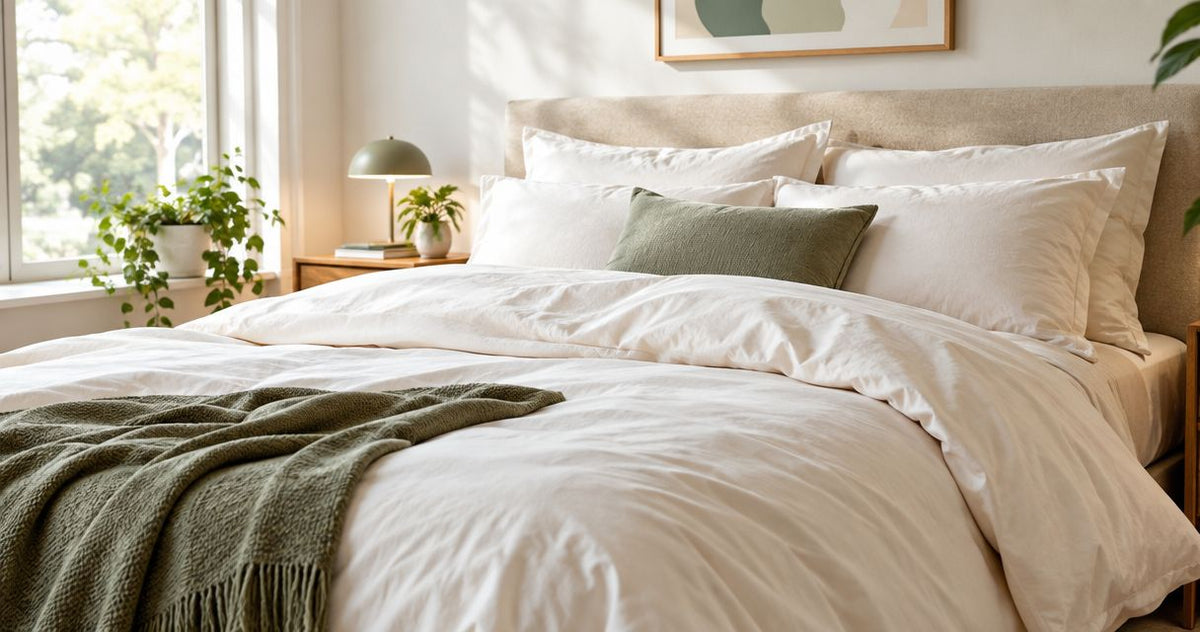
Best overall: certified organic cotton percale bedding sets. Best for a smooth, draped finish: certified organic cotton sateen. Best for cold bedrooms: certified organic cotton flannel. The best organic cotton bedding sets match your preferred fabric feel, mattress dimensions, and care routine—not just a luxury label.
By Editorial Team
For Aeva Vital shoppers, certified organic cotton percale is the default bedding recommendation when a crisp, matte finish is the priority. This 2026 guide ranks fabric constructions rather than unverified products, so you can assess a specific set using its composition, certification, measurements, and included pieces.
- The best organic cotton bedding sets combine documented certification, suitable fabric construction, and correct mattress fit.
- Choose organic cotton percale for a crisp finish; choose sateen for smoother drape.
- Organic cotton jersey suits stretch and softness; brushed flannel suits cold bedrooms.
- Aeva Vital shoppers should check certification scope before treating an organic claim as proof.
Why this matters
Organic describes how the cotton is produced; percale, sateen, jersey, and flannel describe how the fabric is constructed or finished. Those terms answer different questions. An organic claim alone does not tell you whether sheets will feel crisp, stretchy, smooth, or brushed.
Your mattress also affects the result. A fitted sheet that slips off a corner is a poor match regardless of its fiber certification. If nighttime warmth drives your search, consider the whole sleep surface alongside this guide to hybrid mattresses for hot sleepers.
For your 2026 shortlist, separate documented facts from preferences: certification establishes a defined standard, while comfort still depends on your choice of fabric and bedding layers.
What makes the best organic cotton bedding sets?
- Documented organic status: Look for a named standard, certification details, and a clear explanation of which product or material is covered.
- Fabric construction: Choose percale, sateen, jersey, or flannel according to the surface feel you actually want.
- Complete composition: Read the fiber breakdown. Organic cotton in a blend does not make every fiber organic cotton.
- Measured fit: Check sheet dimensions, fitted-pocket capacity, and the combined depth of your mattress and topper.
- Useful set contents: Confirm whether the package includes sheets, pillowcases, a duvet cover, or shams; these are not interchangeable bundles.
- Practical care: Select fabric you can wash and dry according to its instructions without relying on special treatment you will not maintain.
Best organic cotton bedding sets at a glance
The options below are fabric categories, not named store products. Each recommendation assumes the individual set has documented organic status and a suitable fit.
| Ranked option | Best for | Standout characteristic | Key limitation |
|---|---|---|---|
| Certified organic cotton percale | Crisp, matte everyday bedding | Plain weave with a structured hand | Wrinkles and lacks sateen's silky drape |
| Certified organic cotton sateen | Smooth, draped luxury bedding | Satin-type weave with longer surface floats | Surface floats can snag |
| Certified organic cotton jersey | Soft, stretchy casual bedding | Knitted construction | Less tailored appearance; can stretch out of shape |
| Certified organic cotton flannel | Cold bedrooms | Brushed surface that traps insulating air | A poor default when you want a cool, smooth surface |
1. Organic cotton percale: best for crisp everyday bedding
Percale is a plain-woven fabric: yarns cross in a regular over-and-under pattern. In cotton bedding, that construction produces a matte surface and a crisp hand rather than a glossy, fluid finish.
Choose certified organic cotton percale when you want your bedding to feel structured and familiar. It is the strongest default in this ranking because its defining characteristics are straightforward to assess: fiber composition, plain-weave construction, fit, and certification. It is not a promise that every percale set feels identical.
Organic cotton percale pros:
- Crisp surface for people who dislike clingy, draped sheets.
- Matte appearance without a satin-like sheen.
- Woven structure without the stretch of jersey.
- Clear distinction from smoother sateen and brushed flannel.
Organic cotton percale cons:
- Cotton percale wrinkles; a pressed appearance requires additional care.
- Its initial feel can be too crisp for someone seeking immediate softness.
- A percale label does not establish fiber quality or organic certification.
Check whether the set contains the pieces you use nightly. A sheet set and a duvet-cover set serve different purposes, even when both use percale.
Best for: Everyday sleepers who prefer crisp, matte bedding.
Verdict: Buy certified organic cotton percale when crispness is your priority; skip it when you specifically want a silky finish.
2. Organic cotton sateen: best for smooth, draped bedding
Cotton sateen uses a satin-type weave with longer yarn floats on the fabric surface. Those floats create the smooth feel and subtle sheen that distinguish sateen from percale. Sateen is a weave, not a claim that the sheets contain silk.
Choose certified organic cotton sateen for a bed that feels softer and more fluid against the body. Inspect the fiber composition separately: a smooth surface does not prove that the cotton is organic, long-staple, or certified under a particular standard.
Organic cotton sateen pros:
- Smooth surface for sleepers who dislike a crisp hand.
- Fluid drape that suits a less structured bed.
- Subtle sheen for a polished visual finish.
- Cotton composition without requiring silk to achieve a satin-like feel.
Organic cotton sateen cons:
- Longer surface floats create opportunities for snagging.
- The draped feel can be unwelcome if you dislike sheets resting closely against you.
- Sheen and softness do not establish durability or certification.
For a 2026 purchase, avoid treating a high thread count as the deciding feature. Ask what the fabric is made from, how it is woven, and how you must maintain it. Those details explain more than a luxury adjective.
Best for: Sleepers who want smoothness and drape rather than crispness.
Verdict: Buy certified organic cotton sateen for a smooth finish; skip it if you prefer a dry, structured hand.
3. Organic cotton jersey: best for stretch and casual softness
Jersey is knitted rather than woven. Its looped construction gives it stretch and the familiar feel of cotton T-shirt fabric, making it different from both percale and sateen.
Choose certified organic cotton jersey when comfort means softness and flexibility rather than a hotel-style finish. Read the full composition before buying: jersey can contain other fibers, and the construction name does not establish that a particular set is entirely cotton.
Organic cotton jersey pros:
- Stretch accommodates movement in the fabric.
- Familiar knitted texture for people who like T-shirt softness.
- Relaxed appearance that does not depend on crisp folds.
Organic cotton jersey cons:
- Stretch does not replace a correctly sized fitted pocket.
- Knitted fabric can distort if care instructions are ignored.
- The casual appearance does not suit every definition of luxury bedding.
Do not assume a stretchy sheet fits an adjustable bed automatically. The pocket, elastic, mattress depth, and bed movement still determine whether the corners remain secure.
Best for: Sleepers who prioritize flexible, casual softness.
Verdict: Buy certified organic cotton jersey for its knitted feel; skip it if you want a tailored, woven finish.
4. Organic cotton flannel: best for cold bedrooms
Cotton flannel has a brushed surface that raises fibers into a soft nap. That finish traps insulating air, which explains its appeal in a cold bedroom. Flannel describes a fabric finish, not an assurance that the cotton is organic.
Choose certified organic cotton flannel when warmth is the actual goal. It is a distinct seasonal choice, not an automatic upgrade over smoother sheets.
Organic cotton flannel pros:
- Brushed texture for sleepers who like a fuzzy surface.
- Insulating nap suited to cold-room bedding.
- Cotton-based option for a deliberately cozy bed.
Organic cotton flannel cons:
- Extra insulation conflicts with a preference for cooler bedding.
- The raised surface can pill and requires appropriate care.
- Its fuzzy finish lacks the smoothness of sateen and the crispness of percale.
Check whether the care instructions suit your laundry routine. Do not use aggressive washing or drying settings simply because another cotton set tolerated them.
Best for: Cold-bedroom sleepers who want added insulation.
Verdict: Buy certified organic cotton flannel for cold conditions; skip it as your default if overheating is the main complaint.
Organic certification: what the label actually establishes
The Global Organic Textile Standard, or GOTS, covers certified textile processing and includes environmental and social requirements. Its labeling categories distinguish between products labeled organic, which require at least 95% certified organic fibers, and products made with organic materials, which require at least 70%.
Those thresholds are not interchangeable. For a 2026 comparison, read the actual label category rather than treating every reference to GOTS as an identical composition claim.
The Organic Content Standard, or OCS, focuses on verifying organic material content and its chain of custody. It does not carry the same processing requirements as GOTS. OEKO-TEX STANDARD 100 concerns testing for harmful substances; that label alone does not establish organic cotton content.
Use certification for the question it answers. Organic-content documentation does not prove a specific softness level, cooling performance, or medical benefit. Likewise, a harmful-substance testing label is not a substitute for organic certification.
Fit: measure the bed, not just the size label
Standard US mattress dimensions provide a starting point. Bedding manufacturers still need to state their own finished sheet dimensions and fitted-pocket capacity.
| US mattress size | Standard width | Standard length | Fit issue to check |
|---|---|---|---|
| Full | 54 inches | 75 inches | Do not substitute queen sizing without checking dimensions |
| Queen | 60 inches | 80 inches | Include topper depth when assessing the fitted pocket |
| King | 76 inches | 80 inches | Confirm pillowcase size separately |
| California king | 72 inches | 84 inches | Longer and narrower than a standard king |
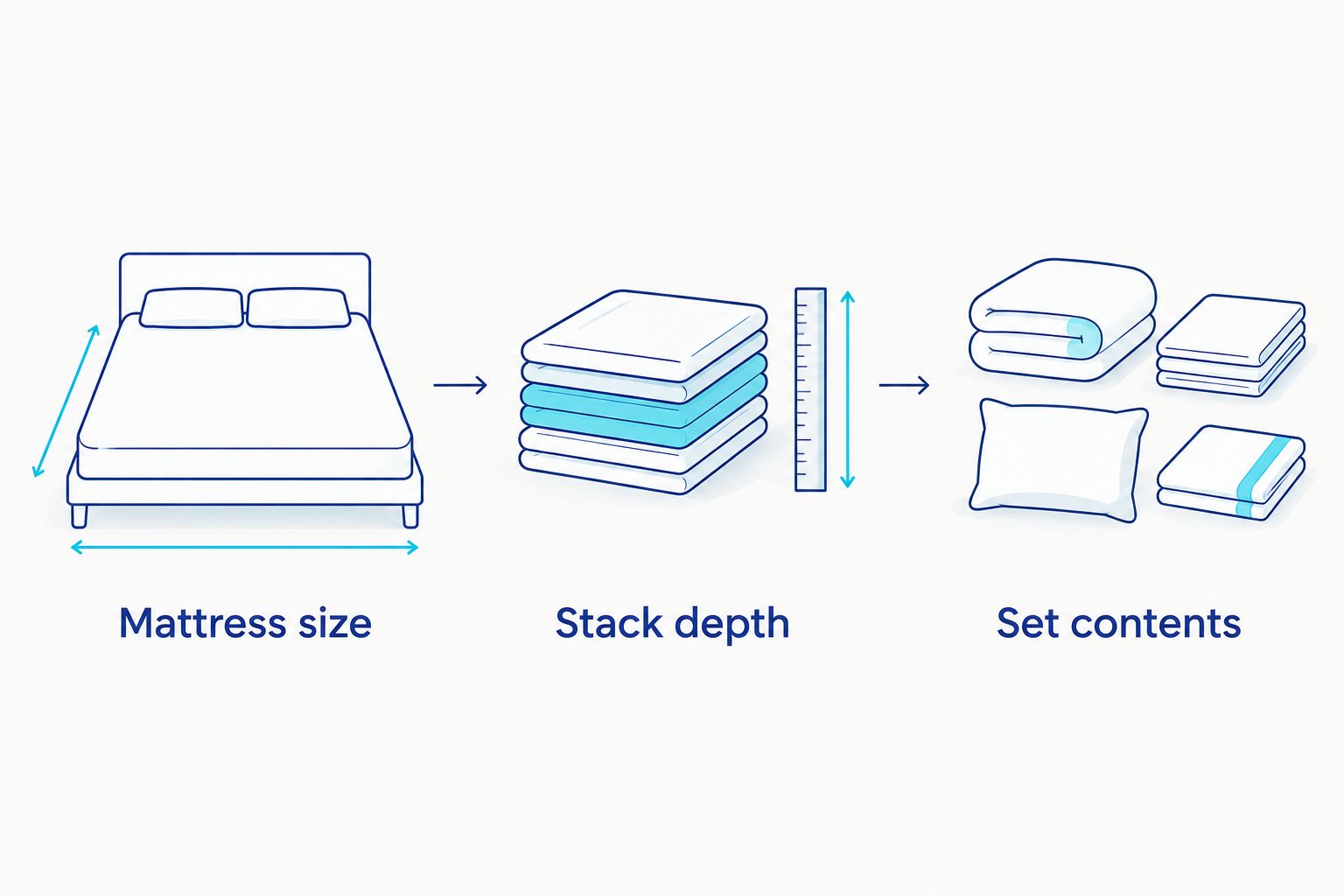
Measure the entire stack the fitted sheet must cover. A mattress protector and topper can change the required pocket depth, while a king label does not make a sheet suitable for a California king.
Aeva Vital bedding shoppers should use three checks before choosing a set: Mattress size, Stack depth, and Set contents. The first determines width and length; the second determines pocket requirements; the third prevents buying an incomplete bundle for your routine.
Construction and care: what luxury does not prove
Thread count describes yarns counted along the length and width of woven fabric, typically within one square inch. It does not measure organic status, and it does not describe knitted jersey in the same way. Comparing every fabric by thread count creates a false equivalence.
Long-staple cotton refers to fiber length, not cultivation method. Egyptian cotton is an origin claim, while organic refers to production standards. None of these terms replaces checking the others.
For your 2026 selection, prioritize specifications you can act on:
- Confirm the fiber composition and certification scope.
- Match the fabric construction to your preferred feel.
- Check whether laundering instructions permit your usual machine settings.
- Confirm duvet-cover dimensions against your actual insert.
- Read whether pillowcases, shams, and a flat sheet are included.
Follow the supplied care label rather than a universal bedding recipe. Organic cotton is not exempt from shrinkage, wrinkles, or wear, and certification does not establish a product's lifespan.
Applying this guide to Aeva Vital bedding
Aeva Vital specializes in premium bedding and home wellness products, including hybrid mattresses. Use this guide as a specification checklist when assessing bedding for that sleep setup; brand positioning does not establish a particular sheet's organic status.
A product-specific recommendation needs a named set, documented composition, certification scope, dimensions, and care instructions. Without those details, choosing a fabric category is more defensible than declaring an individual set the winner.
For Aeva Vital organic cotton bedding comparisons, keep certification and comfort separate. First establish what the product is; then decide whether its weave or knit suits you.
How these options are ranked
This ranking assigns each fabric a distinct use case based on construction: percale for crispness, sateen for smooth drape, jersey for stretch, and flannel for insulation. Certification, fit, contents, and care remain requirements for every option.
The order is a selection framework, not a claim of laboratory testing or measured product performance. Percale takes the default slot because this guide prioritizes a crisp everyday surface; your preferred feel can make another category the better choice.
Which organic cotton bedding should you choose?
Choose certified organic cotton percale if you are undecided and want crisp, matte sheets. Choose sateen for smoother drape, jersey for stretch, or flannel specifically for a cold bedroom.
Before completing a 2026 purchase, verify the exact set rather than relying on the category name. The best choice is the one whose certification, fit, contents, and care requirements match your bed and routine.
FAQ
What's the best organic cotton bedding set for everyday use?
Certified organic cotton percale is the default recommendation for everyday sleepers who prefer crisp, matte sheets. Choose sateen instead if smoothness and drape matter more, and verify the individual set's certification and fit.
Is organic cotton percale better than organic cotton sateen?
Organic cotton percale is better for crispness; organic cotton sateen is better for smooth drape. The fabric construction determines that distinction, while organic certification addresses a separate question.
Does GOTS certification mean the bedding is entirely organic cotton?
GOTS certification does not automatically mean a product is entirely organic cotton. The organic labeling category requires at least 95% certified organic fibers, while the made-with-organic category requires at least 70%; read the actual fiber composition too.
Does OEKO-TEX STANDARD 100 prove cotton sheets are organic?
No, OEKO-TEX STANDARD 100 alone does not prove cotton sheets are organic. It addresses testing for harmful substances, so organic status needs separate documentation.
What thread count should I choose for organic cotton sheets?
Do not choose organic cotton sheets by thread count alone. Compare fabric construction, fiber composition, certification, fit, and care instructions; thread count does not measure organic status.
Will king sheets fit a California king mattress?
Do not assume king sheets fit a California king mattress. A standard US king measures 76 by 80 inches, while a California king measures 72 by 84 inches; check the sheet's stated dimensions.
Do organic cotton bedding sets include a duvet cover?
A bedding set does not necessarily include a duvet cover. Read the itemized contents because sheet sets, duvet-cover sets, and larger bundles contain different pieces.
Are organic cotton sheets guaranteed to keep me cool?
Organic cotton certification does not guarantee cooling performance. Fabric construction, bedding layers, the mattress, and room conditions all affect how the bed feels.
Related guides
- Hybrid mattresses for couples
- 12 vs 13 vs 14 inch mattress thickness guide
- Book holder stands for reading in bed
One last thing
A deep-pocket label is not a measurement. Measure your mattress with its topper and protector installed, then compare that depth with the fitted sheet's stated capacity. Correct fit is the specification you notice every time you make the bed.