
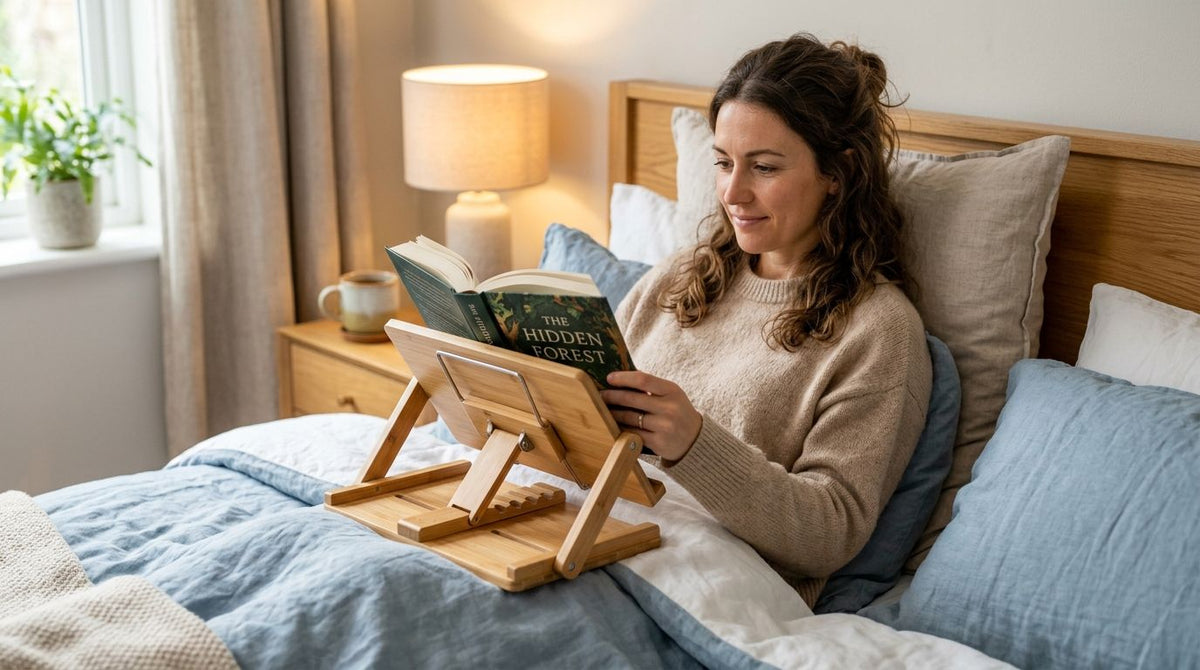
A book holder stand for reading in bed keeps pages open at eye level so you're not craning your neck or gripping a paperback for two hours straight. This guide ranks the five stand types that actually solve that problem in 2026, tells you which one fits your setup, and flags the compromises each one makes.
- Freestanding floor book holder stands are the best book holder stand for reading in bed overall in 2026 — no clamping, no lap weight.
- Clamp-style bed rail holders free both hands but only fit certain headboard and frame shapes.
- Pillow-arm lap stands cost the least and need zero assembly, but they sag under hardcovers over time.
- Adjustable multi-device stands double as tablet holders, useful if you read on a Kindle or phone too.
- Rolling overbed tables win for semi-reclined or propped-up reading on an adjustable bed base.
Why this matters
Most people reading in bed in 2026 are holding a book with one hand, propping it against a knee, or letting it flop open and lose the page. That's a comfort problem and a repetition-strain problem if it happens nightly. A book holder stand fixes the mechanics: it holds the page open, sets the reading angle, and frees your hands for tea, a phone, or nothing at all.
The right stand depends on your bed setup more than your reading habit. Someone on a flat platform bed needs different support than someone using an adjustable bed base that already raises the head section. That's the split this ranking is built around.
Best overall: freestanding floor book holder stand. Best for hands-free reading: clamp-style bed rail holder. Best budget option: pillow-arm lap stand. Best for tablets and e-readers: adjustable multi-device stand. Best for propped-up reading: rolling overbed table with book tray.
What makes the best book holder stand for reading in bed
- Stability at the reading angle — the stand shouldn't wobble or tip when you turn a page
- Height and angle adjustability — the reading surface needs to reach eye level when you're propped on pillows
- Page-holding mechanism — clips, magnetic strips, or weighted arms that keep hardcovers and paperbacks open without damaging the spine
- Footprint and floor clearance — how much floor space or bed-frame width it needs to sit or clamp
- Weight capacity — thick hardcovers and textbooks need a sturdier arm than a mass-market paperback
- Compatibility with tablets or e-readers — a growing number of readers switch between a physical book and a Kindle or phone mid-session
At a glance
| Stand type | Best for | Standout feature | Key limitation |
|---|---|---|---|
| Freestanding floor stand | Overall use | Rolls beside any bed, no clamping | Takes up floor space next to the nightstand |
| Clamp-style bed rail holder | Hands-free reading | Mounts directly to the frame or headboard | Only fits certain frame widths and headboard shapes |
| Pillow-arm lap stand | Budget reading | Zero assembly, works on any surface | Sags under heavy hardcovers over long sessions |
| Adjustable multi-device stand | Tablets and e-readers | Holds phone, tablet, or book interchangeably | Smaller reading surface than a full floor stand |
| Rolling overbed table with tray | Propped-up or reclined reading | Doubles as a surface for tea, glasses, remote | Bulkier than a dedicated book stand |
1. Freestanding floor book holder stand: best book holder stand for reading in bed overall
A freestanding floor stand is a weighted base on a pole with an adjustable arm that holds the book open at whatever height and angle you set. It rolls or slides next to the bed, doesn't touch the mattress or frame, and works whether you're on a platform bed or an adjustable base.
Freestanding floor stand pros:
- Works with any bed frame, headboard, or mattress setup
- Adjusts through a full range of heights, so it fits sitting up, lying flat, or semi-reclined
- No clamping means no risk of scratching a wood or upholstered headboard
Freestanding floor stand cons:
- Needs floor space beside the nightstand
- The base has to be heavy enough to counterbalance the arm, which adds bulk
Best for: anyone who wants one stand that works no matter how they're propped up. Verdict: Buy.
2. Clamp-style bed rail book holder: best book holder stand for hands-free reading
This type clamps onto a bed frame, rail, or headboard and extends a hinged arm over the mattress. Because it's anchored to the frame instead of the floor, it stays in exactly the same position every night once it's set.
Clamp-style holder pros:
- Genuinely hands-free once the book is loaded into the clip
- No floor footprint at all
- Stays in position night after night without resetting
Clamp-style holder cons:
- Only fits frames or headboards within a certain thickness range — a thick upholstered headboard like Aeva Vital's tufted platform bed may not accept every clamp design
- Installing and removing it disturbs the bedding
Best for: readers who want to let go of the book entirely and don't want anything on the floor. Verdict: Buy, but measure your frame or headboard thickness first.
3. Pillow-arm lap book stand: best budget book holder stand for reading in bed
This is a foam or fabric wedge with a shallow tray or arm on top that holds a book at a slight angle across your lap. It needs no setup, no clamping, and no floor space — you just set it on the mattress or your lap.
Pillow-arm stand pros:
- Lowest cost of the five types and the simplest to use
- No assembly, no adjustment, works the moment you unbox it
- Doubles as an actual lap support cushion when you're not reading
Pillow-arm stand cons:
- Sags under hardcovers and heavier books over a long reading session
- Fixed angle means no fine-tuning for how you're propped
Best for: paperback readers on a tight budget who don't need adjustability. Verdict: Buy for light reading, Skip for hardcovers.
4. Adjustable multi-device stand: best book holder stand for tablets and e-readers in bed
This stand uses a folding, articulating arm designed to hold phones and tablets as well as physical books, usually with a wider clip or cradle than a book-only stand. If you switch between a paperback and a Kindle or iPad mid-week, this is the type built for that.
Multi-device stand pros:
- Handles books, tablets, and phones with the same mount
- Folds flatter than a floor stand for storage or travel
- Useful if your reading habit is split between formats
Multi-device stand cons:
- Reading surface is smaller than a dedicated floor stand, so oversized hardcovers can overhang the cradle
- Lighter overall build means less stability for thick books
Best for: readers who alternate between physical books and a tablet or phone. Verdict: Buy if you read on multiple devices.
5. Rolling overbed table with book tray: best book holder stand for propped-up reading
An overbed table rolls under the bed frame or adjustable base and provides a full tabletop surface, often with a raised lip or removable tray insert that holds a book open. It's the only option on this list that also gives you space for a mug, glasses, or a phone.
Overbed table pros:
- Rolls under most bed frames, including adjustable bed bases raised to a reading angle
- Doubles as a surface for anything else you want within reach
- Sturdy tabletop handles heavy textbooks without sagging
Overbed table cons:
- Larger and bulkier than a dedicated stand, harder to store when not in use
- Rolling base needs floor clearance under the bed frame to slide in
Best for: readers who prop up on an adjustable base and want a surface, not just a book clip. Verdict: Buy if you already use an adjustable base.
How we ranked
Each type was scored against the six criteria above: stability, adjustability, page-holding mechanism, footprint, weight capacity, and device compatibility. The freestanding floor stand won overall because it's the only type that scores well on all six without a compatibility caveat — the clamp-style holder loses points on footprint only because it depends on frame thickness.


Which book holder stand should you choose?
If you're not sure which of the five fits your bed, default to the freestanding floor stand — it works regardless of frame, headboard, or mattress size, including standard queen (60 by 80 inches) and king (76 by 80 inches) setups. Switch to a clamp-style holder only if your frame is thin enough to accept the clip, and reach for the pillow-arm stand only for paperbacks under roughly a pound and a half, since heavier hardcovers sag the foam arm over repeated use.
“If you have to hold the stand steady with one hand, it isn't a hands-free reading solution.”
Mattress firmness changes this calculus too. On a softer mattress you sink deeper and need a taller stand to hit eye level; on a firmer profile from a guide like hybrid mattresses ranked by firmness level, you sit higher and a shorter stand works fine. If you're propping yourself up nightly and your back complains by page fifty, it's worth checking recliners for back pain as an alternative reading position entirely.
FAQ
What's the best book holder stand for reading in bed?
The freestanding floor book holder stand is the best overall choice for reading in bed in 2026 because it works with any bed frame or mattress and adjusts to any reading angle. Clamp-style and pillow-arm stands are better picks for specific setups, not general use.
Is a floor-standing book holder better than a clamp-style one?
A floor stand works with every bed setup, while a clamp-style holder only fits frames and headboards within its clamp range. Choose the clamp style only after confirming it fits your specific frame thickness.
How much weight can a book holder stand hold?
Weight capacity varies by stand type — floor stands and overbed tables handle heavy hardcovers and textbooks better than pillow-arm stands, which sag under sustained weight. Check the arm or tray material before assuming it can hold a large hardcover.
Can a book holder stand hold a tablet or e-reader too?
Yes, the adjustable multi-device stand category is built specifically to switch between phones, tablets, and physical books using a wider cradle or clip. Dedicated book-only stands may not fit a tablet's shape as securely.
Do I need a book holder stand if I have an adjustable bed?
An adjustable bed base raises your torso to a reading angle but doesn't hold the book itself, so a stand still solves the hands-free problem. A rolling overbed table pairs especially well with an adjustable base already raised for reading.
What's the cheapest way to hold a book while reading in bed?
A pillow-arm lap stand is the lowest-cost option since it needs no assembly and works straight out of the box. It's best suited to paperbacks rather than heavy hardcovers, which cause the foam arm to sag over time.
Are pillow-arm book stands comfortable for long reading sessions?
They're comfortable for shorter sessions with lighter books, but the fixed angle and foam support can't be fine-tuned the way a floor stand's arm can. Readers doing an hour or more nightly tend to prefer an adjustable stand instead.
Does a book holder stand work with a headboard?
Clamp-style holders can mount to some headboards, but only within a specific thickness range, so a thick upholstered headboard may not accept every clamp design. A freestanding floor stand sidesteps this issue entirely since it doesn't attach to the headboard at all.
One last thing
The detail that matters more than any spec sheet is arm height relative to your propped-up eye line, not the stand's default setting out of the box. Set the stand while you're already sitting against your pillows the way you actually read, not standing beside the bed — most people set it too low and end up hunching within twenty minutes anyway.