
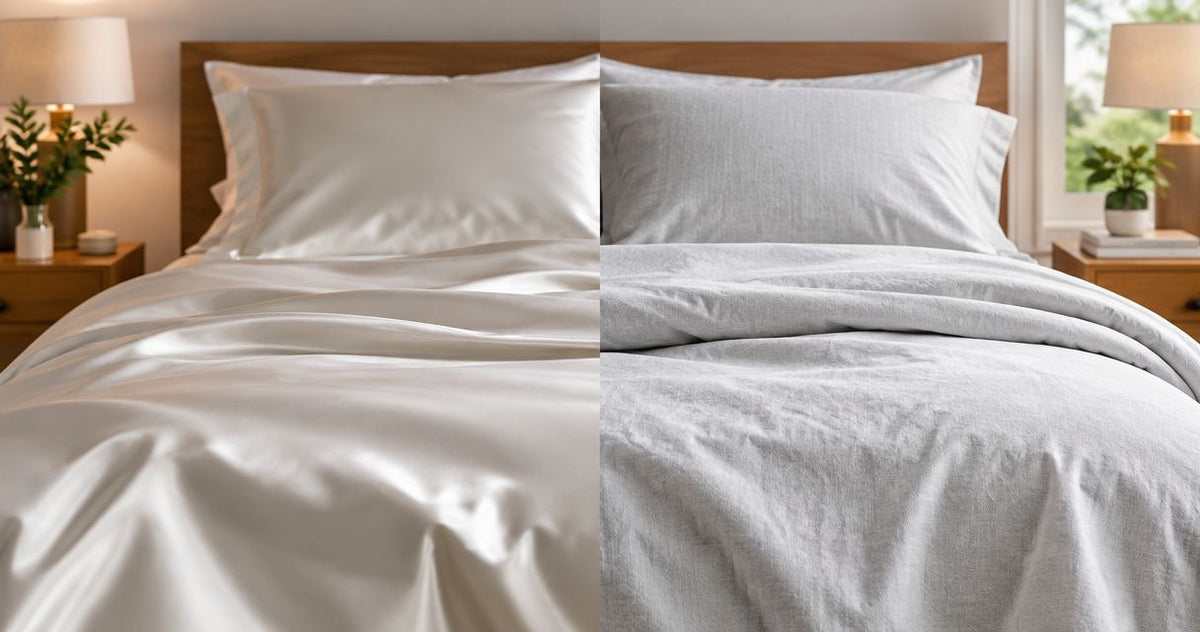
Percale is better for luxury bedding if you want a crisp, matte sheet with a lighter feel; sateen is better if you want a smoother surface, subtle sheen, and closer drape. Neither weave guarantees quality or cool sleep: fiber, yarn, fabric weight, finishing, and the rest of your bedding also matter. This 2026 comparison explains which trade-offs deserve your attention before you choose.
By Editorial Team
- For Aeva Vital luxury bedding readers, percale wins for crispness; sateen wins for a smooth drape.
- Choose sateen vs percale for luxury bedding by texture and sleeping temperature, not thread count alone.
- Cotton percale generally feels airier; cotton sateen generally feels denser when other construction details are comparable.
- Check fiber content, fitted-sheet dimensions, and care instructions before choosing either weave.
Is sateen or percale better for luxury bedding in 2026?
Choose percale for crispness and sateen for smoothness. Compare sheets made from similar fibers before judging the weave; a cotton blend and an all-cotton fabric introduce differences beyond construction.
| Decision factor | Cotton percale | Cotton sateen |
|---|---|---|
| Best for | Sleepers who prefer crisp, less-clingy bedding | Sleepers who prefer smooth, draping bedding |
| Surface | Matte, with a balanced woven texture | Subtle sheen, with more exposed yarn on the face |
| Initial feel | Crisp rather than slippery | Smooth rather than crisp |
| Warmth tendency | Generally airier at comparable fabric quality | Generally denser at comparable fabric quality |
| Appearance | Tailored, with visible creasing | Draped, with light reflecting from the surface |
| Main limitation | Wrinkles readily; crispness does not suit everyone | Longer surface floats create snagging exposure |
| Selection rule | Choose for texture and airflow preference | Choose for smoothness and drape preference |
If overheating drives your decision, start with the criteria in this guide to luxury sheet sets for hot sleepers. A weave name is a starting filter, not a measured cooling result.
Why this matters
Luxury bedding touches your skin throughout the night. A glossy finish that looks appealing in a photograph does not tell you whether the fabric will feel comfortable when you turn over or pull the sheet closer.
The useful question in 2026 is not which weave sounds more expensive. It is which construction delivers the texture you want without creating a care routine you dislike. Treat luxury as a match between fabric, use, and maintenance—not as a synonym for sheen.
Percale: best for a crisp, matte feel
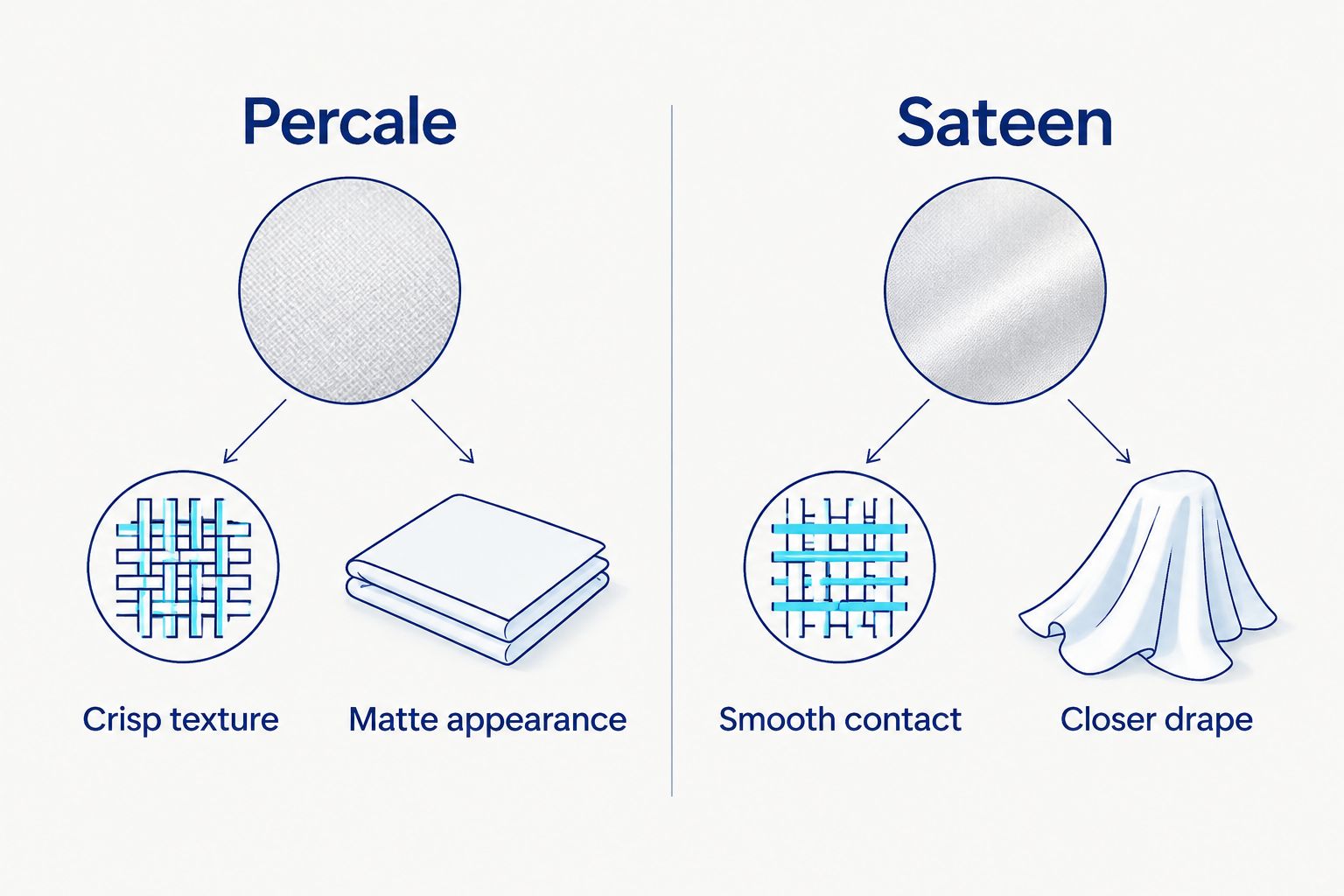
Percale uses a plain weave: each weft yarn passes over 1 warp yarn and under 1 warp yarn, alternating across the fabric. Warp yarns run lengthwise; weft yarns run across them. This regular interlacing produces the balanced surface associated with crisp cotton sheets.
Percale's appeal is its dry, fresh texture rather than a silky finish. It generally rests less closely against the body than a draping sateen fabric, although fabric weight and finishing affect that behavior.
What percale does well
- Crisp texture: Choose percale when you want bedding that feels structured rather than fluid.
- Matte appearance: Choose percale when reflected shine is not part of your preferred bedroom finish.
- Lighter sensation: Cotton percale generally suits people who dislike dense, enveloping sheets.
Where percale falls short
Cotton percale wrinkles, and its crisp hand can feel too papery to someone expecting immediate silkiness. Washing changes fabric feel, but it does not turn a plain weave into sateen.
Recommendation: choose percale if crispness is the feature you want, not a drawback you hope will disappear. Check the actual fabric rather than assuming every percale set feels identical.
Sateen: best for a smooth, draping feel
Sateen uses a weave with longer yarn floats: sections of yarn travel across several crossing yarns before interlacing. One common construction passes over 4 yarns and under 1 yarn. These longer exposed sections create a smoother-looking face and reflect light differently from plain weave.
Sateen is a weave, not a fiber. Cotton sateen remains cotton; its sheen does not make it silk. The word also does not establish fiber length, fabric weight, or manufacturing quality.
What sateen does well
- Smooth contact: Choose sateen when you prefer a less-crisp surface against your skin.
- Closer drape: Choose sateen when you like fabric that follows the contours of the bed and body.
- Subtle sheen: Choose sateen when surface luster is part of the appearance you want.
Where sateen falls short
Longer floats leave more yarn exposed at the surface, creating opportunities for snagging. Cotton sateen also generally feels denser than comparable percale, which is a disadvantage if you already dislike warm, closely draping bedding.
Recommendation: choose sateen for smoothness, but do not mistake its sheen for proof of better durability or temperature control.
Why sateen and percale feel different
The weave explains part of the difference. These factors explain why sheets sharing the same weave name still feel different:
- Fiber content: Compare cotton with cotton before attributing every difference to weave. Blends introduce other material characteristics.
- Fiber length: Longer cotton fibers allow yarn construction with fewer protruding fiber ends, but the weave label does not verify fiber length.
- Yarn construction: Yarn thickness, twist, and ply affect texture and fabric density.
- Fabric weight: A heavier sheet behaves differently from a lighter sheet, even when both use the same weave.
- Finishing: Mechanical and chemical treatments affect initial softness, smoothness, and wrinkle behavior.
- Bedding layers: A protector, blanket, and duvet change the overall sleep environment; sheets do not work in isolation.
For your 2026 shortlist, compare complete specifications rather than collecting weave names. If two sets disclose different levels of detail, do not treat their marketing descriptions as equivalent evidence.
Does higher thread count make sateen better than percale?
No. Thread count does not make one weave categorically better than the other. Thread count describes the number of lengthwise and crosswise threads within 1 square inch of fabric; it does not directly measure softness, breathability, or service life.
Sateen construction often accommodates higher thread counts than percale construction. Comparing their labels as though a larger number automatically wins overlooks the different fabric structures.
Ask what accompanies the count. Fiber content, yarn construction, dimensions, care instructions, and fabric weight provide context that a single figure cannot supply.
Avoid choosing an arbitrary thread-count target before deciding on texture. A dense sheet that feels wrong for your sleeping preference does not become a good purchase because its label shows a bigger number.
Is percale cooler than sateen for hot sleepers?
Cotton percale generally feels airier than comparable cotton sateen, making percale the better starting point for hot sleepers. This is a construction-based preference, not a promise that every percale sheet will sleep cooler than every sateen sheet.
Distinguish cool touch from comfort throughout the night. A smooth surface can feel pleasant when you first get into bed without proving how the whole bed handles heat and moisture later.
In 2026, evaluate cooling claims against the conditions described. A claim without a named test, comparison, or clear scope should not outweigh known fiber content and your own texture preference.
Is sateen more luxurious than percale?
Sateen looks more lustrous; it is not inherently more luxurious. Percale delivers a different finish: matte, crisp, and structured. Both weaves can be made from well-prepared cotton yarns, and both can be made poorly.
Separate appearance from construction quality. Even stitching, accurate sizing, clear material disclosure, and suitable care requirements deserve attention regardless of surface shine.
Aeva Vital's luxury bedding recommendation is to choose the feel you want to keep, not the finish that looks most expensive in a product photograph. A crisp sheet is not unfinished sateen, and a smooth sheet is not automatically a quality upgrade.
How to choose between sateen and percale
Use this sequence to narrow the decision without turning it into a thread-count contest:
- Name your preferred texture. Choose crisp and matte or smooth and draping. If you dislike a fabric sample immediately, do not rely on vague promises about break-in.
- Check your warmest bedding layer. Review the duvet, blanket, and protector before expecting a sheet replacement to solve overheating.
- Compare equivalent materials. Keep fiber content similar so the weave comparison remains useful.
- Measure the fitted-sheet requirements. Check mattress width, length, and total depth, including any topper beneath the sheet.
- Read the care label. Confirm that the washing, drying, and ironing requirements fit your routine.
- Check purchase terms. Read the seller's current conditions before washing or using bedding; do not assume opened textiles qualify for return.
A sample swatch helps you judge surface texture, but it cannot reproduce a full night under your usual bedding. Use it to reject an unwanted feel, not to certify thermal performance.
Check mattress fit separately from weave
Percale and sateen do not solve fitted-sheet sizing problems. A sheet that pulls off the corners needs a fit check, not a different weave label.
Aeva Vital's SpineAlign 12" Queen Firm Cooling Hybrid Mattress provides a concrete example: the stated 12-inch mattress thickness is relevant to pocket-depth selection. It does not establish the required sheet dimensions by itself, particularly if you add a topper.
Measure the complete surface you intend to cover and compare it with the sheet maker's sizing instructions. Neither the mattress's cooling designation nor the sheet's weave proves how the combined bed will feel to you.
Care requirements belong in the comparison
Follow the specific care label rather than a universal luxury-sheet recipe. Fiber blends, dyes, decorative details, and finishes can require different treatment even within the same weave category.
Wash bedding before first use according to its instructions. Avoid overdrying, use only permitted laundry products, and keep snagging hardware away from delicate fabric surfaces.
Percale's creases are an appearance consideration, not evidence of poor quality. Sateen's smoothness does not make it wrinkle-free or immune to wear. Choose the maintenance trade-off you accept rather than expecting either fabric to eliminate laundry decisions.
Related guides
- How to keep luxury sheets soft after washing
- How to choose the right sheet size for a pillow-top mattress
- Is a higher thread count always better for luxury sheets?
FAQ
What's better for luxury bedding, sateen or percale?
Percale is better for a crisp, matte feel; sateen is better for a smooth surface and closer drape. Neither weave alone establishes fabric quality.
Is percale better if I sleep hot?
Cotton percale is generally the better starting point if you sleep hot and prefer an airier sheet. Compare similar fibers and fabric weights, and review your duvet and mattress protector too.
Does sateen mean the sheets are made from silk?
Sateen describes a weave, not silk content. Read the fiber label to identify the material used in a sateen sheet.
Will percale sheets stop feeling crisp after washing?
Percale can soften with laundering while retaining its characteristic plain-weave texture. Washing does not give percale the surface structure of sateen.
Do sateen sheets snag more easily?
Sateen's longer surface floats create more exposure to snagging than plain-weave construction. Actual wear also depends on yarn quality, handling, and care.
Should I buy whichever sheet has the highest thread count?
No, the highest thread count does not automatically identify the best sheet. Compare fiber, yarn construction, fabric weight, feel, and sizing alongside the stated count.
Can I use either weave on a hybrid mattress?
Either weave can be used on a hybrid mattress when the sheet dimensions and pocket depth fit. Include any topper when measuring the surface the fitted sheet must cover.
Is sateen always warmer than percale?
No, sateen is not always warmer than percale. Comparable cotton sateen generally feels denser, but fiber, fabric weight, finishing, and other bedding layers affect the result.
One last thing
For a 2026 bedding purchase, make texture the first decision and specifications the second. Choose percale if you want crispness; choose sateen if you want smoothness. Then verify fiber content, fitted-sheet measurements, and care instructions—the details that determine whether your preferred weave works on your actual bed.