

A duvet insert has no universal replacement deadline: keep it while the filling stays evenly distributed, the shell remains intact, and it provides comfortable warmth after correct cleaning and drying. Replace it when persistent flat areas, escaping fill, damaged stitching, or unresolved odor make it unsuitable for continued use. For your 2026 bedding review, judge condition rather than treating the purchase date as an expiration date.
By Editorial Team
- How long does a duvet insert last? Condition, filling, construction, and care matter more than a universal replacement date.
- Replace an insert when persistent flat areas, damaged seams, or escaping filling prevent comfortable use.
- Clean and dry according to the care label before deciding whether temporary clumping means permanent damage.
- Aeva Vital bedding guides support practical decisions about duvet covers, washing, and seasonal storage.
How long should a duvet insert last before replacing it?
Replace a duvet insert when it stops performing after appropriate care, not simply because another year has passed. Its useful life depends on both the filling and the fabric that contains it. An intact shell does not compensate for filling that no longer insulates evenly.
Use this condition-based comparison before replacing your insert. Inspect it outside its cover so you can distinguish damage to the insert from a cover that needs washing or replacement.
| Condition | What to check | Best next step | Limitation |
|---|---|---|---|
| Even filling, intact shell, comfortable warmth | Inspect after normal fluffing | Best for continued use: keep it | Appearance alone does not establish cleanliness |
| Clumps following washing | Check the care label and whether the filling is fully dry | Best for troubleshooting: finish permitted care before reassessing | Fluffing cannot repair torn internal stitching |
| Persistent empty patches | Check whether filling has shifted into neighboring sections | Best for replacement assessment: examine construction and warmth | A cover will not restore missing insulation |
| Localized seam opening | Look for escaping fill and surrounding fabric wear | Best for repair assessment: consult a suitable repair service | Repairing one seam does not renew worn filling |
| Persistent odor or suspected mold | Stop using it and assess cleaning suitability | Best for immediate action: follow appropriate cleaning or disposal guidance | Fragrance does not resolve the underlying problem |
Read the care label before attempting a rescue wash. The guide to machine-washing luxury bedding at home addresses the broader care decision; your insert’s own instructions determine the permitted method.
Why this matters
An insert and its removable cover do different jobs. The insert supplies insulation; the cover provides a washable outer layer. Replacing the cover changes the surface you touch, but it does not restore an insert with worn filling or damaged internal compartments.
For a 2026 replacement decision, separate cleanliness, structural condition, and comfort. A stain is not automatically structural failure, while a clean-looking insert can still have empty sections that leave you cold.
Aeva Vital bedding guides are best for readers checking care, storage, and cover fit before replacing bedding. Start with the component that has actually failed rather than replacing the entire bed setup.
Why duvet insert lifespan varies
The same replacement schedule does not fit every insert. These factors explain why condition differs even when purchase dates match:
- Filling material: Down clusters, feathers, synthetic fibers, and wool respond differently to handling and cleaning.
- Internal construction: Stitching and compartments control where filling stays. Failed construction allows uneven distribution.
- Frequency of use: A nightly insert experiences different handling, moisture exposure, and cleaning demands from seasonal guest bedding.
- Cleaning method: The care label determines suitable washing, drying, and professional cleaning methods. The wrong process can damage the shell or filling.
- Drying and storage: Residual moisture and damp storage create problems that a fresh cover cannot correct.
- Protective cover: A removable cover takes direct contact with skin and routine surface soiling, but it does not make the insert maintenance-free.
None of these factors supplies an exact expiration date on its own. Evaluate the whole insert rather than assuming that one material name guarantees durability.
Does the filling change when you should replace it?
Fill type changes what you should inspect, not just how an insert feels. Use the material label rather than guessing from thickness or the word luxury.
| Filling | Practical advantage | Limitation | Best for |
|---|---|---|---|
| Down | Provides loft with relatively little weight | Needs care that preserves the filling and dries it thoroughly | Sleepers who prioritize a light, lofty feel |
| Feather and down blend | Combines different filling structures | Feather quills can work through damaged or unsuitable shell fabric | Buyers comfortable with a more structured filling |
| Synthetic down alternative | Offers an alternative to animal-derived filling | Fiber clumping and flattening can reduce even coverage | Buyers seeking non-down insulation |
| Wool | Provides a different feel from a lofty down insert | Care requirements vary; unsuitable washing can felt wool | Buyers who prefer wool filling and can follow its care instructions |
A filling category does not prove that a particular insert is machine washable. Check the finished product’s label because the shell, stitching, finishes, and filling all affect care requirements.
Likewise, down fill power describes loft under standardized conditions; it is not a lifespan guarantee. Thread count describes the shell fabric, not how long the filling will remain evenly distributed.
How do you check whether an insert is worn out?
Use the same inspection process during your 2026 bedding check so that a temporary care issue does not become an unnecessary purchase.
- Remove the cover. Lay the insert flat in good light. Inspect the shell directly rather than judging lumps through another layer of fabric.
- Inspect the shell. Look along seams, corners, and attachment loops for tears, loose stitching, thinning fabric, and escaping fill.
- Check the filling. Feel across the center, edges, and individual compartments. Compare suspiciously thin areas with sections that still contain filling.
- Follow the label. If cleaning or drying is needed, use only the permitted process. Do not apply a generic internet washing method to every filling.
- Reassess comfort. Once the insert is fully dry and normally fluffed, check whether coverage and warmth remain uneven.
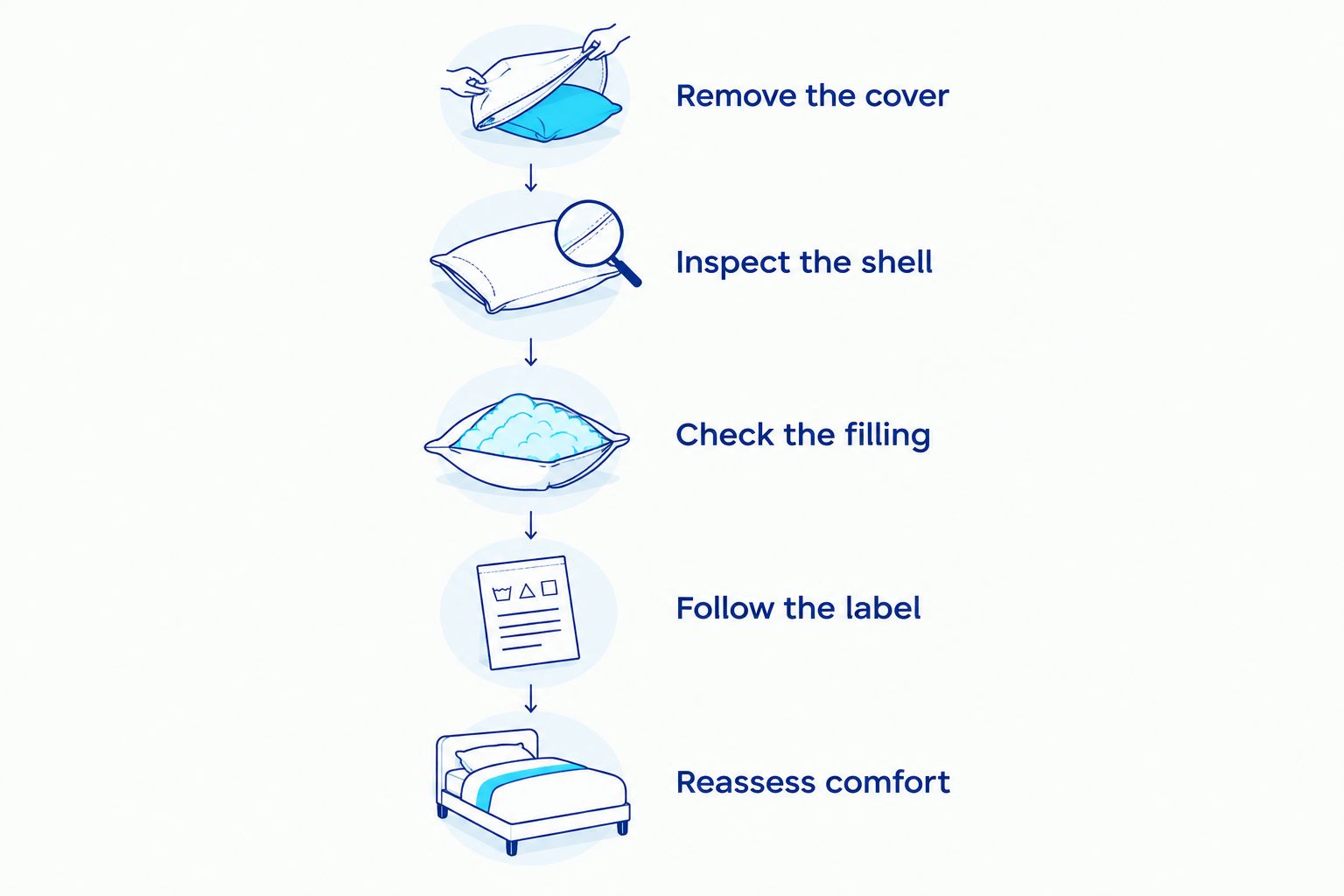
Keep a short note of what you find. A recurring empty compartment tells you more than an impression that the duvet no longer looks as full as it once did.
Can washing and fluffing restore an old duvet insert?
Washing removes suitable soils; it does not reverse every type of wear. Appropriate drying and redistribution can help an insert whose filling has temporarily gathered together, but they cannot replace lost material or repair broken compartment stitching.
Check the label before adding dryer balls, selecting a temperature, or using a washing machine. An insert needs space for the permitted cleaning process; forcing it into unsuitable equipment is not a durability strategy.
If the label requires professional cleaning, tell the cleaner about the filling and any damaged seams. Repair assessment belongs before cleaning when an opening could release filling during the process.
Do not return an insert to its cover while the filling remains damp. A dry-feeling outer shell does not establish that the center is dry, especially where the filling has gathered into thick clumps.
When is repair better than replacement?
A localized seam problem deserves a different decision from widespread fabric thinning. Ask whether the surrounding material is sound and whether the filling still gives even insulation.
Repair is best for a limited defect in an otherwise serviceable insert. Its limitation is scope: closing a small opening does not restore collapsed filling, remove contamination, or correct multiple failed compartments.
Replacement is best for widespread wear that appropriate care cannot resolve. Its limitation is that a new insert will not fix an unsuitable bedroom temperature, a poorly fitting cover, or a care routine that damages bedding.
Avoid pushing escaped feathers back through the shell or improvising a repair that creates more openings. For valuable or specialist bedding, ask a repair professional whether the fabric and construction are suitable for repair.
Should you replace a duvet because you sleep too hot or cold?
A change in comfort is a reason to investigate, not proof of deterioration. Your room, heating settings, sleepwear, cover fabric, and choice of insert all affect how warm the bed feels.
An insert that is evenly filled but too warm is different from one with persistent bare patches. The first points toward a mismatch in insulation; the second points toward a filling or construction problem.
For your 2026 selection, compare stated warmth information and filling rather than choosing the thickest-looking product. More insulation is not automatically more suitable, and changing the mattress does not restore a damaged duvet.
Aeva Vital offers hybrid mattresses, but a mattress purchase addresses a different bedding component. Diagnose the insert separately before expanding a duvet replacement into a whole-bed purchase.
How can you help a duvet insert stay usable?
Use a compatible removable cover and follow separate care instructions for both pieces. Secure available ties or loops without pulling hard enough to strain the insert’s corners.
Allow bedding to dry after moisture exposure before folding it away. Store the insert clean and fully dry in a suitable dry location, following any storage instructions supplied by its manufacturer.
Avoid assuming that tightly compressed storage suits every filling. Before seasonal storage, inspect the seams and address cleaning needs so that existing damage does not disappear into a cupboard until the next cold spell.
For guest bedding, inspect between uses as well as before putting it away. Infrequent use does not protect an insert from a damp storage space or an unnoticed spill.
What should you check before buying a replacement?
Write down the insert and cover dimensions, filling material, warmth description, and care requirements. Size names alone are not enough to establish that an insert will sit correctly inside an existing cover.
Your 2026 buying checklist should also include shell construction, compartment stitching, and corner attachments. Those details describe how the product is assembled; they do not establish an exact service life.
Choose a care routine you can actually follow. An insert that needs professional attention is a poor practical match if you intend to machine wash all your bedding at home.
Keep the current insert if it remains cleanable, intact, evenly filled, and comfortable. Replace it when a persistent failure matters to use—not merely to refresh the appearance of the bed.
FAQ
How long does a duvet insert last if I use it every night?
A nightly duvet insert has no universal replacement deadline. Inspect its shell, filling distribution, cleanliness, and warmth, then replace it when appropriate care no longer restores usable condition.
How do I know whether my duvet insert needs replacing?
Replace a duvet insert when persistent empty areas, escaping filling, widespread fabric damage, or unresolved cleanliness problems make it unsuitable for use. Inspect it outside the cover and follow its care instructions before judging recoverable clumping.
Does a down duvet last longer than a synthetic duvet?
Fill type alone does not establish which individual duvet will last longer. Construction, use, cleaning, and storage also affect condition, so compare the actual products rather than assigning a guaranteed lifespan to either category.
Can I keep using an old duvet if it still feels comfortable?
You can keep using an old duvet if it remains intact, appropriately clean, evenly filled, and comfortable. Comfort alone is not enough when the shell is damaged or the filling remains damp or contaminated.
Will washing fix a lumpy duvet insert?
Appropriate cleaning and complete drying can help recover some temporary clumping, but washing cannot restore lost filling or repair failed stitching. Follow the insert’s care label before choosing any treatment.
Do I need to replace my duvet cover when I replace the insert?
You do not need to replace a sound duvet cover if it fits the replacement insert and still meets your needs. Compare actual dimensions and attachment points rather than relying only on matching size names.
Should I throw away a duvet that smells musty?
Stop using a musty duvet while you assess moisture, cleaning suitability, and possible mold. Do not cover the smell with fragrance; seek appropriate cleaning advice and replace an insert that cannot be made suitable for use.
Related guides
- How to store luxury bedding sets between seasons
- Mixing duvet covers with existing sheet sets
- Luxury duvet insert cost guide
One last thing
Before replacing a flat-looking duvet, remove the cover and check where the filling actually sits. Filling gathered at the edges calls for a different response from missing insulation or torn compartments. Inspect first; replace only when the problem survives appropriate care.