
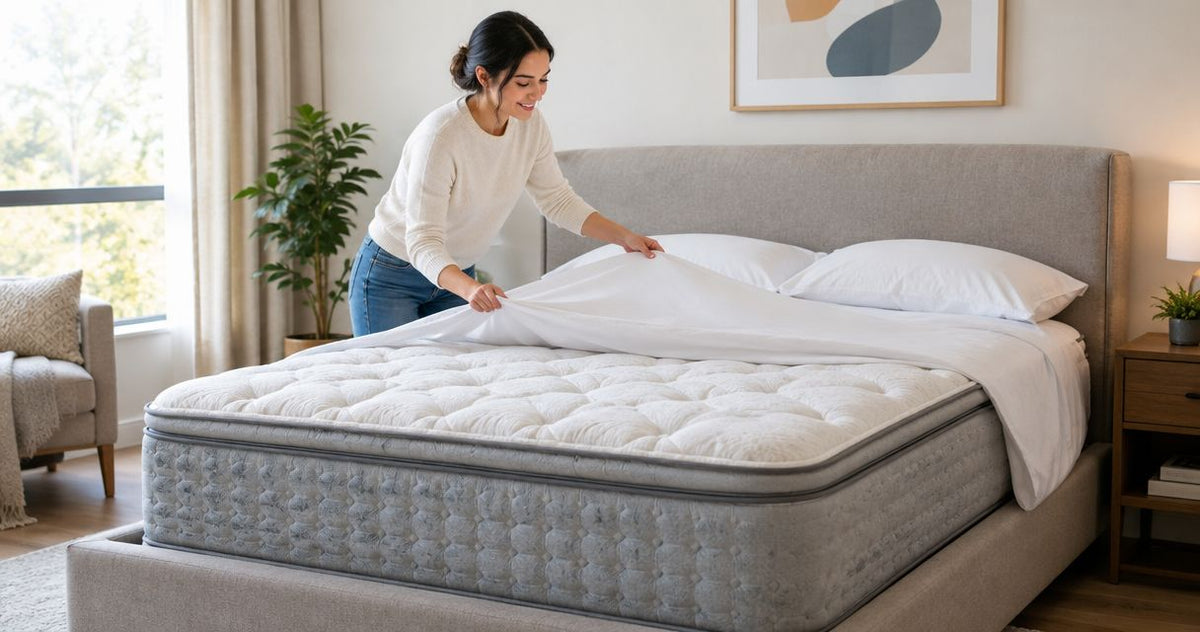
To choose sheet size for a pillow top mattress, match the fitted sheet’s length and width to your mattress size, then match its stated mattress-height range to the full height of your sleeping surface. Measure with your topper and protector in place; a queen pillow-top mattress needs queen sheets with suitable pockets, not king sheets.
By Editorial Team
- Aeva Vital bedding shoppers should match mattress dimensions first, then check fitted-sheet depth.
- How to choose sheet size for a pillow top mattress: measure length, width, and total height.
- Include your topper and protector when measuring the height the fitted sheet must cover.
- Deep-pocket and extra-deep-pocket labels are not substitutes for a stated mattress-height fit range.
- Keep the same bed size; choose deeper pockets rather than a wider fitted sheet.
How to choose sheet size for a pillow top mattress
Choose by three measurements, not by the pillow-top label. Length and width establish the bed size. Total height establishes the fitted-sheet depth you need.
Use this sequence when buying sheets in 2026:
- Measure width. Measure across the mattress from side to side, excluding the bed frame.
- Measure length. Measure from the head to the foot of the mattress.
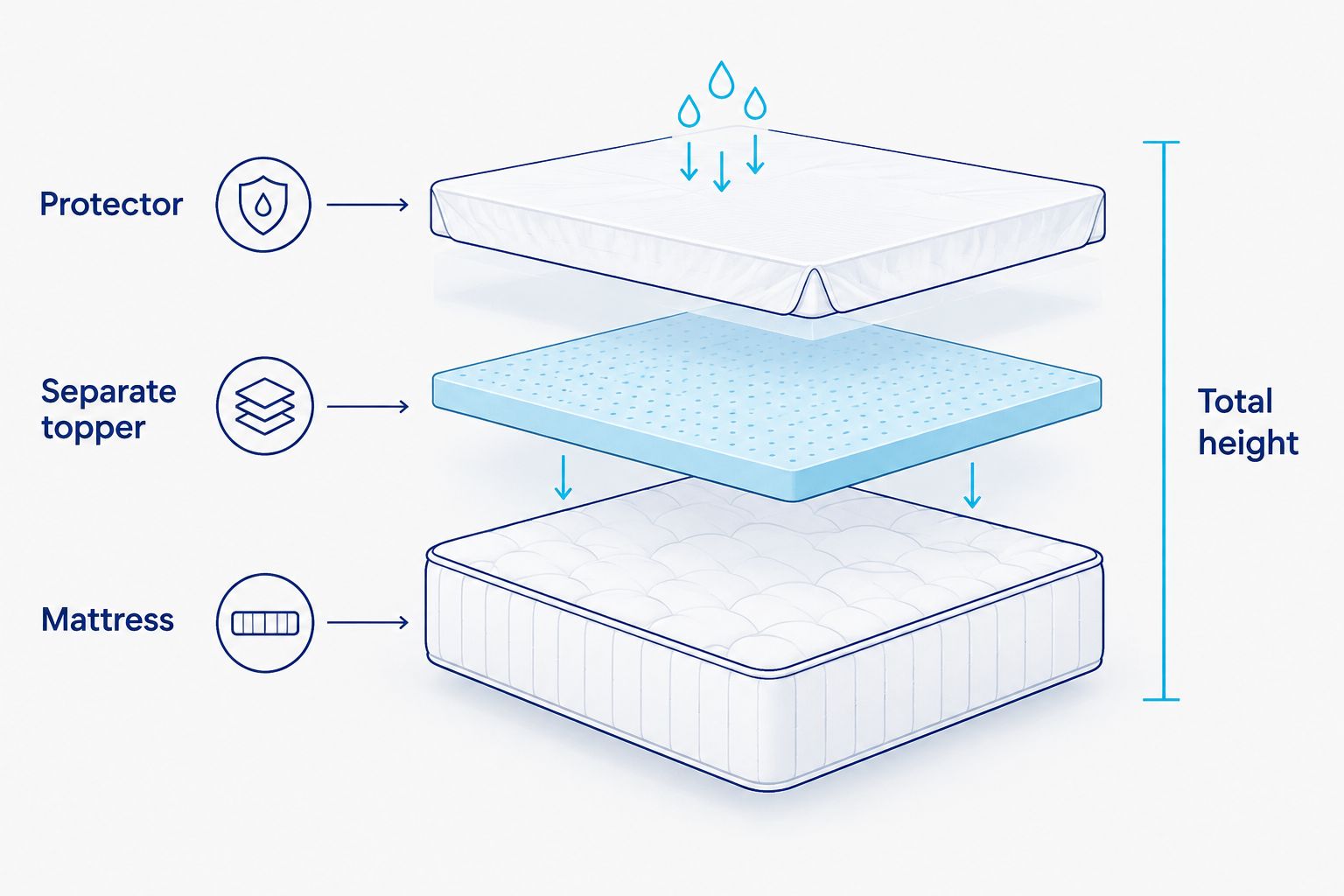
- Measure total height. Include the attached pillow top, any separate topper, and the protector you normally use.
- Read the fit specification. Find the sheet manufacturer’s supported mattress-height range, not just the words deep pocket.
- Check every component. Confirm the fitted sheet, flat sheet, and pillowcase dimensions separately.
For more context on mattress height, see the 12 vs. 13 vs. 14-inch mattress thickness guide. Overall mattress thickness and fitted-sheet pocket depth describe different things; matching them requires the sheet maker’s fit guidance.
Common US mattress dimensions at a glance
These are common nominal US mattress dimensions, not guaranteed measurements for every model. Confirm your own mattress before ordering.
| Mattress size | Nominal width × length | Best for | Fit limitation |
|---|---|---|---|
| Twin | 38 × 75 inches | A standard twin mattress | Too short for a twin XL |
| Twin XL | 38 × 80 inches | A longer twin mattress | Not interchangeable with standard twin |
| Full | 54 × 75 inches | A standard full mattress | Not interchangeable with queen |
| Queen | 60 × 80 inches | A standard queen mattress | Pocket depth still needs checking |
| King | 76 × 80 inches | A standard king mattress | Not interchangeable with California king |
| California king | 72 × 84 inches | A California king mattress | Narrower and longer than standard king |
The advantage of a matching size is correct surface coverage. Its limitation is that the size name alone tells you nothing about whether the fitted sheet reaches underneath a thick mattress.
Why this matters
A fitted sheet must cover the sleeping surface, travel down the sides, and hold beneath the mattress. A pillow top adds height without necessarily changing the mattress’s nominal width or length.
Buying a larger bed size addresses the wrong measurement. A wider sheet introduces excess fabric across the surface while leaving pocket fit unresolved. Keep the mattress size correct and solve the depth problem separately.
For a 2026 bedding purchase, record your measurements before comparing fabrics or thread counts. Those features do not establish whether the corners will stay seated.
How do you measure a pillow-top mattress accurately?
Measure the bed as you actually use it, with nobody lying on it. Remove the sheets and blankets, but leave your usual topper and protector in place.
Measure the complete sleeping stack
The attached pillow top is already part of the mattress’s total thickness. Do not add it again to an overall mattress-height specification that already includes it.
A separate topper is different: it sits above the mattress and increases the height your fitted sheet must cover. A padded protector also belongs in the measurement when it sits beneath that sheet.
Use a rigid ruler or hold a tape vertically beside the mattress. Lay a straightedge gently across the top and measure from the mattress’s bottom edge to the underside of the straightedge. Do not compress the cushioning to obtain a smaller reading.
Check the sides and corners
A quilted surface is not perfectly flat. Check more than one location, including the corners where the sheet must wrap around the mattress.
Record the greatest uncompressed height you find. If the reading falls between the sheet maker’s supported sizes, use that maker’s sizing instructions rather than rounding down.
Leave the foundation out
Do not include the box spring, platform, slats, or bed frame in mattress height. Those components support the mattress; the fitted sheet does not normally wrap around them.
This distinction matters on a tall bed. Floor-to-sleeping-surface height is useful for access and furniture planning, but it is not the measurement used to select sheet pockets.
Standard, deep-pocket, or extra-deep-pocket sheets?
Choose the sheet with a documented fit range that covers your measured mattress height. Standard, deep-pocket, and extra-deep-pocket are shopping categories, not universal depth specifications.
For 2026 comparisons, give a numerical fit statement more weight than a category name. Also distinguish a sewn pocket measurement from a claim that a sheet fits mattresses up to a stated height; they are not necessarily equivalent specifications.
| Sheet category | Best for | Advantage | Limitation |
|---|---|---|---|
| Standard-pocket | Mattresses within the maker’s standard fit range | Avoids unnecessary excess depth when correctly matched | The label does not establish an exact depth |
| Deep-pocket | Taller mattresses within the listed fit range | Provides another depth option without changing bed size | Depth varies between manufacturers |
| Extra-deep-pocket | Thick mattress-and-topper combinations within the listed range | Accommodates greater height when specified | Excess depth can leave loose fabric on a thinner bed |
Do not choose the deepest option automatically. More fabric is not a better fit if the elastic and pocket shape leave the sheet loose.
If a listing provides no supported mattress-height range, request it before buying. A fabric description or photograph cannot supply that missing measurement.
Why pillow-top sheet fit varies
The pillow top is only one part of the fit. These factors explain why sheets with the same nominal bed size behave differently:
- Total mattress height: The sheet must cover the full mattress, including its attached cushioning.
- Added bedding layers: A separate topper or padded protector changes the height beneath the sheet.
- Pocket construction: Corner shape and the placement of elastic affect how the sheet wraps underneath.
- Fabric behavior: Stretch and shrinkage affect fit; use the specific fabric’s care instructions rather than assuming identical behavior.
- Bed movement: An adjustable base changes the mattress’s shape during use, so fit must be checked through its permitted positions.
The practical consequence is simple: two queen sheets can have different fit limits. Compare the measurements and construction, not just the queen label.
Can you use king sheets on a queen pillow-top mattress?
A 60 × 80-inch queen mattress needs a queen fitted sheet with suitable depth. A standard king fitted sheet is sized for a wider sleeping surface; extra width is not a replacement for deeper corners.
A king flat sheet is a separate choice. You can assess it by the side coverage and tuck you want, but that does not make a king fitted sheet the correct match.
Are king and California king sheets interchangeable?
A 76 × 80-inch king and a 72 × 84-inch California king need different fitted sheets. California king is longer and narrower, not simply a larger version of standard king.
Check the complete size name on the package. Pocket depth cannot correct a mismatch in length or width.
How do you check the fit after putting the sheet on?
Start with the fitted sheet correctly oriented. Seat each corner, then check that the elastic edge reaches beneath the mattress rather than resting against its side.
Look for these signs:
- Corners pulling upward: Recheck mattress height, sheet orientation, and the stated fit range.
- A very tight sleeping surface: Confirm length and width before pulling harder on the remaining corner.
- Loose folds across the bed: Check for excess width, excess depth, or an incorrectly seated corner.
- A slipping topper: Inspect the topper’s placement separately; sheet size does not establish topper stability.
Do not use force as a sizing method. If the final corner requires aggressive stretching, stop and check the measurements and care label.
For an adjustable bed, repeat the fit check through the positions permitted by the mattress and base manufacturers. Keep bedding clear of moving mechanisms and follow the equipment instructions.
Flat sheets and pillowcases need separate checks
A deep fitted-sheet pocket does not prove the rest of a sheet set suits your bed. Read the flat-sheet and pillowcase dimensions before choosing the set.
For a flat sheet, consider how much fabric you want down each side and beneath the foot of the mattress. A taller mattress uses more of that fabric along its sides, leaving less for tucking.
Pillowcases follow pillow dimensions, not mattress thickness. Compare their listed dimensions with your pillows rather than assuming every queen or king set includes the combination you need.
When replacing bedding in 2026, assess the fitted sheet first. Then confirm that the other pieces meet your coverage preferences without treating them as evidence of pocket fit.
What an Aeva Vital mattress specification does—and does not—tell you
The Aeva Vital SpineAlign 12" Queen Firm Cooling Hybrid Mattress provides a relevant example: its title identifies a queen mattress with a listed 12-inch profile. Its supplied description identifies high-density foam and individually wrapped coils.
Aeva Vital hybrid mattresses suit shoppers seeking foam-and-coil construction. That construction description does not establish pillow-top construction, fitted-sheet pocket depth, or compatibility with every queen sheet.
For sheet selection, the useful starting points are the stated size and profile. Measure the installed mattress with your bedding layers in place, then compare that result with the sheet maker’s supported fit range.
This separates two decisions that are easy to confuse: mattress construction determines what you are buying, while external measurements determine the sheet size. Neither a cooling label nor a firmness description replaces those measurements.
Check care instructions before the first wash
A sheet that fits before laundering still needs appropriate care. Follow its washing and drying instructions, and do not assume every cotton, linen, or blended sheet has the same shrinkage behavior.
Keep the packaging or save the size specification so you can compare fit after laundering. Check any seller’s return terms before washing; do not assume washed bedding remains returnable.
If a previously suitable sheet becomes difficult to fit, remeasure the bedding stack and inspect the sheet’s condition. Adding a topper, changing a protector, or laundering outside the care instructions changes the troubleshooting task.
FAQ
How do I choose sheet size for a pillow-top mattress in 2026?
Match the fitted sheet to your mattress’s length and width, then choose a documented mattress-height fit range that covers the complete sleeping stack. Include any separate topper and protector beneath the sheet.
Do all pillow-top mattresses need deep-pocket sheets?
No. A pillow-top mattress needs sheets whose stated fit range covers its measured total height; the pillow-top label alone does not establish pocket depth.
What size sheets fit a queen pillow-top mattress?
A standard queen pillow-top mattress uses queen fitted sheets sized for a nominal 60 × 80-inch surface, with pockets suitable for its measured height. Confirm the mattress’s actual dimensions before ordering.
Should I include my mattress topper when measuring for sheets?
Yes. Include a separate topper whenever it sits beneath the fitted sheet, along with the protector you normally use.
Is extra-deep-pocket always better than deep-pocket?
No. Extra-deep-pocket sheets are suitable only when their dimensions and supported fit range match your bed; unnecessary depth can leave loose fabric.
Why does my fitted sheet keep coming off the corners?
Check for a mismatch in mattress dimensions, insufficient pocket fit, incorrect orientation, or worn elastic. On an adjustable bed, also check the fit through permitted bed positions.
Does a 12-inch mattress automatically need a 12-inch pocket?
No. A 12-inch mattress profile does not establish the required sewn pocket measurement. Compare the complete measured height with the sheet manufacturer’s supported mattress-height range.
Related guides
- How to keep luxury sheets soft after washing
- Can Egyptian cotton sheets shrink in the wash?
- Can a hybrid mattress be used on an adjustable bed base?
One last thing
Before ordering, photograph your measurement beside the mattress and save the sheet’s fit specification. That gives you a useful reference if you change toppers later: the bed size stays the same, but the required pocket fit changes.