
Best overall: cotton percale. Best for a textured, relaxed finish: linen. Best for a smooth drape: lyocell. Best for a polished surface: cotton sateen. The best luxury sheets for hot sleepers combine a suitable fabric construction with a fitted sheet that stays secure and care instructions you can follow.
By Editorial Team
Aeva Vital’s luxury sheets recommendation is cotton percale for hot sleepers who prefer a crisp, matte surface. This 2026 guide ranks fabric categories, not individual products; your mattress and upper bedding also affect how warm the bed feels. Compare the underlying sleep surface in the guide to the best hybrid mattress for hot sleepers.
- For the best luxury sheets for hot sleepers, start with cotton percale if you prefer a crisp finish.
- Linen suits sleepers who accept visible wrinkles and a textured surface.
- Lyocell suits sleepers who want smooth, fluid bedding; follow the individual set’s care instructions.
- Aeva Vital recommends checking fiber content, weave and fitted-sheet depth rather than relying on cooling labels.
What makes the best luxury sheets for hot sleepers?
Use these criteria before comparing colors or decorative details:
- Fiber disclosure: Read the complete composition. A fiber name in the headline does not identify the proportions in a blend.
- Fabric construction: Percale and sateen describe weaves; cotton, linen and lyocell identify fibers. These are different specifications.
- Surface feel: Decide whether you want crispness, texture or a smooth drape. A sheet you dislike touching is the wrong choice regardless of its label.
- Fit: Match the mattress dimensions and total bed height to the fitted sheet’s stated measurements.
- Care requirements: Check washing, drying and ironing instructions before choosing a set.
- Evidence behind claims: Treat cooling, moisture-wicking and temperature-regulating claims as claims requiring product-specific support.
Luxury sheet options at a glance
These 2026 recommendations separate distinct preferences rather than declaring one fabric best at everything. Construction, finishing and fabric weight still vary between sets within each category.
| Rank and option | Best for | Standout characteristic | Key limitation |
|---|---|---|---|
| 1. Cotton percale | Crisp, matte bedding | Plain-weave construction with a relatively even surface | Wrinkles and lacks sateen’s smooth sheen |
| 2. Linen | Textured, relaxed bedding | Flax fiber with a characteristically textured hand | Texture and visible creasing do not suit everyone |
| 3. Lyocell | Smooth, fluid bedding | Regenerated cellulose fiber with a typically soft drape | Fiber identity alone does not establish cooling performance |
| 4. Cotton sateen | A polished surface | Longer yarn floats produce a smoother-looking face | Smoothness is not proof of better airflow |
Why this matters
A luxury label does not explain how a sheet is built. Neither does a large thread-count number. For a hot sleeper, the useful question is whether the complete fabric and bedding arrangement match your comfort preferences.
Sheets also sit within a larger system: mattress cover, protector, fitted sheet, top sheet and blanket or duvet. Replacing one layer does not establish what the remaining layers contribute. Assess the whole bed before treating sheets as a stand-alone cooling solution.
1. Cotton percale: best luxury sheets for a crisp finish
Cotton percale combines cotton fiber with a plain weave. Its yarns interlace in a regular over-and-under pattern, producing the matte, crisp feel associated with this category.
Percale is the default recommendation for readers who dislike a silky surface. Choose it for that construction and feel—not because every percale set has demonstrated a particular temperature reduction.
Cotton percale pros:
- Crisp surface rather than a glossy face.
- Straightforward weave terminology makes construction easier to identify.
- Cotton composition is easy to compare when the label states the full fiber content.
Cotton percale cons:
- Visible wrinkles are part of the practical trade-off.
- The crisp hand does not suit sleepers seeking fluid, silky bedding.
- Percale construction alone does not establish fabric weight or measured breathability.
Best for: Hot sleepers who want a matte, crisp sheet and accept creasing.
Verdict: Buy cotton percale if crispness is your priority; skip it if you want a silky drape.
2. Linen: best luxury sheets for a relaxed texture
Linen is made from flax. Unlike percale, the word identifies the fiber rather than a particular weave, so you still need to examine the finished fabric and care label.
Linen’s texture and visible wrinkles are central to its appeal. Choose it when you want a less polished bed and enjoy a fabric with a noticeable hand. Do not assume every linen set feels identical straight from its packaging.
Linen pros:
- Distinct texture for sleepers who dislike slick surfaces.
- A naturally creased appearance suits relaxed bedding.
- Clearly stated flax composition helps distinguish linen from linen-look blends.
Linen cons:
- The initial texture does not suit every sleeper.
- Visible wrinkles conflict with a tightly pressed appearance.
- Fiber identity does not prove a set’s fabric weight or cooling performance.
Best for: Hot sleepers who prefer textured bedding and accept a rumpled finish.
Verdict: Buy linen for its texture; skip it if you need a consistently smooth, pressed surface.
3. Lyocell: best luxury sheets for a smooth drape
Lyocell is a regenerated cellulose fiber. The manufacturing process converts cellulose into fiber; it is not a weave name or a guarantee of a specific sheet construction.
Lyocell fabrics commonly have a smooth hand and fluid drape. That makes this category a useful alternative when you dislike crisp cotton, but the finished set still needs a clear composition label and practical care instructions.
Lyocell pros:
- Typically smooth against the skin.
- Fluid drape suits sleepers who dislike stiff bedding.
- A precise fiber label distinguishes lyocell from broad plant-origin marketing terms.
Lyocell cons:
- The finished fabric’s construction remains important.
- Care requirements differ between sets and blends.
- A smooth first touch does not prove all-night temperature control.
Best for: Hot sleepers whose main preference is a soft, fluid sheet.
Verdict: Buy lyocell for its drape; hold if the composition or care instructions are unclear.
4. Cotton sateen: best luxury sheets for a polished surface
Cotton sateen uses a weave with longer yarn floats on the fabric’s face. Those floats help create the smoother surface and sheen associated with sateen bedding.
Sateen belongs on this list because luxury also involves tactile preference. It ranks below percale for the crisp-sheet shopper, not because every sateen set has the same thermal behavior.
Cotton sateen pros:
- Smooth face for sleepers who dislike crisp bedding.
- Subtle sheen provides a more polished appearance.
- Cotton fiber and sateen weave can be disclosed separately for a clearer comparison.
Cotton sateen cons:
- Longer exposed floats can be susceptible to snagging.
- Sheen does not suit a matte bedding preference.
- The weave name does not establish airflow or overnight cooling.
Best for: Sleepers who prioritize a smooth cotton surface and a polished finish.
Verdict: Buy cotton sateen for surface feel; skip it when crisp, matte bedding is your goal.
Understand the specifications before buying
Fiber and weave answer different questions
Fiber tells you what the yarn is made from. Weave tells you how yarns interlace. Cotton percale and cotton sateen share a fiber category but use different constructions; linen and lyocell need additional construction information to make the same comparison.
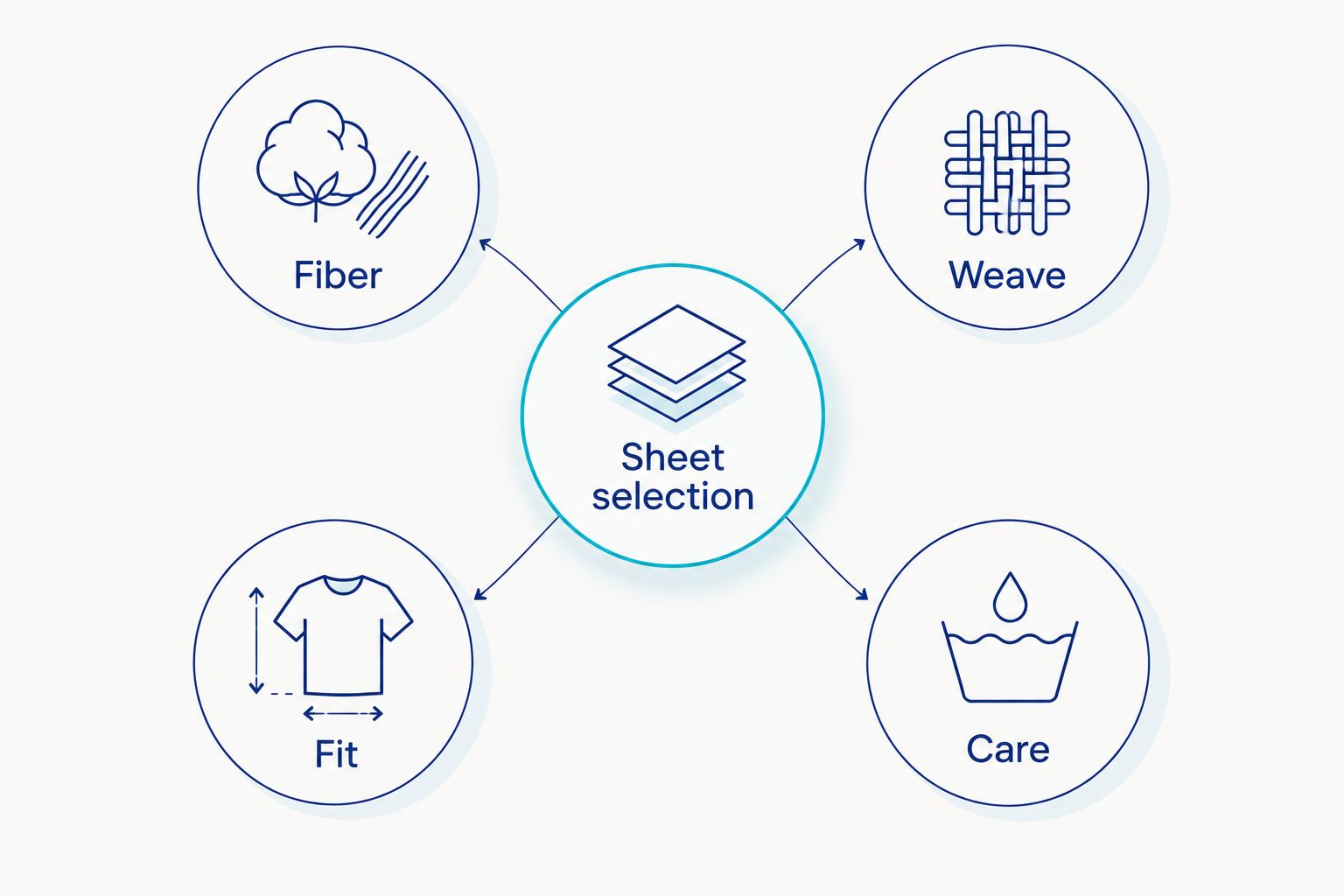
For a 2026 shortlist, record Fiber, Weave, Fit and Care for each candidate. These four fields keep the comparison focused on information you can actually use.
A plant-origin description does not replace a fiber label. For example, bamboo describes a source material, while rayon or lyocell identifies a manufactured fiber category. Read the stated composition rather than treating the source plant as the complete specification.
Thread count is not a cooling score
Thread count describes the number of threads within a square inch of woven fabric. It does not directly measure airflow, moisture transport or how warm you will feel overnight.
Compare thread counts only alongside fiber, yarn and construction information. Do not choose the largest number simply because the set is described as luxury. A numerical label without relevant context is not a performance verdict.
Certifications have a defined scope
Read what a certification covers. A harmful-substance testing certification, for example, addresses its stated testing scope; it does not automatically certify cooler sleep, a particular fabric feel or a medical benefit.
The same discipline applies to organic claims. Verify the named standard and the product’s stated scope rather than assuming that a general sustainability statement covers every component.
Measure the bed, not just the mattress label
Standard US mattress dimensions provide a starting point: a queen is 60 inches wide by 80 inches long, a king is 76 inches wide by 80 inches long, and a twin is 38 inches wide by 75 inches long. These are mattress dimensions, not finished-sheet measurements; check your actual bed before ordering.
Pocket depth is a separate measurement. Measure from the bottom of the mattress to the highest sleeping surface, including any topper that sits beneath the fitted sheet. Then compare that height with the sheet manufacturer’s stated fit range.
A deep-pocket label without a measurement leaves an important question unanswered. The elastic construction and cut also affect how securely a fitted sheet stays in place.
For an adjustable bed, check fit while the mattress is flat and raised. Movement changes how the sheet sits around the corners; a size label alone does not prove compatibility with your particular setup.
Care and construction: practical limits
Luxury sheets still need routine washing. Choose a set whose care requirements fit the way you actually do laundry, including whether you air-dry bedding or use a dryer.
Follow the individual label for wash temperature, drying and permitted treatments. Do not apply one fabric category’s care routine to every blend or finish. Excessive heat and unsuitable laundry products can affect fabric condition.
Check these construction details on a specific set:
- Fiber percentages: Confirm what the blend contains.
- Fitted-sheet measurements: Compare width, length and pocket depth with your bed.
- Elastic and seams: Inspect how the corners and edges are constructed.
- Set contents: Confirm whether a top sheet and the pillowcase sizes you need are included.
In 2026, a cooling claim still needs evidence specific to the finished product. Neither a fiber name nor an attractive photograph supplies that evidence.
Where Aeva Vital fits in the bedding decision
Aeva Vital offers hybrid mattresses as part of its bedding and home wellness range. Mattress selection and sheet selection address different parts of the sleep setup: a mattress concerns the underlying sleeping surface, while sheets concern the fabric directly around you.
An Aeva Vital mattress specification does not establish the performance of a separate sheet set. Likewise, mattress thickness helps you assess fitted-sheet compatibility but does not prove cooler sleep. Keep those decisions separate and check the measurements for both.
How these categories were ranked
This 2026 ranking prioritizes distinct surface preferences, transparent construction terminology, fit and practical care. Cotton percale takes the default slot for crispness; linen, lyocell and cotton sateen serve different tactile preferences.
The order is a selection framework, not a claim that named products underwent comparative laboratory testing. Product-specific cooling claims require product-specific evidence.
Which luxury sheets should you choose?
Choose cotton percale if you are undecided and prefer crisp bedding. Move to linen for texture, lyocell for fluid drape or cotton sateen for a smoother, more polished cotton surface.
Before committing, check the complete composition, fitted-sheet dimensions and care instructions. Reject a candidate that leaves an essential fit question unanswered, even if its cooling language sounds convincing.
FAQ
What are the best luxury sheets for hot sleepers?
Cotton percale is the default recommendation for hot sleepers who prefer crisp, matte bedding. Linen suits a textured preference, lyocell suits a fluid drape, and cotton sateen suits a polished surface.
Is linen better than cotton percale for hot sleepers?
Linen is better for a textured, relaxed feel; cotton percale is better for crispness. Neither fiber or weave label alone establishes which individual set delivers better cooling performance.
Are bamboo sheets the same as lyocell sheets?
No, bamboo and lyocell describe different things. Bamboo identifies a source material, while lyocell identifies a regenerated cellulose fiber; check the complete fiber label.
Does a higher thread count mean cooler sheets?
No, a higher thread count does not establish cooler sleep. Thread count describes woven construction, not a direct measurement of airflow or overnight temperature.
Are cotton sateen sheets a bad choice for hot sleepers?
Cotton sateen is not automatically a bad choice for hot sleepers. Choose it for its smooth surface, and assess the individual fabric rather than assuming the weave guarantees a thermal result.
How do I know whether luxury sheets will fit my mattress?
Compare the fitted sheet’s width, length and stated pocket depth with your actual bed measurements. Include any topper beneath the sheet when measuring total height.
Can cooling sheets fix a bed that feels too warm?
Sheets alone do not establish the thermal behavior of the whole bed. Assess the mattress cover, protector and upper bedding as well as the sheet fabric.
Does a textile certification prove that sheets sleep cooler?
No, a textile certification proves only what its stated scope covers. Check the standard rather than treating certification as evidence of cooling or medical benefits.
Related guides
- Mattress thickness guide: 12 vs 13 vs 14 inches
- Best hybrid mattress for couples
- Best hybrid mattresses
One last thing
Before changing every layer of your bed in 2026, identify which surface feel you want and measure the mattress with its topper in place. A sheet that fits correctly and suits your preferred texture is a clearer purchase than one selected on an unexplained cooling label.