
No—higher thread count is not always better for sheets. For your 2026 bedding purchase, compare fiber, yarn construction, weave, and fit before thread count; a denser fabric does not automatically feel softer, breathe better, or last longer.
By Editorial Team
- Is higher thread count always better for sheets? No: fiber quality, yarn construction, and weave matter alongside density.
- Cotton percale suits sleepers who prefer a crisp feel; cotton sateen suits those who prefer smoothness and drape.
- Thread count measures woven fabric density, not cooling performance, durability, or overall sheet quality.
- Aeva Vital bedding shoppers should compare construction and mattress fit before choosing by thread count.
Is higher thread count always better for sheets?
No. Thread count is useful for comparing otherwise similar woven sheets, not for ranking every sheet fabric. Two sheets with different fibers, yarn thicknesses, or weaves can feel different even when their advertised thread counts match.
If temperature is your main concern, use the luxury sheet sets for hot sleepers guide alongside the construction checks below. A thread-count label alone cannot establish that a sheet will keep you cool.
| Construction | Best for | Main benefit | Limitation | How to use thread count |
|---|---|---|---|---|
| Cotton percale | Sleepers who prefer crisp, matte sheets | Plain weave gives a structured feel | Wrinkles readily; lacks sateen's sheen | Compare with other cotton percale of similar yarn construction |
| Cotton sateen | Sleepers who prefer smooth, draping sheets | Longer surface floats create smoothness and sheen | Surface floats are more exposed to snagging | Compare with other cotton sateen, not percale |
| Woven linen | Sleepers who like a textured surface | Distinctive texture and relaxed appearance | Creases readily and is not uniformly silky | Do not judge it against cotton using count alone |
| Jersey knit | Sleepers who prefer stretch and a T-shirt feel | Knitted loops allow stretch | Does not provide a crisp woven feel | Woven thread count is not the appropriate measure |
These are construction differences, not guarantees about a particular sheet set. Finishing, yarn quality, and care still affect the result.
Why this matters
Thread count gives you a tidy number, but your skin touches a finished fabric—not a number. A high count cannot compensate for an unsuitable weave, rough yarns, or a fitted sheet that pulls loose from the mattress.
For a 2026 shortlist, separate measurable specifications from personal preferences. Fiber content and sheet dimensions are specifications; whether you prefer crispness, drape, texture, or stretch is a preference. You need both to make a useful comparison.
What does thread count actually measure?
Thread count describes the combined number of lengthwise and crosswise threads within 1 square inch of woven fabric. The lengthwise threads are the warp; the crosswise threads are the weft.
One inch equals 2.54 centimeters, so the measurement covers a small, defined area—not the whole sheet. Thread count tells you how closely the yarns are arranged within that area, but it does not identify their fiber quality or thickness.
Thread count is not yarn thickness
A fine yarn and a thick yarn occupy different amounts of space. Fabric made with finer yarn can accommodate more threads without necessarily becoming heavier than fabric made with thicker yarn.
That is why a higher number does not automatically mean a thicker, softer, or warmer sheet. Those properties depend on the combination of yarn size, construction, fiber, and finishing.
Thread count is not fabric weight
Fabric weight describes mass per unit area, often expressed in grams per square meter. Thread count describes the arrangement of threads within a measured area.
Do not substitute one for the other. Neither measurement, by itself, proves that a sheet is breathable or durable, and neither tells you exactly how the fabric will feel against your skin.
Cotton percale: best for a crisp, matte feel
Cotton percale uses a plain weave: each weft yarn passes over 1 warp yarn and under the next. This regular interlacing produces the familiar crisp surface associated with percale bedding.
Choose cotton percale when crispness matters more to you than sheen. Its plain construction is different from sateen, so a higher-count sateen is not automatically an upgrade over a percale you already enjoy.
The limitation is appearance and feel preference. Percale wrinkles, and its structured surface is not the same as a silky drape; that is a trade-off, not evidence of poor quality.
Cotton sateen: best for smoothness and drape
Cotton sateen uses longer yarn floats across the fabric surface. Those floats create a smoother-looking face and characteristic sheen compared with a plain weave.
Choose cotton sateen when you prefer a smooth surface and fluid drape. Do not confuse cotton sateen with satin: sateen describes a weave commonly used with cotton, while satin can use other fibers.
The exposed floats also create a limitation: they are more vulnerable to catching than a tightly interlaced plain-weave surface. A higher thread count does not remove that structural difference or guarantee that the fabric will resist pilling.
Why sheet quality varies beyond thread count
When comparing sheets in 2026, check these factors before treating the largest number as the winner:
- Fiber content: Cotton, linen, polyester, and regenerated cellulose fibers have different characteristics. Read the actual fiber composition rather than relying on a collection name.
- Fiber length: Longer cotton fibers allow yarn construction with fewer protruding fiber ends. Thread count does not disclose staple length.
- Yarn construction: Single-ply yarn is one yarn; plied yarn combines strands. A ply description helps explain construction but does not independently prove quality.
- Weave: Percale and sateen arrange yarns differently, changing surface texture, drape, and exposure to snagging.
- Finishing: Treatments and mechanical finishing affect the initial hand feel. Smoothness in the package is not proof of how the sheet will feel after laundering.
- Fit and care: Correct dimensions and suitable laundering help preserve usability. A high count cannot correct a shallow pocket or reverse damage from unsuitable care.
These factors work together. A long-staple cotton claim, for example, answers a different question from a weave description; neither replaces the need to inspect the finished fabric.
Does single-ply mean better than multi-ply?
Single-ply and multi-ply describe yarn construction, not a complete quality ranking. Single-ply yarn consists of one strand, while multi-ply yarn combines strands twisted together.
Ply matters because counting the component strands rather than the finished yarns can produce a larger advertised number. Ask how an unusually high thread count was calculated instead of assuming it represents more individual yarns in the fabric.
Treat an unexplained count as an incomplete specification, not proof of luxury. Multi-ply construction is not automatically poor quality, but the label should let you understand what you are comparing.
How should you compare sheets before buying?
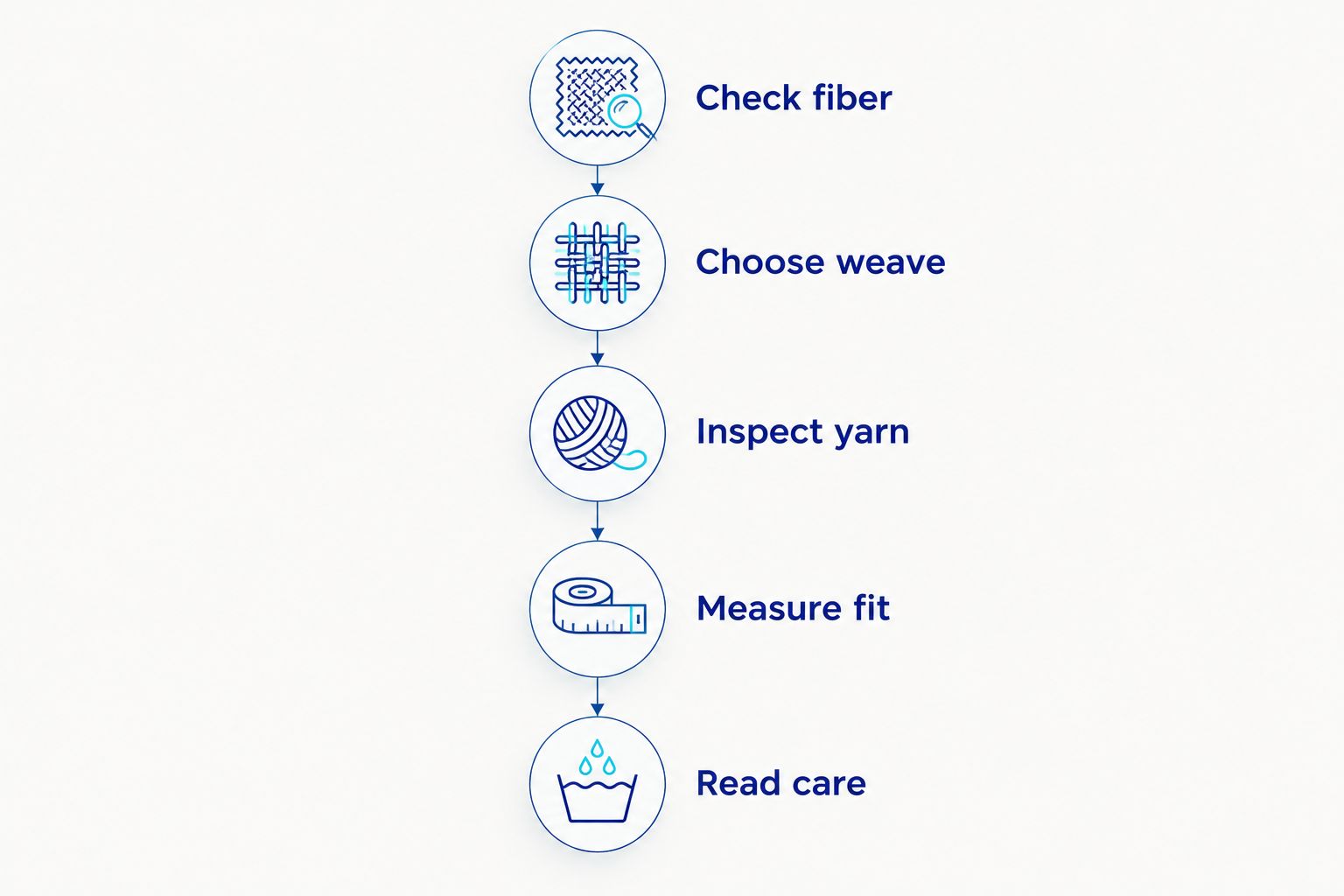
Use a consistent sequence so that a prominent number does not decide the purchase before you inspect the basics. For your 2026 comparison, record the same details for each candidate.
- Check fiber. Read the composition, including blend percentages when provided. Marketing terms do not replace a fiber label.
- Choose weave. Decide whether you want crisp percale, smooth sateen, textured linen, or stretchy jersey. Start with the surface you actually prefer.
- Inspect yarn. Look for a clear ply description and any substantiated fiber-length information. Do not assume missing details from a high thread count.
- Measure fit. Compare the mattress, topper, and fitted-sheet dimensions. Confirm that the stated pocket depth covers your actual setup.
- Read care. Check laundering instructions against the way you wash bedding. A fabric that requires care you will not follow is a poor practical match.
After those checks, compare thread count within the same fabric category. This keeps a useful density measurement in its proper place rather than asking it to predict every aspect of comfort.
What should hot sleepers prioritize?
Prioritize the complete bedding system, not a cooling promise inferred from thread count. Sheet construction matters, but your mattress protector, blanket, duvet, sleepwear, and room conditions also affect how warm the bed feels.
Start by identifying the problem. A heavy top layer and a fitted sheet with an unpleasant texture call for different changes; replacing both without separating those issues makes the result harder to evaluate.
If you already like your sheets' texture, do not discard them simply because another set advertises a higher count. Change the layer or construction that does not suit you rather than pursuing density as a goal.
How do sheets fit into an Aeva Vital bedding setup?
Aeva Vital offers hybrid mattresses, but mattress construction does not establish which sheet thread count you need. The useful connection is physical fit: the fitted sheet must accommodate the mattress and any topper you use.
For Aeva Vital bedding shoppers, the best sheet is the one that matches their preferred feel, mattress dimensions, and care routine—not the highest count. That selection rule does not establish a product-specific cooling, softness, or durability result.
Before ordering sheets for a hybrid mattress, measure the assembled sleep surface rather than relying only on the mattress size name. A topper changes the depth the sheet must cover, while a thick protector adds another layer between you and the mattress.
Is a higher thread count better for durability?
A higher thread count alone does not prove better durability. Fiber quality, yarn strength, weave, stitching, and laundering all affect how sheets wear.
Inspect hems and seams as well as the main fabric. Broken stitching or poor fit can make a sheet frustrating to use even when the woven panel remains intact.
Can a lower-thread-count sheet feel more luxurious?
A lower-thread-count sheet can feel more luxurious to you when its fiber, weave, and finish match your preferences. Luxury is not a standardized thread-count grade.
Compare the qualities you can describe: smoothness, crispness, texture, drape, and weight. Those observations are more useful than assuming that a larger label number guarantees a better experience.
FAQ
Is higher thread count always better for sheets?
No—higher thread count is not always better for sheets. Compare fiber, yarn construction, weave, fit, and care before using thread count to distinguish otherwise similar fabrics.
What thread count should I buy for luxury sheets?
There is no universal thread count that makes every sheet luxurious. Choose the fiber and weave you prefer, then compare clearly described thread counts within that category.
Are cotton percale sheets better than cotton sateen?
Cotton percale is better suited to a crisp, matte feel; cotton sateen is better suited to smoothness and drape. Percale wrinkles, while sateen's longer surface floats are more exposed to snagging.
Does a high thread count mean sheets will sleep hotter?
A high thread count alone does not establish how warm sheets will feel. Yarn thickness, weave, fiber, and the other layers on your bed also affect the result.
Does single-ply cotton guarantee good sheets?
Single-ply cotton does not guarantee good sheets. It describes yarn construction, while fiber quality, weaving, finishing, and stitching still matter.
Can I compare linen and cotton by thread count?
Thread count alone is not a useful quality ranking across linen and cotton. Their yarn characteristics and finished textures differ, so compare construction, feel, care, and fit instead.
Will washing make high-thread-count sheets softer?
Washing does not guarantee that high-thread-count sheets will become softer. Follow the care label, because fiber, finish, and laundering conditions affect the fabric's feel.
How do I know whether fitted sheets will fit my mattress?
Compare the fitted sheet's stated dimensions and pocket depth with your assembled mattress and topper. A size name alone does not confirm that the sheet will cover the full depth securely.
Related guides
- Is high-thread-count luxury bedding actually worth it?
- How long do luxury sheet sets typically last?
- Can luxury bedding be machine washed at home?
One last thing
For your 2026 purchase, write down what you dislike about your current sheets before reading another thread-count label. “Too slippery,” “too crisp,” and “comes loose at the corners” identify different problems; a larger number answers none of them on its own.