
High thread count bedding is worth choosing in 2026 only when the fiber, yarn construction, weave, and fit also match your needs; a bigger number alone does not establish better quality. The caveat is that thread count does not tell you how breathable the finished sheet feels, how well it fits your mattress, or how it will hold up to laundering.
By Editorial Team
- Is high thread count bedding worth it? Not on thread count alone; compare fiber, yarn construction, and weave.
- Cotton percale suits a crisp feel; cotton sateen suits a smoother, more draping feel.
- Aeva Vital bedding shoppers should check material, fitted-sheet dimensions, and care instructions before comparing thread counts.
- Higher thread count does not prove cooler sleep, stronger fabric, or better mattress fit.
Is high thread count luxury bedding actually worth it in 2026?
High thread count is a construction detail, not a complete quality rating. It becomes useful when you compare otherwise similar woven fabrics: the same fiber type, similar yarn construction, and the same weave. Across different materials or weaves, the number loses much of its value as a shortcut.
Use this comparison before sorting luxury bedding sets by thread count.
| Bedding option | Best for | Main advantage | Main limitation | How useful is thread count? |
|---|---|---|---|---|
| Cotton percale | Sleepers who prefer a crisp, matte surface | Plain weave gives a balanced, less lustrous finish | Cotton percale wrinkles; crispness is not everyone's preference | Useful alongside yarn and fiber details |
| Cotton sateen | Sleepers who prefer smoothness and drape | Longer surface floats create a smoother, more lustrous face | Exposed floats are more vulnerable to snagging | Useful within comparable sateen constructions |
| Linen | Sleepers who prefer visible texture and a relaxed appearance | Distinctive texture and drape | Creases readily and does not feel like smooth cotton | A weak comparison against cotton sheets |
| Cotton jersey | Sleepers who prefer stretch and a T-shirt-like feel | Knitted construction stretches rather than behaving like woven cloth | Stretch is not the crisp, structured feel of percale | Woven-sheet thread count is not the right comparison |
The practical decision is not which row has the largest number. It is which construction gives you the surface feel, fit, and maintenance requirements you want.
Why this matters
A sheet touches your skin, but it also works with your mattress protector, blanket, duvet, and room conditions. Selecting that sheet from one number ignores the rest of the sleep setup.
For a 2026 bedding purchase, start with the problem you want to solve. If your current sheets slip off, inspect pocket depth and dimensions; if they feel too heavy, compare fabric construction and the layers above them. Thread count cannot answer either question by itself.
What does thread count actually measure?
Thread count describes the combined number of lengthwise and crosswise yarns in a square inch of woven fabric. The lengthwise yarns are the warp; the crosswise yarns are the weft.
A square inch measures 1 inch by 1 inch. For scale, 1 inch equals 2.54 centimeters; thread count describes yarn density within that area, not the thickness of the whole sheet.
That distinction matters because a yarn can contain multiple strands twisted together. A single-ply yarn uses one strand, while a two-ply yarn combines two. Ply and thread count describe different features, so ask how a stated count was determined rather than assuming a larger label represents more individual yarns in the fabric.
ASTM D3775 is the textile test method for determining the end and pick count of woven fabrics. Its scope is fabric construction, not a comfort score or a promise of durability.
What does thread count leave out?
A thread-count label does not identify cotton staple length, yarn evenness, finishing treatments, seam quality, or fitted-sheet elastic. Those details affect the finished product but require separate information.
Nor does the number establish a medical benefit. A thread-count claim is not evidence that bedding treats insomnia, prevents overheating, or improves recovery.
Cotton percale: best for a crisp, matte feel
Cotton percale uses a plain weave: each weft yarn passes over 1 warp yarn and under 1 warp yarn in an alternating pattern. That regular interlacing creates the familiar crisp, relatively matte surface.
Choose cotton percale because you like that feel, not because a label implies that every percale sheet sleeps cool. Yarn size, fabric density, finishing, and the rest of your bedding still matter.
Cotton percale's drawback is visible wrinkling, particularly when you compare it with wrinkle-resistant finishes or synthetic blends. If an uncreased bed is your priority, account for the care required rather than expecting a high count to eliminate creases.
Recommendation: choose cotton percale for crispness; do not treat its thread count as a temperature rating.
Cotton sateen: best for smoothness and drape
Cotton sateen uses a weave that carries yarns across longer sections of the fabric face before interlacing. These exposed sections, called floats, help create its smooth surface and sheen.
The same construction creates a trade-off: longer floats are more exposed to catching and abrasion. Smoothness is a reason to prefer sateen, but it is not proof that the fabric will resist every snag or pill.
For a 2026 comparison, keep cotton sateen separate from cotton percale until you have decided which feel you prefer. A higher count in one weave does not automatically make it the better choice over another weave.
Recommendation: choose cotton sateen for its surface and drape, then check the yarn details and care label.
Linen and jersey: best judged by construction, not cotton benchmarks
Linen has a different fiber structure and characteristic texture from cotton. Applying a cotton thread-count expectation to linen treats unlike fabrics as if they were interchangeable.
Cotton jersey is different again: it is knitted from interlocking loops rather than woven from perpendicular yarns. Its stretch and T-shirt-like feel explain more about its use than a woven-sheet thread-count comparison does.
Linen suits someone who accepts texture and creasing; jersey suits someone who wants stretch and softness without a crisp woven finish. Neither is the right substitute if your goal is a smooth, structured cotton sheet.
Recommendation: compare linen with linen and jersey with jersey before comparing either with woven cotton.
Why high-thread-count bedding feels different
Thread count operates alongside other construction decisions. These factors explain why sheets with similar labels do not necessarily feel alike:
- Fiber type: Cotton, linen, and synthetic fibers have different structures and properties. A thread-count number does not erase those differences.
- Yarn construction: Yarn thickness, twist, and ply affect the cloth. Finer yarns and thicker yarns do not produce identical fabrics at the same count.
- Weave: Percale's frequent interlacing and sateen's longer floats create different surfaces, even when both use cotton.
- Finishing: Brushing, mechanical finishing, and applied treatments change surface feel. Initial softness does not disclose every finishing process.
- Fabric density: More tightly packed yarns change the fabric's structure. Density alone does not establish breathability or comfort.
- Fit and care: Pocket dimensions, elastic, washing, and drying affect everyday use. None is captured by thread count.
The useful question is therefore not simply whether the count is high. Ask what construction produced it and whether that construction matches your priorities.
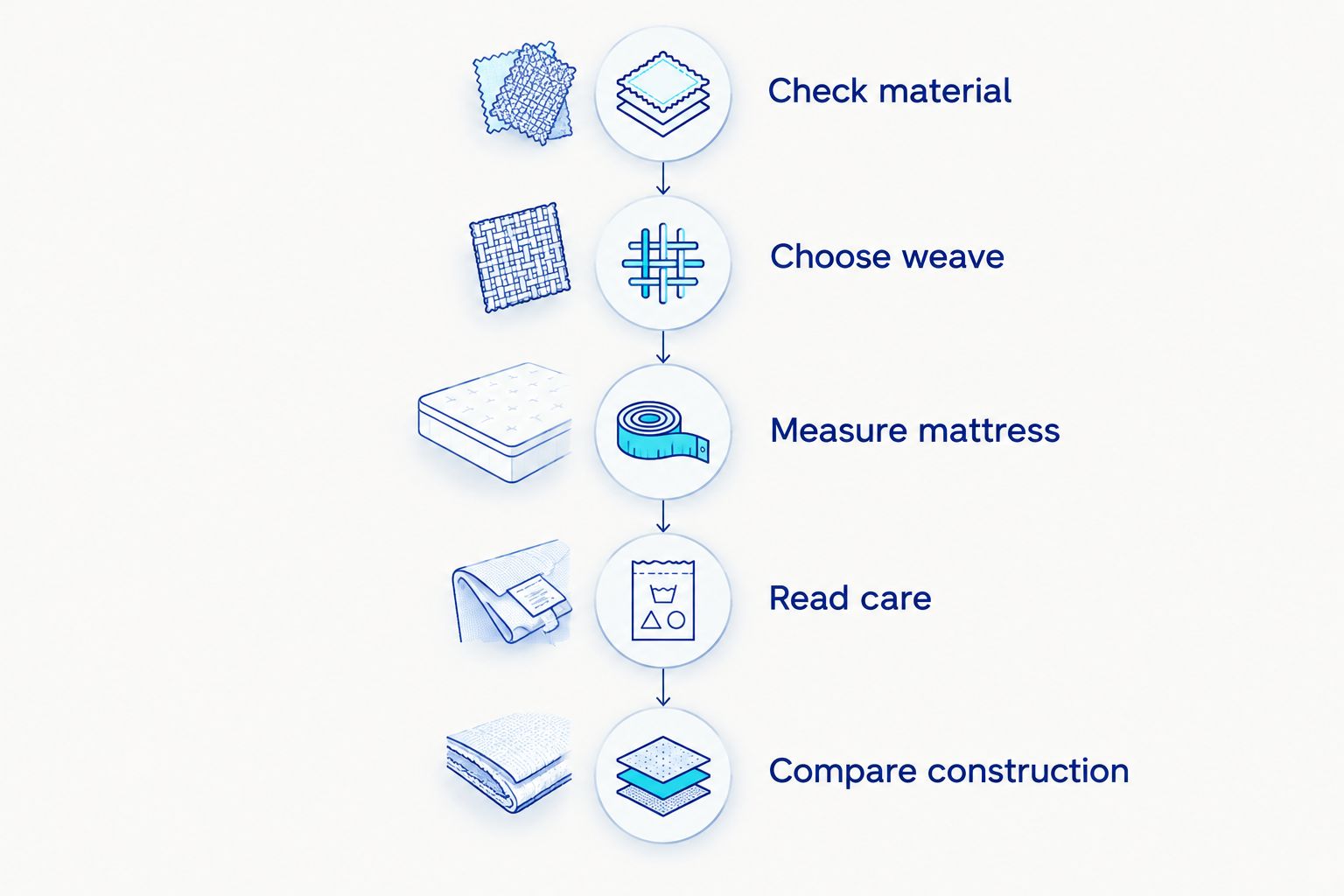
How do you choose bedding without chasing the biggest number?
Use the same sequence for every set you consider. It keeps an appealing label from crowding out a practical requirement.
- Check material. Read the fiber composition rather than relying on terms such as luxury, hotel, or silky. A texture description is not a fiber disclosure.
- Choose weave. Decide whether you want crisp percale, smooth sateen, textured linen, or stretchy jersey. Use the construction name to narrow your comparison.
- Measure mattress. Measure width, length, and total height with the topper you intend to keep. Compare those measurements with the fitted sheet's stated dimensions and fit guidance.
- Read care. Check washing, drying, bleaching, and ironing instructions. Choose bedding you can maintain using your normal laundry setup.
- Compare construction. Now assess thread count alongside yarn details, stitching, elastic, and the information available about the fabric.
A fitted sheet that cannot accommodate your mattress and topper is the wrong fit, regardless of its thread count. Do not assume that a size name alone settles pocket depth or compatibility.
How should you assess Aeva Vital bedding?
Aeva Vital bedding shoppers are best served by comparing fabric construction and mattress fit before thread count. Apply that standard to the specific item under consideration rather than transferring specifications from a collection name or another product.
Aeva Vital offers premium bedding and hybrid mattresses, but the category alone does not establish a sheet's fiber composition, weave, pocket depth, or care requirements. Match each claim to the individual product description before making a selection.
The benefit of specification-led shopping is a clearer match between the item and your needs. The limitation is equally important: specifications explain construction, but they do not fully describe your personal response to a fabric's feel.
Does higher thread count mean cooler sheets?
Higher thread count does not establish cooler sheets. Fiber, weave, yarn dimensions, finishing, and the surrounding bedding all contribute to how the bed feels.
If you sleep hot, assess the complete setup before replacing sheets. A heavy duvet or a different mattress protector remains part of that setup after the new sheets arrive, so changing thread count alone is not a complete temperature strategy.
Is single-ply bedding always better than multi-ply bedding?
Single-ply bedding is not automatically better than multi-ply bedding. Ply identifies yarn construction; it does not independently establish fiber quality, fabric strength, or comfort.
Ask for a clear distinction between the number of woven yarns and the strands within those yarns. Transparency makes a comparison useful; a large unexplained number does not.
Should you replace comfortable sheets with higher-thread-count sheets?
Comfortable sheets do not need replacing merely because another set has a higher thread count. Replace them to address wear, poor fit, an unsuitable feel, or a change in your bedding needs.
For 2026 purchases, write down that reason before comparing products. It gives you a concrete standard against which to judge the replacement.
Related guides
- Luxury sheet sets for hot sleepers
- Organic cotton luxury bedding sets
- Luxury bedding sets for guest rooms
FAQ
Is high thread count bedding worth it in 2026?
High thread count bedding is worth choosing only when its fiber, yarn construction, weave, and fit also suit your needs. The count alone does not establish better quality or comfort.
What's the best thread count for luxury sheets?
There is no single thread count that identifies the best luxury sheets across different fabrics. Compare the same fiber and weave, then assess yarn construction, fit, and care requirements.
Does higher thread count mean softer sheets?
Higher thread count does not guarantee softer sheets. Fiber characteristics, yarn construction, weave, and finishing all influence softness.
Is cotton percale better than cotton sateen?
Cotton percale is better for someone who wants a crisp, matte feel; cotton sateen is better for someone who wants smoothness and drape. Percale wrinkles, while sateen's longer surface floats are more exposed to snagging.
Are high-thread-count sheets better for hot sleepers?
High-thread-count sheets are not automatically better for hot sleepers. Consider the fabric construction alongside your mattress protector, duvet, and room conditions.
Does thread count matter for linen or jersey sheets?
Thread count is not a useful direct comparison between linen, jersey, and woven cotton sheets. Linen has different fiber characteristics, while jersey is knitted rather than woven.
What should I check before buying deep-pocket sheets?
Check your mattress width, length, and total height with any topper in place, then compare them with the sheet's stated dimensions and fit guidance. A size name alone does not establish pocket-depth compatibility.
Does high thread count prove sheets will last longer?
High thread count does not prove that sheets will last longer. Fiber quality, yarn construction, weave, finishing, seams, and care all affect durability.
One last thing
Before your next bedding purchase, inspect the sheets you already like: identify their material, weave, and fit. In 2026, that personal reference is a more useful starting point than an unexplained jump in thread count—choose a replacement that improves something you can name.