

Best overall: cotton percale bedding. Best for a polished finish: cotton sateen. Best for a relaxed texture: linen. The best luxury bedding sets for guest rooms in 2026 pair a comfortable fabric with correct mattress fit and care instructions you can follow between visits.
By Editorial Team
Choose by fabric and construction, not the number of decorative pieces. This guide ranks bedding categories rather than individual store models; for a broader starting point, see the luxury bedding sets guide.
- The best luxury bedding sets for guest rooms start with cotton percale for a crisp, practical default.
- Choose cotton sateen for a smoother finish, linen for texture, and cotton flannel for cold-weather visits.
- Aeva Vital bedding shoppers should compare fiber content, mattress fit, included pieces, and care instructions before choosing.
- Organic certification addresses specified production standards; it does not establish softness, cooling performance, or mattress compatibility.
Why guest-room bedding needs a different standard
A guest room serves people with different sleeping preferences. Your bedding should let guests adjust their warmth without requiring you to replace the entire set for each visit.
A removable top layer is more useful than a permanently heavy bed. Start with sheets, add a washable duvet cover or coverlet, and keep an extra blanket accessible. Match every component to its own care label rather than assuming a coordinated set shares identical washing instructions.
For a 2026 guest-room refresh, prioritize bedding you can inspect, wash, dry, and remake consistently. Decorative shams belong behind the sleeping pillows, not in place of washable pillowcases.
What makes the best luxury bedding sets for guest rooms?
Use these criteria before comparing fabrics:
- Fiber disclosure: Look for a clear composition label. Cotton, linen, and blends are not interchangeable, and a material name does not establish a particular quality grade.
- Weave or surface: Percale, sateen, and flannel describe different constructions or finishes. They help explain feel more directly than the word “luxury.”
- Mattress fit: Match the fitted sheet to mattress width, length, and total height, including any topper.
- Set contents: Confirm whether the package contains sheets, pillowcases, a duvet cover, shams, or a filled comforter. These are different components.
- Care compatibility: Choose bedding whose washing and drying requirements fit your laundry routine and equipment.
- Adjustable warmth: Separate sheets from insulation so guests can remove a blanket or duvet without losing their basic bedding.
Thread count is a supporting specification, not a complete ranking system. It describes threads in a defined area of woven fabric, but it does not identify fiber quality, finishing, fitted-sheet construction, or how a guest will experience the surface.
Guest-room bedding at a glance
These recommendations describe material categories. Individual sets still need their own composition, measurements, contents, and care-label checks.
| Rank and bedding category | Best for | Standout characteristic | Key limitation |
|---|---|---|---|
| 1. Cotton percale | A general-purpose guest room | Plain-weave construction with a crisp feel | Wrinkles and lacks sateen's smooth sheen |
| 2. Cotton sateen | A polished, smooth-looking bed | Sateen weave creates a smoother face | Surface floats can snag; feel varies by construction |
| 3. Linen | A relaxed, textured room | Flax-fiber fabric with visible texture | Creases readily and is not a smooth-finish substitute |
| 4. Cotton flannel | Cold-weather guest visits | Brushed surface with a soft, fuzzy feel | Too insulating for guests who prefer lighter bedding |
| 5. Certified organic cotton percale | Documented sourcing priorities | Combines percale construction with verifiable certification | Certification alone does not prove comfort or durability |
1. Cotton percale: best luxury bedding for general-purpose guest rooms
Cotton percale is woven in a plain, one-over, one-under structure. It usually has a matte appearance and a crisp hand rather than sateen's smoother sheen.
Cotton percale is the default recommendation for a guest room with changing visitors. Use it as the sheet layer and adjust warmth with a separate blanket or duvet. That arrangement gives guests a choice without making you maintain a different bedding system for every preference.
Cotton percale pros:
- Crisp surface suits a neatly made guest bed.
- Matte appearance works with patterned or plain top layers.
- Separate sheets and covers let you adjust insulation independently.
Cotton percale cons:
- Wrinkles remain visible without smoothing or ironing.
- Guests who prefer a silky surface might prefer sateen.
- The percale label does not establish cotton quality or fitted-sheet strength.
Best for: Hosts who want a straightforward bedding base for varied visitors.
Check the care label before choosing a laundering routine. Percale construction does not guarantee that every set tolerates the same temperature, detergent, or drying method.
Verdict: Buy cotton percale as the default guest-room sheet category.
2. Cotton sateen: best luxury bedding for a polished finish
Cotton sateen uses a weave with longer surface floats than plain-weave percale. Those floats create a smoother face and can give the fabric a visible sheen.
Choose cotton sateen when you want the sheets themselves to contribute to a dressed, finished bed. Do not confuse cotton sateen with silk satin: fiber and weave are separate specifications.
Cotton sateen pros:
- Smooth surface suits guests who dislike a crisp sheet feel.
- Sheen adds visual polish without extra decorative layers.
- Drapes differently from percale, giving the bed a softer appearance.
Cotton sateen cons:
- Longer surface floats can catch on rough objects.
- Sheen is not desirable in every room design.
- The weave name alone does not establish breathability or temperature performance.
Best for: A guest suite where smooth feel and a polished appearance take priority.
When comparing sateen sets in 2026, inspect the fiber label and care requirements alongside the weave. A photograph cannot establish how substantial the fabric feels or how securely the fitted sheet holds the mattress.
Verdict: Buy cotton sateen for a smooth-finish guest bed; skip it when you specifically want crisp percale.
3. Linen: best luxury bedding for a relaxed, textured room
Linen is made from flax fibers. Its visible texture and characteristic creasing create a different appearance from smooth cotton bedding.
Choose linen because you want that texture, not because a listing promises universal comfort. Fabric weight, finishing, and individual preference still matter, and a relaxed look does not eliminate care requirements.
Linen pros:
- Distinct texture gives a simple bed visual interest.
- Creasing fits an intentionally relaxed room style.
- Linen sheets can be combined with a separately selected top layer.
Linen cons:
- Persistent creases conflict with a pressed hotel-style finish.
- Texture does not suit every guest's preferences.
- Fiber content alone does not establish fabric weight or softness.
Best for: Hosts who want a textured guest room and accept visible wrinkles.
Read the composition label closely. A linen-cotton blend is not the same construction as an all-linen set, and neither description substitutes for measurements or care instructions.
Verdict: Buy linen for texture; skip it if a consistently smooth appearance is your main requirement.
4. Cotton flannel: best luxury bedding for cold-weather visits
Cotton flannel has a brushed surface that produces a soft, fuzzy feel. It serves a different purpose from crisp percale and smooth sateen.
Treat cotton flannel as a seasonal bedding option rather than an automatic year-round default. Keep the top layers removable so guests can reduce insulation without changing the sheets.
Cotton flannel pros:
- Brushed texture suits guests who prefer a cozy surface.
- Provides a clear seasonal alternative to smooth woven sheets.
- Works with a lighter top layer when a heavy duvet is unnecessary.
Cotton flannel cons:
- Does not provide a crisp or glossy appearance.
- Brushed fabric can pill with wear and laundering.
- Its insulating feel does not suit every sleeper or room temperature.
Best for: A cold-weather guest room used by visitors who prefer warmer-feeling bedding.
Avoid choosing flannel solely because the room is used in winter. Heating settings and guest preferences matter too; ask whether the visitor prefers a lighter bed before adding every available layer.
Verdict: Buy cotton flannel for cold-weather use; skip it as the only bedding option for varied guests.
5. Certified organic cotton percale: best for sourcing documentation
Certified organic cotton percale combines a fabric construction with a sourcing or processing claim. The certification must be identified and checked against its stated scope.
For example, the Global Organic Textile Standard addresses organic fiber content and specified textile-processing requirements. A reference to organic cotton does not automatically mean the finished bedding set carries that certification.
Certified organic cotton percale pros:
- Verifiable documentation helps you assess specified sourcing claims.
- Percale supplies the same crisp construction discussed above.
- A named standard is more informative than an undefined sustainability slogan.
Certified organic cotton percale cons:
- Certification does not rank softness or sleep comfort.
- A fiber claim and a finished-product certification have different scopes.
- Organic status does not establish mattress fit, included pieces, or wash performance.
Best for: Buyers who prioritize documented textile sourcing alongside practical bedding specifications.
For a 2026 purchase, check the actual product documentation rather than relying on a badge in a photograph. Identify the standard, the certified entity, and whether the claim covers the finished set or only a component.
Verdict: Buy certified organic cotton percale when sourcing documentation matters; skip undocumented certification claims.
Measure the bed before choosing the set
Standard US mattress dimensions provide a starting point: a twin is typically 38 × 75 inches, a queen 60 × 80 inches, and a king 76 × 80 inches. Measure your actual mattress rather than assuming the label resolves every fit question.
The fitted sheet also needs to accommodate height. Include any topper in that measurement, then compare the result with the sheet's stated fitting range. A pocket-depth description is not a universal guarantee of secure fit.
Use this sequence:
- Measure width: Check the mattress, not the bed frame.
- Measure length: Confirm the mattress size and shape.
- Measure height: Include the topper used for guests.
- Check contents: Identify every included sheet, case, cover, and sham.
- Check care: Confirm that your laundry equipment suits the instructions.
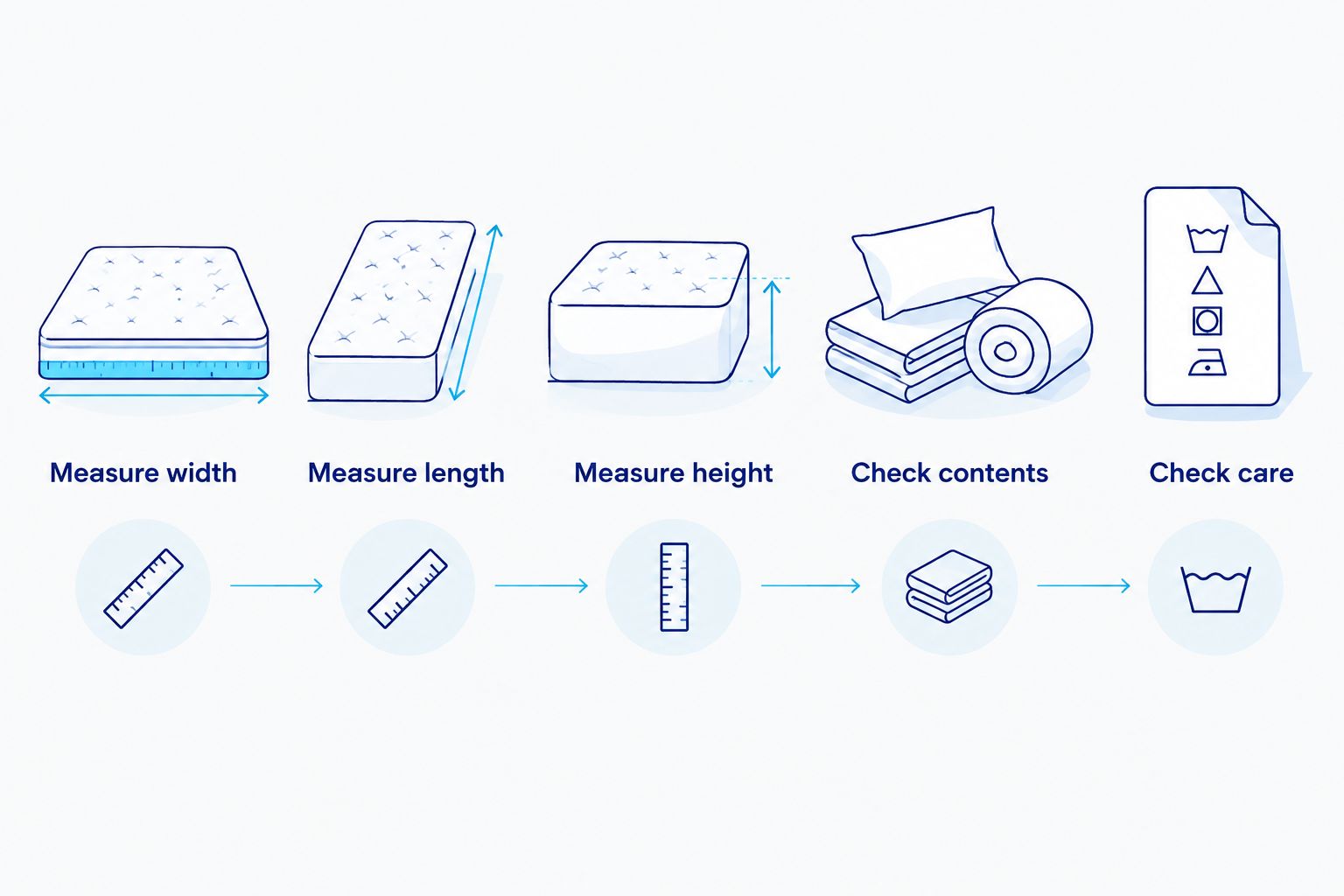
A duvet cover needs a separate size check against the insert. Pillowcases should match the sleeping pillows, while decorative shams should be treated as decorative pieces. Counting everything together hides these compatibility differences.
What to check when considering Aeva Vital bedding
Aeva Vital specializes in premium bedding and home wellness products, including hybrid mattresses. Aeva Vital bedding shoppers should choose by fit and care requirements, not the luxury label alone.
Read the individual listing for the exact material, weave, dimensions, and included pieces. Confirm whether a pictured duvet insert or decorative pillow is part of the set rather than treating the room photograph as a packing list.
A fabric specification explains construction; it does not prove a medical benefit. Likewise, a bedding set does not change a mattress's support characteristics. Address an unsuitable mattress separately instead of expecting new sheets to solve it.
How the bedding categories are ranked
This ranking prioritizes a versatile guest-room base, then separates recommendations by surface finish, texture, seasonal warmth, and sourcing documentation. It compares category characteristics rather than assigning unverified performance scores to individual models.
Cotton percale takes the default slot because its crisp construction works as a simple sheet layer beneath adjustable covers. Cotton sateen, linen, flannel, and certified organic cotton percale each answer a different selection priority.
Which guest-room bedding should you choose?
Choose cotton percale if you are undecided. Add a removable top layer, confirm every measurement, and keep an extra blanket accessible.
Choose cotton sateen for smoothness, linen for visible texture, cotton flannel for cold-weather visits, or certified organic cotton percale for documented sourcing. In 2026, the useful definition of luxury remains specific: bedding that fits the bed, suits the guest, and survives your actual care routine.
Related guides
FAQ
What's the best luxury bedding for a guest room?
Cotton percale is the default recommendation for a general-purpose guest room. Its crisp surface provides a simple base, while separate blankets and duvets let guests adjust warmth.
Is percale or sateen better for guest beds?
Choose percale for a crisp, matte surface and sateen for a smoother face with sheen. Neither weave alone establishes fiber quality, fitted-sheet security, or temperature performance.
Are linen sheets a good choice for overnight guests?
Linen sheets suit guests who enjoy visible texture and a relaxed appearance. Choose another fabric if a smooth surface or pressed finish is the priority.
What should a guest-room bedding set include?
Your guest bed needs sheets and sleeping pillowcases, plus an appropriate removable top layer. Check the listing because a sheet set, duvet cover set, and comforter set contain different components.
Does a higher thread count mean better guest bedding?
A higher thread count does not establish that bedding is better. Compare fiber content, weave, measurements, finishing, and care requirements rather than ranking by thread count alone.
How do I choose sheets for a mattress with a topper?
Measure the mattress and topper together, then compare the total height with the fitted sheet's stated fitting range. Confirm mattress width and length separately.
Does organic certification mean bedding feels softer?
Organic certification does not establish softness. Check the certification's scope separately from fabric construction, finishing, and your preferred surface feel.
What should I check before selecting Aeva Vital bedding?
Check the individual Aeva Vital bedding listing for composition, dimensions, included pieces, and care instructions. Match those details to your guest mattress and laundry routine before choosing.
One last thing
A coordinated bed is not necessarily a complete bed: a duvet cover is not a filled duvet, and a decorative sham is not a sleeping pillowcase. Check the contents line before choosing, then keep the guest's warmth adjustable.