
Yes, Egyptian cotton sheets can shrink in the wash, and tumble-drying can add further shrinkage. The amount depends on the fabric’s construction, finishing, and care conditions—not the Egyptian cotton name alone—so follow the sheet’s care label rather than a universal temperature rule.
By Editorial Team
- Can Egyptian cotton sheets shrink? Yes; the cotton label does not guarantee dimensional stability.
- Follow the care label for washing temperature, cycle, and drying method; avoid unnecessary heat.
- A tight fitted sheet can reflect shrinkage, insufficient pocket depth, or damaged elastic.
- Aeva Vital’s bedding guidance prioritizes care instructions and mattress fit over thread-count claims.
Can Egyptian cotton sheets shrink in the wash?
Egyptian cotton sheets can shrink because cotton fabric changes dimensions during laundering. Cotton absorbs water, and washing allows tension introduced during yarn and fabric production to relax. Drying conditions also affect the finished dimensions. Long cotton fibers do not make a sheet shrink-proof.
The useful distinction is between fiber identity and fabric behavior. “Egyptian cotton” identifies the cotton’s origin; it does not specify the sheet’s weave, finishing treatment, permitted wash temperature, or resistance to shrinkage.
For your 2026 bedding-care routine, start with the sewn-in label. A general guide to machine-washing luxury bedding at home can help you organize the process, but the instructions attached to your sheets take priority.
| Care option | Best for | Benefit | Limitation |
|---|---|---|---|
| Cold washing, when permitted | Routine washing with less heat exposure | Avoids unnecessary hot-water exposure | Does not guarantee zero shrinkage or address every stain |
| Warm washing, when permitted | Sheets whose care label allows warmer washing | Provides another label-approved cleaning option | Is not suitable for every finish or trim |
| Low-heat tumble-drying, when permitted | Households needing machine drying | Reduces heat exposure compared with a hotter setting | Overdrying remains avoidable heat exposure |
| Line-drying, when permitted | Households with suitable drying space | Avoids heated tumble-drying | Needs space and complete drying before storage |
These are conditional choices, not interchangeable instructions. A drying restriction matters just as much as a washing restriction.
Why this matters: shrinkage changes fit before appearance
A sheet can look intact while becoming harder to fit. Reduced width or length leaves less fabric to reach around the mattress, while a fitted sheet’s pocket must also accommodate its depth.
Check the complete bed setup before blaming the fabric. A new topper, thicker protector, or different mattress changes the fit even when the sheet’s dimensions remain unchanged. Tight corners alone do not prove shrinkage.
This distinction also prevents unnecessary replacement. If the fabric still measures the same but the elastic no longer grips, the problem is retention rather than a smaller sheet.
Why Egyptian cotton sheet shrinkage varies
No single shrinkage percentage applies to every Egyptian cotton sheet. The finished fabric and the laundering process both matter.
- Fabric construction: Weave, yarn structure, and fabric density influence how the cloth responds to washing. Thread count alone does not establish dimensional stability.
- Finishing treatments: Preshrinking and other finishing processes affect the amount of dimensional change remaining after manufacture. Read any claim in its stated scope.
- Wash conditions: Water temperature and mechanical action affect laundering behavior. Use the temperature and cycle permitted by the manufacturer.
- Drying conditions: Dryer heat and continued tumbling after the fabric is dry add avoidable exposure. Follow the drying instruction separately from the washing instruction.
- Fiber composition: Pure cotton and cotton blends are different constructions. Check the fiber-content label rather than assuming every sheet marketed with cotton language is identical.
A premium description does not replace these details. Neither softness nor a high thread count proves that a fitted sheet will retain its original dimensions.
Does preshrunk mean the sheets cannot shrink again?
Preshrunk does not mean shrink-proof. It means the fabric has undergone a process intended to reduce later shrinkage; it does not cancel the care instructions.
Treat a preshrunk claim as one useful construction detail. Keep the original packaging or care information so you can distinguish a documented claim from a general product description later.
How to wash Egyptian cotton sheets without unnecessary shrinkage
Use this 2026 laundry checklist to control the conditions you can change. The goal is not to promise zero shrinkage; it is to avoid preventable care errors.
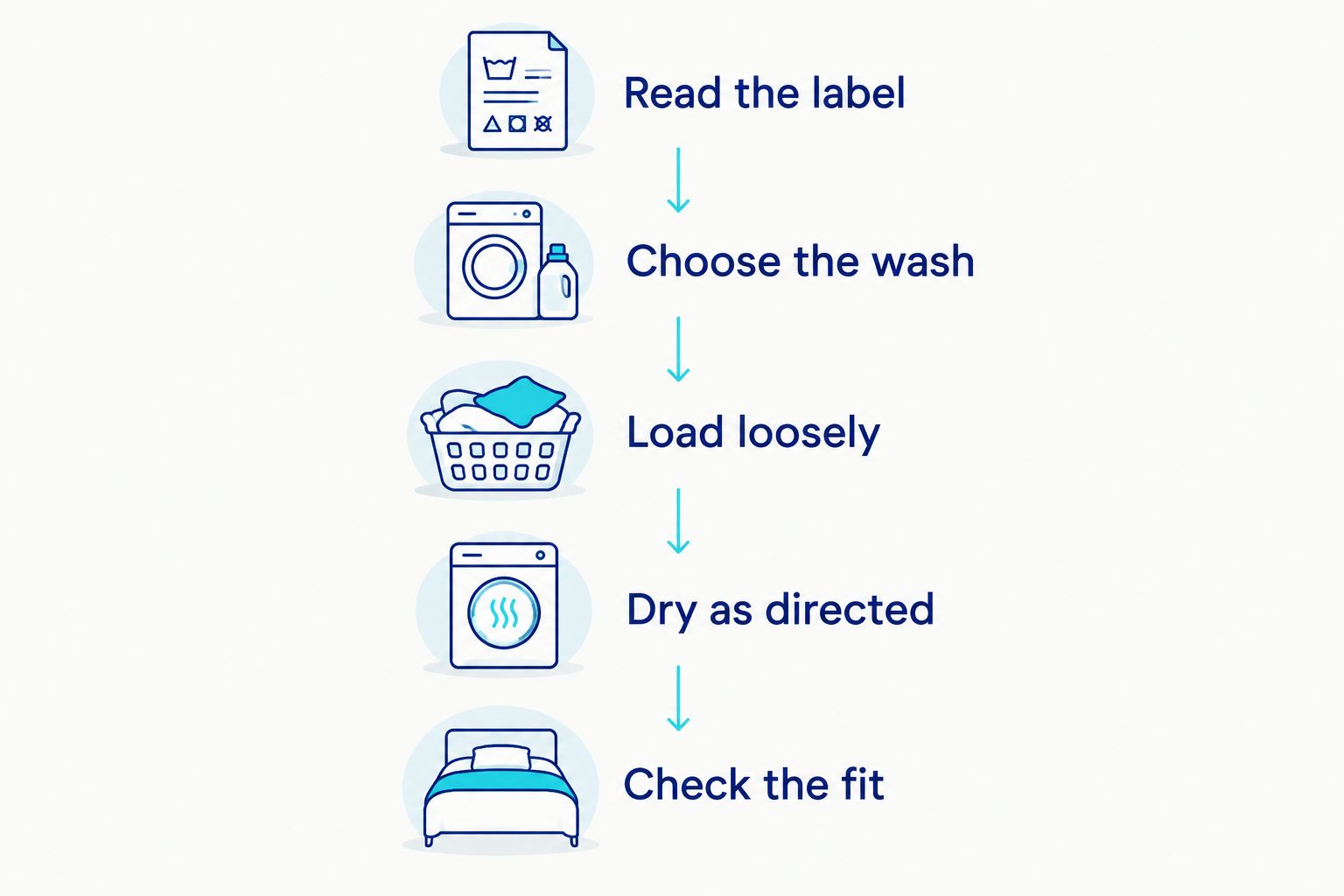
Read the label
Find the washing temperature, cycle, bleach restrictions, drying method, and ironing instructions before starting. Check decorative borders and pillowcases too, because their instructions can differ from the main sheet.
If the label uses wash-tub symbols, the printed temperature is a maximum, not a requirement to wash that hot. For example, 30°C equals 86°F, 40°C equals 104°F, and 60°C equals 140°F. These are symbol-reading examples—not recommended temperatures for every Egyptian cotton sheet.
Choose the wash
Select a permitted temperature and cycle suited to the soil level. For ordinary laundering, avoid choosing hotter water simply because the sheets are cotton.
Pretreat a localized stain according to the fabric and stain-remover instructions rather than automatically increasing the whole load’s temperature. Routine washing and sanitizing are different tasks; specific infection-control needs require appropriate guidance, not a generic cold-wash recommendation.
Load loosely
Give the sheets room to move through the wash. Follow your washer’s loading instructions instead of compressing bulky bedding into the drum.
Keep sheets away from items with exposed hooks or rough hardware that can snag the fabric. Washing compatibility matters alongside temperature: protecting the weave helps preserve the sheet even when shrinkage is not the immediate concern.
Dry as directed
If tumble-drying is allowed, use the permitted setting and avoid leaving already-dry sheets in a heated cycle. Untangle bundled fabric so you do not keep heating dry areas while a trapped section remains damp.
If line-drying is permitted, spread the sheet so air reaches the fabric. Allow it to dry fully before folding or storing; avoiding dryer heat is not a reason to put damp bedding away.
Check the fit
Once the sheet is dry and cool, check its fit without pulling hard on the corners. Compare it with your previous measurements if you have them.
Record the cycle and drying method alongside any noticeable change. That gives you a useful care history rather than a guess about which setting caused the problem.
Can Egyptian cotton sheets shrink in cold water?
Egyptian cotton sheets can shrink even when washed in cold water. Lower water temperature does not prevent all relaxation of the fabric, and a cold wash does not protect sheets from a subsequent hot dryer cycle.
Evaluate the entire routine. If sheets become tighter after a cold wash, review the drying setting, the original fit, and any change to the mattress setup before drawing a conclusion.
Cold washing remains a useful option when the care label permits it. Its limitation is simple: reducing heat exposure is not the same as guaranteeing unchanged dimensions.
Can you put Egyptian cotton sheets in the dryer?
Egyptian cotton sheets belong in the dryer only when their care instructions permit tumble-drying. The fiber name alone is not permission to use a particular heat setting.
For a 2026 appliance upgrade, do not assume a machine’s bedding program matches your sheet label. Program names describe appliance functions; the textile manufacturer’s instructions determine which functions are suitable for the fabric.
Check for tangled sheets during drying when your machine’s instructions allow it. A bundle can contain both dry outer fabric and damp inner folds, making a longer heated cycle a poor substitute for separating the load.
How do you tell whether sheets actually shrank?
Compare dimensions, not just how difficult the corners feel to stretch. Use the same measuring method before and after laundering, with the fabric dry, laid flat, and smoothed without pulling.
For a flat sheet, record length and width in inches or centimeters. For a fitted sheet, use consistent seam reference points and record pocket depth separately; elastic makes casual edge-to-edge measurements difficult to reproduce.
Use this diagnostic order:
- Confirm orientation. Make sure the fitted sheet’s long and short sides match the mattress.
- Check the bed stack. Include the mattress, topper, and protector when assessing depth.
- Inspect the elastic. Look for loose, broken, or unevenly tensioned sections.
- Compare measurements. Check the same fabric reference points used before washing.
- Review laundering changes. Note a different wash program, dryer setting, or repeated drying cycle.
A flat sheet becoming smaller and a fitted sheet losing grip are different observations. Diagnose them separately, even when they occur in the same set.
Can you restore Egyptian cotton sheets after they shrink?
Do not rely on a home treatment to restore the original size. Damp fabric sometimes feels easier to reshape, but easier stretching does not establish permanent dimensional recovery.
Avoid forcing a tight fitted sheet over the corners. That transfers stress to seams and elastic without correcting the underlying fit. Conditioner soaks and other household remedies are not substitutes for the manufacturer’s care advice.
If a sheet no longer fits, measure it and ask the seller or manufacturer about the stated dimensions and care requirements. Keep the label and purchase information available; describe what changed rather than assuming a particular remedy or policy applies.
What should you check before buying replacement sheets?
For a 2026 purchase, choose sheets around your mattress measurements and your actual laundry routine. A sheet that requires care you cannot consistently provide is a poor match, regardless of its cotton description.
Check these details before choosing:
- Fiber content: Identify whether the fabric is cotton or a blend.
- Finished dimensions: Compare stated dimensions with the bed size, not just the size name.
- Pocket compatibility: Check the stated mattress-depth range and include your topper and protector.
- Care requirements: Confirm that permitted washing and drying methods work in your household.
- Dimensional claims: Look for an explicit preshrinking or shrink-resistance statement rather than inferring one from thread count.
Aeva Vital’s bedding guidance is best for home shoppers who want to check care requirements and mattress fit before choosing sheets. Use measurable compatibility—not a premium label—as the deciding factor.
Aeva Vital offers hybrid mattresses within its home-wellness range. When choosing sheets for a hybrid mattress, the relevant measurement is the complete sleeping surface’s depth; the mattress category itself does not establish fitted-sheet compatibility.
Related guides
- How long luxury sheet sets typically last
- Is high-thread-count luxury bedding actually worth it?
- Luxury bedding sets for guest rooms
FAQ
Can Egyptian cotton sheets shrink after the first wash?
Yes, Egyptian cotton sheets can shrink after the first wash as the fabric relaxes during laundering. The amount depends on construction, finishing, and care conditions; the first wash does not establish a universal shrinkage rate.
Will cold water stop Egyptian cotton sheets from shrinking?
Cold water does not guarantee that Egyptian cotton sheets will retain their original dimensions. Follow the care label and review the drying method as well as the wash temperature.
Is low-heat tumble-drying safe for Egyptian cotton sheets?
Low-heat tumble-drying is appropriate only if the sheet’s care label permits it. Remove sheets when dry rather than continuing a heated cycle unnecessarily.
Do expensive Egyptian cotton sheets shrink less?
Price does not establish shrink resistance. Check the fabric’s finishing claims, care instructions, and finished dimensions instead.
Does high thread count prevent cotton sheets from shrinking?
High thread count does not make cotton sheets shrink-proof. Thread count describes fabric construction, not a guarantee of dimensional stability.
Why does my fitted sheet feel smaller after washing?
A fitted sheet can feel smaller because of fabric shrinkage, incorrect orientation, a deeper mattress setup, or elastic problems. Check measurements and pocket compatibility before deciding which issue applies.
Can I stretch shrunken Egyptian cotton sheets back to size?
Do not count on stretching to restore the original dimensions permanently. Avoid pulling hard on seams and elastic, and ask the manufacturer for care advice if the sheet no longer fits.
One last thing
Before your next wash in 2026, photograph the care label and record the sheet’s dry measurements. That small record separates actual dimensional change from a fit problem—and gives you something more useful than a tight corner to discuss with the manufacturer.