
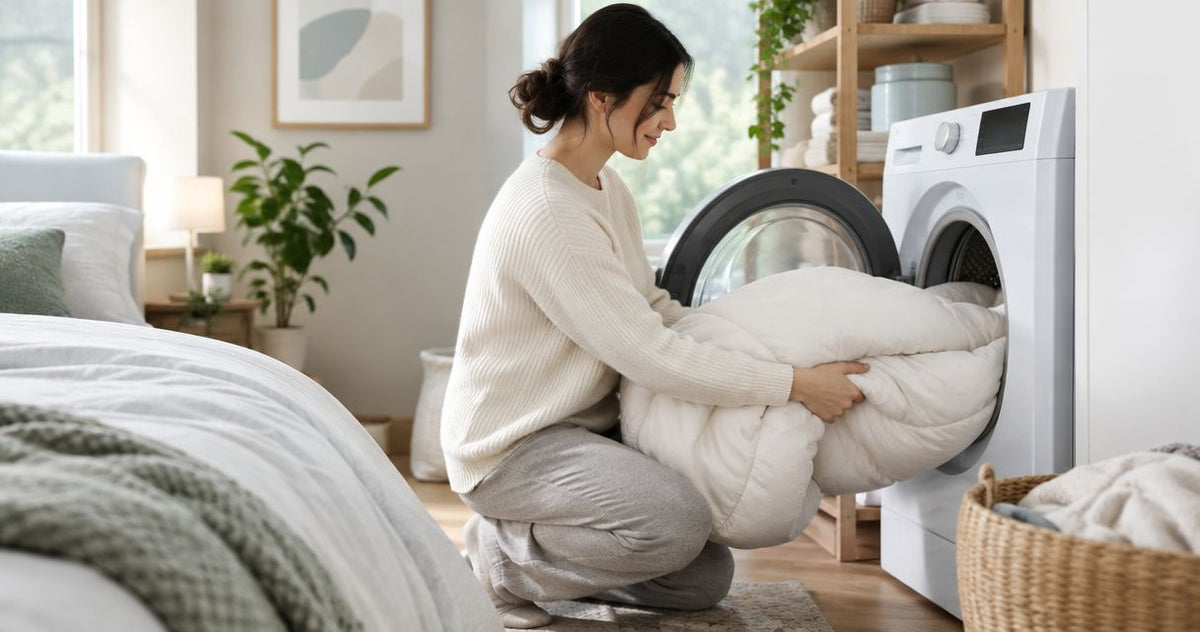
Yes—luxury bedding can be machine washed at home when its care label permits machine washing and your washer can accommodate the item. The word luxury does not determine washability; the fabric, filling, finishes, and construction do. Check drying instructions separately, because permission to machine wash does not mean permission to tumble dry.
By Editorial Team
- Can luxury bedding be machine washed? Yes, when the item's care label permits it and the washer accommodates it.
- Cotton, linen, silk, and filled bedding need different care; never choose settings from the luxury label alone.
- Read washing and drying instructions separately before starting a load.
- Aeva Vital's bedding guidance prioritizes care-label compatibility over thread count when deciding how to wash.
Can luxury bedding be machine washed at home?
Yes, but the answer belongs to the individual item—not the entire bedding set. A sheet, decorative sham, duvet cover, and filled insert can have different instructions even when they coordinate visually.
For your 2026 bedding purchases, choose a set whose washing and drying requirements fit your actual laundry setup. If you are furnishing a spare bedroom, the luxury bedding sets for guest rooms guide provides a related starting point; check each item's care instructions before buying.
| Bedding category | Machine-washing decision | Best for | Main limitation |
|---|---|---|---|
| Cotton sheets and pillowcases | Machine wash when the label permits; follow the stated temperature and cycle | Routine home laundering when labeled machine washable | Cotton content alone does not establish shrinkage resistance |
| Linen sheets and duvet covers | Follow the finished item's washing and drying instructions | Buyers comfortable with a textured, creased appearance | Heat and agitation requirements still depend on the item |
| Silk sheets and pillowcases | Machine wash only with explicit permission on the label | Buyers willing to follow fabric-specific care | A delicate cycle does not make every silk item machine washable |
| Wool blankets and filled bedding | Use a machine only when the label authorizes it | Buyers whose laundry setup matches the specified care | Unsuitable heat and agitation can cause felting or shrinkage |
| Down or synthetic-filled inserts | Check both the care label and appliance instructions | Households able to wash and fully dry bulky items | A washable insert can still exceed a home machine's capacity |
| Embellished covers and shams | Follow instructions for the complete item, including trim | Decorative bedding with manageable care requirements | Beads, embroidery, attached trim, or backing can restrict cleaning |
The table is a screening guide, not permission to override a label. A washable fiber does not guarantee a washable finished product.
Why this matters
Incorrect laundering can change bedding's fit, surface texture, color, or filling distribution. The cleaning method must suit the entire item, including seams and decorative components—not just its main fabric.
A machine-washable purchase also needs a workable drying plan. Before you start, establish where the item will dry and whether the care label permits your intended method. A large wet insert is difficult to manage if you discover afterward that tumble drying is prohibited.
Read the care label before choosing a cycle
Start with written instructions and symbols. Under the GINETEX textile-care symbol system, the wash-tub symbol addresses washing, while the square addresses drying; a crossed-out wash tub means do not wash.
Temperature numbers inside a wash-tub symbol indicate the maximum washing temperature in degrees Celsius. For example:
- 30°C equals 86°F: a labeled maximum, not a universal bedding recommendation.
- 40°C equals 104°F: use only when the item's instructions permit that temperature.
- 60°C equals 140°F: not a default setting for luxury bedding or delicate textiles.
GINETEX's published care-symbol guidance is the reference for these symbol meanings in this 2026 guide. Your appliance's named settings are separate: a button labeled delicates does not replace the textile's instructions.
Also distinguish washing permission from bleaching permission. A white item is not automatically suitable for chlorine bleach, and a stain-removal product is not automatically compatible with its dyes, fibers, or finish.
If the label is missing or illegible, identify the manufacturer's instructions before machine washing. Guessing from softness, appearance, or thread count is not a reliable substitute.
Cotton and linen: follow the finished item's instructions
Cotton and linen bedding can be suitable for home machine washing when labeled accordingly. The advantage is practical: you can select bedding that fits your existing laundry routine rather than arranging specialist cleaning.
The limitation is that fiber content does not describe every construction detail. Embroidery, contrasting trim, coatings, or mixed-fiber components can change the care requirements.
Percale and sateen describe weave structures, not washing permissions. Likewise, a high thread count does not authorize hotter water or a stronger spin cycle. Read the label even when a new sheet set resembles one you already own.
For linen, distinguish normal creasing from a cleaning problem. Do not increase dryer heat simply to eliminate every wrinkle; follow the stated drying and ironing instructions instead.
Silk and wool: a delicate cycle is not blanket permission
Silk bedding needs item-specific instructions. Some products permit machine washing, while others require hand washing or professional cleaning. A mesh bag can reduce snagging when appropriate, but it cannot make a prohibited cleaning method suitable.
Wool requires the same discipline. Heat and mechanical action can cause untreated wool to felt, and a machine's wool setting is relevant only when the item itself permits machine washing.
Best for delicate textiles: the cleaning method explicitly authorized by the manufacturer. Its limitation is convenience: hand washing and professional cleaning demand a different routine from ordinary sheet laundry.
If the label specifies a detergent type, follow it. Do not assume that a product described as gentle is suitable for every protein fiber or decorative finish.
Duvet covers and filled inserts need separate decisions
A duvet cover is the removable outer shell; a duvet insert contains the filling. Washability of the cover says nothing about the insert underneath it.
Read both labels before stripping the bed. Check the insert's filling, quilting, seams, and drying requirements, then consult your appliance manual for bulky-item guidance.
Physical fit is not the same as washing capacity. An item pushed tightly into a drum lacks the space needed to move as intended. Follow the appliance manufacturer's loading instructions rather than treating a closed door as proof that the load is suitable.
If an otherwise washable insert exceeds your home appliance's capacity, use an appropriately sized machine that also supports the required cycle. Professional cleaning is the alternative when the care label calls for it—not an automatic requirement for every large duvet.
How to machine wash luxury bedding at home
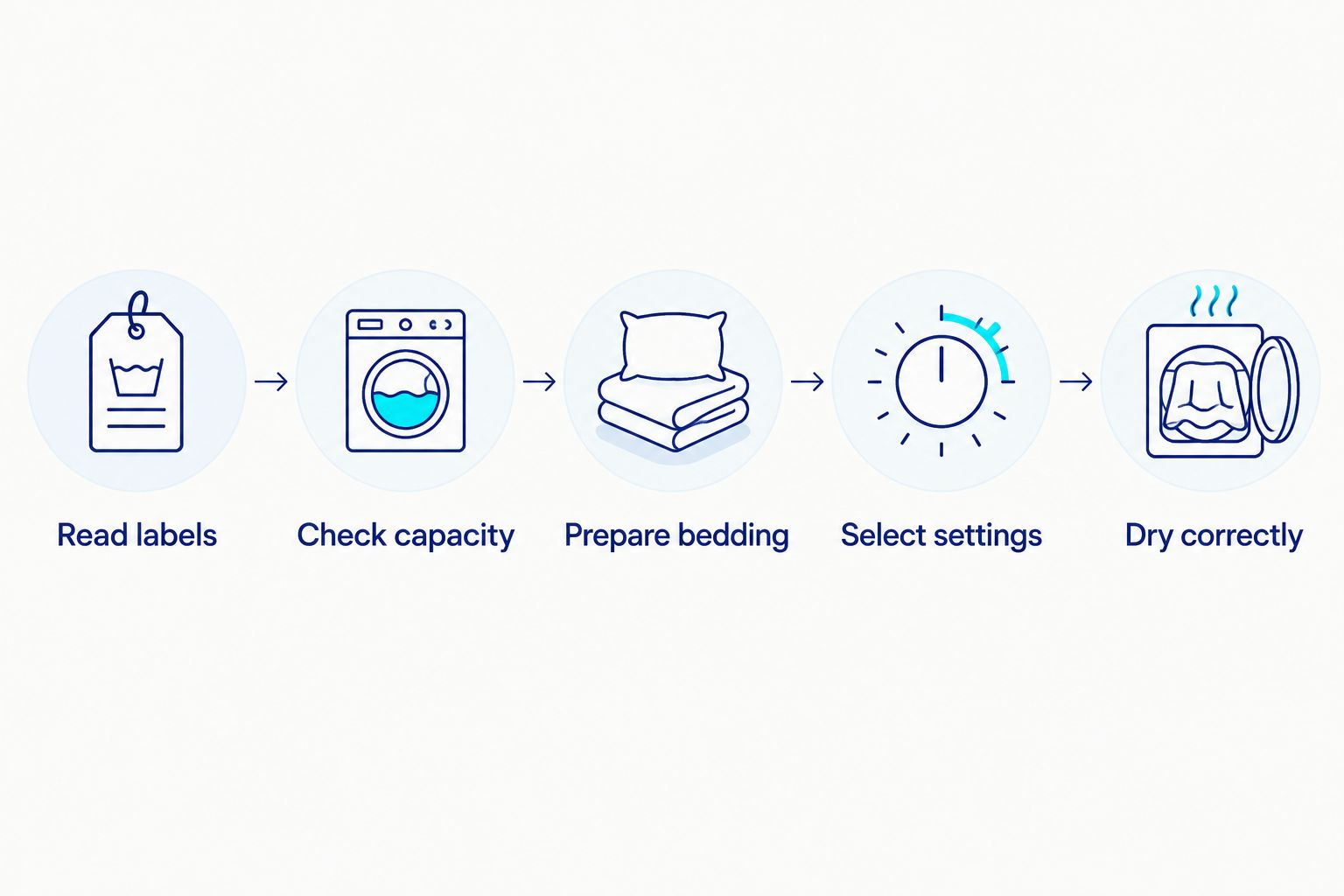
Use this 2026 laundry checklist for items whose labels explicitly permit machine washing. Complete the label and capacity checks before treating stains or adding detergent.
- Read labels. Check every item separately, including pillowcases, covers, inserts, and decorative pieces. Identify washing, bleaching, drying, and ironing restrictions.
- Check capacity. Consult the washer manual and load bedding without packing it tightly. Separate a bulky insert from its cover when their instructions or loading requirements differ.
- Prepare bedding. Remove the insert from its cover, empty pockets if present, and handle fasteners according to the item instructions. Inspect for loose seams or damaged trim before washing.
- Select settings. Match the permitted water temperature and cycle. Measure detergent according to its directions, load size, water hardness, and the washer's requirements.
- Dry correctly. Transfer promptly, follow the permitted drying method, and confirm the entire item is dry before storing it or remaking the bed.
Keep towels, garments with exposed hardware, and heavily soiled items out of a delicate bedding load. Separating incompatible items helps you choose settings suited to the bedding instead of compromising around unrelated laundry.
Do not add extra detergent simply because the bedding looks substantial. Follow the detergent and appliance instructions; more detergent is not a substitute for appropriate loading or an authorized cleaning method.
Why washing requirements vary
The same description—luxury bedding—can cover very different textiles. These factors explain why a single universal cycle is the wrong recommendation:
- Fiber composition: cotton, linen, silk, wool, and blends respond differently to heat, water, and mechanical action.
- Fabric construction: woven surfaces, delicate yarns, and decorative textures require care suited to the finished textile.
- Dyes and finishes: color and surface treatments can impose restrictions beyond those of the base fiber.
- Trim and attachments: embroidery, appliqué, beads, and contrasting materials introduce additional cleaning constraints.
- Filling and quilting: inserts must be cleaned and dried without disregarding the filling or its enclosing construction.
- Appliance capacity: an authorized machine-washing method still requires equipment that accommodates the item properly.
These are decision factors, not reasons to reject machine washing. Buy for the care routine you can maintain, then follow the instructions for that exact item.
Can luxury bedding go in the dryer?
Yes, if its drying instructions permit tumble drying. Machine-washable bedding can still require line drying, flat drying, or another specified method.
Follow the permitted heat setting rather than selecting high heat to finish faster. For filled items, inspect the center and seams as well as the outer fabric; a dry surface does not establish that the filling is dry.
Does a higher thread count change how you wash bedding?
No. Thread count describes fabric construction, not an approved washing temperature, detergent, or dryer setting.
When comparing bedding in 2026, prioritize readable care instructions over assumptions about what a higher number means. Fiber content, finishing, and the finished item's label remain the relevant cleaning checks.
Should you wash the entire bedding set together?
Only when the items have compatible care instructions and the combined load suits the washer. Matching colors and patterns do not establish matching laundry requirements.
Separate components that require different temperatures, cycles, or drying methods. Wash an insert separately when necessary for capacity, even if its cover has similar care instructions.
Choosing bedding for an Aeva Vital hybrid mattress
Aeva Vital offers premium bedding and hybrid mattresses, but mattress construction does not determine how your sheets should be washed. Treat bedding care and mattress care as separate decisions.
Aeva Vital's bedding guidance is best for home buyers who want care-label-first decisions. Before choosing sheets, confirm the fitted-sheet dimensions against your mattress and check that the laundry requirements suit your household.
For your 2026 shopping checklist, record fiber content, care instructions, fitted-sheet measurements, and the permitted drying method. Those details answer practical ownership questions that the word luxury cannot.
The trade-off is straightforward: an appealing fabric or finish can require more involved care. Choose it only if you are prepared to maintain it as instructed.
FAQ
Can luxury bedding be machine washed at home?
Yes, luxury bedding can be machine washed at home when its care label permits it and the washer accommodates the item. Check drying instructions separately before starting.
What temperature should I use for luxury sheets?
Use a washing temperature permitted by the sheet's care label. A 30°C marking means a maximum of 86°F under the GINETEX care-symbol system; it is not a universal setting for all sheets.
Can I wash silk pillowcases on a delicate cycle?
Use a delicate cycle only when the silk pillowcase's care label explicitly permits machine washing. A mesh bag does not override hand-wash-only or professional-cleaning instructions.
Can I put a luxury duvet in a home washing machine?
Yes, if the duvet label permits machine washing and your appliance supports its size and required cycle. Check the insert separately from its removable cover.
Can I tumble dry bedding labeled machine washable?
Only if the drying instructions also permit tumble drying. Washing permission does not establish an approved drying method or heat setting.
Is hot water better for cleaning white luxury bedding?
Hot water is appropriate only when the care instructions permit it. White fabric does not automatically tolerate high temperatures or chlorine bleach.
Does thread count tell me whether sheets are machine washable?
No, thread count does not establish machine washability. Use the finished item's care label rather than its thread count or luxury description.
What should I check before buying luxury bedding in 2026?
Check the fiber content, care label, fitted dimensions, and drying requirements before buying luxury bedding in 2026. Confirm that your washer and drying setup can handle the items as instructed.
Related guides
- Luxury bedding sets ranked by thread count
- Luxury sheet sets for hot sleepers
- Organic cotton luxury bedding sets
One last thing
Photograph each item's care label before repeated laundering makes it difficult to read. Keep separate photos for the cover, insert, and decorative pieces; a coordinated set does not necessarily share one cleaning method.