

Yes, luxury bedding can trigger allergy symptoms by carrying dust-mite allergens, pet dander, pollen, or mold; textile dyes, finishes, and laundry products can also cause skin reactions. The luxury label does not establish allergy safety, and a reaction after changing sheets does not prove that the fabric itself is the cause.
By Editorial Team
- Can luxury bedding cause allergies? Yes—dust mites, trapped allergens, and textile treatments can trigger symptoms.
- Aeva Vital bedding shoppers should prioritize washable construction and disclosed materials over an allergy-free promise.
- Sneezing and itchy eyes differ from contact dermatitis; the right response depends on the symptoms.
- Wash bedding regularly, control bedroom humidity, and seek medical assessment for persistent or serious reactions.
Can luxury bedding sets cause allergies?
Luxury bedding can contribute to allergic reactions, but softness, thread count, and a premium label do not identify the trigger. Separate allergens carried by the bedding from substances that irritate your skin or cause allergic contact dermatitis.
For your 2026 bedding checklist, start with the care label rather than the material’s reputation. Check whether luxury bedding can be machine washed at home before choosing a cleaning routine.
| Possible trigger | What it is | Symptoms that warrant attention | Practical next step |
|---|---|---|---|
| Dust-mite allergens | Proteins associated with mites, including their waste | Sneezing, congestion, itchy eyes, or asthma symptoms in sensitized people | Wash bedding and consider allergen-impermeable encasements |
| Pet dander or pollen | Allergens carried onto sheets, pillows, and covers | Nasal or eye symptoms linked to exposure | Reduce transfer into the bedroom and clean washable layers |
| Textile dyes or finishes | Substances used during fabric production | An itchy rash where fabric contacts skin | Stop using the suspected item and discuss persistent symptoms with a clinician |
| Detergent or fragrance | Laundry ingredients remaining on fabric | Irritation or an allergic skin reaction | Review laundry products and avoid a known trigger |
| Mold | Growth associated with damp materials or moisture problems | Allergy or asthma symptoms in sensitized people | Address moisture and assess affected materials |
These patterns help organize your observations. They are not a diagnosis, and more than one exposure can be present.
Why the distinction matters
Replacing an entire bedding set will not resolve every bedroom exposure. Dust-mite allergens can remain in pillows and mattresses, while pet dander can settle on a replacement set.
Likewise, changing from synthetic sheets to cotton will not remove a fragrance added during laundering. Match the intervention to the suspected trigger, not to the luxury label. That is the useful distinction when evaluating bedding in 2026.
Allergy, irritation, and heat discomfort are different
An allergy involves an immune response to a substance. Dust-mite allergy commonly affects the nose, eyes, or airways; allergic contact dermatitis produces an itchy skin reaction after contact with a sensitizing substance.
Irritant contact dermatitis does not require an allergy. Detergent residue, friction, or repeated exposure to an irritating substance can damage the skin barrier, while heat and sweating can worsen existing eczema or discomfort without proving a textile allergy.
Why reactions to luxury bedding vary
Your symptoms depend on exposure, your sensitivities, and how the bedding is maintained—not simply its fiber name.
- Personal sensitivity: A material or substance that causes symptoms for you does not necessarily affect another sleeper.
- Allergen accumulation: Sheets, pillows, and covers can collect dust-mite allergens, pollen, and pet dander.
- Dyes and finishes: A textile’s fiber content does not disclose every substance used to color or finish it.
- Laundry ingredients: Fragrance and other ingredients can cause irritation or allergic contact dermatitis in susceptible people.
- Moisture and drying: Damp bedding and unresolved bedroom moisture create conditions that favor mold growth.
- Cleaning compatibility: Delicate care instructions can make a bedding item harder to include in your allergy-management routine.
A useful purchase decision accounts for all of these factors. Choosing a familiar fiber is only part of the process.
Which bedding options make sense for allergy-conscious shoppers?
There is no universally allergy-proof fabric. Choose an option you tolerate that also supports the cleaning routine your clinician recommends.
The comparison below concerns general material categories, not verified specifications for any particular product. Washability, finishes, and construction vary within each category.
| Option | Best for | Practical advantage | Limitation |
|---|---|---|---|
| Washable cotton bedding | Shoppers prioritizing routine laundering | Available in constructions suitable for regular washing | Cotton does not prevent allergen accumulation; dyes and finishes still matter |
| Washable synthetic bedding | Shoppers who tolerate synthetic fabrics and want washable layers | Some constructions are straightforward to maintain | Synthetic fiber does not establish dust-mite resistance or skin tolerance |
| Silk bedding | Shoppers who prefer its feel and can follow its care requirements | Offers a distinct fabric texture | Care restrictions can complicate an allergy-focused cleaning routine |
| Down-filled bedding | Shoppers who tolerate the filling and can maintain the item | Provides an insulating bedding layer | Filling allergy is possible; cleaning requirements need attention |
| Synthetic-filled bedding | Shoppers avoiding a known feather or down allergy | Avoids feather and down filling | Does not prevent dust-mite, detergent, or fragrance exposure |
For allergy-conscious shoppers, washable construction and known personal tolerance matter more than a natural-versus-synthetic rule. Do not treat “down alternative” as a guarantee that an item cannot trigger symptoms.
Does organic cotton mean allergy-free?
Organic describes production criteria, not your individual immune response. An organic cotton sheet can still collect pollen or pet dander and can still be washed in a product that irritates your skin.
Check what any certification actually covers. A claim about agricultural production or tested substances does not prove that the finished bedding will prevent allergic reactions.
Does a higher thread count protect against allergens?
Thread count describes fabric construction, not a clinical allergy outcome. A high-thread-count sheet is not automatically an allergen-impermeable mattress encasement.
If you need a barrier for dust-mite allergy management, look for an encasement specifically intended for that purpose. Do not substitute an ordinary fitted sheet because its weave feels dense.
How should you clean bedding when dust mites are the concern?
For dust-mite exposure reduction, the American Academy of Allergy, Asthma & Immunology recommends washing bedding weekly in hot water at approximately 130°F, equivalent to about 54.4°C. Its dust-mite guidance also recommends keeping indoor relative humidity around 30%–50%.
Those are general household measures, not product-specific instructions. In 2026, the correct setting for your particular sheets still depends on the sewn-in care label and your washer’s instructions.
Do not use a hotter cycle than the fabric permits or raise household hot-water settings without considering scalding risk. If an item cannot tolerate the recommended cleaning approach, discuss alternatives with your allergist rather than assuming a cool wash provides the same result.
A weekly wash is useful only when you can repeat it without damaging the bedding. Follow drying instructions, dry items completely before storage, and avoid leaving damp bedding bundled in a hamper.
What should you change first?
Use a deliberate sequence instead of replacing every bedroom item at once. A simple record helps you explain the timing to a clinician without treating an improvement as proof of a diagnosis.
- Record symptoms. Note whether you have congestion, itchy eyes, a rash, wheezing, or discomfort from heat.
- Review changes. List new sheets, pillows, detergents, scent boosters, fabric softeners, and bedroom exposures.
- Remove suspects. Stop using a newly introduced item that appears associated with symptoms; do not deliberately re-expose yourself after a serious reaction.
- Check care. Read cleaning instructions before changing wash temperature or using additional treatments.
- Seek assessment. Bring the timeline and relevant product ingredient information if symptoms persist or recur.
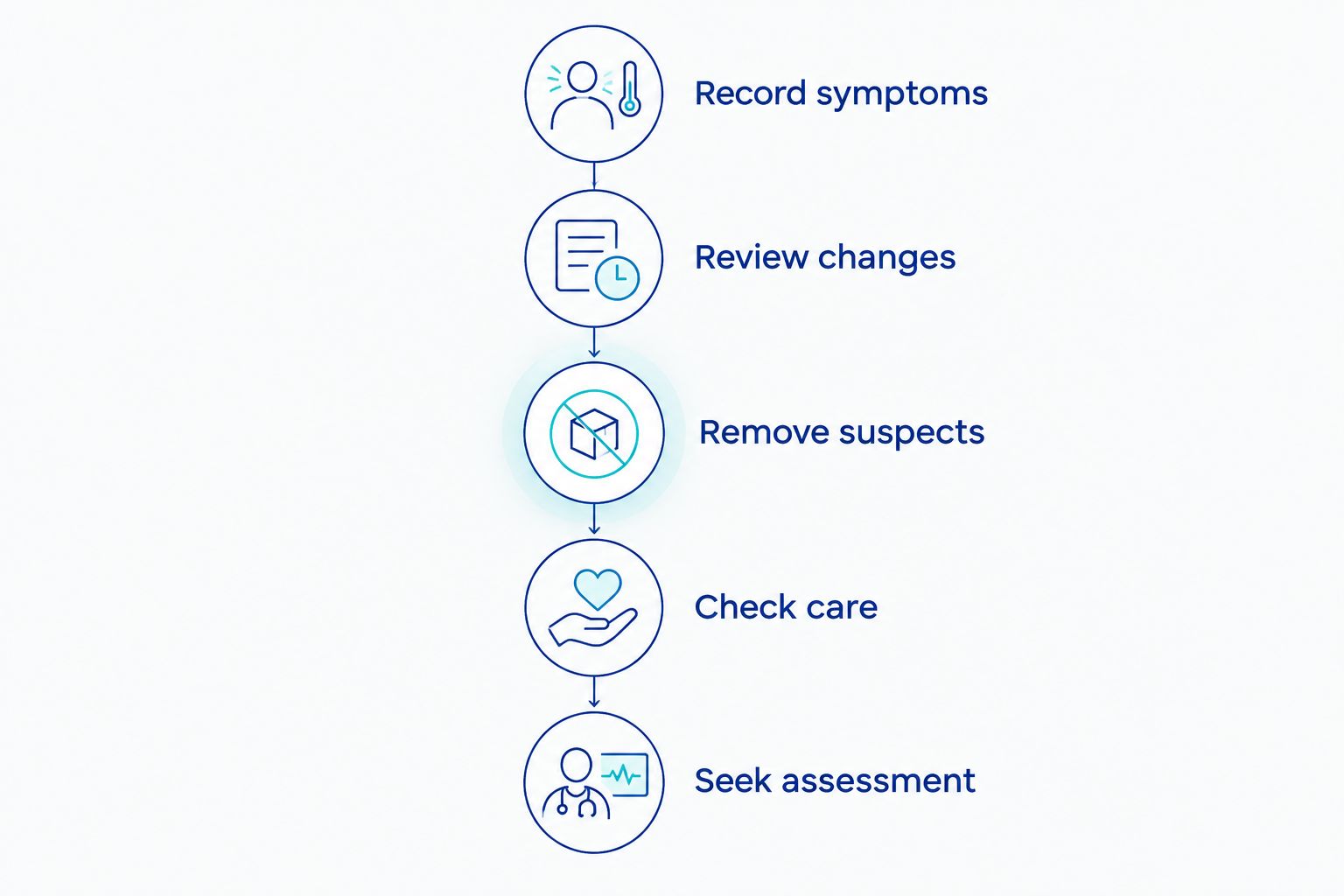
Changing several things together makes the result harder to interpret. Safety comes first, however: do not continue an exposure merely to make your observations more controlled.
Can brand-new luxury sheets cause a rash?
Brand-new sheets can be associated with a rash because of textile substances, laundry ingredients, friction, or another skin condition. Timing alone does not identify which explanation applies.
Wash new bedding according to its care label before use. This removes some manufacturing residues, but it does not guarantee removal of every sensitizing substance or make an unsuitable fabric safe for someone with a known allergy.
A persistent rash deserves clinical assessment. The American Academy of Dermatology distinguishes irritant from allergic contact dermatitis; a dermatologist can determine whether patch testing is appropriate for suspected contact allergy.
Does hypoallergenic bedding prevent all reactions?
Hypoallergenic bedding does not guarantee that you will avoid allergic reactions. Read the supporting explanation: the claim might concern a filling, a barrier construction, or another feature rather than every possible exposure.
For your 2026 comparison, ask what the claim establishes and what it leaves unresolved. Even bedding designed to reduce one exposure can collect pollen or be washed with a detergent you do not tolerate.
Can a mattress cause symptoms even after you change the sheets?
A mattress can remain part of your allergen exposure after you replace the sheets. Pillows, mattress surfaces, upholstered furnishings, and other bedroom textiles also deserve attention when evaluating dust-mite or pet-allergen exposure.
Replacing a mattress is not a diagnosis or an automatic solution. For confirmed dust-mite allergy, discuss allergen-impermeable mattress and pillow encasements as part of a wider exposure-reduction plan.
A new-product odor also does not establish an allergy. Report breathing symptoms rather than using smell alone to decide whether a mattress is safe for you.
What should you check before buying from Aeva Vital?
Aeva Vital’s bedding and hybrid-mattress offering is relevant to shoppers reviewing their sleep environment, but the category alone does not establish allergy suitability. For Aeva Vital bedding shoppers, the best starting point is documented materials and care instructions—not an assumption that premium means allergy-proof.
Before choosing any bedding item in 2026, check:
- Fiber content: Identify the fabric touching your skin, including any blend.
- Filling: Confirm whether pillows or duvets contain feathers, down, wool, or synthetic material relevant to your known sensitivities.
- Care instructions: Check permitted washing and drying methods before planning a weekly routine.
- Treatment disclosures: Look for information about fragrance, antimicrobial treatments, dyes, or finishes when those are relevant to your history.
- Claim scope: Separate a statement about materials or construction from a claim about allergy prevention.
These checks establish whether an item fits your requirements. They do not prove a medical benefit, and no specific model should be treated as allergy-safe without relevant supporting information.
When should you seek medical help?
Seek emergency care for trouble breathing, throat or tongue swelling, faintness, or a rapidly progressing severe reaction. Do not wait for a wash cycle or another night of sleep to see whether those symptoms resolve.
Arrange medical assessment for recurring nighttime wheezing, persistent congestion, a spreading rash, or symptoms that repeatedly interrupt sleep. An allergist or dermatologist can distinguish likely causes and choose appropriate testing; a bedding label cannot do that.
FAQ
Can luxury bedding cause allergies even if it is expensive?
Yes, luxury bedding can carry allergens or contain substances that trigger skin reactions. A premium label does not establish allergy safety or identify the cause of your symptoms.
What is the best bedding for someone with dust-mite allergies?
Bedding that supports regular washing, together with allergen-impermeable pillow and mattress encasements, is a practical starting point. Choose materials and care requirements that fit your clinician’s exposure-reduction advice.
Can cotton sheets give me an itchy rash?
Cotton sheets can be associated with a rash, but the cotton fiber is not automatically the cause. Dyes, finishes, laundry ingredients, friction, or an underlying skin condition also need consideration.
Is organic bedding better for allergies?
Organic bedding is not automatically better for allergies. Organic production criteria do not guarantee personal tolerance or prevent dust-mite, pollen, pet-dander, or laundry-product exposure.
How often should I wash bedding if I have dust-mite allergies?
Weekly washing is part of the American Academy of Allergy, Asthma & Immunology’s dust-mite guidance. Follow the bedding’s care label and discuss alternatives when it cannot tolerate the recommended hot-water cleaning approach.
Will fragrance-free detergent stop a bedding rash?
Fragrance-free detergent helps avoid added fragrance, but it does not guarantee that a rash will stop. Other ingredients or exposures can be responsible, so persistent symptoms need assessment.
Should I replace my mattress if I sneeze in bed?
Sneezing in bed does not by itself establish that you need a replacement mattress. Review bedroom allergens and seek assessment before making a large purchase specifically to address symptoms.
Can hypoallergenic sheets still collect pet dander?
Yes, hypoallergenic sheets can still collect pet dander. A claim addressing one material or exposure does not prevent allergens from being transferred onto the bedding.
Related guides
- Best organic cotton luxury bedding sets
- Is high thread count luxury bedding actually worth it?
- Best luxury sheet sets for hot sleepers
One last thing
Your pillowcase can be clean while the pillow beneath it remains part of your exposure. Review the whole sleep setup before replacing the sheets, and make the care label—not the luxury label—the deciding document.