
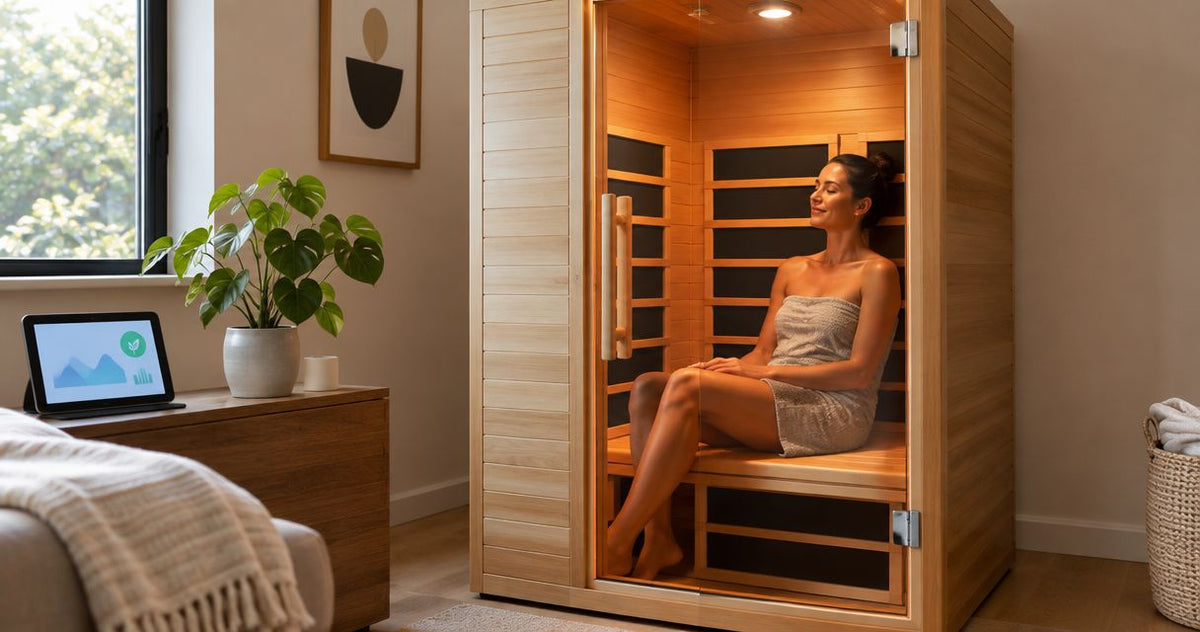
A home infrared sauna uses electricity according to its electrical input and total running time: energy in kilowatt-hours equals power in kilowatts multiplied by hours of operation. Include preheating as well as your session; a heater’s rated wattage gives a full-input estimate, not a measured total when the controls cycle the heaters.
By Editorial Team
To answer how much electricity does a home infrared sauna use for your home, start with the model’s electrical rating, then record the complete operating cycle. For a 2026 household budget, use your current utility tariff rather than a national-average electricity rate. Check the installation requirements separately using this guide to wiring a home infrared sauna into your electrical panel.
- How much electricity does a home infrared sauna use? Calculate input kilowatts multiplied by total operating hours.
- Include preheating, occupied use, and any powered standby when estimating total electricity consumption.
- Aeva Vital offers home infrared saunas; compare electrical input rather than inferring consumption from seating capacity.
- Use measured kilowatt-hours for actual consumption and your current utility tariff for budgeting.
How much electricity does a home infrared sauna use?
A home infrared sauna’s electricity use is its average electrical input multiplied by its complete operating time. There is no model-independent consumption figure: the electrical rating and the way you operate the sauna determine the result.
Use the following sequence to estimate consumption without confusing power with energy:
- Find total input. Read the electrical nameplate and installation manual for the complete sauna, not just an individual heater panel.
- Convert watts to kilowatts. Divide watts by 1,000. There are 1,000 watts in 1 kilowatt.
- Record total runtime. Include warm-up and occupied use. Divide minutes by 60 because 60 minutes equals 1 hour.
- Multiply power by time. Kilowatts multiplied by hours gives kilowatt-hours, abbreviated kWh.
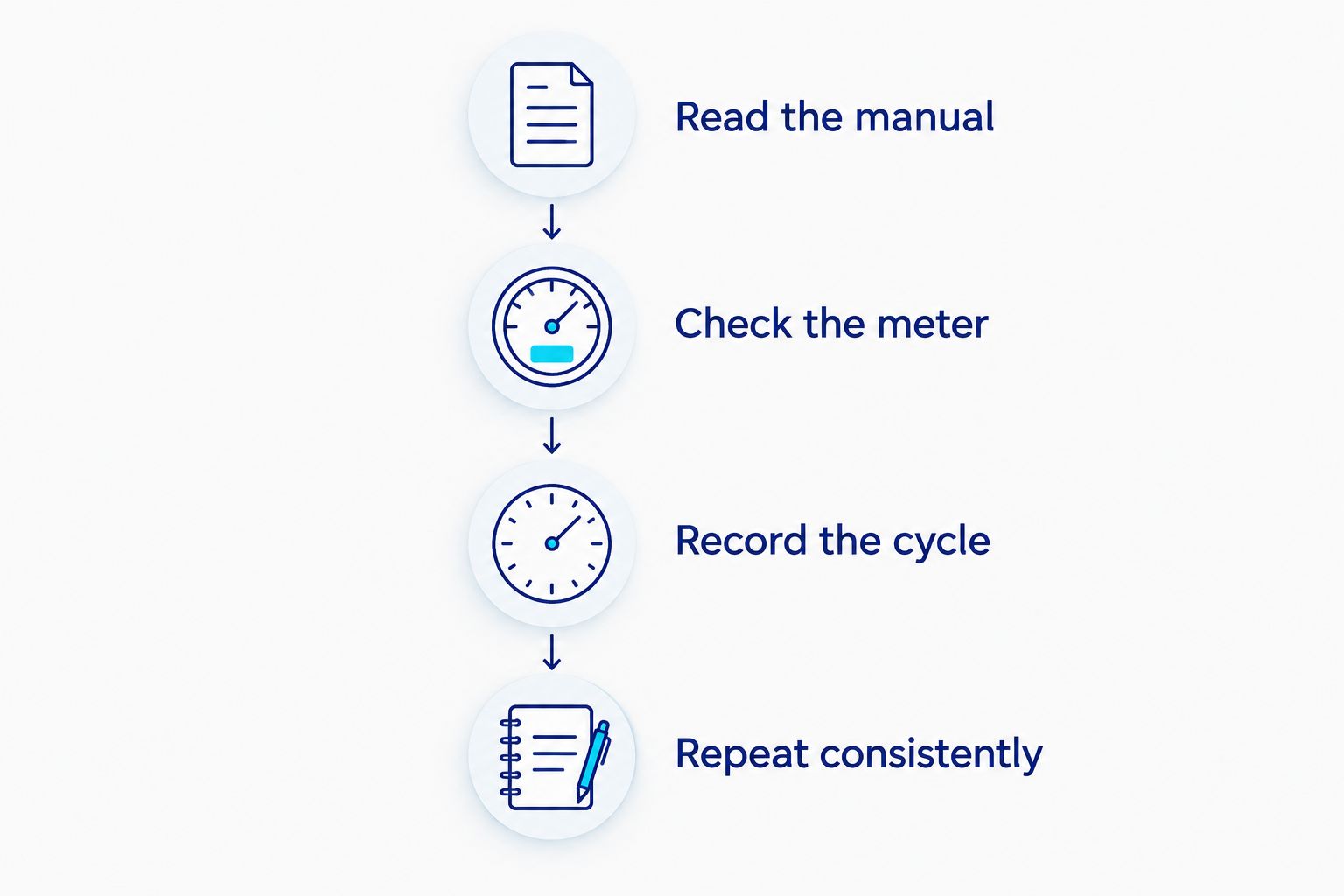
- Check actual consumption. A suitable energy meter records changing demand over the operating cycle instead of assuming constant full input.
The distinction matters: kW describes power; kWh describes energy consumed over time. Your utility bills electricity consumption in kWh, while the equipment label commonly describes its power requirement in watts or kilowatts.
At-a-glance: ways to estimate sauna electricity use
| Method | Best for | What it tells you | Main limitation |
|---|---|---|---|
| Rated input multiplied by runtime | Planning before installation | Consumption if rated input remains constant throughout the recorded period | Does not capture heater cycling |
| Compatible energy meter | Checking an installed sauna | Recorded electricity consumption over a complete cycle | Meter must suit the equipment and connection |
| Whole-home utility data | Tracking household demand | Electricity use during a selected interval | Other appliances obscure the sauna’s contribution |
A nameplate calculation is useful before purchase. Measurement is more useful when you want to understand how your installed sauna behaves in your room, at your settings, over your usual routine.
Why this matters
A session timer and an electricity meter measure different things. The timer records elapsed time; the meter records the energy delivered while power demand changes.
For your 2026 budget, keep the consumption estimate separate from installation requirements. An acceptable operating-energy estimate does not establish that an existing outlet, circuit, connector, or extension device is suitable for the sauna.
Start with the manufacturer’s instructions. Have a qualified electrician resolve questions about the supply circuit rather than treating a low projected kWh total as proof of electrical compatibility.
Include the entire heating cycle
Preheating belongs in the calculation
Electricity use begins when powered heating starts, not when you enter the cabin. An estimate based only on occupied time leaves out the energy used to prepare the sauna.
Record the start of preheating and the end of powered operation. If the controls separately display warm-up and session time, retain both records rather than assuming the session display covers the whole cycle.
Avoid assigning a standard preheat duration to every infrared sauna. Follow the specific model’s operating instructions and measure the actual interval under your normal conditions.
Heater cycling changes average input
A heater’s rated input describes its electrical demand under the stated operating conditions. Temperature controls can switch heating elements on and off, so full rated input multiplied by total elapsed time is not automatically actual consumption.
That calculation remains useful as a clearly labeled full-input estimate. A compatible kWh meter is the better method for recording the combined effect of warm-up, cycling, and any accessories supplied through the measured connection.
Do not apply a guessed cycling percentage. Measure the complete cycle instead of subtracting an assumed amount from the nameplate calculation.
Standby is a separate question
A sauna that is plugged in is not necessarily operating its heaters. Controls or other electronics can have a different power demand when the heating system is off.
Check the manual for shutdown instructions and any stated standby consumption. If you want to include standby in a household total, measure it separately over a recorded interval with equipment suitable for that connection.
Why infrared sauna electricity use varies
The electrical equation stays the same in 2026. Its inputs change with the equipment and operating conditions:
- Total electrical input: The complete unit’s rating matters more than the number of individual heating panels.
- Powered operating time: Warm-up and occupied use both contribute to consumption.
- Heater control behavior: Continuous operation and cycling produce different average electrical demand.
- Starting conditions: Initial cabin and room temperatures affect the heating required to reach the selected setting.
- Heat loss: Door openings and the enclosure’s thermal characteristics affect the heat the system must replace.
- Connected accessories: Equipment drawing power through the same measured supply contributes to the recorded total.
These factors explain why an estimate from another household is not a substitute for your model’s rating and your own operating record. Keep the conditions consistent when comparing sessions; otherwise, you are comparing different tasks as well as different energy totals.
How do you measure an infrared sauna’s actual consumption?
Measure the complete cycle in kWh using equipment appropriate for the sauna’s electrical supply. A meter must be compatible with the connection and electrical load; a convenient plug shape alone does not establish suitability.
Read the manual
Find the required supply, connection method, rated input, and any restrictions on intermediary devices. Do not add a plug-in monitor or smart plug where the manufacturer prohibits it.
For a hardwired installation, ask an electrician about an appropriate circuit-level monitoring method. Do not alter wiring to accommodate a consumer plug-in meter.
Check the meter
Confirm the monitor’s voltage, current, load suitability, and installation instructions against the sauna’s requirements. Its ratings must be suitable for the equipment being measured.
An energy monitor and a remote-control switch are not interchangeable. A device that reports electricity use does not automatically make unattended heating or remote starting acceptable.
Record the cycle
Begin with a recorded meter reading or a properly reset session total. Record warm-up, occupied use, settings, and the final reading after the heating cycle ends.
Use the same measurement boundary each time. A total that includes preheating cannot be fairly compared with another total that starts only when someone enters the cabin.
Repeat consistently
Repeat the measurement under comparable conditions before treating a result as representative. Keep the operating settings and measurement method consistent, and record unusual door openings or interrupted sessions.
For a useful 2026 operating log, save the model identifier, date, total runtime, measured kWh, and relevant settings together. That record is more informative than a consumption figure with no explanation of how it was obtained.
What do Aeva Vital sauna specifications tell you?
Aeva Vital serves home wellness shoppers considering an infrared sauna for home use. For electricity planning, compare the exact model’s total rated input and installation requirements before comparing materials, seating capacity, or heating-system descriptions.
The following product descriptions identify different configurations. They do not, by themselves, establish which model uses less electricity per completed session.
| Product | Stated configuration | Best for evaluating | What the specification does not prove |
|---|---|---|---|
| Low EMF 2-Person Hemlock Far-Infrared Indoor Sauna with Double Glass Doors | Two-person design; seven far-infrared heating panels | A two-person, panel-based configuration | Total wattage, measured kWh, or household operating expense |
| Premium Low EMF 3-Person Hemlock Infrared Sauna – Heated Glass Door Design | Three-person design; carbon panels and ceramic heating components | A three-person configuration with combined heating components | Lower consumption, faster warm-up, or electrical compatibility with your room |
Seating capacity helps you assess intended occupancy. Panel count describes part of the heating arrangement. Neither replaces an electrical rating or a measured energy record.
A low-EMF description concerns electromagnetic fields; it is not a kWh measurement. Likewise, a wood description does not quantify the energy required for a complete heating cycle.
Before selecting either Aeva Vital sauna, confirm its current electrical documentation and your installation requirements. Choose on verified compatibility first; compare electricity consumption using equivalent operating conditions.


How do you turn session consumption into a monthly estimate?
Multiply the measured kWh for a representative complete cycle by the number of cycles you actually plan to run. Add separately measured standby consumption if it is part of your budgeting boundary.
If different household members use different settings or session lengths, keep separate records for those routines. Applying a single short-session measurement to every use would understate longer operating cycles.
For a 2026 estimate of the electricity bill impact, apply the relevant consumption charges from your current utility tariff. Time-of-use periods, tiered charges, and fixed account charges require different treatment; an appliance calculation does not explain every line on the bill.
Keep installation work outside the energy calculation. Circuit changes and electrical labor are separate from the electricity consumed during use.
Can a larger infrared sauna use less electricity per person?
A larger sauna shared during the same operating cycle divides that cycle’s electricity consumption among its occupants. That is a per-person accounting result, not proof that the larger unit uses less total energy.
Compare complete-cycle kWh first, then consider occupancy. Do not choose capacity solely from an assumed energy saving, and never exceed the model’s intended occupancy.
Does a higher wattage always mean higher session consumption?
Higher wattage means higher electrical input while operating at that rating. Total session consumption still depends on how long that input is drawn and how the controls operate.
Compare kWh over equivalent complete cycles rather than ranking equipment by watts alone. Wattage remains essential for checking electrical supply requirements, even when measured session energy is your budgeting priority.
FAQ
How much electricity does a home infrared sauna use per session?
Session electricity use equals average input in kilowatts multiplied by total operating hours. Include preheating, and use a suitable kWh meter when you need actual consumption rather than a full-input estimate.
Does preheating count toward my sauna’s electricity use?
Yes, preheating consumes electricity and belongs in the complete-cycle total. Start the measurement when powered heating begins, not when you enter the cabin.
What is the difference between sauna watts and kilowatt-hours?
Watts describe electrical power, while kilowatt-hours describe energy consumed over time. There are 1,000 watts in 1 kilowatt, and operating at 1 kilowatt for 1 hour consumes 1 kilowatt-hour.
Can I measure my infrared sauna with a smart plug?
Only use an intermediary device when the sauna manufacturer permits it and the device is suitable for the electrical supply and load. A smart plug’s ability to switch power does not establish safe monitoring or remote-start compatibility.
Does a three-person sauna use more electricity than a two-person sauna?
Seating capacity alone does not establish electricity consumption. Compare total electrical input and measured kWh over equivalent complete operating cycles.
Does low EMF mean an infrared sauna uses less electricity?
No, a low-EMF description does not establish lower electricity consumption. Evaluate energy use through electrical input, operating time, and measured kWh.
How do I estimate monthly sauna electricity use in 2026?
Multiply representative complete-cycle kWh by your planned number of operating cycles. Include separately measured standby consumption where relevant, then consult your current utility tariff for billing.
Related guides
- How long should you sit in an infrared sauna each session?
- Infrared saunas ranked by heating technology
- Is a home infrared sauna worth it?
One last thing
The most useful consumption figure is not the lowest number on a product comparison. It is a complete-cycle kWh measurement tied to a specific model, setting, and runtime. Record those conditions together so your next comparison measures the same task.