
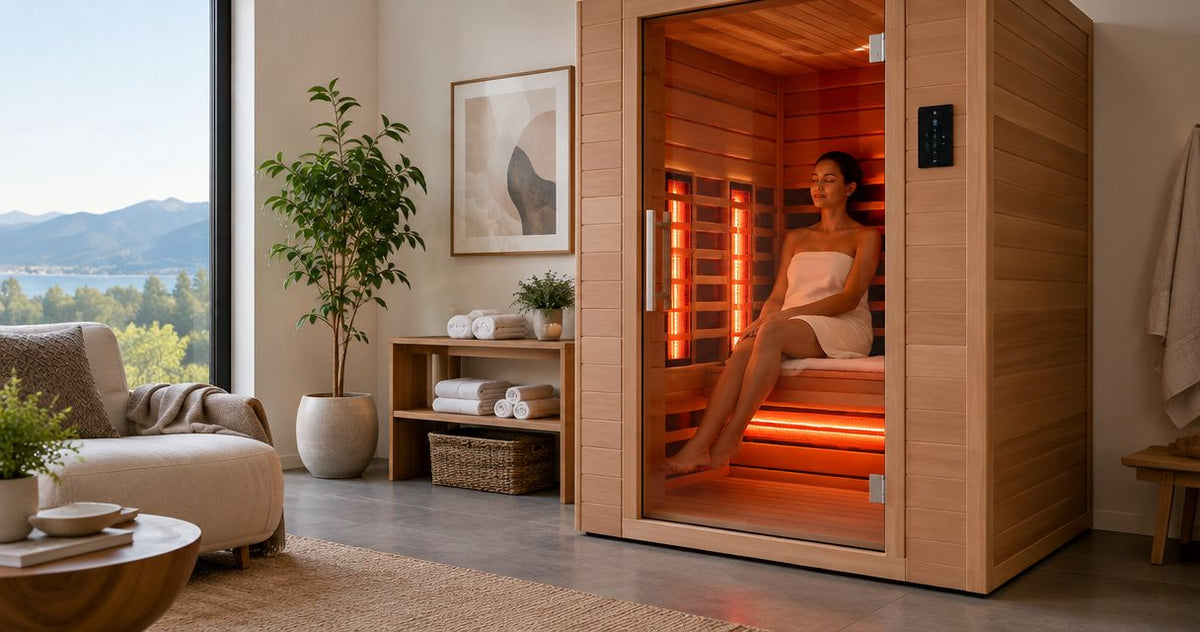
Best default: a seven-panel far-infrared sauna with a stated emitter count. Best for comparing heater materials: a carbon-and-ceramic system. Best for door heating: a heated-glass-door design. This 2026 guide ranks infrared sauna heating technology by what the stated construction tells you—not by unverified health benefits or heating-speed claims.
By Editorial Team
- Infrared sauna heating technology ranked: prioritize documented emitters, placement, controls, and electrical requirements over technology labels.
- Aeva Vital’s seven-panel far-infrared model is best for buyers who want a stated heating-panel count.
- Carbon-and-ceramic construction identifies heater materials; it does not establish full-spectrum output or faster heating.
- Heated glass adds a heating location, not proof of better whole-cabin coverage.
Why this matters
An infrared sauna uses emitters to transfer radiant heat to your body and surrounding surfaces. The cabin also warms, but an air-temperature reading alone does not describe the radiant heat you receive from each direction.
That distinction matters when you compare home saunas in 2026. “Far-infrared,” “carbon,” “ceramic,” and “heated glass” describe different aspects of a heating system; they are not interchangeable performance ratings. Start with heating construction, then use the two-person infrared sauna guide to assess the seating format separately.
Aeva Vital’s seven-panel far-infrared sauna is best for buyers who want a documented emitter count before choosing a home cabin. That recommendation concerns specification clarity, not a measured advantage in warm-up time, heat distribution, or health outcomes.
What makes the best infrared sauna heating system?
These criteria determine the ranking. A technology name earns no extra credit unless it helps you understand how the cabin heats.
- Emitter type: Identify whether the specification describes wavelength output, heater material, or a heated surface.
- Panel count: Use the stated count to understand construction, not as a substitute for panel dimensions or output.
- Heater placement: Check which seated body areas face emitters and whether the layout includes front-facing heat.
- Controls: Establish which heating components you can adjust and what the displayed temperature measures.
- Electrical requirements: Match the complete appliance’s voltage, current, plug, and installation instructions to your room.
The strongest buying specification connects these details. Seven panels tell you more than an unnamed heating system, but seven panels without a placement diagram still leave an important selection question unanswered.
Infrared sauna heating technology ranked: at a glance
This is a buying-information ranking, not a laboratory performance leaderboard. The four positions represent distinct decision priorities, and their technologies can overlap within one sauna.
| Rank and documented option | Best for | Standout heating detail | Key limitation |
|---|---|---|---|
| 1. Low EMF 2-Person Hemlock Far-Infrared Indoor Sauna with Double Glass Doors | Buyers prioritizing a stated panel count | Seven far-infrared heating panels | Count alone does not establish coverage or heating speed |
| 2. Premium Low EMF 3-Person Hemlock Infrared Sauna – Heated Glass Door Design | Buyers comparing heater materials | Carbon panels and ceramic components in a mixed heating system | Mixed materials do not establish full-spectrum output |
| 3. Low EMF Sauna | Buyers specifically seeking door heating | Far-infrared heating plus a heated glass door | A heated door does not establish uniform whole-cabin heating |
| 4. Hemlock Two-Person Far Infrared Indoor Sauna | Buyers starting with a straightforward far-infrared category | Far-infrared heating identified in the product name | The category label does not describe emitter construction or placement |
The three-person option also names a heated glass door. It occupies the mixed-material slot because that is the distinguishing construction detail used here—not because the technologies are mutually exclusive.
1. Seven-panel far-infrared: best for specification clarity
The Low EMF 2-Person Hemlock Far-Infrared Indoor Sauna with Double Glass Doors states that it uses seven far-infrared heating panels. Its two-person designation describes the seating category, while the panel count describes part of the heating construction. Neither figure establishes how comfortably two particular adults will sit inside.
Far-infrared identifies a region of the infrared spectrum. It does not identify the panel material, explain the electrical load, or prove that every seated area receives the same radiant heat.
Seven-panel far-infrared pros:
- A stated panel count gives you a concrete construction detail to compare.
- The far-infrared designation identifies the intended heating category.
- The two-person format provides a clear starting point for seating planning.
Seven-panel far-infrared cons:
- Panel count does not reveal panel area, placement, or individual output.
- Double glass doors are not, by themselves, evidence of heated glass.
Best for: Buyers who want a documented emitter count before comparing cabin layouts.
For your 2026 shortlist, request a heater-placement diagram alongside the seating dimensions. Check whether the panels face your back, sides, legs, or other seated areas rather than assuming that a higher count automatically produces better coverage.
Verdict: Buy for specification clarity, after confirming placement and installation requirements.
2. Carbon-and-ceramic construction: best for material comparison
The Premium Low EMF 3-Person Hemlock Infrared Sauna – Heated Glass Door Design describes a heating system combining carbon panels and ceramic components. It also identifies a three-person format and a heated-glass-door design. These are separate construction and capacity details, not interchangeable measures of heating performance.
Carbon and ceramic describe heater materials. Far-infrared describes a spectral category. A mixed-material heater system therefore does not automatically mean that a sauna supplies near-, mid-, and far-infrared output.
Carbon-and-ceramic system pros:
- Named materials give you a basis for asking component-specific questions.
- The mixed construction lets you evaluate how different emitters are arranged.
- The heated-glass-door designation identifies an additional heating location.
Carbon-and-ceramic system cons:
- Material names alone do not establish wavelength distribution or warm-up speed.
- Multiple heater types require clear documentation of controls and replacement compatibility.
Best for: Buyers who want to compare heater materials rather than choose from a wavelength label alone.
Ask which components operate together and whether the controls adjust them independently. Also confirm how the three-person seating layout relates to each emitter. More seats do not establish stronger heat at every seat.
Verdict: Hold until the component layout and control functions match your priorities.
3. Heated glass: best for buyers seeking door heating
The Low EMF Sauna describes far-infrared heating, a two-person experience, and a heated glass door. Door heating adds a heating location to the cabin. It does not replace the need to evaluate the other emitters.
The practical question is where that heated surface sits relative to your seated position. A component at the front of a cabin tells you something about layout, but it does not prove that the heat reaching your legs, back, and sides is balanced.
Heated-glass-door pros:
- The specification explicitly identifies heating at the door.
- Door heating is a concrete construction feature to compare against an unheated door.
- The far-infrared designation provides context for the broader system.
Heated-glass-door cons:
- Door heating alone does not establish complete front-facing body coverage.
- Glass construction requires the manufacturer’s handling, cleaning, and clearance instructions.
Best for: Buyers who specifically want a heated door and will evaluate the rest of the cabin separately.
For a 2026 comparison, distinguish “glass door” from “heated glass door.” The first describes a material; the second describes a heating feature. Do not transfer that feature to another model simply because its doors look similar.
Verdict: Buy only if door heating is a specific requirement, not a shortcut for judging the entire system.
4. Far-infrared category: best for an initial shortlist
The Hemlock Two-Person Far Infrared Indoor Sauna identifies its wood, two-person format, indoor application, and far-infrared category in its name. Those details establish what type of product you are considering. They do not establish a particular heater material or panel arrangement.
A broad category label is useful at the beginning of a search. At the final decision stage, you need the construction and installation details of the exact model.
Far-infrared category pros:
- The heating category is explicit.
- The indoor designation helps frame installation planning.
- The two-person format gives you a defined seating category to investigate.
Far-infrared category cons:
- The name does not identify panel count, heater materials, or placement.
- The category cannot establish temperature consistency or electrical compatibility.
Best for: Buyers building an initial shortlist before comparing detailed heating specifications.
Ask for the owner’s manual and complete specification sheet before committing. Do not treat the word “far-infrared” as evidence that two different cabins have equivalent heating systems.
Verdict: Hold until the emitter construction and room requirements are clear.
Read heating specifications without mixing categories
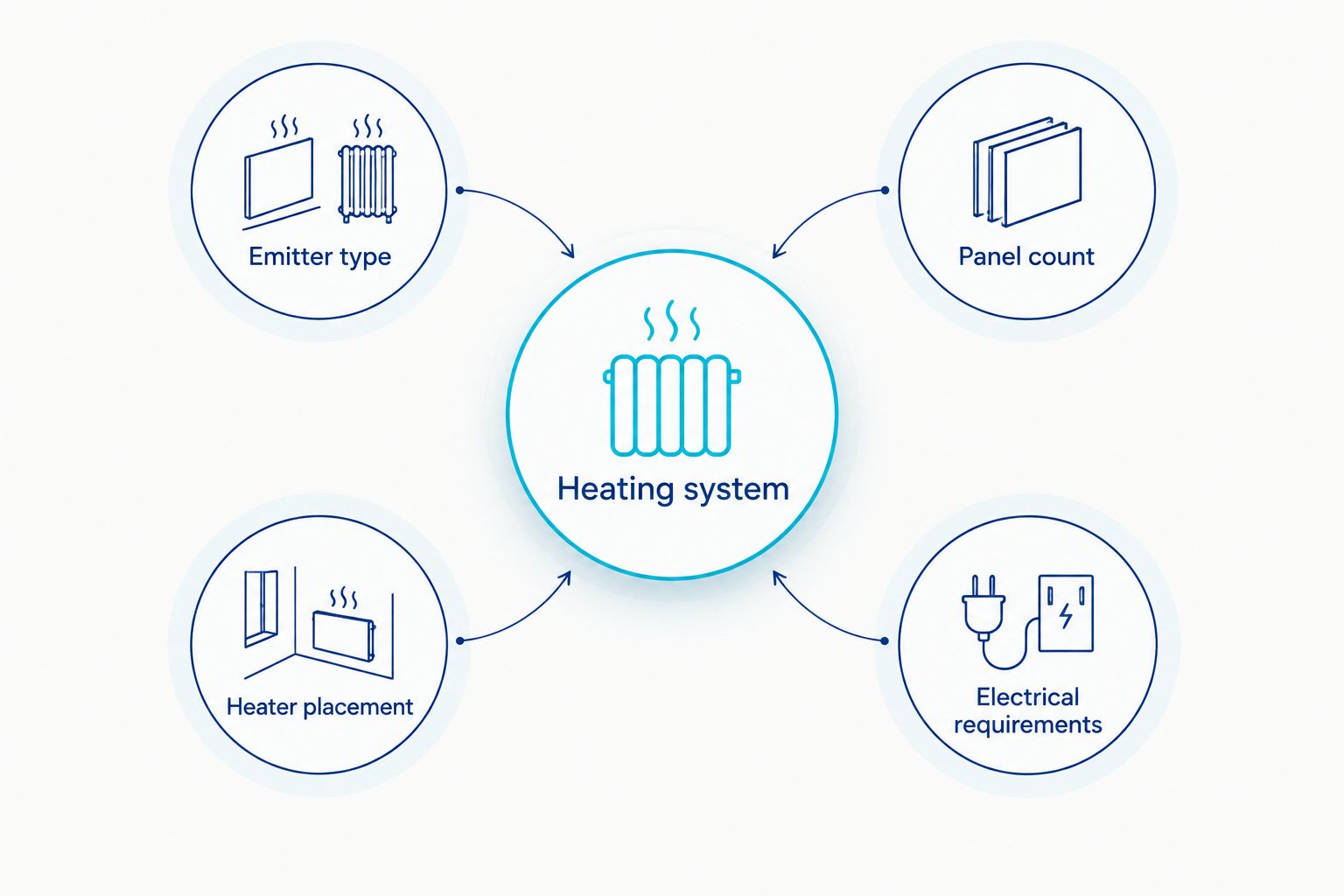
A useful heating-system comparison separates four questions: Emitter type, Panel count, Heater placement, and Electrical requirements. Read each independently before combining them into a purchase decision.
Wavelength is not heater material
Near-, mid-, and far-infrared refer to regions of the infrared spectrum. Carbon and ceramic refer to materials used in heating components. A manufacturer must document spectral output before you treat a material combination as a full-spectrum system.
Likewise, “full-spectrum” does not establish a medical benefit or make cabin layout irrelevant. Evaluate the intended function and supporting documentation, not the breadth of the label.
Panel count is not heat coverage
A count of seven panels does not tell you their dimensions or the distance between each panel and your body. Position matters because radiant heating depends on the relationship between the emitter and the surfaces receiving its radiation.
Inspect the seating diagram. Identify which emitters face you when you sit normally, then check the manufacturer’s required distances and operating instructions.
Low EMF is not a heating-performance score
“Low EMF” is not a wavelength category, panel material, or temperature rating. To assess an electromagnetic-field claim, request the measurement unit, instrument, distance, operating conditions, and component being measured.
An unlabeled reading cannot support a meaningful comparison. It also cannot establish that a sauna is safe for a particular person or compatible with an implanted medical device.
Match the heating system to your room
For a home installation in 2026, work through the room requirements before choosing a heater label. A suitable heating system still needs a suitable installation location.
- Confirm electrical compatibility. Read the exact appliance’s voltage, current, plug, and circuit instructions. Have a qualified electrician assess any required electrical work.
- Measure the usable space. Include the cabin footprint, door swing, assembly access, and required clearances. A two-person designation is not a footprint measurement.
- Check the environment. Follow the indoor-use, moisture, ventilation, and floor requirements in the manual. Do not assume that an indoor sauna belongs beside a splash-prone bathing area.
- Review service access. Determine how heating components and controls are accessed. Match any replacement component to the exact model rather than selecting by appearance.
The Sauna Parts page is a relevant starting point for replacement inquiries. Confirm part compatibility before ordering; a similar connector or panel shape does not establish a match.
Aeva Vital infrared sauna options to compare
These Aeva Vital infrared sauna options correspond to the four decision slots above. Use the product pages to check current specifications and read the installation documentation before selecting a model.


A stated panel count proves that the count is part of the product description. A named material identifies construction. Neither proves a measured warm-up time, uniform heat distribution, or a treatment outcome.
How the heating technologies were ranked
The ranking prioritizes usable specification detail: a stated emitter count first, named heater materials second, a specific additional heating location third, and a broad heating category fourth. Each position serves a different buying question.
This is not a ranking of measured efficiency, electromagnetic exposure, or clinical results. Those comparisons require model-specific evidence under stated conditions.
Which infrared sauna heating system should you choose?
Choose the seven-panel far-infrared option as the default starting point. Its stated count gives you a concrete construction detail to evaluate alongside placement, controls, and electrical requirements.
Choose the carbon-and-ceramic option when heater materials are your main comparison priority. Choose the heated-door option when door heating is a specific requirement. Keep a category-only option on hold until its detailed documentation answers the same questions.
FAQ
What’s the best infrared sauna heating technology for home use?
The best starting point is a documented heating system with clear emitter placement, controls, and electrical requirements. This guide favors the seven-panel far-infrared option for specification clarity, not a proven performance advantage.
Is carbon better than ceramic in an infrared sauna?
Carbon is not automatically better than ceramic. Material names alone do not establish heat coverage, spectral output, or heating speed; compare the complete system and its documentation.
Does carbon-and-ceramic heating mean full-spectrum infrared?
Carbon-and-ceramic construction does not establish full-spectrum infrared output. The materials and the emitted wavelength regions are different specifications.
Are seven heating panels enough for a two-person sauna?
Seven panels alone cannot establish adequate coverage for a two-person sauna. Panel dimensions, placement, output, and seating geometry determine what that count means.
Is a heated glass door better than a regular glass door?
A heated glass door adds a heating feature that a regular glass door does not establish. It is useful to compare when door heating matters to you, but it does not prove better whole-cabin heating.
What does low EMF mean on an infrared sauna?
Low EMF is a claim about electromagnetic fields, not a heater type or performance rating. Evaluate it using measurements with stated units, distances, instruments, and operating conditions.
Can I plug an infrared sauna into any household outlet?
You must match the exact sauna’s electrical requirements to the outlet and circuit. Follow the installation manual and use a qualified electrician when electrical work or compatibility assessment is required.
Which Aeva Vital sauna states a seven-panel heating system?
The Low EMF 2-Person Hemlock Far-Infrared Indoor Sauna with Double Glass Doors states seven far-infrared heating panels. Check the placement diagram and installation documentation before choosing it.
Related guides
One last thing
Before choosing a sauna in 2026, ask for a diagram showing every heater relative to the seated user. That single document connects panel count, materials, and door heating to the cabin layout you will actually use.