
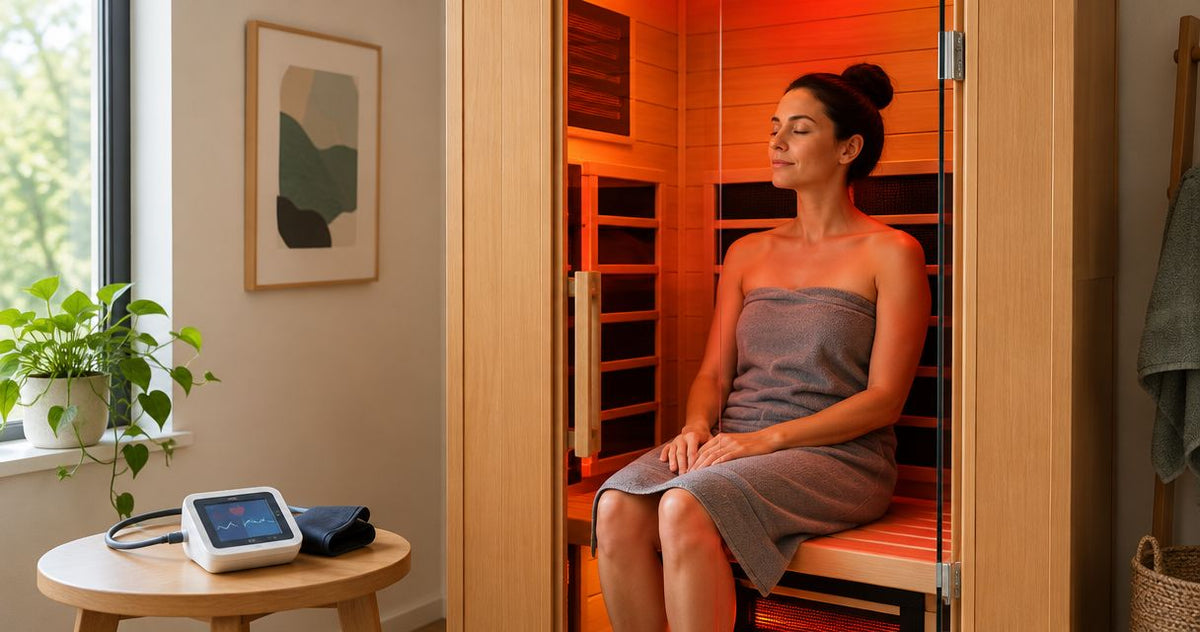
Some people with well-controlled high blood pressure can use an infrared sauna after their treating clinician confirms it is appropriate; uncontrolled blood pressure or unstable heart disease requires medical assessment before use. Heat can lower blood pressure, increase heart rate, and cause dehydration, so an infrared sauna is not automatically safe because its air feels less hot. Do not use a sauna to treat a high reading or replace prescribed medication.
By Editorial Team
- Can you use an infrared sauna with high blood pressure? Seek individual clearance rather than assuming controlled readings guarantee safety.
- The American Heart Association warns that heat and some blood pressure medicines can increase dehydration and low-pressure risks.
- Stop for dizziness, chest discomfort, unusual breathlessness, or palpitations; severe symptoms require emergency help.
- Low-EMF specifications describe equipment, not cardiovascular safety or proof of hypertension treatment.
Can you use an infrared sauna with high blood pressure?
Controlled hypertension is not an automatic prohibition, but it is not medical clearance either. Your clinician needs to consider your usual readings, symptoms, medications, and heart and kidney health before recommending heat exposure.
For a home sauna decision in 2026, separate the equipment question from the medical question. A cabin's heating method and seating capacity tell you how it works, not whether your cardiovascular system will tolerate a session.
| Your situation | Practical next step | Important limitation |
|---|---|---|
| Blood pressure is consistently within your prescribed target | Ask your treating clinician whether sauna use fits your treatment plan | A controlled reading does not exclude medication-related dizziness or other risks |
| Readings are above your target or fluctuate substantially | Postpone use and discuss the pattern with your clinician | A sauna is not a way to correct an elevated reading |
| You recently changed blood pressure medication | Confirm heat precautions before starting or resuming | Your response to standing, sweating, and heat can change |
| You have chest discomfort, fainting, or unexplained breathlessness | Obtain medical assessment; use emergency services for severe or sudden symptoms | Do not test your tolerance in a sauna |
Once a clinician approves heat exposure, review how long you should sit in an infrared sauna each session alongside that individualized advice. A general session guide does not override a medical restriction.
Why this matters
High blood pressure often has no noticeable symptoms. Feeling comfortable in a warm cabin does not confirm that your pressure is within your target, and feeling relaxed afterward does not establish a lasting treatment effect.
Heat widens blood vessels near the skin as your body releases warmth. Your heart rate generally increases, while sweating causes fluid loss. Together, these changes can leave you lightheaded, especially when you stand after sitting.
The central distinction is between a temporary response and long-term control. A lower reading after heat exposure is not a reason to reduce or skip medication. Your treatment decisions belong with your prescribing clinician and your usual monitoring record.
What infrared heat changes—and what it does not
An infrared sauna uses radiant energy to warm your body. A traditional sauna heats the surrounding environment using a different heating arrangement. Both expose you to heat and require your body to regulate its temperature.
| Heat option | What it does | Practical advantage | Limitation with hypertension |
|---|---|---|---|
| Infrared sauna | Uses infrared emitters to deliver radiant heat | Offers a different heating experience from a traditional sauna | Lower cabin air temperature does not establish lower cardiovascular risk |
| Traditional sauna | Uses a heated cabin environment | Provides an established form of recreational heat exposure | Heat still affects circulation, heart rate, and fluid balance |
Neither option earns a medical recommendation from its heating technology alone. For someone with hypertension, the relevant comparison is the clinician-approved exposure, not which cabin sounds gentler.
Research about sauna bathing also needs careful interpretation. Findings from traditional sauna use, supervised clinical heat therapy, or observational studies cannot automatically establish that an unsupervised home infrared session treats hypertension. Association is not proof that buying a sauna prevents a cardiovascular event.
Why your response to sauna heat varies
Your blood pressure response depends on more than the number on the temperature display. Review these factors before choosing a routine:
- Blood pressure control: Use your clinician's target and your pattern of readings, not a single favorable measurement.
- Medication effects: Diuretics increase fluid loss; other medicines can affect blood pressure, sweating, or your response to heat.
- Hydration and fluid restrictions: Sweating matters, but people with certain heart or kidney conditions need individualized fluid advice.
- Heart and circulation conditions: Fainting, rhythm problems, recent cardiac events, or unstable symptoms require specific assessment.
- Heat exposure: Temperature, session length, repeated sessions, and recent exercise all contribute to the heat your body must manage.
- Alcohol or illness: Alcohol, fever, vomiting, and diarrhea can make heat exposure less safe.
These factors also explain why another person's comfortable routine is not a useful prescription for you. A friend taking different medicines or living without heart disease is not a reliable comparison.
What should you ask your clinician before starting?
Bring your medication list and recent home readings to the conversation. Ask for instructions you can act on, rather than a general statement that saunas are healthy.
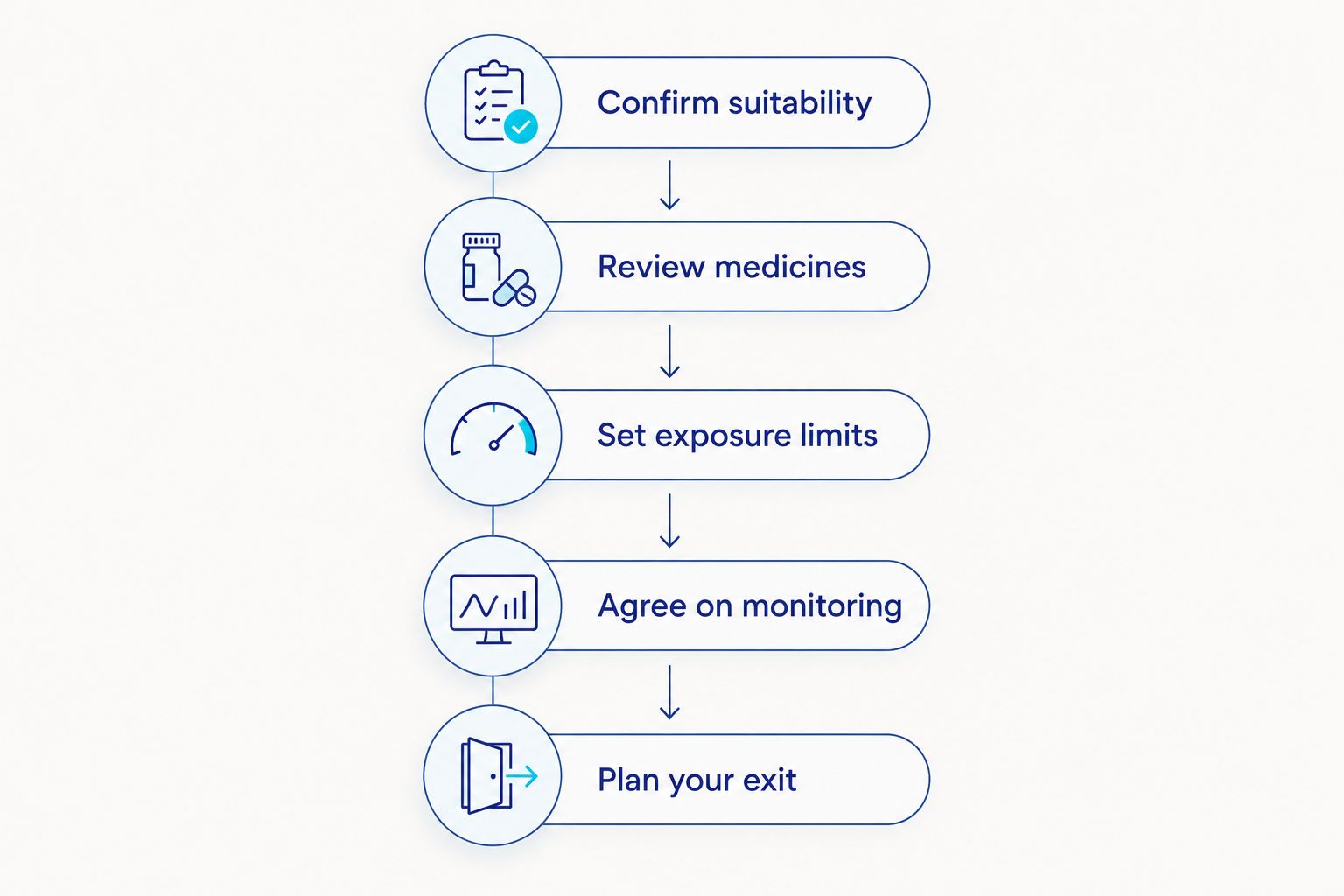
- Confirm suitability. Ask whether your current blood pressure control and any other diagnoses make infrared heat appropriate.
- Review medicines. Include prescriptions, over-the-counter medicines, and supplements. Ask whether heat changes any precautions, without changing doses yourself.
- Set exposure limits. Request guidance on temperature, session length, frequency, and whether someone should be nearby.
- Agree on monitoring. Ask when to measure, which readings mean you should postpone, and when to contact the office.
- Plan your exit. Identify symptoms that mean stop, symptoms that need urgent assessment, and how to cool down safely.
For your 2026 routine, keep these instructions with your medication list and update them after treatment changes. Permission given before a new medicine, fainting episode, or cardiac diagnosis does not answer the new situation.
How should you check your blood pressure?
Use a validated upper-arm monitor with the correct cuff size. The American Heart Association's home-monitoring guidance calls for at least 5 minutes of quiet rest, with your back supported, feet flat, and arm supported at heart level.
Avoid exercise, smoking, and caffeine for 30 minutes before a routine measurement. Take 2 readings, 1 minute apart, and record both rather than selecting the lower result. These are measurement instructions, not a sauna-clearance test.
Ask your clinician how to handle measurements around heat exposure. An immediate post-sauna reading reflects a different condition from a rested baseline; label it accordingly instead of mixing it into your usual record without context.
Record symptoms alongside the numbers. Note dizziness, medication changes, recent illness, and whether a measurement followed heat exposure. That context helps your clinician interpret a change rather than treating every reading as interchangeable.
What if your reading is above 180/120 mm Hg?
A systolic reading above 180 mm Hg or a diastolic reading above 120 mm Hg is not a sauna situation. American Heart Association guidance advises waiting at least 1 minute and measuring again when you do not have emergency symptoms; if the reading remains that high, contact a healthcare professional immediately.
If a reading in this range accompanies chest pain, shortness of breath, back pain, weakness, numbness, vision changes, or difficulty speaking, call 911. Do not wait for the pressure to fall on its own or attempt to lower it with heat.
Severe or sudden symptoms can require emergency care even without a blood pressure reading. A monitor is not a prerequisite for getting help.
What precautions matter after medical clearance?
Follow your clinician's exposure limits and the equipment instructions together. If they conflict, do not improvise; resolve the difference before using the sauna.
- Start conservatively: Use the starting exposure your clinician recommends rather than copying an experienced user's routine.
- Avoid alcohol: Do not combine sauna heat with drinking.
- Follow your fluid plan: Replace fluids as advised, respecting any prescribed restriction.
- Keep the exit clear: Make it easy to leave without stepping over cords, towels, or stored equipment.
- Rise slowly: Pause before standing and leaving, particularly if you have a history of positional dizziness.
- Stop for symptoms: Dizziness, nausea, headache, palpitations, or unusual weakness are reasons to end the session, not push through.
If you become lightheaded, leave the heat safely and sit or lie down in a cooler place. Do not drive while dizzy. Seek medical advice for persistent symptoms and emergency help for chest pain, fainting, neurological symptoms, or severe breathlessness.
Do not add a cold plunge as an automatic cooldown. Sudden cold exposure constricts blood vessels and can raise blood pressure. Approval for sauna use does not imply approval for alternating hot and cold exposure.
What home sauna specifications actually tell you
Aeva Vital infrared saunas are home wellness equipment, not hypertension treatment. Consider the equipment only after the medical question is settled; no cabin specification substitutes for personal clearance.
The supplied Aeva Vital product information identifies the following construction and capacity details. These are equipment descriptions, not evidence of medical suitability.
| Product | Stated equipment detail | Best for evaluating | What the specification does not prove |
|---|---|---|---|
| Low EMF 2-Person Hemlock Far-Infrared Indoor Sauna with Double Glass Doors | Two-person design with seven far-infrared heating panels | A medically cleared buyer comparing shared seating and heating layout | That seven panels improve blood pressure or eliminate heat risk |
| Hemlock Two-Person Far Infrared Indoor Sauna | Two-person far-infrared indoor sauna | A medically cleared buyer considering an indoor shared-use cabin | That seating capacity establishes safe session length or temperature |
A shared cabin provides room for another user, but it is not medical supervision. Likewise, a low-EMF description addresses a different equipment characteristic from heat tolerance; it does not establish safety for cardiovascular disease.
Before selecting Aeva Vital equipment in 2026, confirm the current manual, operating controls, installation requirements, and dimensions directly. The descriptions here do not supply a clinically approved heat protocol.


Can an infrared sauna replace blood pressure medicine?
An infrared sauna cannot replace prescribed blood pressure medicine. Do not skip a dose to accommodate a session, and do not interpret a temporary drop after sweating as evidence that you no longer need treatment.
For hypertension care in 2026, keep sauna use separate from decisions about medication, exercise, diet, and follow-up. Discuss changes with your clinician using properly collected home readings.
Is there a safe temperature or session length for everyone?
There is no universal infrared sauna setting that guarantees safety for everyone with hypertension. Your medications, symptoms, other conditions, and response to heat determine the appropriate limits.
A manufacturer's maximum temperature or timer range describes what the equipment can do. It is not a recommendation to use the highest setting or complete the longest session.
FAQ
Can I use an infrared sauna if my high blood pressure is controlled?
Some people with controlled high blood pressure can use an infrared sauna after their treating clinician confirms it is appropriate. Medication effects, heart conditions, and previous fainting still matter.
Will an infrared sauna lower my blood pressure permanently?
A sauna session does not establish lasting blood pressure control. A temporary change after heat exposure is not a reason to alter prescribed treatment.
Can I use a sauna while taking blood pressure medication?
Blood pressure medication requires an individual heat-safety review, not an automatic yes or no. Ask your prescriber about dehydration, low blood pressure, and dizziness, and do not change doses yourself.
What blood pressure reading means I should skip the sauna?
Use the postponement threshold your clinician sets for you. A systolic reading above 180 mm Hg or a diastolic reading above 120 mm Hg needs prompt medical action, not sauna use; associated emergency symptoms require calling 911.
Is an infrared sauna safer than a traditional sauna for hypertension?
Infrared heating alone does not establish greater safety for someone with hypertension. Both forms of sauna expose your body to heat and affect circulation and fluid balance.
Should I stop if I feel dizzy in the sauna?
Stop the session if you feel dizzy and leave the heat safely. Sit or lie down in a cooler place; persistent symptoms need medical advice, and severe symptoms need emergency care.
Can I cold plunge after a sauna if I have high blood pressure?
Do not assume a cold plunge is safe because your clinician approved sauna use. Sudden cold exposure can raise blood pressure, so ask specifically about hot-to-cold transitions.
Does a low-EMF sauna mean it is safe for high blood pressure?
A low-EMF description does not establish cardiovascular safety. It does not remove the effects of heat, sweating, medication, or underlying heart disease.
Related guides
- Can you use an infrared sauna every day?
- Infrared saunas ranked by heating technology
- Is a home infrared sauna worth it?
One last thing
Before your first session in 2026, write down your clinician's stop rules next to the sauna controls. A timer tells you when a session ends; symptoms can tell you to leave sooner. This article provides general education, not personal medical clearance.