
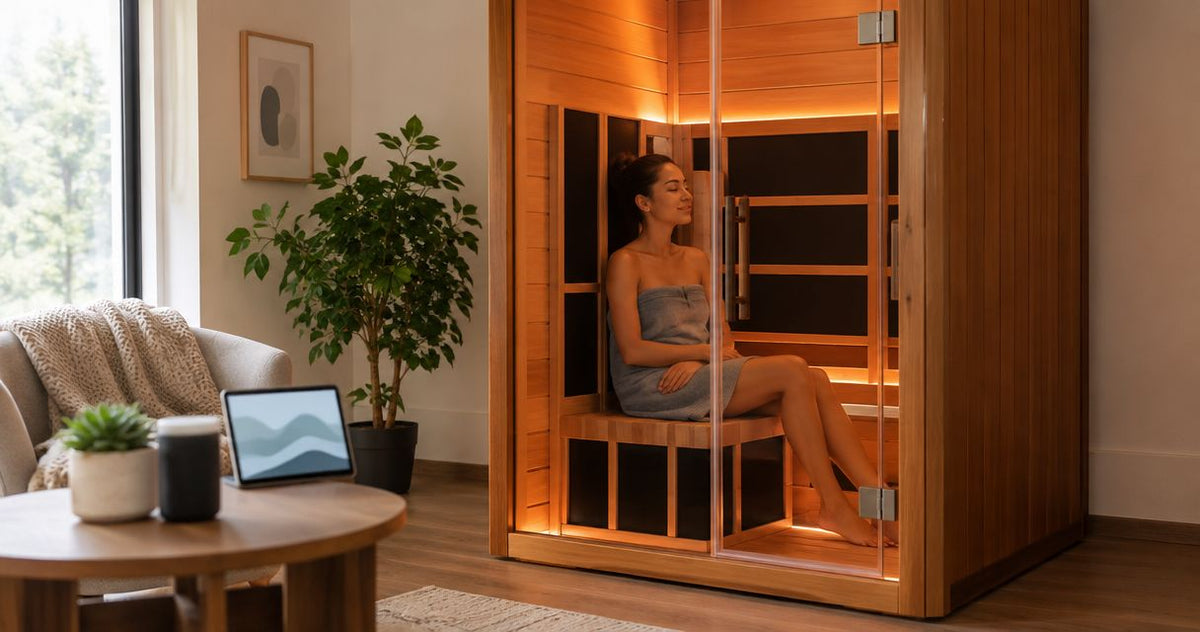
An infrared sauna’s heat-up time depends on the model, starting room temperature, and selected cabin temperature; there is no single preheat time that applies to every home sauna. Follow the manufacturer’s preheating instructions, then measure your own cabin under repeatable conditions rather than treating heater activation, a warm interior, and reaching the set temperature as the same event.
By Editorial Team
- How long does it take to heat up an infrared sauna? Use the model’s instructions and measure your cabin.
- Aeva Vital offers hemlock sauna options; seating capacity and heater descriptions do not establish warm-up speed.
- Separate preheat time from occupied session time when planning your routine.
- Compare elapsed time only when starting temperature, target temperature, and door position match.
How long does it take to heat up an infrared sauna?
Use a model-specific preheat instruction, not a universal countdown. Infrared heaters transfer radiant energy to your body and surrounding surfaces, while the cabin air also warms. The temperature display reports the condition at its sensor, not a complete measurement of the heat reaching every part of your body.
For a 2026 purchase, distinguish a heating-technology description from a documented warm-up result. Terms such as far-infrared, carbon, and ceramic describe aspects of the heating system; they do not independently establish how many minutes a finished cabin takes to reach a selected temperature. The guide to infrared saunas ranked by heating technology provides related context.
To establish a useful answer for your own sauna:
- Check the instructions. Find the manufacturer’s preheat procedure, permitted installation conditions, and operating limits.
- Record the starting conditions. Note the room temperature and displayed cabin temperature before heating begins.
- Choose the endpoint. Use the manufacturer’s recommended readiness condition or your selected permitted temperature.
- Start the timer. Record elapsed time from activating the heaters to reaching that endpoint.
- Repeat consistently. Keep the target setting, door position, and measurement method unchanged.
Your result answers a precise question: how long this cabin takes under these conditions. It is not a universal performance claim for every installation.
Why this matters
Preheating and bathing are separate parts of your schedule. If you count only the time spent sitting inside, you leave out preparation, entry, and shutdown.
An advertised maximum temperature answers a different question from warm-up time. A cabin’s ability to reach a setting does not establish how quickly it reaches that setting in your room, or whether that setting is appropriate for your session.
Plan around the manufacturer’s operating procedure and your measured routine. Do not extend heat exposure simply because the display has not reached a number you expected.
What does “heated up” actually mean?
A useful warm-up comparison needs a defined finish line. Without one, two descriptions of the same sauna can sound contradictory even when both describe something real.
| Readiness measure | What it tells you | Useful for | Limitation |
|---|---|---|---|
| Heaters operating | The heating system has started | Confirming startup | Does not establish a ready cabin |
| Display reaches the selected temperature | The control sensor reports the target | Repeatable timing at a defined setting | Does not measure every surface or body position |
| Manufacturer’s preheat procedure completed | The specified preparation has been followed | Model-specific operation | Must be read alongside the rest of the instructions |
| Cabin feels warm | Your immediate perception of warmth | Assessing personal comfort | Subjective; unsuitable for performance comparisons |
Heater operation is not the same as cabin readiness
An operating indicator tells you the system is active. It does not establish that the bench, surrounding surfaces, and air have reached stable conditions.
Check the control instructions before interpreting indicator lights or cycling behavior. Different controls communicate different operating states, so do not diagnose a heating fault from an unfamiliar symbol alone.
Set temperature is not a personal exposure target
The controller’s temperature setting manages the equipment. It is not a medical recommendation or proof that a particular duration is safe for you.
Follow the operating instructions and stop if you feel unwell. Ask a qualified healthcare professional about sauna use when a health condition, pregnancy, or medication affects your tolerance of heat.
Why infrared sauna heat-up time varies
Heat-up time reflects both heat entering the cabin and heat leaving it. These factors explain why a timing result needs context rather than a stand-alone number.
- Starting temperature. A colder cabin needs a larger temperature increase to reach the same target. Record the starting condition before comparing runs.
- Target temperature. Reaching a lower setting and reaching a higher setting are different tests. Keep the endpoint identical when assessing consistency.
- Heater output and control. Electrical input, heater operation, and the controller affect heat delivery. Panel count alone does not describe total output.
- Cabin construction. Interior volume, materials, glazing, and ventilation affect the heating task and heat loss. Seating capacity is not a substitute for these specifications.
- Installation environment. Room conditions and drafts affect heat exchange around the enclosure. Use the sauna only in locations permitted by its instructions.
- Door opening. Opening the door exchanges cabin air with room air. Keep the door closed during preheating unless the manufacturer instructs otherwise.
Do not block ventilation or add improvised insulation to shorten the wait. A faster reading is not a useful improvement if it requires operating the equipment outside its intended setup.
How to measure your sauna’s preheat time
For your 2026 home setup, a simple written record is more useful than remembering that the cabin felt slow on a particular day. Keep preparation consistent and use the same displayed temperature source each time.
Record the starting conditions
Before switching on, note the date, room temperature, displayed cabin temperature, and selected target. Record whether the cabin has already been used that day, because a still-warm enclosure is not equivalent to a cold start.
Use the same units throughout your log. Mixing Fahrenheit and Celsius creates an avoidable comparison error.
Time to target
Start your timer when you activate heating. Stop at the endpoint defined by the manual or your selected permitted setting, and note any door openings or interruptions.
If the operating instructions separate preheating from occupied use, follow that distinction. Do not remain inside simply to watch the display rise.
Repeat consistently
Repeat the procedure on separate occasions under similar conditions. You are looking for a dependable planning reference, not the fastest result you can produce.
A repeatable log also gives customer support useful information if performance changes. A description of the starting conditions, setting, elapsed time, and any displayed error is more actionable than “it takes too long.”
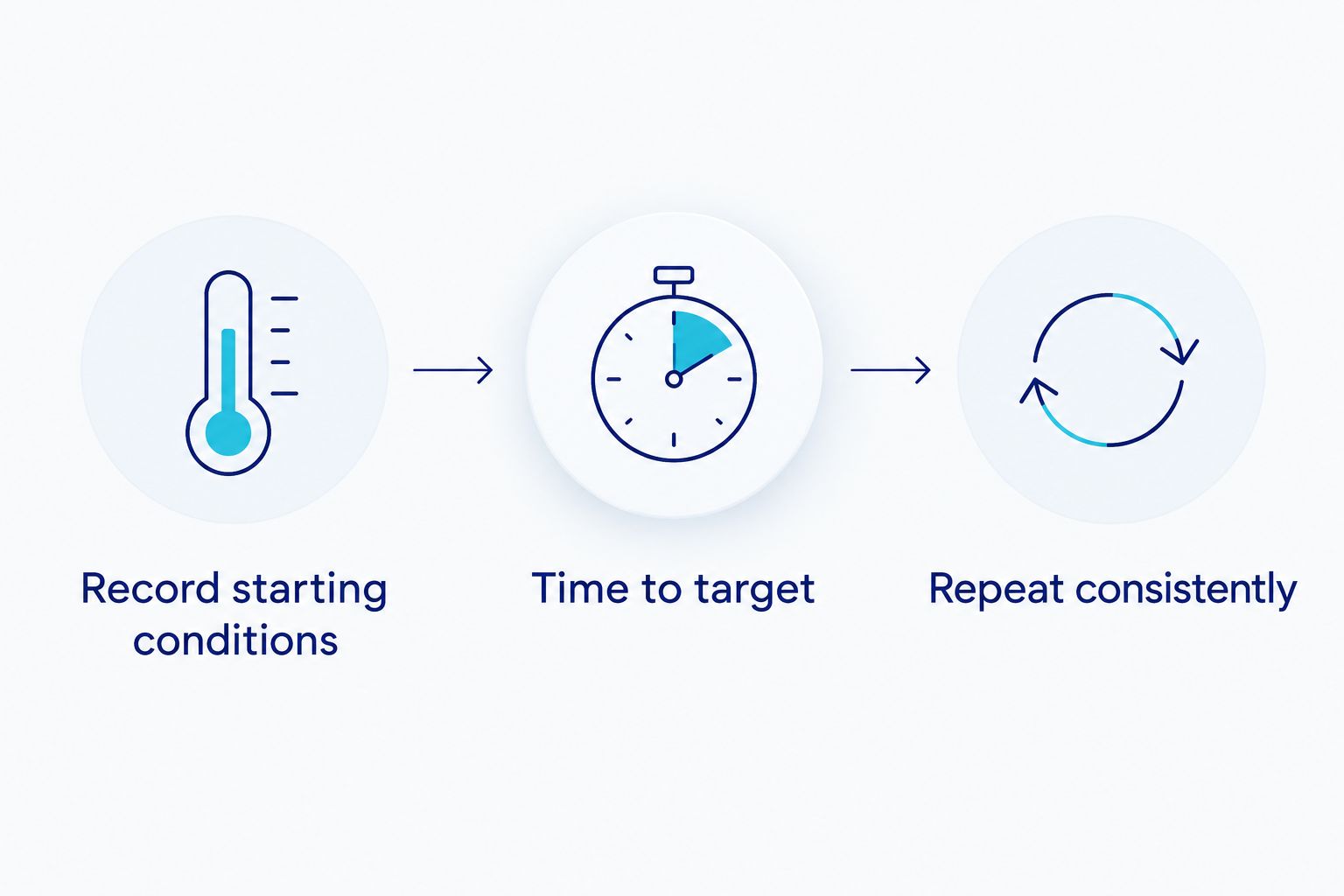
Keep the record with your operating manual. If you change the installation location or temperature setting, establish a new reference rather than comparing unlike conditions.
What Aeva Vital sauna specifications tell you
Aeva Vital is best suited to home sauna shoppers comparing hemlock cabins by seating capacity and heating design. Those specifications help narrow your choice, but they do not establish a fastest-heating model.
For a 2026 shortlist, compare the stated construction separately from warm-up evidence. The following two models illustrate why capacity, panel count, and heating-system descriptions need different interpretations.
| Model | Stated details | Best for | What the details do not prove |
|---|---|---|---|
| Low EMF 2-Person Hemlock Far-Infrared Indoor Sauna with Double Glass Doors | Two-person design; seven far-infrared heating panels | Buyers comparing a two-person cabin with a stated panel count | A specific preheat time or measured EMF exposure |
| Premium Low EMF 3-Person Hemlock Infrared Sauna – Heated Glass Door Design | Three-person design; carbon panels and ceramic heating in a stated 2-in-1 system | Buyers comparing a three-person cabin with a mixed heating design | Faster warm-up than the two-person model |
Two-person design: seven heating panels
The Low EMF 2-Person Hemlock Far-Infrared Indoor Sauna with Double Glass Doors has a stated seven-panel heating system. That is a concrete construction detail, not a time-to-temperature measurement.
Its advantage for comparison is a clearly stated heater count and seating category. Its limitation is that neither tells you total heater wattage, installed warm-up time, or the temperature distribution around a seated user.
Three-person design: carbon and ceramic heating
The Premium Low EMF 3-Person Hemlock Infrared Sauna – Heated Glass Door Design describes a 2-in-1 system using carbon panels and ceramic heating. That identifies the stated heating components without establishing a speed advantage.
Its advantage is a larger stated seating category and a different heating design to evaluate. Its limitation is that the description does not provide a controlled head-to-head warm-up result against the smaller cabin.
Choose capacity and installation fit before using warm-up speed as a deciding factor. Confirm the model’s dimensions, electrical requirements, operating instructions, and preheat guidance before ordering.


Can you make an infrared sauna heat up faster?
You can avoid unnecessary heat loss by following the installation instructions and keeping the door closed during preheating. You cannot establish a safe shortcut by raising the setting beyond your intended target or changing the electrical setup.
Do not cover heaters, obstruct vents, bypass controls, or add a portable heater inside the cabin. Use the specified power connection and have electrical concerns assessed by a qualified electrician.
For a 2026 scheduling setup, confirm manufacturer permission before adding remote controls, smart plugs, or automated startup. A device’s ability to switch power does not establish that unattended sauna operation is permitted.
Why is my infrared sauna taking longer than usual?
First compare the starting conditions with your normal record. A colder room, a higher selected temperature, or repeated door opening changes the test before any equipment fault is considered.
Next, check the manual for operating indicators and troubleshooting instructions. Record displayed errors and whether the behavior differs from earlier runs under comparable conditions; do not open electrical compartments or attempt heater repairs unless the manufacturer explicitly authorizes that work.
Stop operation if you notice smoke, a burning smell, damaged wiring, or repeated protective-device trips. Arrange qualified assessment rather than repeatedly restarting the sauna.
Does preheating count toward sauna session time?
Preheating an empty cabin is preparation, not time spent exposed to heat. Once you enter, your exposure has begun even if the display is still rising.
Keep separate records for preparation and occupied use. Reaching the target temperature does not reset the time you have already spent inside.
FAQ
How long does it take to heat up an infrared sauna at home?
Heat-up time is model- and condition-specific; follow the manufacturer’s preheat instructions and measure your own cabin. Record the starting temperature, selected target, and elapsed time for a useful reference.
Should I wait until my infrared sauna reaches its maximum temperature?
Maximum temperature is not a required target for every session. Follow the model’s operating guidance rather than treating its highest setting as a readiness requirement.
Does a sauna with more heating panels warm up faster?
Panel count alone does not establish warm-up speed. Total output, cabin construction, starting conditions, and the selected temperature also matter.
Will a two-person infrared sauna heat faster than a three-person sauna?
Seating capacity alone cannot establish which sauna heats faster. Compare documented results measured under matching conditions rather than assuming the smaller cabin wins.
Can I sit in an infrared sauna while it warms up?
Follow your model’s instructions on entering during warm-up. If you enter before the target is reached, count that occupied period as heat exposure rather than restarting your session timer later.
Does Aeva Vital list a seven-panel infrared sauna?
Aeva Vital’s Low EMF 2-Person Hemlock Far-Infrared Indoor Sauna with Double Glass Doors has seven far-infrared heating panels in its product description. That panel count does not establish a specific preheat time.
Can I use a smart plug to preheat my sauna before I get home?
Use remote startup only when the sauna manufacturer permits it and the complete control setup meets its requirements. A smart plug’s switching capability does not establish permission for unattended operation.
What should I record if my sauna heats more slowly than before?
Record the room temperature, starting cabin temperature, selected target, elapsed time, and any displayed errors. Compare those conditions with your usual record before contacting support.
Related guides
- Automatically preheat your infrared sauna before arrival
- How long should you sit in an infrared sauna each session?
- Wiring a home infrared sauna into your electrical panel
One last thing
For your 2026 routine, write down the finish line before timing the warm-up. “Heaters on,” “cabin feels warm,” and “selected temperature reached” are different observations; choosing one consistent endpoint makes your schedule useful without turning a personal measurement into a product guarantee.