
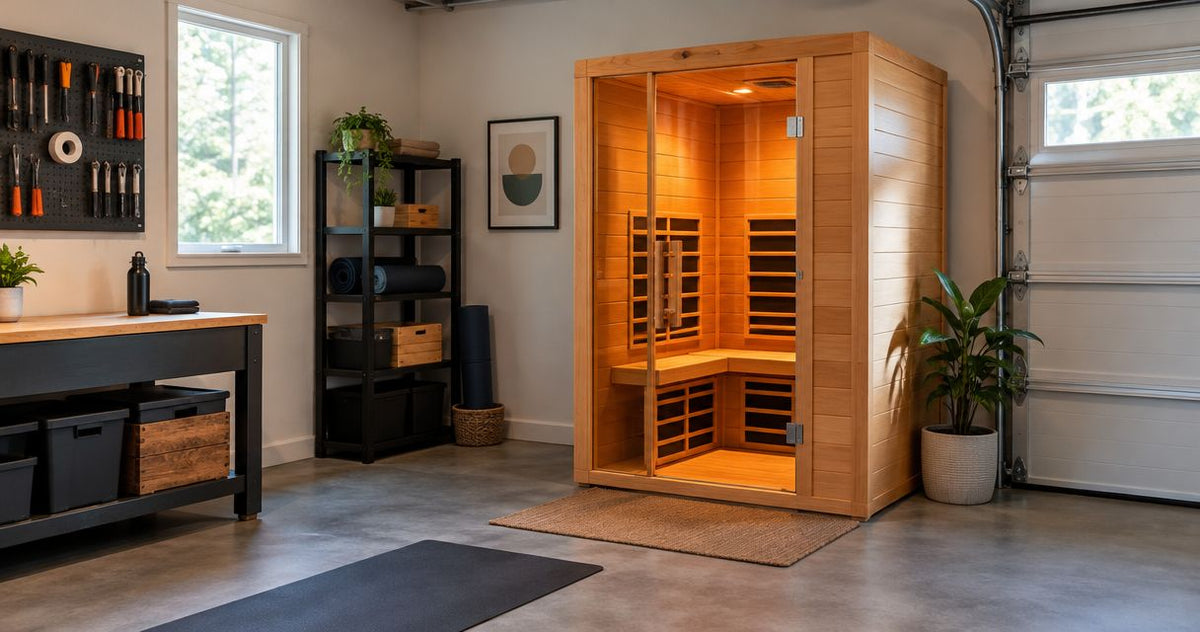
Yes, an infrared sauna can be installed in a garage when the manufacturer permits that environment and the space meets the sauna’s electrical, temperature, moisture, floor, and clearance requirements. A roof alone does not make a garage suitable for an indoor-rated sauna. For a 2026 installation, confirm the exact model’s requirements before ordering or changing the garage wiring.
By Editorial Team
- Can an infrared sauna be installed in a garage? Yes, with manufacturer approval and a suitable electrical supply.
- Aeva Vital lists indoor infrared saunas; an indoor designation does not establish approval for an unconditioned garage.
- Check ambient temperature limits, floor conditions, moisture exposure, and assembly clearances before choosing a location.
- Reject locations exposed to vehicle exhaust, water intrusion, or obstructed exits.
Can an infrared sauna be installed in a garage?
A garage installation is acceptable only when both the sauna and the location meet the manufacturer’s installation instructions. Start with the manual, not the available floor space. A cabinet that fits beside your workbench still needs an appropriate environment, safe access, and a correctly specified electrical connection.
Use this comparison to assess the location before selecting a cabinet:
| Garage condition | Best for | Advantage | Limitation and next move |
|---|---|---|---|
| Enclosed, dry, temperature-controlled garage | Evaluating an indoor-rated sauna | More control over the surrounding environment | Confirm that the manufacturer accepts garage placement; temperature control is not approval |
| Enclosed, unheated garage | Further assessment before purchase | Keeps equipment outside living areas | Check seasonal temperature and humidity against the exact model’s limits |
| Open-sided, wet, or weather-exposed garage | Rejecting an unsuitable indoor-sauna location | Identifies exposure problems before installation | Do not assume an indoor cabinet tolerates rain, splashing, or outdoor conditions |
For the electrical portion, review the home infrared sauna wiring guide, then have a qualified electrician assess your specific unit and garage circuit. A general guide does not replace the appliance manual or locally adopted electrical requirements.
Check the installation in this order
- Confirm permitted placement. Obtain the model’s installation manual and ask whether your garage conditions are allowed.
- Check environmental limits. Compare the permitted ambient temperature and humidity with the actual garage throughout the year.
- Verify power. Give an electrician the sauna’s electrical nameplate and installation instructions.
- Measure the complete installation. Include the cabinet, assembly space, ventilation clearances, door swing, and service access.
- Assess everyday garage use. Keep the sauna separated from vehicle movement, water exposure, exhaust, and stored hazards.
If any requirement fails, resolve it before assembly. Moving a completed cabinet is not a substitute for planning its location.
Why this matters
A garage combines conditions that do not usually exist together in a bedroom or finished wellness room: vehicle traffic, stored chemicals, changing temperatures, and a floor that slopes toward a door. Each affects placement differently. Treat the space as a working garage until its actual conditions establish otherwise.
The distinction matters when comparing indoor and outdoor equipment. An indoor sauna’s enclosed cabin does not establish weather resistance, and a timber exterior does not establish tolerance for damp storage.
For your 2026 project, make the location decision before the model decision. That keeps a larger cabinet or a preferred door layout from becoming a reason to accept an unsuitable site.
Why garage installation suitability varies
These factors determine whether a particular garage is appropriate. The cabinet’s instruction manual supplies the acceptance criteria; there is no universal garage specification that replaces it.
- Manufacturer permission: Confirm whether the exact model allows installation in your type of garage.
- Ambient conditions: Check temperature and humidity limits for both operation and storage.
- Electrical supply: Match the appliance’s specified connection and circuit requirements.
- Floor conditions: Provide the support, levelness, and dryness the assembly instructions require.
- Space and access: Preserve required clearances, ventilation openings, door movement, and maintenance access.
- Garage activities: Account for vehicles, exhaust, tools, chemicals, and water entering the space.
Do not treat a successful power-on test as proof that the location is suitable. The sauna must remain within its permitted conditions when it is off as well as when it is heating.
Does an unheated garage work for an infrared sauna?
An unheated garage works only if its actual conditions remain within the model’s permitted operating and storage limits. Check both. A unit used occasionally still sits in that environment between sessions.
Distinguish ambient temperature from cabin temperature. Ambient temperature means the surrounding garage air; cabin temperature means the air inside the sauna. A high cabin-temperature setting does not establish that the controls or other components are approved for a cold garage.
For a 2026 winter installation, document the garage’s conditions rather than relying on the outdoor forecast alone. Give the manufacturer a clear description of the space, including whether it is insulated, heated, attached, or detached.
Does insulation make the garage suitable?
Insulation slows heat transfer; it does not by itself provide heating, cooling, or moisture control. An insulated garage still needs to meet the sauna’s environmental requirements.
Use the same approval process for an insulated garage as for any other location. If the manufacturer requires a controlled indoor environment, confirm what that means for your installation before proceeding.
What electrical checks does a garage sauna need?
The sauna’s nameplate and manual determine its electrical requirements—not its advertised seating capacity. Do not choose a connection based on another owner’s setup or assume every infrared sauna uses the same outlet.
Ask a qualified electrician to review:
- The specified supply voltage and appliance current.
- The required circuit arrangement and connection method.
- Grounding and applicable ground-fault protection requirements.
- Existing loads on the proposed circuit.
- Outlet placement and protection from damage or moisture.
- Any required permits and inspection under local rules.
An outlet that physically accepts a plug is not proof that the circuit is suitable. Likewise, an outlet near the ideal cabinet position does not establish sufficient circuit capacity.
Do not solve a poor outlet location with an improvised adapter, power strip, or extension arrangement. Have the installation designed around the sauna’s instructions. Stop using the equipment if the connection becomes damaged, shows scorching, or repeatedly trips protection, and have the fault assessed.
How should you prepare the garage floor and layout?
Start with a dry, stable location that meets the manufacturer’s floor requirements. Check levelness across the complete cabinet footprint, not just where the front edge will sit. Garage drainage slopes deserve particular attention.
Then measure the space around the footprint. Assembly access, roof installation, door swing, and maintenance access are separate from the cabinet’s published width and depth.
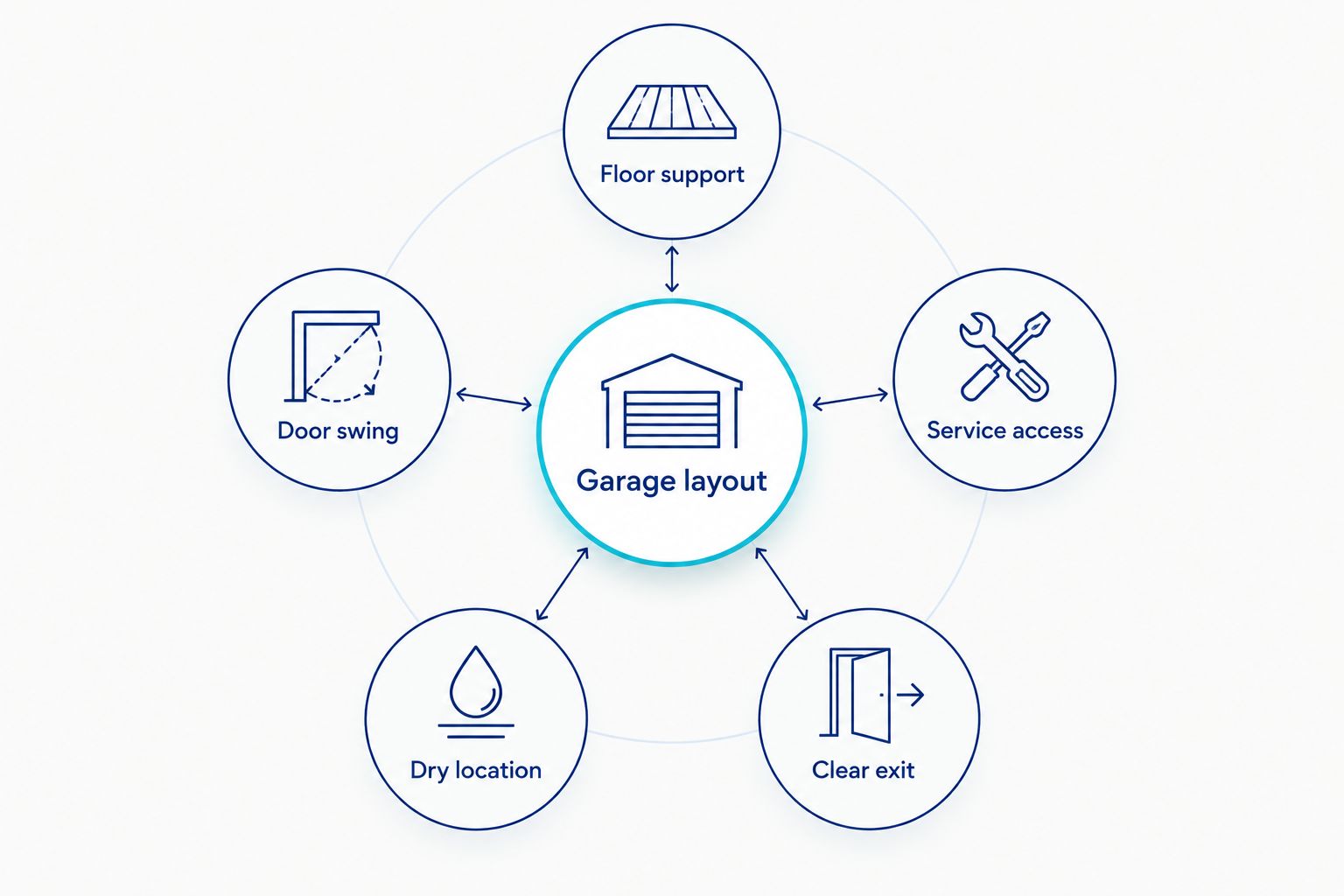
Use a complete placement checklist
- Floor support: Follow the required supporting-surface instructions; do not assume a flexible mat corrects an unsuitable base.
- Door swing: Keep the sauna entrance clear of vehicles, shelves, and stored equipment.
- Service access: Preserve access to the components identified in the manual.
- Dry location: Avoid areas reached by rainwater, washing, plumbing leaks, or other water intrusion.
- Vehicle separation: Choose a position outside normal parking and maneuvering paths.
- Clear exit: Keep a direct, unobstructed route out of the sauna and garage.
The layout should work during normal garage use, not only when everything has been temporarily moved for installation. Mark the proposed cabinet position on the floor and test door movement and walking routes before assembly.
Can you keep parking a car beside the sauna?
Keeping a car in the garage requires a layout that protects the sauna and its users from vehicle movement and exhaust. Never run a vehicle engine in an enclosed garage during a sauna session. Opening the garage door is not a substitute for preventing exhaust exposure.
Also assess what enters with the vehicle. Water, dirt, and stored items must not compromise the sauna’s location or block its entrance.
Keep gasoline, solvents, and other flammable materials away from heat sources according to their storage instructions and applicable safety rules. Do not place the cabinet where opening its door requires stepping into a vehicle’s movement path.
If ordinary parking makes safe access unreliable, choose another location. A sauna installation should not depend on remembering to move hazards before every session.
Which indoor sauna specifications help you choose?
Aeva Vital’s supplied product listings identify indoor models and construction details, but those details serve different purposes. Seating capacity helps shortlist cabin size; heater-panel count describes part of the heating arrangement. Neither establishes garage approval.
For a 2026 shortlist, these two indoor models illustrate the distinction:
| Model | Best for | Listed detail | Advantage | What remains to confirm |
|---|---|---|---|---|
| Low EMF 2-Person Hemlock Far-Infrared Indoor Sauna with Double Glass Doors | Buyers comparing a two-person indoor cabin with double doors | Seven far-infrared heating panels | Identifies the panel count and door configuration | Garage permission, dimensions, power requirements, and environmental limits |
| Hemlock Two-Person Far Infrared Indoor Sauna | Buyers shortlisting a two-person indoor hemlock cabin | Two-person indoor designation | Clearly identifies its intended indoor category | Garage permission, clearances, floor requirements, and environmental limits |
Aeva Vital infrared saunas are best considered by home buyers seeking indoor equipment whose installation requirements match their intended room. For garage placement, get model-specific confirmation rather than treating the category name as approval.
The Low EMF 2-Person Hemlock Far-Infrared Indoor Sauna with Double Glass Doors lists seven heating panels. That count does not establish a warm-up time, permitted garage temperature, or electrical circuit specification. Similarly, the Hemlock Two-Person Far Infrared Indoor Sauna’s seating designation does not supply its installation footprint.
Use the product details to build a shortlist, then obtain the missing installation specifications before deciding.


What should you confirm before ordering?
Send the seller a description of your garage and ask for answers tied to the exact model. Include seasonal conditions, the proposed floor, nearby vehicle use, and whether the space is temperature-controlled.
Request the installation manual, electrical requirements, environmental limits, assembly clearances, and any relevant placement restrictions. Also ask how the proposed location affects the product’s warranty terms; do not assume coverage from a general product description.
Keep that information with your 2026 installation records. It gives you and your electrician a shared specification instead of a collection of assumptions.
FAQ
Can an infrared sauna be installed in a garage in 2026?
Yes, if the exact model permits the garage environment and the location meets its electrical, environmental, floor, and clearance requirements. Confirm those requirements before purchase or assembly.
Can I put an indoor infrared sauna in an unheated garage?
Only if the garage remains within the model’s permitted operating and storage conditions. An indoor designation alone does not establish approval for an unheated space.
Does a garage infrared sauna need a dedicated circuit?
The exact model’s installation instructions and applicable electrical rules determine the circuit requirements. Have a qualified electrician assess the nameplate, proposed connection, and existing garage loads.
Can an infrared sauna sit on a concrete garage floor?
A concrete floor is suitable only when it meets the manufacturer’s support, levelness, and moisture requirements. Check the full cabinet footprint because garage floors often slope for drainage.
How much clearance should I leave around a garage sauna?
Use the exact clearances stated in the sauna’s manual. Include assembly space, ventilation openings, door swing, and service access rather than measuring only the cabinet footprint.
Can I use a sauna while a car is running in the garage?
No. Never run a vehicle engine in an enclosed garage during a sauna session because exhaust creates a carbon monoxide hazard.
Does Aeva Vital approve its indoor saunas for garage installation?
An indoor product designation does not establish garage approval. Ask Aeva Vital for model-specific confirmation based on your garage’s temperature, moisture, electrical supply, and layout.
Related guides
- Infrared saunas for small spaces
- Two-person infrared saunas for home use
- Infrared sauna to cold plunge workflow
One last thing
Check the garage when it is least inviting—not just when you first measure it. A dry afternoon does not establish year-round suitability. Before committing, confirm the model’s storage limits as carefully as its operating requirements: the sauna occupies that location between sessions, too.