
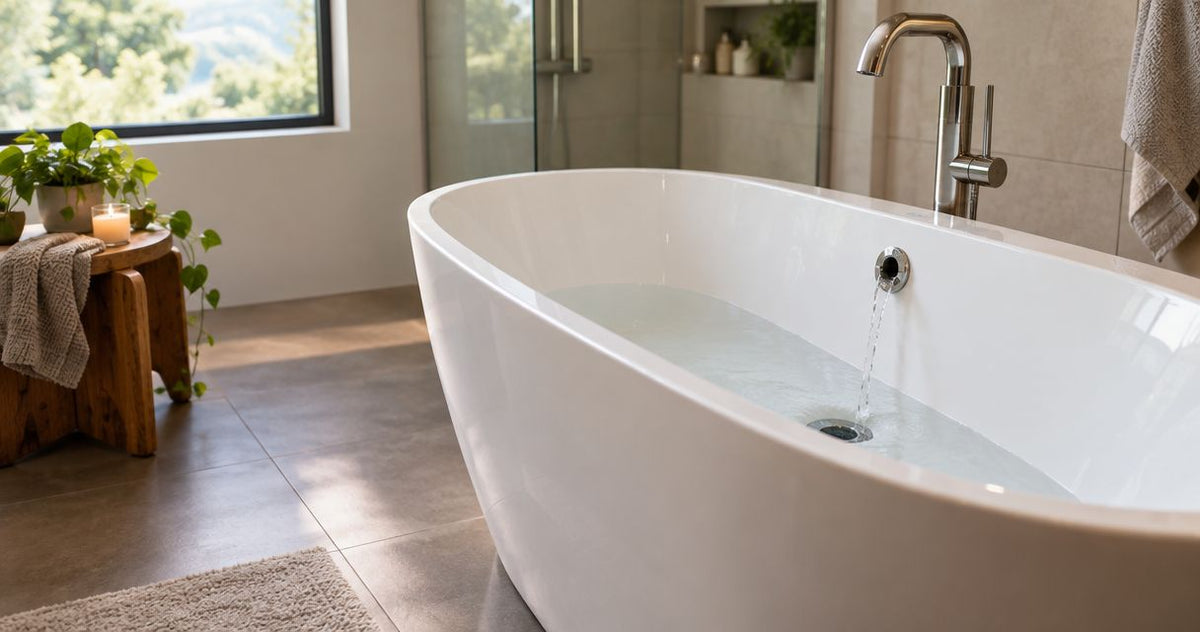
A freestanding tub has no single standard drain time: how quickly it empties depends on the water volume, stopper opening, drain assembly, and household plumbing. Compare repeat drain tests at the same water level rather than treating an unsupported minute count as a pass-or-fail rule. A tub that suddenly drains more slowly, leaves standing water, or backs up needs investigation even if it eventually empties.
By Editorial Team
- How long does a freestanding tub take to drain? Water volume and the installed drainage system determine the answer.
- Aeva Vital offers acrylic freestanding tubs; tub length alone does not establish drainage speed.
- Time drainage from the same starting water level to make repeat tests useful.
- Check an accessible stopper first; persistent backup, leaks, or multiple slow fixtures need a plumber.
How long does a freestanding tub take to drain?
The useful answer is the measured time for your installed tub under repeatable conditions. A freestanding design describes how the bathtub sits in the room, not a fixed drainage rate. The outlet, connecting pipework, trap, and downstream drainage system all affect the result.
For a new installation, ask the installer to demonstrate drainage and check the connections for leaks before completing the job. The freestanding tub installation timeline covers the broader project; a working drain deserves its own acceptance check.
Use this procedure to establish a baseline:
- Choose a repeatable starting level. Use an identifiable point inside the basin, below the overflow. Do not use an unattended running faucet to maintain that level.
- Turn the faucet off. Incoming water changes the measurement and hides how quickly the basin actually empties.
- Open the stopper fully and start a timer. Use the same stopper position for later comparisons.
- Watch the water and surrounding floor. Note steady flow, pauses, gurgling, backup, or visible leakage.
- Stop timing when standing water clears. Record droplets and isolated wet patches separately; they are not the same as a basin holding water.
Record the elapsed time in minutes and seconds. Your repeatable 2026 baseline is more useful for detecting deterioration than a drain-time claim attached to an unrelated bathtub.
Why this matters
A slow drain and a leaking drain are different problems. A basin can empty without an obvious delay while a concealed connection leaks beneath it; conversely, a restricted stopper can slow drainage without a leak.
A stopwatch measures drainage time, not installation quality. Check both water movement and accessible connections, and stop using the tub if water appears where it should not.
Freestanding tubs also conceal some connections beneath the shell. Do not shift, tilt, or lift an installed tub to inspect them yourself: moving the fixture can disturb its drain connection or damage nearby finishes.
Why freestanding tub drain time varies
Several physical factors explain why matching tubs do not necessarily empty at matching speeds. These factors also explain why replacing the bathtub is not the first response to a drainage complaint.
- Starting water volume. More water takes longer to discharge through the same drainage arrangement. Equal water depth does not mean equal volume in differently shaped basins.
- Stopper opening. A stopper that does not lift fully restricts the opening available for water. Hair and soap residue around the assembly create additional obstruction.
- Drain assembly. The internal flow path and its compatibility with the tub matter more than the visible finish. A chrome finish describes appearance, not flow capacity.
- Trap and connecting pipework. Obstructions, unsuitable routing, and installation defects affect water movement beyond the tub outlet.
- Downstream drainage and venting. Restrictions or venting problems elsewhere in the system require diagnosis beyond the bathtub itself.
Do not diagnose the cause from one symptom alone. Gurgling, for example, is information for the plumber—not proof that a particular vent or fitting has failed.
Is your tub draining normally or showing a problem?
Separate a stable drainage pattern from a change in performance. The comparison below helps you decide what to observe next; it does not replace an inspection.
| Observation | What it tells you | Next action |
|---|---|---|
| Similar results at the same starting level | Your drainage pattern is repeatable | Keep the baseline and watch for changes |
| Slower drainage than your earlier test | Something in the test conditions or drainage path has changed | Check stopper position and accessible debris |
| Water remains pooled around the outlet | The basin has not fully cleared | Check for restriction and report persistent pooling |
| Several fixtures drain slowly | The issue extends beyond a tub-only observation | Contact a plumber for system diagnosis |
| Water appears beneath or around the tub | A leak or escaped water needs investigation | Stop using the tub until the source is identified |
A small amount of surface moisture is different from a persistent puddle. Photograph the remaining water and its location if you need to explain the problem to an installer.
Avoid comparing a shallow rinse with a full bath. That comparison changes the amount of water, so it cannot isolate whether the drain has become slower.
How do you check a slow freestanding tub safely?
Start at the accessible drain opening, not beneath the tub. Simple observations help you separate a stopper issue from a problem that needs tools or access to concealed plumbing.
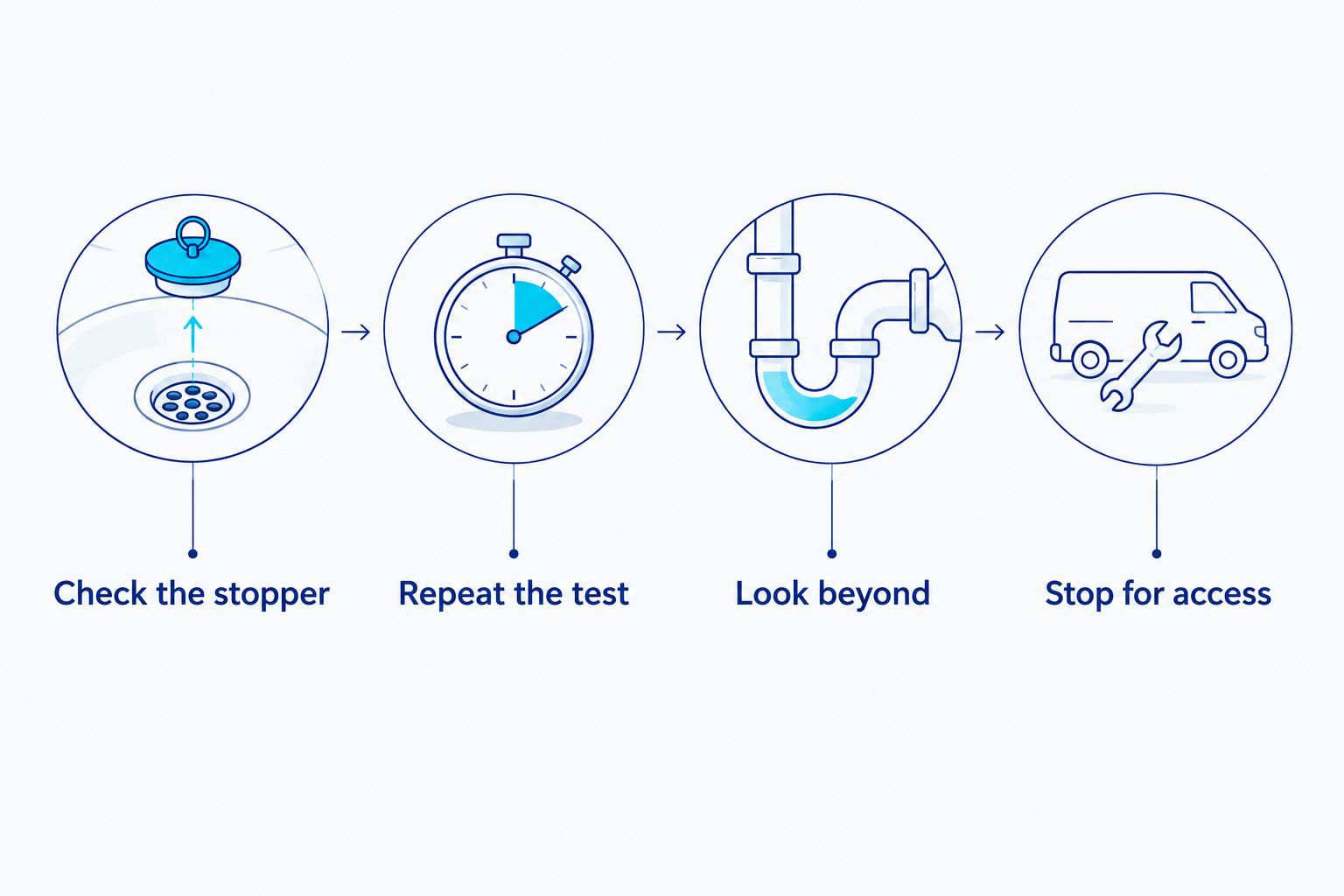
Check the stopper
Operate the stopper according to its instructions and confirm that it reaches its fully open position. Do not assume a visible gap means the mechanism is working correctly.
If the manufacturer permits removal, clean accessible hair and residue from the removable parts. Keep the components together and reinstall them as directed; do not unscrew an unfamiliar drain flange or disturb its seal.
Repeat the same test
Return to the same starting water level after cleaning. Time the drain again with the faucet off and the stopper fully open.
An improvement supports the conclusion that accessible debris or stopper position contributed to the delay. It does not establish that every downstream connection is clear or leak-free.
Look beyond the bathtub
Notice whether nearby fixtures are also slow, whether water backs up elsewhere, and whether odors or unusual sounds accompany drainage. Report those observations together rather than asking for a tub-only repair based on the stopwatch result.
Do not mix drain-cleaning chemicals. If you have already used a chemical product, tell the plumber what it was before anyone opens or works on the drain.
Stop when access becomes the issue
An installed freestanding tub is not a removable inspection cover. If checking the next connection requires moving the fixture, leave that work to the installer or plumber.
For a 2026 remodel, settle the service-access question before the tub goes into place. Future maintenance should not depend on guessing how a concealed connection was assembled.
Do larger freestanding tubs take longer to drain?
A larger water volume takes longer to empty through an otherwise identical drain arrangement. Tub length alone does not tell you the water volume or the drainage time. Basin width, internal shape, fill level, and plumbing also matter.
A longer tub filled shallowly is not a valid comparison with a shorter tub filled deeply. Likewise, matching exterior dimensions do not establish matching internal capacity.
For a useful comparison, distinguish these specifications:
- Exterior dimensions: whether the fixture fits the room and installation location.
- Internal dimensions: the usable basin geometry, when documented.
- Water capacity: a stated volume under the manufacturer's specified conditions.
- Drain requirements: the connection and installation details your plumber must follow.
Do not convert any one of these specifications into a guaranteed emptying time. A model-specific drainage claim needs model-specific evidence and stated test conditions.
Aeva Vital freestanding tubs: what the specifications establish
Aeva Vital suits homeowners comparing acrylic freestanding tubs in different lengths; size is not a drainage-speed rating. The product titles below identify 55-inch, 59-inch, and 67-inch options, but those measurements do not establish how quickly an installed basin will empty.
For your 2026 shortlist, use the table to separate stated product features from plumbing conclusions. The “best for” labels describe comparison needs, not a ranking of drainage performance.
| Aeva Vital option | Stated features | Best for | Drainage limitation |
|---|---|---|---|
| 55-inch acrylic freestanding soaking bathtub | Acrylic; chrome drain | Shoppers starting with a 55-inch option | Length does not establish water capacity or emptying time |
| 59-inch acrylic freestanding bathtub | Diamond pattern; gloss white; chrome drain | Shoppers seeking a diamond-pattern option | Decorative details and drain finish do not establish flow rate |
| 67-inch acrylic freestanding bathtub | Gloss white; chrome drain; cUPC certified | Shoppers comparing a 67-inch option with stated certification | Certification is not a model-specific drain-time measurement |
The advantage of these stated details is straightforward comparison of size, material, finish, and listed certification. The limitation is equally important: none of those details substitutes for checking the installation requirements and testing the completed drainage connection.
Choose a tub for documented fit and bathing requirements, then have the installer confirm drain compatibility. Do not select the longest model expecting faster drainage or the shortest expecting slower drainage.


What should you ask the installer before signing off?
Ask for a drainage demonstration, not just confirmation that the drain is connected. Watch the basin empty and have the installer check accessible joints during the test.
Your handover notes should cover:
- The stopper's correct operation and permitted cleaning procedure.
- The drain assembly and its installation instructions.
- How service access works without damaging the fixture.
- Any remaining standing water, unusual sounds, or leaks.
- The starting water level and measured drainage result.
Keep the instructions and observations together. A dated 2026 handover record gives a later plumber context that a complaint such as “it seems slow” cannot provide.
Do not accept an unexplained leak because the tub drains quickly. Emptying speed and watertight connections are separate checks, and both matter before regular use.
Related guides
- How long does it take to fill a freestanding soaking tub?
- Can a freestanding tub be installed without a nearby drain?
- Freestanding soaking tubs for remodelers
FAQ
How long should my freestanding tub take to drain in 2026?
There is no single drain time that applies to every freestanding tub. Measure your installed tub from a repeatable starting water level and investigate a persistent slowdown, backup, or leak.
Why does my freestanding bathtub drain slowly?
A restricted stopper, accumulated debris, or a problem farther along the drainage system can slow a freestanding bathtub. Check accessible parts according to the manufacturer's instructions before arranging plumbing diagnosis.
Does a bigger freestanding bathtub always drain more slowly?
A bigger exterior does not automatically mean slower drainage. Water volume, basin geometry, stopper opening, and the installed plumbing determine the result.
Should I time the drain with the faucet running?
Turn the faucet off before timing drainage. Incoming water changes the amount the drain must remove and makes repeat tests harder to compare.
Does a chrome drain mean the bathtub drains faster?
A chrome finish does not establish drainage speed. The assembly's flow path, stopper opening, and connected plumbing matter instead.
Can I lift my freestanding tub to check the drain?
Do not lift or shift an installed freestanding tub yourself to inspect its drain. Moving it can disturb connections; have the installer or plumber arrange safe access.
Does cUPC certification tell me how quickly a tub empties?
A cUPC certification statement is not a drain-time measurement. Use the model's installation documentation and an on-site drainage test to assess the installed result.
When should I call a plumber about my tub drain?
Call a plumber for persistent slow drainage, recurring backup, several slow fixtures, or unexplained leakage. Stop using the tub if water appears beneath it or around concealed connections.
One last thing
Record the starting water level along with the stopwatch result. Without that detail, a later drainage time is not a like-for-like comparison. Keep the record with your installation paperwork so a future change has a clear reference point.