
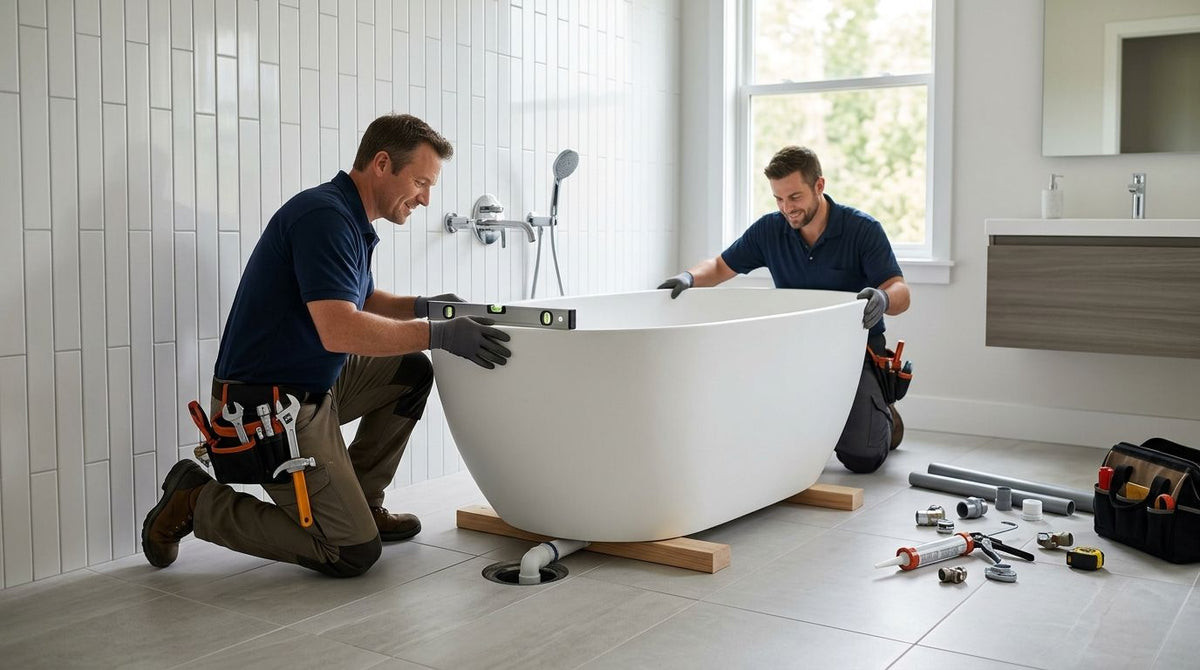
A straightforward freestanding tub installation takes 4 to 8 hours for a licensed plumber to complete in 2026, assuming the existing drain and water supply lines already sit close to where the new tub needs them. That number stretches to 1 to 3 days the moment the job requires relocating supply lines, cutting into a subfloor, or laying new flooring around the tub — the hidden labor variable that quoted "install" times often leave out.
- A straightforward freestanding tub installation takes 4 to 8 hours in 2026 when plumbing stays in place.
- Relocating the drain or supply lines pushes the job to 1 to 3 days.
- DIY installs typically run 1 to 2 full days because leveling and drain alignment take longer without a crew.
- Floor-mount fillers need separate rough-in work that a simple wall-mount faucet doesn't require.
- Acrylic freestanding tubs like Aeva Vital's 67-inch and 59-inch models are lighter and faster to maneuver into place than cast iron.
Why this matters
Contractors quote tub installation in ranges because "installation" covers two very different jobs: swapping a tub in the same footprint, and rerouting plumbing to a new footprint. Homeowners who book a plumber expecting a same-day job and then discover the drain needs to move end up paying for an extra visit and losing a bathroom for a weekend.
The same logic applies across home wellness equipment generally — infrared sauna cost guides run into the same pattern, where electrical prep work (not the unit itself) drives the bigger time and cost swings. A freestanding bathtub purchase follows the same rule: the tub is rarely the bottleneck, the plumbing behind the wall is.
How long does freestanding tub installation take?
Break the job into stages and the time adds up fast, even on an easy swap:
| Step | Typical time |
|---|---|
| Remove old tub/fixture | 1-2 hours |
| Check and adjust rough-in plumbing | 1-3 hours (only if relocating) |
| Set and level the new freestanding tub | 1-2 hours |
| Connect drain and overflow | 30-60 minutes |
| Connect floor-mount or wall-mount filler | 1-2 hours |
| Test for leaks and seal | 30-60 minutes |
On a job where the drain and supply lines already line up, a two-person crew moves through these stages in a single day. Add subfloor reinforcement, a new drain location, or a floor-mount filler that needs its own supply line run under the floor, and the job spans two to three calendar days once inspections and drying time for sealant and mortar beds are counted.
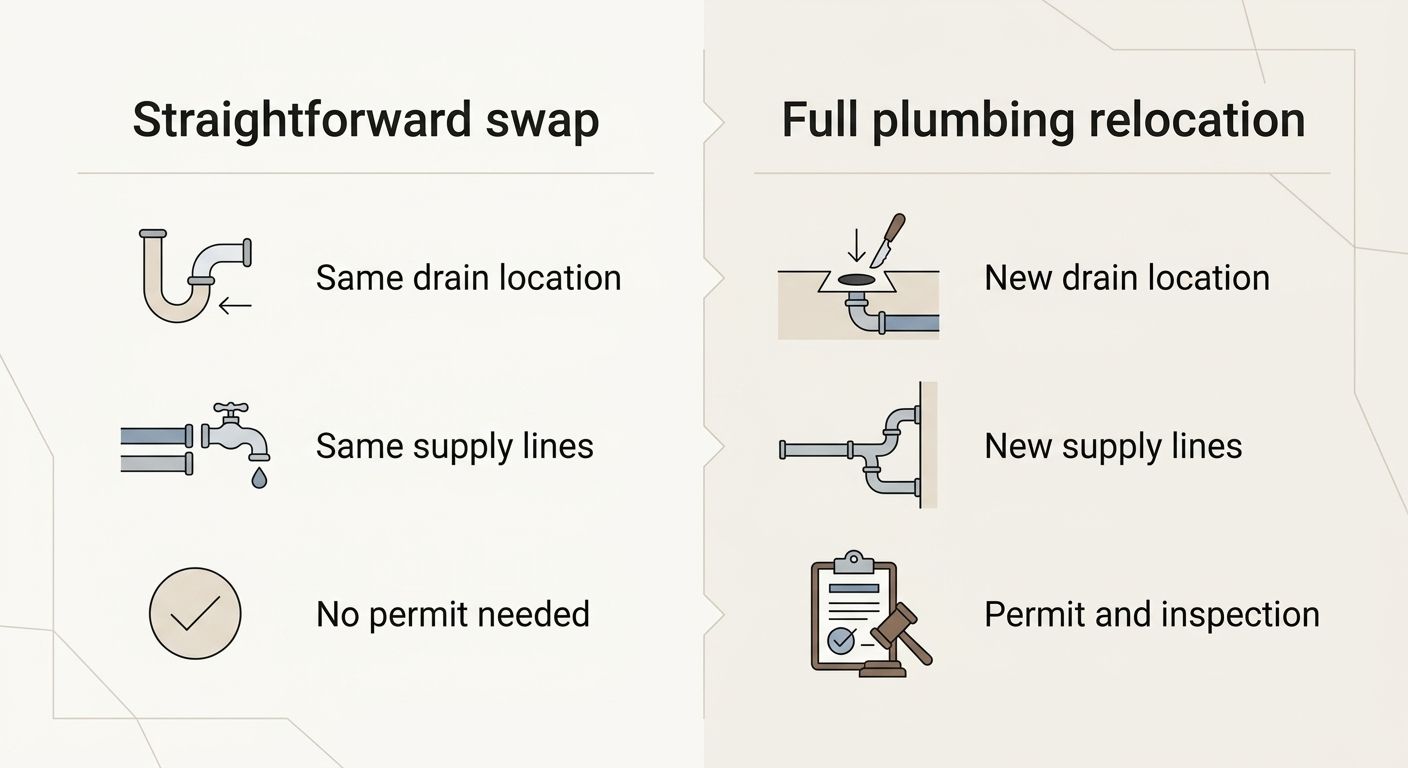
Straightforward swap: 4 to 8 hours
This is the fastest path: same footprint, same drain location, same supply line height. The old tub comes out, the new freestanding tub goes in, the faucet connects, and the plumber tests the seal before leaving. Best for: homeowners replacing an existing freestanding tub with a similar-sized model. Verdict: Go this route if your plumbing already fits — it's the cheapest and fastest option in 2026.
Full plumbing relocation: 1 to 3 days
Moving the tub to a different wall, changing from an alcove tub to a freestanding model, or switching drain sides all fall here. The crew has to cut into the floor or wall, run new lines, pass an inspection in many jurisdictions, and patch the opening before the tub goes in. Verdict: Budget the extra days if the new tub sits anywhere other than exactly where the old fixture stood.
DIY installation: 1 to 2 full days
A homeowner working alone or with one helper typically needs a full day just to level the tub, dry-fit the drain, and get the seal right on the first attempt — professionals do this daily and move faster. Verdict: Skip DIY for anything involving a floor-mount filler or drain relocation; fine for a simple wall-mount swap if you're comfortable with basic plumbing.
Why freestanding tub installation time varies
- Drain and supply line location — anything more than a few inches from the old fixture usually means opening the floor.
- Faucet type — a floor-mount filler needs its own rough-in and supply line run before the tub ever goes in place; a wall-mount faucet uses existing lines.
- Tub material and weight — acrylic tubs like the cold plunge tub lineup style of lighter units move into place with two people in minutes; cast iron and stone resin tubs often need equipment or more hands.
- Subfloor condition — a freestanding tub filled with water adds significant point load, and a soft or unlevel subfloor needs reinforcement before the tub is set.
- Permit and inspection scheduling — any job that touches supply or drain lines may require a permit and a scheduled inspection in many municipalities, which adds calendar days even if the labor itself is short.
- Flooring work around the tub base — replacing tile or flooring under and around a freestanding tub extends the timeline beyond the plumbing work itself.
Do you need a plumber to install a freestanding tub?
A licensed plumber is standard for connecting drain and supply lines, and required by code in most jurisdictions for any work involving the water and waste lines. Setting the tub itself and connecting a freestanding faucet is straightforward, but the plumbing connections are where code compliance and leak risk live.
Can you install a freestanding tub yourself?
Yes, a freestanding tub can be a DIY install when the faucet is wall-mounted and the drain lines up with the existing rough-in, though the job runs 1 to 2 full days rather than the 4 to 8 hours a professional crew needs. Leveling a large acrylic tub and getting a watertight drain connection on the first try takes longer without experience.
What size freestanding tub fits a small bathroom?
Freestanding tubs commonly run from around 55 inches up to 67 inches in length, and the shorter models fit bathrooms where a full-size soaking tub wouldn't clear the doorway or leave walking space. A 55-inch model needs less floor footprint but still delivers a full soaking depth, which matters more for install access than for time on the clock.
How much does professional tub installation cost?
Professional installation cost tracks the same variables as time — a same-footprint swap costs far less than a job requiring new plumbing runs, permits, and flooring repair. The cost pattern for professional installation on other home equipment categories follows this same rule: labor scope, not the product itself, drives the bill.
One freestanding tub detail worth checking before scheduling any install: acrylic construction with a cUPC-certified drain, like Aeva Vital's 67-inch and 59-inch models, ships with a chrome drain assembly already matched to standard rough-in dimensions, which removes one common source of install-day delay — a drain kit that doesn't fit the existing waste line.


FAQ
How long does freestanding tub installation take on average?
A straightforward freestanding tub installation takes 4 to 8 hours in 2026 when the drain and supply lines are already in the right spot. It stretches to 1 to 3 days when plumbing needs to move.
Do you need a plumber to install a freestanding tub?
Yes, a licensed plumber is standard for connecting the drain and supply lines, which is where code compliance and leak risk live. Setting the tub itself is the easier part of the job.
Can you install a freestanding tub yourself?
A DIY install is possible when the faucet is wall-mounted and the drain lines up with existing plumbing, but expect 1 to 2 full days rather than the 4 to 8 hours a professional crew needs. Leveling and drain alignment take longer without experience.
Does moving the drain add time to a tub installation?
Yes, relocating the drain or supply lines can add 1 to 2 extra days for cutting into the floor, running new lines, and passing inspection. This is the single biggest driver of installation time.
Is a permit required for freestanding tub installation?
A permit is commonly required in many jurisdictions when the job touches drain or supply lines, but usually not for a same-footprint swap. Check local code before scheduling since permit timing can add calendar days beyond the labor itself.
What size freestanding tub fits a small bathroom?
Freestanding tubs commonly range from around 55 inches to 67 inches in length, and shorter models fit bathrooms with tighter floor space. Install time doesn't change much by size, since the plumbing scope is the bigger factor.
Does tub material affect installation time?
Yes, lighter acrylic freestanding tubs move into place with two people in minutes, while heavier cast iron or stone resin tubs often need more hands or equipment. The material affects handling time more than the plumbing work.
One last thing
Have the faucet or filler on hand before the plumber arrives — a floor-mount filler needs its own rough-in, and ordering the wrong one after the crew has already opened the floor turns a one-day job into a two-visit job. Confirm the drain kit matches your existing rough-in dimensions before installation day, not after the old tub is already out.