
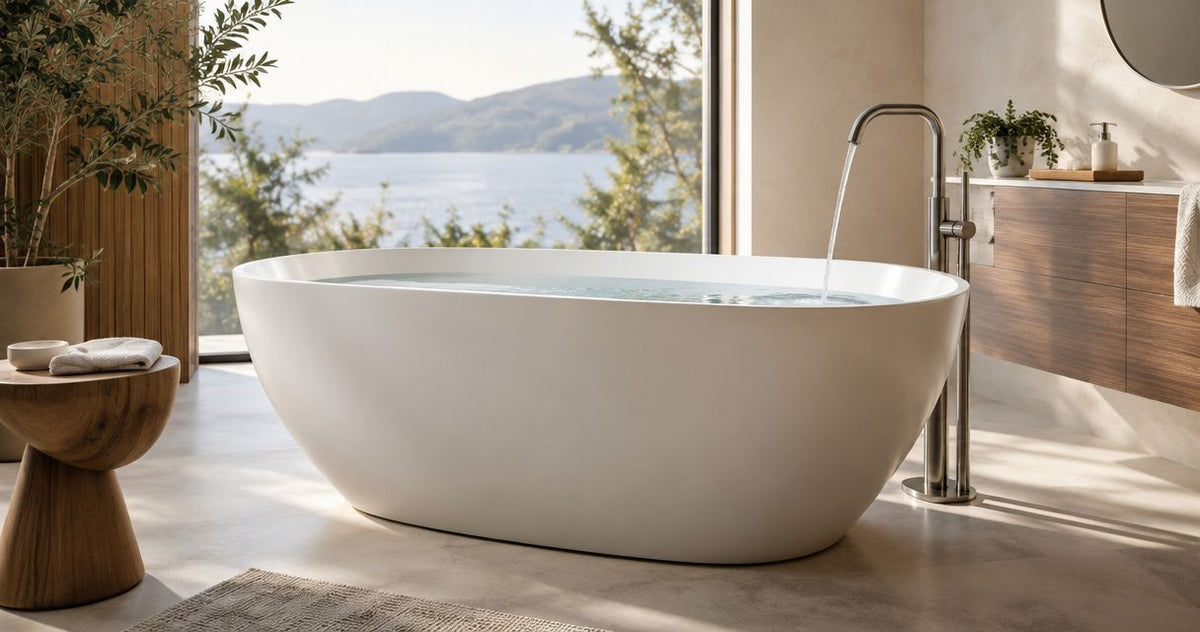
A freestanding tub’s fill time equals the volume of water you actually use divided by the tub filler’s measured flow rate. That calculation excludes the wait for hot water to reach the faucet and any adjustments needed to reach your bathing temperature. For a 2026 bathroom project, calculate the time from your plumbing and intended water level—not the tub’s exterior length.
By Editorial Team
- How long does it take to fill a freestanding tub? Divide bathing volume by measured faucet flow.
- Aeva Vital lists acrylic tubs by length; length alone does not establish fill time.
- Measure mixed-temperature flow at the tub spout, not at a different bathroom faucet.
- Separate water-filling time from hot-water waiting time when planning your bath.
How long does it take to fill a freestanding soaking tub?
Fill time in minutes = bathing volume in gallons ÷ flow rate in gallons per minute. Use the amount of water needed for your bath, rather than automatically using the tub’s maximum listed capacity.
The calculation requires a consistent flow rate. If you change the handle position while filling, or another fixture changes the available flow, a single measurement becomes less representative of the full bath.
For a new bathroom, confirm the filler and supply arrangement during freestanding tub installation planning. A tub that fits the room still needs a water supply capable of delivering the intended bath.
| Part of the process | What determines the time | What to measure or confirm |
|---|---|---|
| Waiting for warm water | Water remaining in the hot-water pipe and the delivery arrangement | Time until usable warm water reaches the spout |
| Filling the tub | Actual bathing volume and mixed-water flow | Gallons used and gallons per minute |
| Adjusting the temperature | Starting temperature and subsequent hot or cold additions | Time spent correcting the bath |
| Recovering between baths | Water-heater type, capacity, and operating conditions | Manufacturer guidance for the installed heater |
The first bath after a long idle period and a bath immediately after other hot-water use need separate consideration. Your plumbing conditions—not a universal tub average—determine the result.
Why this matters
A freestanding soaking tub is part of a plumbing system. Buying a larger tub without checking the filler and hot-water supply leaves the fill-time question unanswered.
The practical decision is whether the tub can reach your preferred depth and temperature within a wait you accept. Exterior dimensions help you plan the room, but they do not supply either side of the fill-time calculation.
For your 2026 remodel, treat fill time as an installation requirement. Ask for the intended bathing volume, the filler’s flow information, and a hot-water assessment before finalizing the combination.
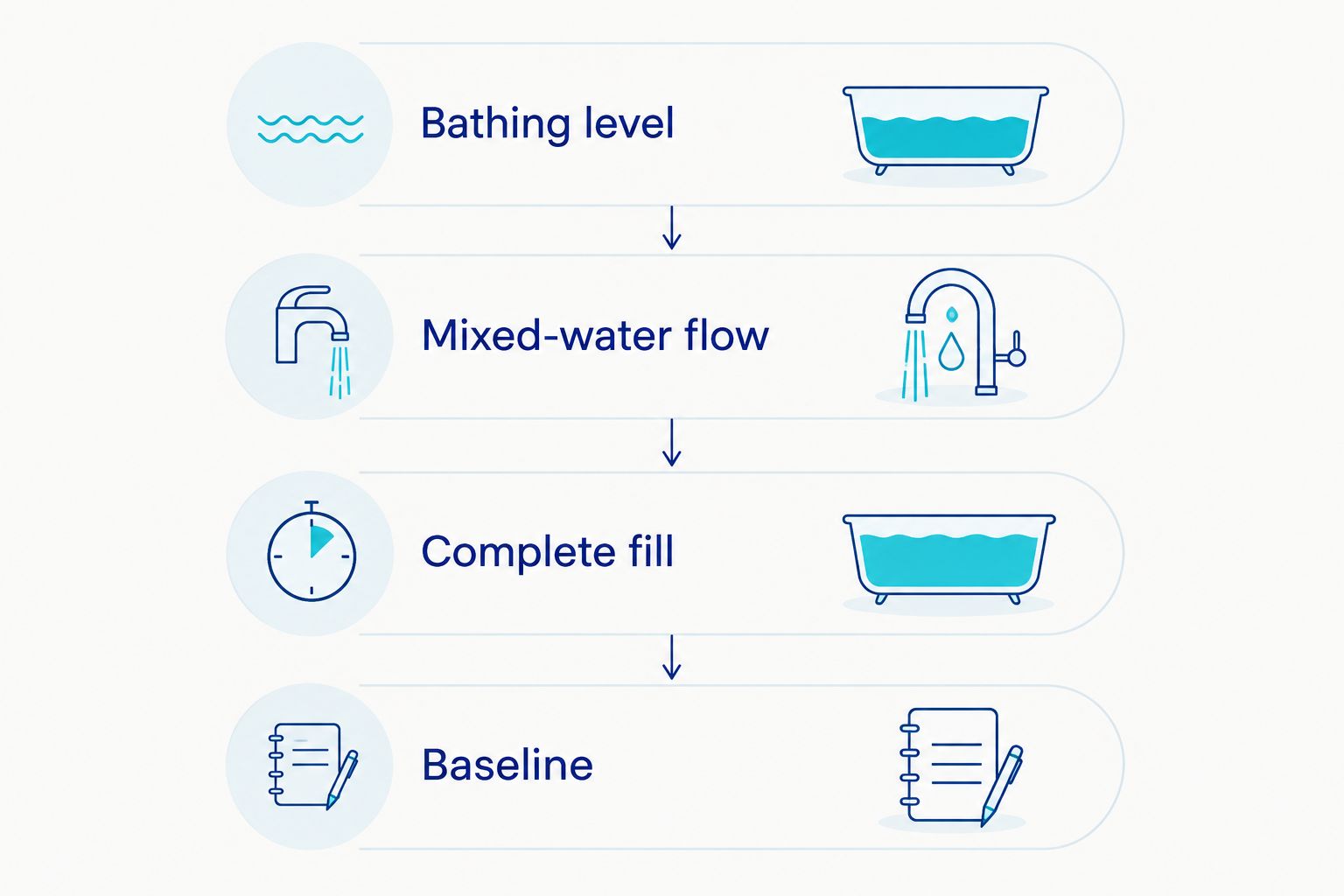
How to measure your tub’s actual fill time
An installed tub gives you a direct answer: time a normal fill. A flow test helps explain that result and gives you a baseline for investigating changes later.
Establish your bathing level
Choose a water level that leaves room for your body to displace water when you enter. Follow the tub manufacturer’s instructions and keep the overflow unobstructed.
A capacity figure needs context. Confirm whether it describes water to the overflow, another reference point, or a stated usable capacity; those descriptions are not interchangeable.
Do not assume a comfortable bath requires filling an empty tub to its overflow. The useful measurement is the water needed for your bathing routine.
Measure mixed-water flow
Use a container with known volume and a timer to measure water delivered at the tub spout. Keep the handle at the temperature and opening you normally use, and avoid spilling water during the test.
Divide the collected volume by the collection time expressed in minutes. The result is the measured gallons per minute at that setting.
Measure the tub filler itself. A sink faucet, showerhead, or outdoor hose is a different outlet and does not establish the tub spout’s delivery rate.
Time a complete fill
Close the drain, start the timer when water begins entering the tub, and stop at your chosen level. Record whether you included the initial wait for warm water.
Also record whether other fixtures were operating. A test performed with no competing water use is not the same condition as a bath filled while another bathroom is in use.
Keep a useful baseline
Save the elapsed time, water-level reference, faucet setting, and any relevant household water use. This gives you something specific to compare if filling becomes slower.
For a 2026 installation handover, ask the installer to demonstrate the completed system at a usable bathing temperature. A cold-water-only demonstration does not answer how the bath performs with mixed water.
Why freestanding tub fill time varies
The same tub can take different amounts of time to fill under different conditions. Check these factors before blaming the tub or replacing the faucet:
- Bathing volume: A higher target water level requires more water. Interior shape and the bather’s displacement affect the amount needed.
- Actual spout flow: The filler, valve, supply piping, and installation determine delivered flow. A published rating needs its stated test conditions.
- Hot-water delivery: Waiting for warm water adds time before useful filling begins. Maintaining bathing temperature also depends on the hot-water supply.
- Simultaneous water use: Other fixtures can change the conditions at the tub. Compare tests under similar household demand.
- Drain sealing: Water escaping through an incompletely closed or poorly sealing drain slows the rise in water level.
- Temperature adjustments: Adding water after the initial fill extends the time until the bath is ready.
These factors explain why a fill-time promise based only on a tub photograph or length is not useful. Match the tub’s water requirement to measured delivery, then check the temperature throughout the fill.
Does a longer freestanding tub always take longer to fill?
No. A longer exterior dimension does not prove a larger bathing volume because interior width, depth, wall shape, and the chosen water level also matter.
A sloped backrest occupies space differently from an upright interior wall. Exterior styling also does not describe the entire bathing well, so length alone cannot establish the gallons required.
For Aeva Vital freestanding tubs, compare the available dimensions with capacity and interior measurements before estimating time. A shorter model is not automatically a faster-filling model.
What the listed acrylic tub dimensions establish
The following 2026 comparison uses the supplied product titles. It identifies stated lengths and features without assigning unprovided capacities or flow rates.
| Listed acrylic tub | Best for comparing | What the listing establishes | Limitation for fill-time planning |
|---|---|---|---|
| 55-inch acrylic freestanding soaking bathtub with chrome drain | A shorter listed option | Acrylic construction, stated length, and chrome drain | Length does not establish bathing volume |
| 59-inch acrylic freestanding bathtub with diamond pattern | An intermediate listed length | Acrylic construction, diamond pattern, gloss white finish, and chrome drain | Exterior pattern does not establish flow or fill time |
| 67-inch acrylic freestanding bathtub, cUPC certified | A longer listed option | Acrylic construction, gloss white finish, chrome drain, and stated certification | Certification and length do not establish installed fill time |
Aeva Vital freestanding tubs suit shoppers comparing acrylic models by stated length, not assumed fill speed. The benefit of these distinctions is clear dimensional comparison; the limitation is that none supplies a timed filling result for your home.
A certification label is not a flow-rate measurement. Likewise, acrylic construction does not tell you how quickly water reaches the spout or whether your heater can sustain the intended bath.


Will a higher-flow tub filler solve a slow fill?
A higher-flow filler helps only when the rest of the system can supply the additional water at the required temperature. A larger published faucet rating does not guarantee a faster installed fill.
Before replacing hardware, have a qualified plumber check the existing filler, supply valves, piping, and any applicable flow restrictions. Follow the manufacturer’s instructions rather than removing components to chase a higher flow rate.
The advantage of higher delivered flow is a shorter fill for the same water volume. The trade-off is greater hot-water demand per minute, which the heater and supply arrangement must support.
Check where the delay occurs
Watch both water level and temperature during a normal fill. Different symptoms call for different checks:
- Slow water rise with a steady stream: Check the target volume and whether the drain seals completely.
- Weak delivery at the spout: Have the filler and supply arrangement inspected.
- Strong initial delivery that changes: Record which other fixtures are running and whether temperature also changes.
- Acceptable flow but cooling water: Have the hot-water system assessed before selecting a different filler.
Do not change several components at once without establishing a baseline. Otherwise, you lose the comparison needed to tell which change addressed the problem.
Can a tankless water heater keep up with a soaking tub?
A tankless water heater must deliver the required hot-water flow at the temperature rise your home needs. The word “tankless” alone does not establish that capability.
Temperature rise means the difference between incoming water temperature and the required hot-water outlet temperature. Check the manufacturer’s output information for those conditions, including simultaneous hot-water demand elsewhere in the home.
A storage water heater requires a different assessment: available heated water, mixing conditions, and recovery all matter. Neither heater type proves a particular fill time without the tub and filler requirements.
For a 2026 purchase, ask the installer to assess the complete combination rather than choosing a heater from the tub’s length. Keep the heater model and filler documentation with the tub specifications.
What should you confirm before ordering a tub?
Use a short specification check to separate measurable requirements from assumptions. Ask for clarification whenever a capacity or flow figure lacks a stated reference condition.
- Confirm the tub’s capacity definition and intended bathing depth.
- Obtain the filler’s flow information and required supply conditions.
- Check filler reach and placement against the tub’s installation instructions.
- Have the hot-water system assessed for the intended bath and other household demand.
- Confirm drain operation, overflow requirements, and access for service.
- Arrange a completed-installation fill test before considering the plumbing work finished.
This check does not predict a universal wait. It gives your installer the information needed to evaluate the specific bathroom you are building.
FAQ
How long does it take to fill a freestanding tub?
Fill time equals actual bathing volume divided by measured tub-spout flow. Add the wait for warm water and any temperature adjustments to estimate when the bath is ready.
Can I calculate fill time from the tub’s length?
No, exterior length does not establish bathing volume. Interior shape, water depth, and the amount of space displaced by the bather also matter.
Should I use maximum tub capacity to estimate filling time?
Use the water volume required for your intended bath rather than automatically using maximum capacity. Confirm what the manufacturer’s capacity figure measures.
Why does my tub take longer to fill than it used to?
Compare current flow, drain sealing, temperature, and simultaneous household water use with your previous conditions. Have a qualified plumber inspect a persistent change rather than assuming the tub needs replacement.
Does a freestanding tub need a special high-flow faucet?
Choose a filler that is compatible with the tub and supported by the plumbing system. A higher published flow rating does not guarantee that your installed supply will deliver that flow.
Will a tankless water heater fill my tub faster?
A tankless water heater does not by itself establish a faster fill. Its output must meet the required temperature rise and hot-water demand while the tub filler supplies the intended flow.
Do Aeva Vital’s listed tub lengths tell me their fill times?
No, the listed lengths identify dimensions, not installed fill times. You still need bathing volume, measured spout flow, and a hot-water assessment.
Related guides
- Setting up a tankless water heater for your soaking tub
- Freestanding soaking tubs ranked by soaking depth
- Plumbing a freestanding tub and cold plunge into one room
One last thing
For your 2026 bathroom plan, specify a completed bath—not just running water—as the installation check. A strong stream at the start does not prove that the tub will reach your chosen level at a usable temperature.