
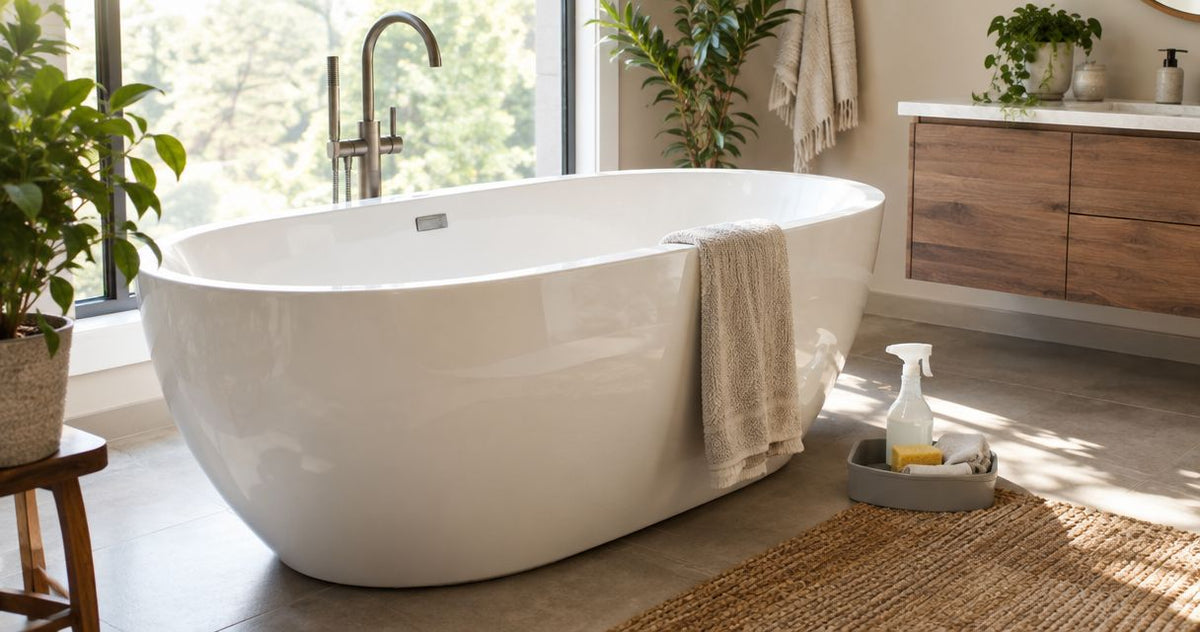
To clean a freestanding soaking tub, rinse away loose residue, wipe the surface with a soft cloth and a cleaner approved for its material, then rinse thoroughly and dry. Maintain the tub by removing bath-product residue after use, clearing accessible hair from the drain, and checking for leaks; abrasive tools and incompatible chemicals can damage the finish.
By Editorial Team
- How to clean a freestanding soaking tub: use a material-approved cleaner, a soft cloth, thorough rinsing, and drying.
- Aeva Vital acrylic freestanding bathtubs need acrylic-compatible care; size and certification do not establish cleaner compatibility.
- Treat soap film, mineral deposits, and surface damage differently. Stronger scrubbing is not a universal solution.
- Never mix cleaning products, and do not move an installed tub to clean behind it.
How to clean a freestanding soaking tub
Start with the tub's care instructions, not the cleaner's advertising. Freestanding describes how the tub is installed, not what its surface can tolerate. Acrylic, enamel, and solid-surface materials do not share one universal cleaning method. If you need to identify the differences, read the acrylic versus stone resin freestanding tub guide.
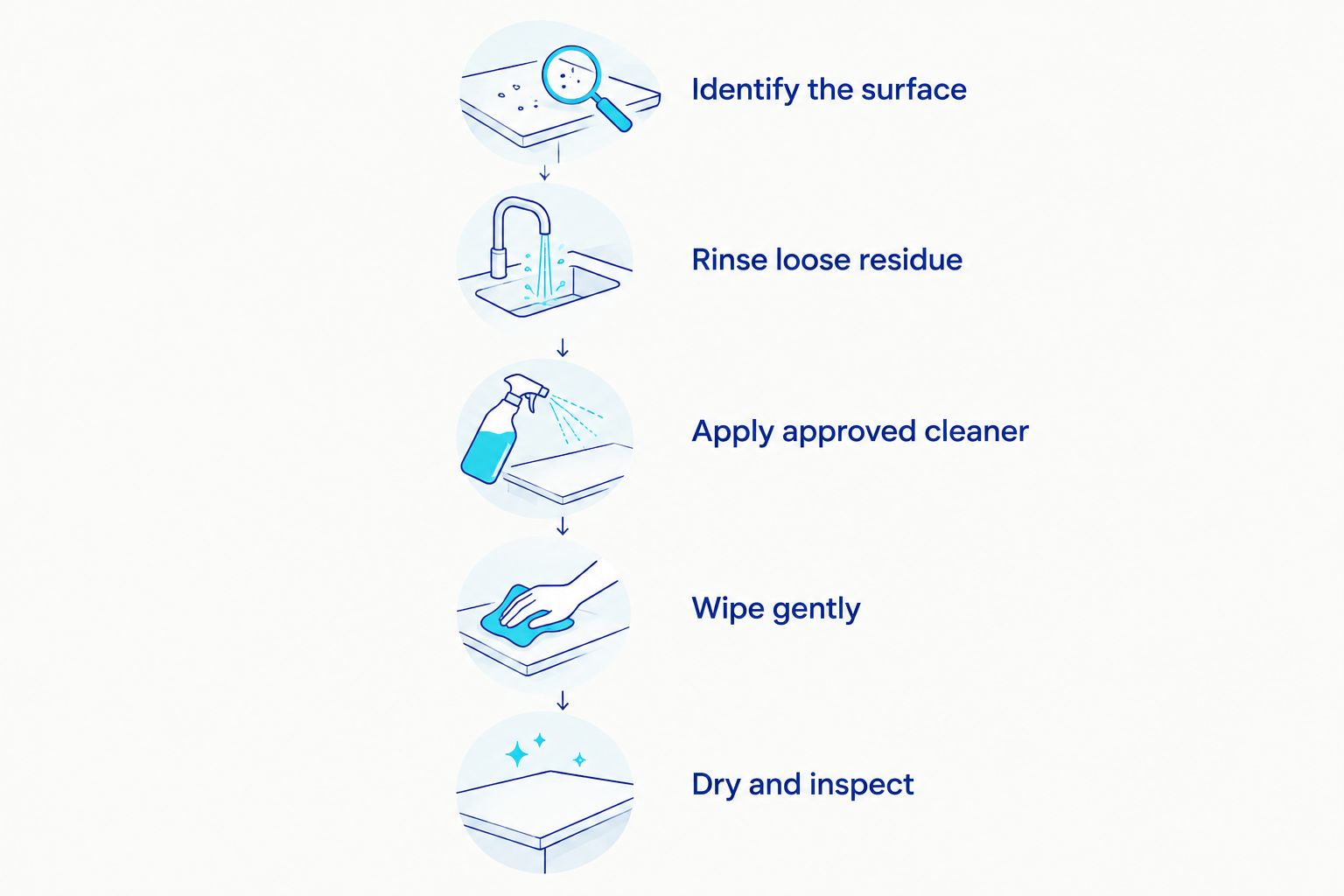
Use this sequence for routine cleaning, subject to the manufacturer's instructions:
- Identify the surface. Check the model documentation for the tub material, finish, and prohibited products. Check the drain and faucet finishes separately.
- Prepare the area. Remove bottles, bath pillows, mats, and loose hair. Keep the bathroom ventilated and follow the cleaner's protective-equipment instructions.
- Rinse loose residue. Use comfortably warm water to wash away soap, oils, and grit. Do not scrub grit into the surface.
- Apply an approved cleaner. Follow its dilution and contact-time instructions. Do not substitute an improvised recipe for a material-specific recommendation.
- Wipe gently. Work with a clean, soft cloth or an approved nonabrasive sponge. Clean the rim, basin, exterior, and accessible areas around the fittings.
- Rinse completely. Remove cleaner from the basin, rim, drain surround, and any surface that bathwater touches.
- Dry and inspect. Use a clean, soft towel. Look for persistent marks, loose fittings, pooling water, or moisture around the base.
Keep the cleaner label and tub care sheet together in your 2026 home-maintenance records. Written instructions remove the guesswork when someone else cleans the bathroom.
Why this matters
Cleaning has two separate jobs: removing residue and preserving the surface. A product that removes a stain can still be unsuitable for the tub, drain finish, or surrounding sealant.
Freestanding tubs also expose an exterior that needs attention. Water behind the tub, residue around its base, and inaccessible plumbing connections are maintenance issues—not reasons to reach for a stronger bathroom cleaner.
For your 2026 cleaning routine, prioritize a method you can repeat without scraping, aggressive polishing, or shifting the fixture. A clean tub should not require damage to look clean.
Which cleaning method fits the problem?
Match the treatment to the deposit before choosing a product. These are cleaning approaches, not permission to use a particular chemical on every tub.
| Approach | Best for | Advantage | Limitation |
|---|---|---|---|
| Warm-water rinse and soft cloth | Fresh, loose bath residue | Removes residue without adding cleaner | Does not reliably remove established scale or provide disinfection |
| Material-approved routine cleaner | Soap film and ordinary body oils | Provides a defined cleaning method when used as directed | Must also be compatible with nearby fittings |
| Manufacturer-approved mineral-deposit treatment | Confirmed hard-water deposits | Targets mineral buildup rather than ordinary soil | Acidic products are unsuitable for some surfaces and finishes |
| Surface-compatible disinfectant | Situations requiring disinfection | Provides labeled disinfection when used correctly | Requires the stated contact time and any specified rinsing |
| Manufacturer-directed repair | Scratches, chips, or persistent finish damage | Addresses damage rather than treating it as dirt | Is not a routine cleaning task |
Cleaning removes soil; disinfection addresses microorganisms under a product's labeled conditions. Do not assume that a mild cleaner disinfects, or that a disinfectant is safe for acrylic simply because it is sold for bathrooms.
How should you clean different tub materials?
Acrylic: avoid abrasion and incompatible chemicals
For an acrylic soaking tub, choose products expressly permitted by the tub manufacturer. Use a soft cloth, keep it free of grit, and rinse away cleaner rather than allowing residue to dry on the surface.
Do not assume that scouring powder, a melamine sponge, solvent, or stiff brush is harmless. Some products remove marks through abrasion or chemical action that also affects the finish. An inconspicuous test does not override an explicit prohibition in the care instructions.
Stone resin and solid surface: identify the finish first
Stone resin and solid surface are broad material descriptions. Glossy and matte finishes can have different care and repair requirements, even when their product categories sound similar.
Do not transfer polishing or sanding advice from another model. A repair technique intended for a particular solid surface can alter an unrelated tub's appearance. Get model-specific instructions before attempting to remove a scratch.
Enameled metal: protect the coating
On an enameled tub, clean the coating rather than treating the fixture as bare metal. Avoid scraping deposits with metal tools, and investigate chips instead of scrubbing them repeatedly.
A dark mark, discolored chip, or rough patch is not automatically removable dirt. If cleaning changes the surrounding finish without removing the mark, stop and seek repair guidance.
Why cleaning needs vary
A useful maintenance plan responds to the tub and household, rather than assigning every bathroom the same schedule. For a 2026 maintenance checklist, assess these factors:
- Surface material and finish: These determine which cleaners and tools are compatible.
- Water hardness: Dissolved minerals can leave deposits as water evaporates.
- Bath products: Oils, soaps, and other additives leave different types of residue.
- Use frequency: More bathing creates more opportunities for residue and hair accumulation.
- Access around the tub: Narrow gaps make the exterior and floor harder to reach.
- Drain condition: Hair and buildup can slow drainage independently of basin cleanliness.
Rinse and wipe after bathing, then perform a fuller clean when residue develops. Increase attention where you see recurring buildup rather than using a harsher product on an arbitrary timetable.
How do you remove soap scum and hard-water marks?
For soap film, start with the routine cleaner approved for the tub. Apply it as directed, wipe gently, and rinse. If the film remains, confirm that the cleaner is intended for that deposit before repeating the process.
Hard-water deposits need a different assessment. A chalky ring or rough deposit can indicate mineral buildup, but appearance alone does not establish which chemical is safe. Use only a mineral-removal treatment approved for the surface and nearby metal finishes.
Do not make vinegar, baking soda, or bleach your default tub-cleaning recipe. Vinegar is acidic, baking soda can act as an abrasive, and bleach requires material compatibility and label-directed use. Never mix bleach with vinegar, acids, ammonia, or other cleaners.
Avoid inventing a soaking time for stubborn marks. The relevant duration comes from the approved cleaner's label and the tub's care instructions—not from how difficult the stain looks.
How do you clean the drain, overflow, and exterior?
Drain and stopper
Remove visible hair from an accessible stopper using the method described in its instructions. Wear suitable gloves, keep removed material out of the drain, and replace removable parts correctly.
Do not unscrew unfamiliar fittings or pour drain chemicals into a slow-draining tub without checking compatibility. Drain cleaners introduce separate risks to the finish, plumbing, and anyone who later services the drain. Persistent slow drainage calls for diagnosis, not repeated chemical treatment.
Overflow and fittings
Wipe accessible overflow trim with a compatible cleaner on a soft cloth. Do not flood openings with cleaning solution or remove the assembly simply to reach behind the cover.
The drain and faucet require their own care instructions. A cleaner approved for the basin is not automatically approved for chrome or another decorative finish.
Exterior and surrounding floor
Wipe the outside of the tub, then clean the accessible floor around it. Use a soft, nonabrasive tool that reaches the gap without forcing against the shell or plumbing.
Never pull an installed freestanding tub away from the wall to clean behind it. Its drain and other connections are not cleaning handles. For installation context, see how long freestanding tub installation takes.
What maintenance problems need professional attention?
Check around the base after bathing and drying the room. If moisture returns, establish whether it comes from splashing, condensation, a fitting, or a plumbing connection before sealing anything.
Stop using the tub and arrange an inspection if you find active leakage, a crack, unexplained movement, or recurring water at the base. Do not cover a suspected leak with additional sealant or tighten fittings blindly.
Record the location and circumstances of a problem in your 2026 maintenance log. A photograph showing where moisture appears is more useful to a technician than a description that the bathroom sometimes feels damp.
Aeva Vital acrylic tubs: what the specifications establish
Aeva Vital acrylic freestanding bathtubs are best for shoppers comparing 55-inch, 59-inch, and 67-inch formats. The listed models identify acrylic construction and chrome drains; those details tell you to check care compatibility for both the tub surface and its metal fittings.
| Listed model | Verified details | Care implication |
|---|---|---|
| 55" Acrylic Freestanding Soaking Bathtub with Chrome Drain | 55-inch format; acrylic; chrome drain | Confirm acrylic-compatible cleaning and separate drain-finish care |
| 59" Acrylic Freestanding Bathtub – Diamond Pattern, Gloss White, Chrome Drain | 59-inch format; acrylic; gloss white; diamond pattern; chrome drain | Check instructions for both the finished surface and exterior detailing |
| 67" Acrylic Freestanding Bathtub – Gloss White, Chrome Drain, cUPC Certified | 67-inch format; acrylic; gloss white; chrome drain; cUPC certification listed | Do not interpret certification as approval for a cleaning chemical |
Aeva Vital's listed dimensions help you compare formats, but they do not establish installed cleaning clearance, scratch resistance, or compatibility with bleach or descalers. The practical limitation is straightforward: a product listing is not a care manual. Obtain the applicable instructions before choosing cleaning chemicals or attempting a repair.


FAQ
What's the safest way to clean a freestanding soaking tub?
Use the tub manufacturer's approved cleaner and a soft, nonabrasive cloth, then rinse and dry. Identify the surface material before choosing a product, and check the drain finish separately.
Can I use vinegar to clean an acrylic freestanding tub?
Use vinegar only if the tub manufacturer expressly permits it. Vinegar is acidic, and approval for the basin does not establish compatibility with the drain, faucet, or surrounding surfaces.
How often should I clean my freestanding soaking tub?
Rinse and wipe the tub after bathing, and perform a fuller clean when residue develops. Use frequency, bath products, water hardness, and the manufacturer's instructions determine the appropriate routine.
Can I use bleach to disinfect my soaking tub?
Use bleach only when both the tub instructions and the product label permit that application. Follow the labeled dilution, contact time, ventilation, and rinsing requirements, and never mix bleach with other cleaners.
How do I clean behind a freestanding tub without moving it?
Clean accessible areas with a soft, nonabrasive tool that fits without forcing against the tub or plumbing. Do not move an installed tub; ask an installer about access when the gap cannot be reached safely.
What should I do if my soaking tub drains slowly?
Remove accessible hair according to the stopper instructions and check whether drainage improves. Persistent slow drainage needs plumbing assessment rather than repeated use of chemical drain cleaner.
Does cUPC certification mean a tub is safe to clean with any bathroom cleaner?
No, cUPC certification does not establish compatibility with every bathroom cleaner. Use the model's care instructions to select cleaning products and repair methods.
Related guides
One last thing
Before replacing a stubborn-stain cleaner, check the cloth: trapped grit can turn gentle wiping into abrasion. For your 2026 care routine, keep a clean cloth reserved for the tub and store the model's cleaning instructions where everyone who maintains the bathroom can find them.