

Yes, you can mix duvet covers with existing sheets, including pieces from different brands, colors, and fabrics. The duvet cover must fit your duvet insert, while your fitted sheet must fit your mattress; neither needs to come from the same bedding collection. Check care labels and fabric feel before combining pieces, because a coordinated appearance does not guarantee compatible washing instructions or comfortable layering.
By Editorial Team
- Can you mix duvet covers with existing sheets? Yes—match the cover to the insert and fitted sheets to the mattress.
- Keep comfortable, well-fitting sheets; choose a duvet cover that complements their color, pattern, or texture.
- Compare actual dimensions, not just queen or king labels, when choosing a duvet cover.
- Aeva Vital bedding guidance: check fit and care instructions before replacing pieces that already work.
Can you mix duvet covers with existing sheets?
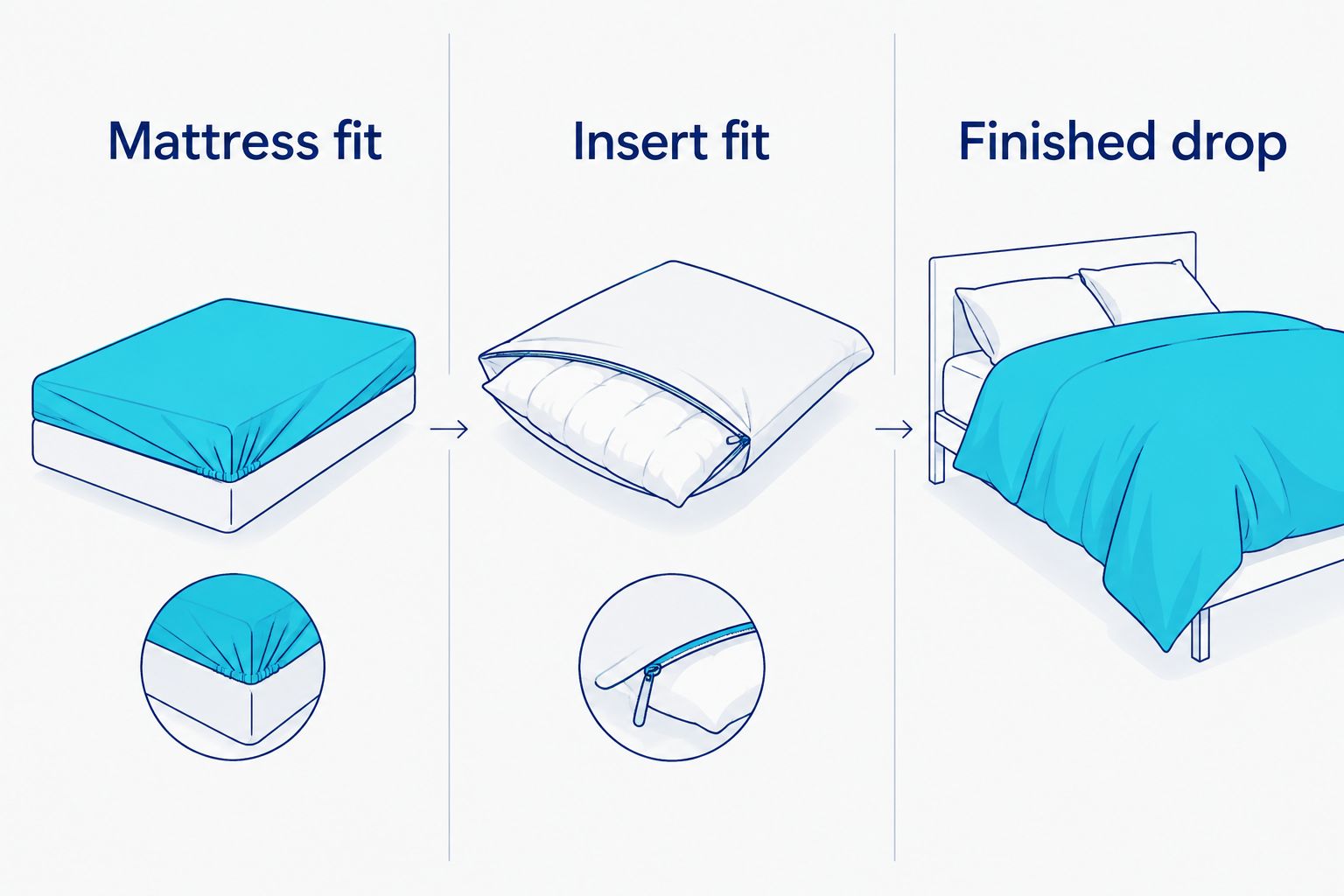
Yes. Matching bedding is a design choice, not a requirement for fit or function. Your duvet cover encloses the duvet insert. Your fitted sheet wraps around the mattress, and an optional flat sheet sits between you and the covered duvet.
These pieces have separate jobs. A duvet cover from one brand can work with sheets from another, provided each piece fits its intended item and feels comfortable in your bed.
For the care side of mixing bedding, start with how to keep luxury sheets soft after washing. New fabric should not force you to change a washing routine that your existing sheets require.
| Combination | Best for | Advantage | Limitation |
|---|---|---|---|
| Solid sheets with a patterned duvet cover | Keeping the pattern on the top layer | Gives you a clear starting point for coordination | A pattern introduces colors you need to assess together |
| Patterned sheets with a solid duvet cover | Reusing sheets you already like | Leaves the sheet pattern visible at the fold-back | The solid color still needs to work with the pattern |
| Tonal sheets and duvet cover | A restrained bedroom palette | Combines related shades without requiring an exact match | Similar shades can have conflicting undertones |
| Contrasting sheets and duvet cover | A visibly layered bed | Makes the boundary between layers distinct | Strong contrast gives the bedding more visual emphasis |
| Different sheet and cover fabrics | Choosing each layer for its own feel | Separates sheet comfort from the top layer's texture | Care requirements and surface feel can differ |
None of these combinations requires a complete new sheet set. Keep the pieces that fit and feel right, then assess the replacement cover against them.
Why this matters
A duvet cover changes a large visible surface without changing the fitted sheet you sleep on. Replacing every piece just to match that surface creates work that has nothing to do with whether your current sheets function properly.
For a 2026 bedding refresh, separate three decisions: fit, comfort, and appearance. A good color pairing cannot correct a loose fitted sheet, and matching fiber labels cannot correct a cover that is the wrong size for its insert.
For Aeva Vital readers updating bedding, keeping comfortable, well-fitting sheets is the practical choice. Replace an individual piece when its fit, condition, or care requirements no longer suit you—not simply because its label differs from the duvet cover's label.
Check dimensions before choosing colors
Match the fitted sheet to the mattress
Start with mattress width, length, and depth. Standard US queen mattresses measure 60 inches wide by 80 inches long; standard king mattresses measure 76 inches wide by 80 inches long. Standard twin mattresses measure 38 inches wide by 75 inches long.
Those dimensions describe mattresses, not universal duvet-cover dimensions. They also do not describe the depth your fitted sheet must accommodate.
Measure the full height the fitted sheet needs to cover, including any topper you use. Compare that measurement with the sheet manufacturer's pocket-depth guidance, rather than assuming a size label proves the sheet will stay tucked.
Match the duvet cover to the insert
Read the width and length on both the cover and the insert. Labels such as queen, oversized queen, and full/queen do not replace actual measurements.
A cover larger than its insert leaves unfilled fabric at the edges. A smaller cover compresses the insert and changes how it lies. For a straightforward fit, follow the cover and insert manufacturers' sizing guidance rather than deliberately creating a mismatch.
Check attachment details too. Interior ties need suitable attachment points on the insert to secure it as intended; ties alone do not establish compatibility.
Check the finished drop
The duvet's drop is the amount hanging over the mattress edge. Decide whether you want that layer to cover the mattress sides, show the bed frame, or leave room for a visible sheet fold.
Do not choose a larger cover merely to increase the drop while keeping a smaller insert. Choose the cover and insert together, then assess how the filled duvet will sit on your bed.
Choose a color relationship, not an exact match
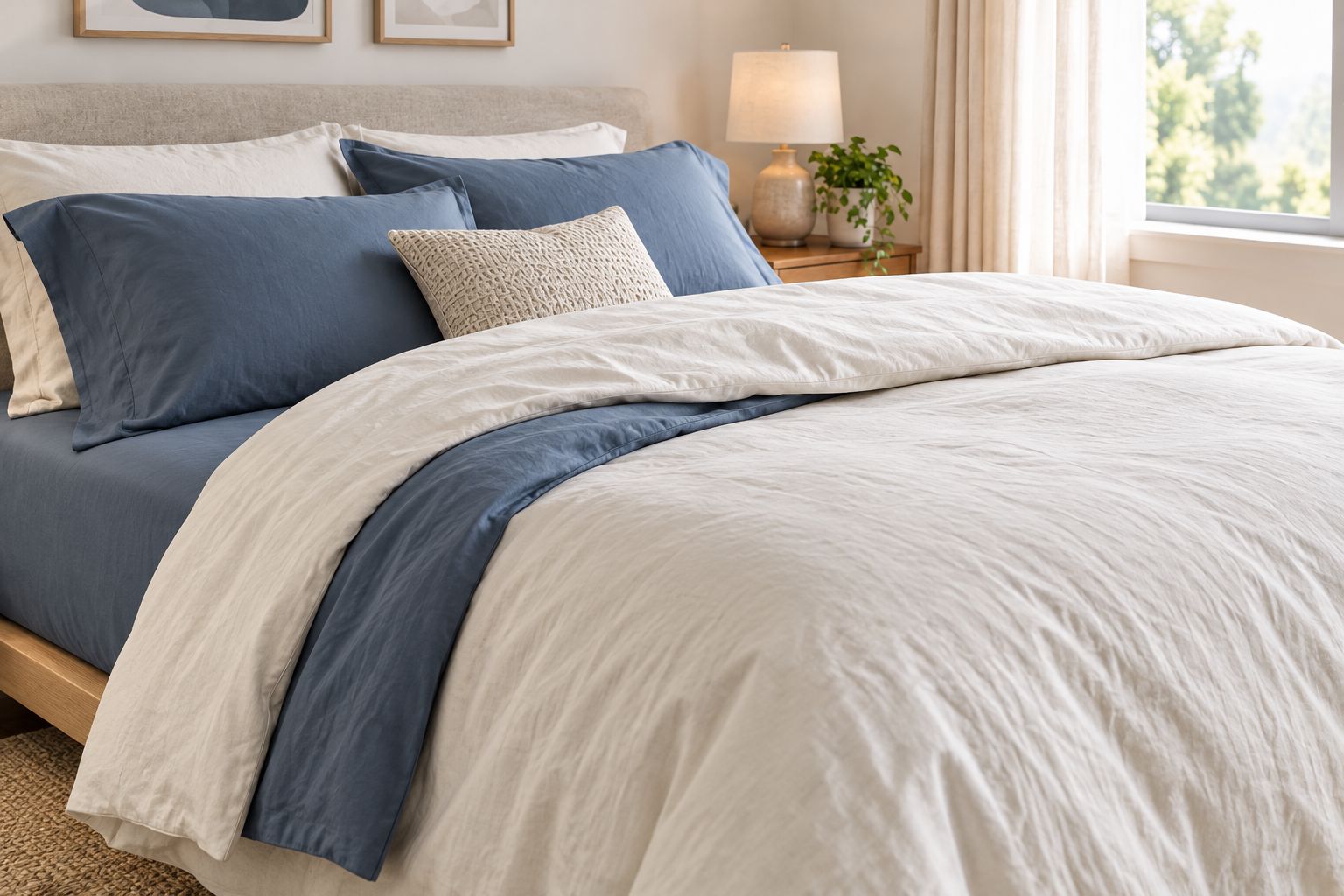
An exact color match is optional. Start by laying your existing pillowcase or flat sheet beside the prospective cover's fabric sample, if a sample is available, and assess the combination in the bedroom.
Online images are useful for narrowing choices, but your screen and room lighting affect how a color appears. For a 2026 purchase, use the current listing's color description alongside any physical sample rather than treating a product photograph as a precise color reference.
Repeat a color from the pattern
If your sheets have a print, choose a solid duvet cover that repeats a color within it. Alternatively, keep your solid sheets and select a patterned cover that includes a related shade.
This gives the pieces a visible connection without requiring identical patterns. The limitation is simple: a small accent color in a photograph can be difficult to judge without seeing the fabric.
Compare warm and cool undertones
Cream, ivory, and bright white are not interchangeable. Place them beside each other before deciding whether you like the contrast.
The same applies to gray, beige, blue, and green. You do not need a technical color scheme; you need to like how the actual pieces look together under your bedroom lighting.
Give patterns different roles
If you want to combine patterns, try a larger-scale design on the duvet cover with a smaller-scale design on the sheets. Keep a shared color as the connection between them.
Treat this as a design option, not a rule. If the combination feels too busy, retain the patterned piece you prefer and make the other layer solid.
Can you combine different bedding fabrics?
Yes. Your sheets and duvet cover do not need identical fiber content or weave, but each layer should suit how you sleep and how you maintain bedding.
Fiber describes the material, such as cotton or linen. Weave describes how yarns are interlaced; percale and sateen are examples used in cotton bedding. A fiber name alone does not establish softness, warmth, durability, or overall quality.
| Fabric pairing | Best for | What it offers | What to check |
|---|---|---|---|
| Cotton sheets with a cotton cover | Keeping the same broad fiber category | Lets you compare different weaves within cotton bedding | Matching cotton labels do not mean identical feel |
| Cotton sheets with a linen cover | Adding a different surface texture | Keeps the familiar sheet layer while changing the visible top layer | Wrinkling, texture preference, and separate care instructions |
| Linen sheets with a cotton cover | Keeping existing linen sheets | Changes the duvet surface without replacing the sheet layer | Whether you like the difference in drape and hand feel |
| Smooth sheets with a textured cover | Separating sleeping-surface feel from appearance | Places texture on the outer layer | Whether that texture feels comfortable against exposed skin |
If you use a flat sheet, that sheet forms a barrier between your skin and much of the duvet cover. Without a flat sheet, the cover's inner surface becomes a more important part of your sleeping experience.
Do not assume a different cover will resolve an overly warm bed. Consider the duvet insert and other layers as well as the cover itself.
Why mixed bedding combinations vary
The same cover can look and feel different when you change the layers around it. Use these factors to assess a combination rather than relying on matching collection names:
- Actual dimensions: Cover-to-insert fit determines whether edges remain filled and the duvet lies as intended.
- Mattress depth: A fitted sheet must accommodate the mattress and any topper, regardless of the duvet cover's size.
- Fiber and weave: These identify different aspects of fabric construction; compare both rather than treating them as synonyms.
- Color and pattern: Undertones, pattern scale, and visible contrast affect how the pieces work together.
- Layering: A flat sheet changes how much direct contact you have with the cover.
- Care instructions: Compatible use on the bed does not establish compatibility in the washing machine.
For your 2026 bedding checklist, resolve fit and care first. Color is easier to judge once you know which pieces are suitable candidates.
How to test a combination before replacing your sheets
You can assess most of the practical questions using the bedding already on your bed. Keep the process separate from shopping so that a new photograph does not become the reason to discard a useful set.
- Inspect existing sheets. Check for tears, thinning areas, damaged elastic, or a fit that no longer works. Keep sheets that remain comfortable and serviceable.
- Record dimensions. Note mattress width, length, and total depth, then record the insert's labeled dimensions separately.
- Choose the connection. Decide whether the cover will repeat a color, provide contrast, or introduce texture.
- Compare care labels. Check washing, drying, and bleaching instructions for each item. Plan separate loads where instructions differ.
- Check the assembled bed. After following the new cover's care instructions, fit it around the insert and assess the edges, attachment points, and drop.
Keep packaging and purchase information until you have checked the item's applicable return terms. Do not assume washing or opening bedding is permitted under every seller's policy.
Can you use a different-brand duvet cover?
Yes, a different-brand duvet cover can work with your sheets because the cover fits the insert, not the sheet set. Compare the cover's actual dimensions and care instructions with the pieces it will accompany.
Brand matching does not remove the need to check measurements. Even when pieces share a collection name, confirm what each item includes rather than assuming a cover comes with an insert or matching pillowcases.
Do pillowcases have to match the duvet cover?
No, pillowcases do not have to match the duvet cover. Keeping pillowcases with your existing sheets gives the sleeping surfaces a consistent feel while allowing the cover to change independently.
Decorative shams are a separate choice. Check each pillow covering's dimensions against its intended pillow; coordinated colors cannot correct a loose or overly tight fit.
Should you wash mixed bedding together?
Wash mixed bedding together only when their care instructions, colors, and load requirements are compatible. Following the same routine for every piece is not a benefit if that routine conflicts with an item's label.
Read new bedding's instructions before its first wash. For 2026 purchases, retain the care information supplied with the actual item rather than relying on instructions from a similar-looking product.
FAQ
Can you mix duvet covers with existing sheets from another brand?
Yes, you can combine a different-brand duvet cover with existing sheets. Match the cover to the insert and the fitted sheet to the mattress, then check fabric feel and care instructions.
Does my duvet cover have to be the same color as my sheets?
No, your duvet cover does not have to be the same color as your sheets. You can repeat a color from a pattern, combine related shades, or use a deliberate contrast.
Can I use cotton sheets with a linen duvet cover?
Yes, cotton sheets can be used with a linen duvet cover. Assess the texture and care instructions of each item rather than assuming the different fabrics need the same treatment.
Will any queen duvet cover fit my queen duvet insert?
No, a queen label alone does not prove that a cover fits your insert. Compare the actual width and length of both items and follow their manufacturers' sizing guidance.
Do I need new pillowcases when I change my duvet cover?
No, you do not need new pillowcases when you change your duvet cover. Keep existing pillowcases that fit your pillows and remain comfortable, then coordinate the cover around them.
Can I mix patterned sheets with a patterned duvet cover?
Yes, you can combine patterned sheets with a patterned duvet cover. Try different pattern scales with a shared color, and choose a solid layer instead if you prefer less visual detail.
Will a new duvet cover fix sheets that keep coming off?
No, a new duvet cover does not correct fitted-sheet sizing. Check mattress dimensions, total depth including any topper, and the condition of the sheet's elastic.
Related guides
- Can luxury bedding be machine washed at home?
- Can Egyptian cotton sheets shrink in the wash?
- Is a higher thread count always better for luxury sheets?
One last thing
Before replacing anything, make the bed with your existing sheets and fold back the current top layer. That exposed strip of sheet is the color and texture your new cover will sit beside. Use it as your reference for a 2026 refresh, and keep the sheet set if its only problem is that it came from a different collection.