

Yes, luxury bedding can be ironed safely when the care label permits ironing and you stay within its temperature and steam instructions. Cotton and linen sheets often tolerate ironing, while silk, synthetic blends, decorative trims, and specialty finishes need different treatment. The word luxury does not identify a safe heat setting; the instructions on each piece do.
By Editorial Team
- Can luxury bedding be ironed? Yes, if its care label permits the heat setting and steam you use.
- Aeva Vital’s bedding-care verdict: follow the sewn-in label, not thread count or the word luxury.
- Check sheets, pillowcases, and duvet covers separately; matching pieces can have different trims and care instructions.
- Use a clean ironing board, test a hidden area, and keep heat away from elastic and closures.
Can luxury bedding sets be ironed safely?
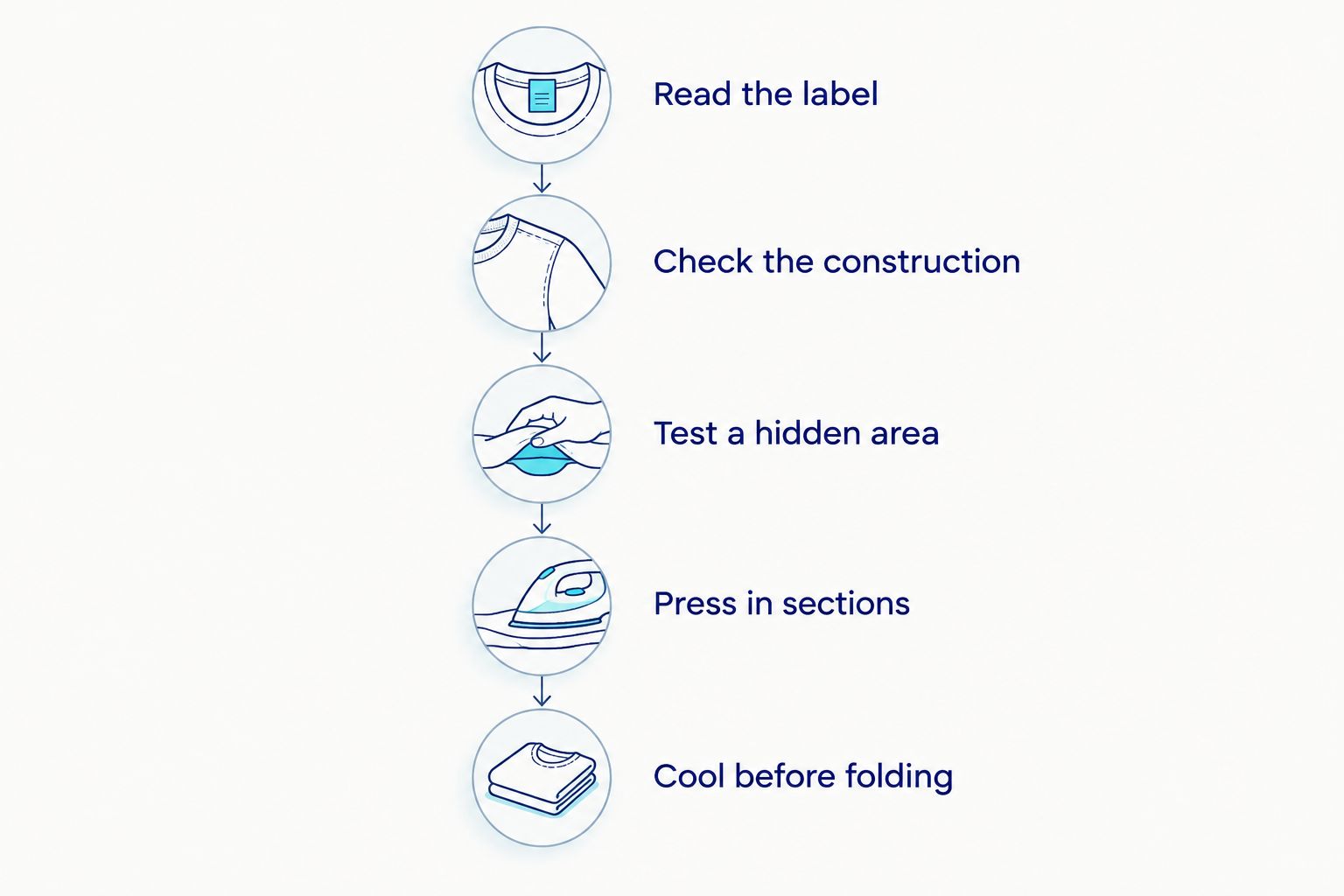
The safe method starts with the label, not the fiber name. For this 2026 guide, use the following sequence before pressing a sheet, pillowcase, or duvet cover:
- Read the label. Confirm that ironing is allowed and check for restrictions on steam.
- Check the construction. Identify embroidery, elastic, coatings, buttons, and zippers that need protection.
- Test a hidden area. Begin below the permitted maximum and inspect the cooled fabric before continuing.
- Press in sections. Support the fabric on an ironing board and keep the iron moving.
- Cool before folding. Let the bedding dry completely before storing it.
Iron clean bedding only. If laundry care is causing stiffness or creases before you reach the ironing board, start with the guide to machine-washing luxury bedding at home.
At-a-glance fabric comparison
These are general handling differences, not permission to override a product’s instructions. “Sateen” and “percale” describe weaves; neither name identifies the complete fiber composition.
| Fabric or construction | When ironing is appropriate | Main benefit | Main limitation |
|---|---|---|---|
| Cotton percale | When the label permits the selected setting | Smooths a crisp, plain-weave surface | Excessive heat can scorch fabric |
| Cotton sateen | When the label permits ironing; protect the face | Smooths creases while preserving the intended finish | Direct pressing can leave unwanted shine |
| Linen | When the label permits ironing and any added moisture | Reduces pronounced creases | A pressed finish does not prevent later wrinkling |
| Silk | Only under the item’s specific instructions | Allows careful smoothing of permitted pieces | Heat and moisture can mark delicate fabric |
| Polyester or mixed fibers | Only at the setting specified for the finished item | Smooths permitted fabrics without assuming cotton-level heat tolerance | Excessive heat can deform heat-sensitive fibers |
| Embroidered or embellished bedding | Only where both the fabric and decoration permit it | Tidies accessible flat areas | Trim, backing, and stitching can require different treatment |
Why this matters
Ironing changes appearance; it is not a required step for making clean bedding ready to use. You can leave ordinary wrinkles alone if you prefer a relaxed finish. A smooth pillowcase is a presentation choice, not proof that bedding is cleaner or more comfortable.
Heat damage is different from a crease. Scorching, melted fibers, and flattened decoration are not problems that another pass with the iron fixes. Accepting a few wrinkles is the better choice when the instructions are unclear.
What temperature should you use to iron bedding?
Use the maximum stated on the bedding’s label, then choose the lowest permitted setting that removes the crease. An iron’s “cotton” or “linen” dial is not a substitute for the item’s instructions. Check the iron’s manual as well, particularly when matching dots to dial positions.
The Federal Trade Commission’s Clothes Captioning: Complying with the Care Labeling Rule explains care-label terminology and the use of ASTM care symbols in the United States. Common US ironing-symbol guidance uses these temperature ceilings:
| Label instruction | Common maximum soleplate temperature | What to do |
|---|---|---|
| One-dot iron / cool | 110°C / 230°F | Use a low setting; follow any separate steam restriction |
| Two-dot iron / warm | 150°C / 302°F | Stay at or below the indicated maximum |
| Three-dot iron / hot | 200°C / 392°F | Use only when the finished item permits this setting |
| Crossed-out iron | Do not iron | Do not test an iron on the item |
These figures describe the iron’s soleplate, not a washing temperature or a target fabric temperature. They are ceilings, not instructions to start at maximum heat. Follow explicit written instructions when supplied, and check the manufacturer’s symbol key if its markings differ.
For your 2026 laundry checklist, record the setting separately for each bedding piece. Do not transfer the instructions from a plain fitted sheet to a decorated pillowcase simply because they came in one set.
How do you iron luxury sheets without damaging them?
Read the label
Look for ironing temperature, steam restrictions, and instructions such as “iron on reverse” or “do not iron decoration.” Also read the fiber-content label. A cotton-rich blend is not the same construction as pure cotton.
If the label is missing or illegible, ask the bedding manufacturer for the exact item’s care instructions. Do not use a hidden-area test to overrule a “do not iron” symbol. A test checks your technique within permitted care, not whether a prohibited method is safe.
Check the construction
Set up a stable ironing board with a clean cover, and inspect the iron’s soleplate for residue. Keep excess sheet fabric supported in a clean basket or on another clean surface. Dragging a freshly washed sheet across the floor defeats the preparation.
Separate flat fabric from elastic, piping, decorative stitching, and closures. Open duvet covers so you can work around buttons or zippers rather than pressing over them. Do not iron bedding while it is spread across a mattress.
Test a hidden area
Choose an inconspicuous section, such as the inside of a hem. Use a setting below the label’s maximum and a clean pressing cloth where appropriate. Lift the iron and allow the test area to cool before judging the result.
Check for color transfer, new shine, puckering, or a change in texture. Stop if you see a change. A pressing cloth reduces direct contact but does not make excessive heat safe.
Press in sections
Work across manageable areas without pulling the weave out of shape. Keep the iron moving, and avoid leaving the soleplate resting on fabric while you reposition the sheet. For permitted damp pressing, use only the moisture method allowed by the label.
Support the finished section so its weight does not drag against the area you are ironing. Treat deep folds gradually rather than increasing the heat beyond the stated limit. Stop when the finish is acceptable; repeated passes add handling without changing the care limit.
Cool before folding
Let pressed fabric release residual heat and moisture before you stack it. Fold on a clean surface and store only when fully dry. A warm, damp fold can set a fresh crease and leave moisture trapped in the stack.
Why safe ironing methods vary between bedding sets
The correct method depends on the finished textile, not its appearance in a product photograph. Aeva Vital’s bedding-care guidance for 2026 puts these factors ahead of decorative claims:
- Fiber composition: Cotton, linen, silk, and polyester have different responses to heat. Check the full blend rather than the first fiber listed in the product name.
- Weave and surface: Percale, sateen, and textured fabrics have different surfaces to preserve. A smooth result is not useful if pressing changes the intended finish.
- Applied finishes: Wrinkle-resistant treatments, prints, and coatings can carry restrictions that the base fiber alone does not explain.
- Decoration and closures: Embroidery, beads, elastic, buttons, and zippers need separate attention. Do not assume they tolerate the sheet’s permitted setting.
- Moisture instructions: Steam permission and ironing permission are separate checks. Do not add steam because dry pressing feels slow.
- Existing condition: Worn areas, loose threads, and damaged seams need gentle handling. Inspect them before stretching fabric across the board.
Does cotton or linen bedding need to be damp before ironing?
Cotton and linen can be easier to smooth with moisture when their care instructions permit it. Slight dampness helps with creases, but it is not a reason to soak fabric or ignore a no-steam instruction. Distinguish a recommendation to iron damp from permission to use every moisture setting on your iron.
For silk, coated textiles, and mixed-fiber bedding, do not transfer a cotton routine without checking. Avoid spraying fabric indiscriminately. Moisture can mark some materials, and an iron that spits water can leave an uneven result.
Let finished pieces dry fully before putting them away. If you prefer to skip ironing, straighten seams after washing and smooth the fabric as you hang or fold it, following the drying instructions.
Can you iron a duvet cover, fitted sheet, or mattress cover?
A removable duvet cover can be ironed when its own label allows it. Remove the insert first, open the cover, and work around closures. Do not press through the cover into a duvet insert or assume the filling tolerates the same treatment.
For fitted sheets, work on the flat central panel and handle elasticated edges separately. Avoid direct heat on elastic unless the manufacturer specifically permits it. There is no need to force a fitted corner flat to achieve a tidy bed.
Mattress protectors, waterproof covers, and padded encasements require their own instructions. Washable does not mean ironable. Do not use an iron on a mattress or assume a removable mattress cover is suitable for pressing.
Is steaming better than ironing luxury bedding?
Steaming is not automatically safer than ironing. Both expose fabric to heat, and steaming also adds moisture. Choose only a method permitted by the bedding manufacturer and follow the appliance’s instructions.
Best for a crisp finish: label-permitted ironing on a supported, flat surface. Its limitation is direct heat and pressure against the textile.
Best for light crease release: label-permitted steaming where a sharply pressed finish is unnecessary. Its limitation is moisture exposure, and it does not reliably produce the same flat finish as pressing.
A no-iron symbol does not establish that steaming is allowed. Ask the manufacturer rather than treating a steamer as a workaround.
Does high thread count make bedding safer to iron?
High thread count does not establish a safe ironing temperature. Fiber composition, finishes, and the completed item’s care instructions determine the permitted method. A densely woven sheet can still contain heat-sensitive fibers or decoration.
When selecting bedding in 2026, read care requirements alongside the size and material description. Aeva Vital’s bedding-care recommendation is best for readers who want a repeatable routine: choose instructions you can follow every wash, not a finish you must struggle to maintain.
FAQ
Can luxury bedding be ironed safely in 2026?
Yes, luxury bedding can be ironed safely when its care label permits the temperature, steam, and technique you use. Check every piece separately, particularly when a set includes decorative pillowcases or a duvet cover.
What temperature should I use to iron luxury cotton sheets?
Use the temperature permitted on the cotton sheets’ care label, starting below the maximum. Cotton content alone does not establish the limit because blends, finishes, and trim can change the instructions.
Can I iron silk pillowcases on the cotton setting?
Do not use a cotton setting on silk pillowcases unless the manufacturer explicitly instructs it. Follow the silk item’s own temperature, moisture, and reverse-side pressing directions.
Can I steam bedding that says do not iron?
A do-not-iron instruction does not confirm that steaming is safe. Ask the manufacturer whether steam treatment is permitted before using a garment steamer.
Should I iron embroidered pillowcases inside out?
Follow the pillowcase’s instructions for reverse-side pressing and protection of embroidery. Do not press directly over raised decoration or assume the embroidery tolerates the base fabric’s maximum heat.
Can I iron sheets directly on my mattress?
Do not iron sheets directly on a mattress. Use a stable ironing board, and keep hot appliances away from mattress foam, covers, and protectors.
Do luxury sheets have to be ironed after every wash?
Luxury sheets do not need ironing after every wash unless you want a pressed appearance. Follow the washing and drying instructions, smooth the fabric, and store it fully dry.
What should I do if my bedding has no readable care label?
Contact the manufacturer for care instructions for that exact bedding item before ironing. Do not infer a safe setting from price, thread count, or appearance.
Related guides
- How to keep luxury sheets soft after washing
- How to store luxury bedding sets between seasons
- Can Egyptian cotton sheets shrink in the wash?
One last thing
Photograph each piece’s care label before it fades, and keep the images with your household laundry notes. That small addition to your 2026 routine preserves the instructions that matter more than any generic fabric chart. Iron only the areas that need the finish you want; an entire set does not need pressing because one pillowcase is creased.