

Luxury bedding can be dry cleaned when its care label permits it, but dry cleaning is not an automatic substitute for washing. Follow each item's instructions: washable sheets, a silk pillowcase, and a filled duvet can require different cleaning methods. In 2026, the deciding evidence is still the sewn-in care label—not the word luxury.
By Editorial Team
- Can luxury bedding be dry cleaned? Yes, if the individual item's care label permits professional dry cleaning.
- Aeva Vital bedding-care guidance: choose the cleaning method by construction and care instructions, not luxury branding.
- Machine washing and professional laundering are different from solvent-based dry cleaning.
- Check sheets, pillowcases, duvet covers, and filled inserts separately before sending a set to a cleaner.
Can luxury bedding sets be dry cleaned instead of washed?
Yes, when dry cleaning is permitted; no, when the label prohibits it. Permission to wash does not, by itself, establish permission to dry clean. A cleaner also needs to assess stains, trim, filling, and the item's condition before accepting treatment.
Dry cleaning uses a cleaning solvent rather than an ordinary water-based wash. Professional laundering uses water and detergent, while professional wet cleaning uses controlled water-based processes suited to the textile. Booking a professional service does not necessarily mean booking dry cleaning.
If your label specifies a water-based method, start with the instructions for machine washing luxury bedding at home. If your equipment cannot accommodate the item, ask a professional laundry about that same permitted method rather than changing the cleaning chemistry.
| Cleaning method | Best for | Main advantage | Main limitation |
|---|---|---|---|
| Home washing | Bedding labeled for machine washing that fits your equipment | Direct control over detergent, cycle, and drying | A crowded drum restricts movement and rinsing |
| Professional laundering | Washable bedding that needs suitable commercial equipment | Handles items your home equipment cannot accommodate | The laundry still needs the correct fabric and drying instructions |
| Professional dry cleaning | Bedding whose label permits solvent-based cleaning | Offers a permitted alternative for compatible textiles and construction | Not suitable for items marked do not dry clean |
| Professional wet cleaning | Items approved for a specialist water-based process | Provides controlled cleaning beyond an ordinary home wash | Requires assessment; it is not interchangeable with every other method |
Why the cleaning method matters
A bedding set is not necessarily a single care category. The duvet cover touches your skin, but the insert contains filling, internal stitching, and a separate shell. Decorative pillow covers can introduce trims or backing materials absent from the sheets.
The wrong process can affect dimensions, color, texture, or construction. A more expensive service does not remove those risks. Choose the permitted process first, then choose the provider capable of carrying it out.
For a bedding purchase in 2026, cleaning instructions belong beside size and fabric composition on your checklist. If you need routine home washing, confirm that requirement before selecting a set—not after the first spill.
Read the whole care label before choosing a service
A care label can combine written instructions with symbols for washing, bleaching, drying, ironing, and professional cleaning. Read the entire sequence. Permission for one stage does not cancel restrictions on another.
Common international care symbols include a wash tub for washing and a circle for professional cleaning. A crossed-out dry-cleaning circle means do not dry clean. Letters and bars can specify professional processes or restrictions, so show the cleaner the actual label rather than describing it from memory.
Temperature figures on a wash symbol are limits, not targets to exceed:
- 30°C: a maximum wash temperature of 30 degrees Celsius.
- 40°C: a maximum wash temperature of 40 degrees Celsius.
- 60°C: a maximum wash temperature of 60 degrees Celsius.
These examples explain label markings; they do not prescribe temperatures for your bedding. Use the temperature printed on your item and follow its cycle restrictions. The same principle applies to tumble-drying and ironing settings.
If the label is missing or unreadable, identify the manufacturer and exact item before choosing a process. Fabric appearance alone does not establish compatibility. Ask a textile-cleaning specialist to assess the piece rather than assuming dry cleaning is the cautious option.
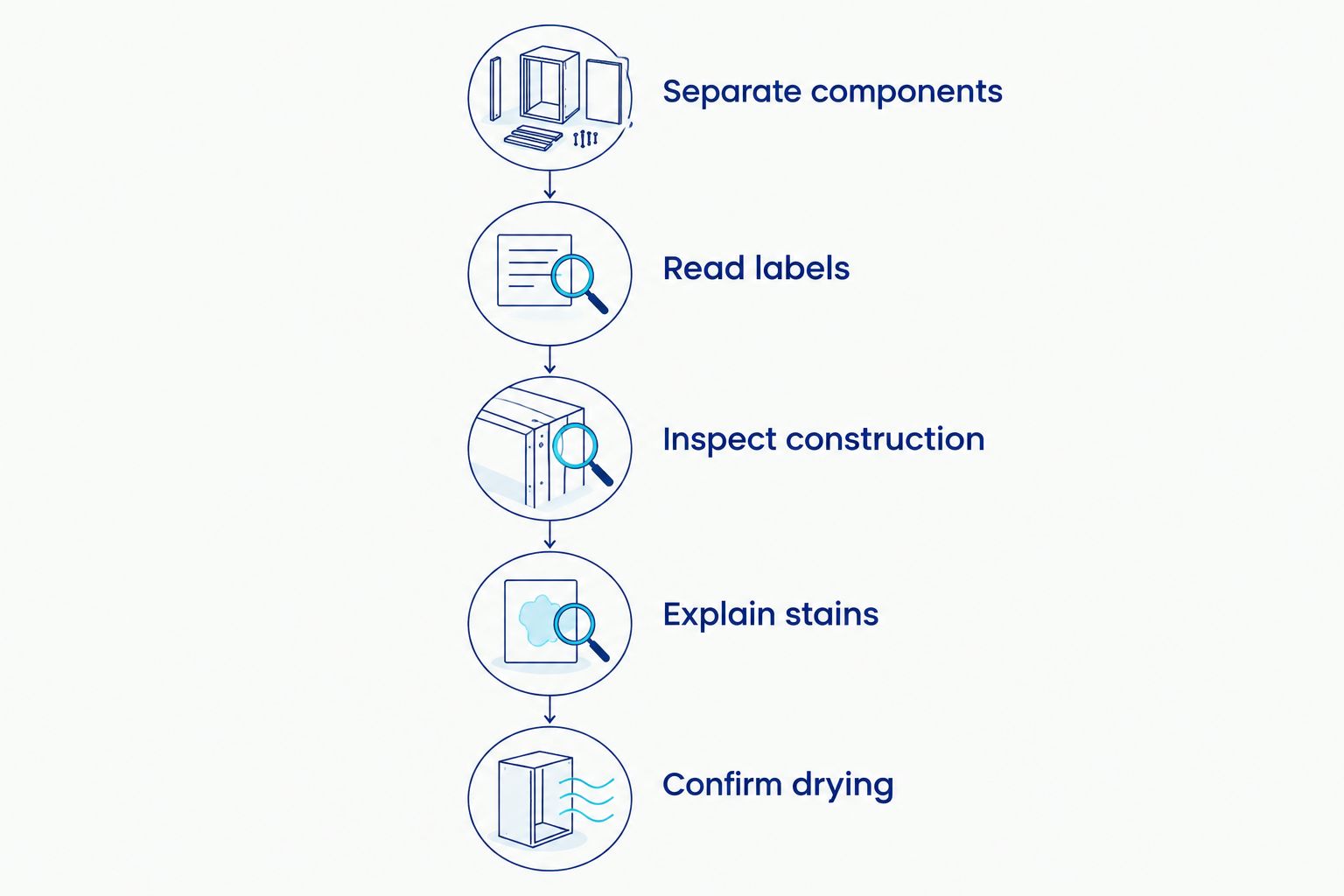
Check the set in this order
Keep the decision practical. Before putting bedding into a washer or taking it to a cleaner, work through the following sequence:
- Separate components. Remove the duvet insert from its cover and separate decorative pieces from everyday sheets.
- Read labels. Match each care label to its own item; do not apply the sheet instructions to the entire set.
- Inspect construction. Identify embroidery, piping, attached decoration, lining, and filled sections that need attention.
- Explain stains. Tell the cleaner what caused the mark and disclose any treatment already applied.
- Confirm drying. Establish the permitted drying method before cleaning begins, especially for filled bedding.
Photograph the labels while they remain readable. Keep those pictures with your bedding care records in 2026 so you can give a laundry the original instructions even after printed text fades.
Washable cotton and linen bedding
For cotton or linen sheets labeled machine washable, washing is a suitable routine method. Follow the specified temperature, cycle, detergent restrictions, and drying instructions. Neither a premium fiber description nor a high thread count automatically requires dry cleaning.
The advantage is straightforward care when your equipment matches the item's needs. The limitation is that fabric composition alone does not describe every finish, dye, or decorative detail. Cotton sheets with attached trim require attention to the finished item's label, not generic advice for plain cotton.
Best for routine home care: bedding explicitly labeled for machine washing. If dry cleaning is also permitted, ask the cleaner which approved process suits the soil or stain rather than choosing by perceived prestige.
Silk pillowcases and silk bedding
Silk does not have a universal cleaning instruction. Some finished silk items permit washing; others specify professional cleaning. Dye, finish, seams, and decoration all belong to the care decision, so do not transfer instructions between unrelated silk products.
The benefit of following a permitted washing method is that you can maintain washable silk without automatically sending it for solvent cleaning. The limitation is that a silk fiber claim does not establish the correct cycle, detergent, or drying method.
Best for silk care: the process stated for that exact pillowcase, sheet, or cover. Give the cleaner the label and describe any oily skincare residue, makeup, or previous stain treatment before work begins.
Filled duvets, comforters, and decorative covers
A removable duvet cover and its insert are separate cleaning jobs. The cover's washable label says nothing about the insert. Likewise, the insert's permitted process does not establish what is safe for an embroidered cover.
Filled bedding needs attention to the shell, filling, internal construction, and drying directions. A home washer that accepts an item through its door is not necessarily suitable for cleaning it properly. Follow both the bedding instructions and the appliance's guidance for bulky loads.
Best for bulky washable inserts: a laundry with appropriate equipment that agrees to follow the label. The advantage is equipment suited to the load; the limitation is that equipment size does not override an instruction against washing.
Keep decorative covers separate when they have different instructions. Ask whether removable inserts should be taken out before collection, and make sure the provider records which components require which process.
Why dry-cleaning suitability varies
The word luxury describes positioning, not a cleaning standard. These construction and care factors explain why visually similar bedding can require different treatment:
- Fiber composition: silk, cotton, linen, wool, and blends do not share a single care instruction.
- Dyes and finishes: the finished textile determines care compatibility, not the fiber name alone.
- Trim and decoration: attached details introduce additional materials that need assessment.
- Filling and lining: an outer fabric's care requirements do not establish the requirements of everything inside it.
- Stain history: the substance involved and previous treatments influence the cleaner's approach.
- Drying restrictions: cleaning is only part of the process; the item must also tolerate the specified drying method.
This is particularly relevant when washing a mulberry silk pillowcase: the fiber description does not replace instructions for the finished pillowcase. Use its label to establish whether washing is permitted before choosing a cycle or booking a professional service.
For your 2026 care routine, record these differences by item rather than keeping a single instruction for the whole bed. That avoids sending a washable cover and a differently labeled insert through the same process.
What should you tell a professional cleaner?
Ask which method the business intends to use. A request to have bedding professionally cleaned leaves room for laundering, wet cleaning, or dry cleaning; those are not equivalent services.
Show every label and identify fragile seams, loose decoration, existing discoloration, and damaged areas. Explain the source of any known stain. Tell the cleaner about stain removers, bleach, soaking, or heat already applied, because prior treatment is part of the item's condition.
Ask how the provider will handle a set if its pieces have different requirements. Confirm whether drying and finishing follow each label, and whether the cleaner will contact you before changing the agreed process. Do not authorize an unspecified substitute simply because it sounds gentler.
Is dry cleaning better than washing for luxury bedding?
Dry cleaning is not inherently better than washing. The better method is the one permitted for the finished item and suited to the cleaning task. A washable sheet does not become better cared for merely because a solvent process is used.
For washable bedding, professional laundering is an option when you need suitable equipment or outside help. For an item labeled dry clean only, follow that instruction and have the cleaner inspect it before treatment.
Can you wash bedding labeled dry clean only?
Do not substitute home washing for a dry-clean-only instruction. Water, agitation, and drying introduce conditions that the stated care method does not authorize. Ask the manufacturer about an approved alternative if the required service does not suit your routine.
Distinguish that instruction from wording that permits dry cleaning without making it the exclusive method. Read the complete label before deciding what is allowed.
Does professional cleaning replace regular bedding care?
Professional cleaning does not replace following the item's routine care instructions. Clean bedding according to use, visible soil, and manufacturer guidance rather than treating a professional visit as a permanent reset.
Make sure bedding is fully dry before you put it back on the bed or into storage. Do not pack away a damp insert simply because its outer shell feels dry; follow the specified drying process for the whole item.
Aeva Vital bedding care starts with the individual item
Aeva Vital's bedding-care guidance is best for home users who want a clear rule: follow each item's label, not its luxury description. Aeva Vital offers home wellness products, including hybrid mattresses, but mattress construction does not establish cleaning instructions for removable sheets or duvet covers.
Keep those decisions separate. In a 2026 bedroom care plan, the mattress, protector, sheets, and filled bedding each need their own maintenance instructions. Do not apply a removable cover's cleaning method to the mattress beneath it.
FAQ
Can luxury bedding be dry cleaned instead of washed?
Yes, luxury bedding can be dry cleaned when its care label permits the process. Do not substitute dry cleaning when the label prohibits it, and check every component separately.
Is dry cleaning gentler than machine washing for expensive sheets?
Dry cleaning is not automatically gentler than machine washing. Choose a method permitted by the finished item's label rather than judging by purchase price or fabric marketing.
Can I take machine-washable bedding to a dry cleaner?
Yes, you can ask a professional cleaner to handle machine-washable bedding, but specify an approved method. The business can offer laundering rather than solvent-based dry cleaning.
Does all silk bedding need to be dry cleaned?
No, silk bedding does not have a universal dry-cleaning requirement. Some finished silk items permit washing, while others specify professional cleaning; follow the individual label.
Can I clean my duvet cover and duvet insert together?
Do not assume a duvet cover and its insert can be cleaned together. Separate them, read both labels, and use each item's permitted cleaning and drying process.
What should I do if my bedding has no care label?
Identify the manufacturer and exact item before choosing a cleaning process. Ask a textile-cleaning specialist to assess it rather than assuming that dry cleaning is safe.
Can I put professionally cleaned bedding straight into storage?
Store professionally cleaned bedding only when it is fully dry. Follow the item's storage instructions and do not seal away residual moisture.
Related guides
- How to keep luxury sheets soft after washing
- How to store luxury bedding sets between seasons
- Can Egyptian cotton sheets shrink in the wash?
One last thing
Before choosing bedding, check whether its drying requirements fit your home as carefully as its washing requirements. A set that needs a drying process you cannot provide creates a care problem even when every piece is washable. Photograph the labels before the first clean and keep the cover and insert instructions separate.