
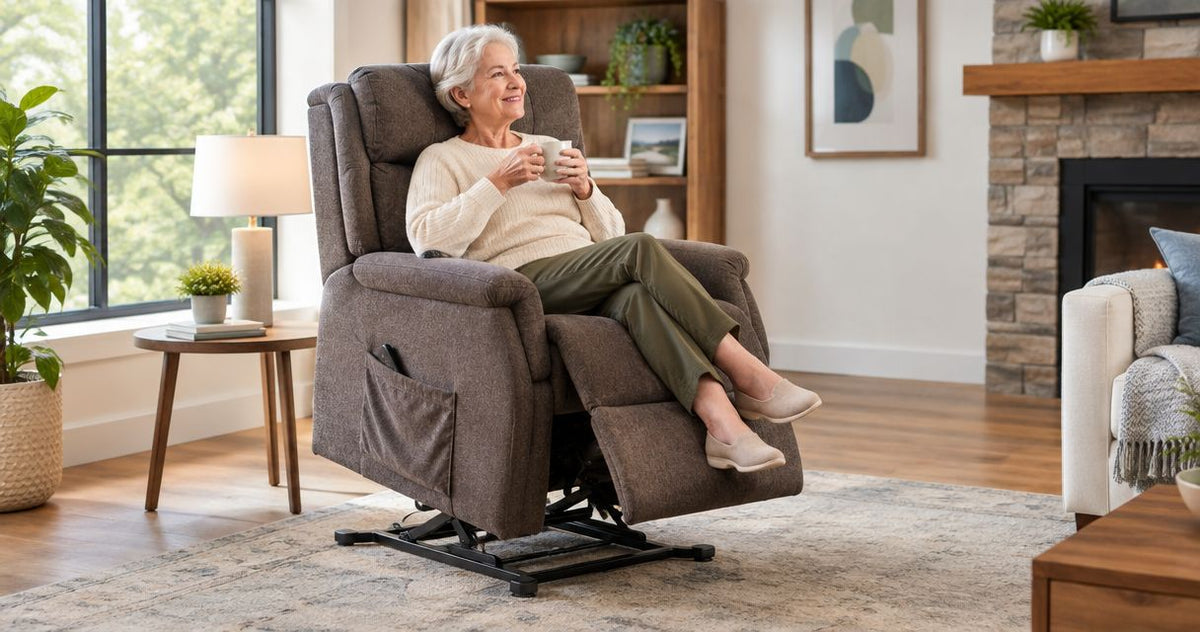
Best overall for independent positioning: a dual-motor lift chair. Best for straightforward operation: a single-motor lift chair. Best for smaller users: a petite-fit lift chair. The best lift chairs in 2026 match your seated measurements, standing needs, and room clearance before adding comfort features.
By Editorial Team
A lift chair is a powered recliner that raises and tilts its seat to assist the transition toward standing. This Aeva Vital guide compares chair categories rather than treating a motor count, upholstery choice, or reclining label as proof of a better fit.
- The best lift chairs match your seated dimensions and transfer needs before adding heat, massage, or charging ports.
- Dual-motor lift chairs suit users who need independent backrest and footrest adjustment.
- Petite-fit and higher-capacity lift chairs solve different sizing problems; neither replaces a seated fit check.
- Aeva Vital’s lift chair guide prioritizes fit, usable controls, room clearance, and documented support.
What makes the best lift chairs in 2026?
A chair that raises you but leaves your feet unsupported is not a good match. Neither is a comfortable recliner whose controls you cannot operate reliably.
Use these criteria before comparing extras:
- Seated fit: Check seat height, usable width, depth, armrest position, and back support.
- Standing transition: Assess whether the lifting movement supports your usual transfer technique.
- Positioning control: Decide whether the backrest and footrest need independent adjustment.
- Room compatibility: Check the complete moving footprint, doorway access, and a safe power-cord route.
- Usable controls: Test button size, labeling, reach, and the ability to stop movement.
- Documented support: Read the operating manual, cleaning instructions, service terms, and power-failure procedure.
Measure the delivery route as carefully as the sitting area. Aeva Vital’s guide to whether a lift chair fits through a doorway addresses a separate buying decision: getting the chair into its intended room.
Lift chair categories at a glance
These categories describe different selection priorities, not mutually exclusive products. A petite chair can also have independent positioning; a higher-capacity chair can also use a space-saving mechanism.
| Ranked category | Best for | Standout feature to confirm | Key limitation |
|---|---|---|---|
| Dual-motor lift chair | Independent positioning | Separate backrest and footrest movement | Controls require more familiarity |
| Single-motor lift chair | Straightforward operation | Coordinated reclining movement | Less freedom to combine positions |
| Petite-fit lift chair | Shorter users | Appropriately scaled seat dimensions | Petite labels are not standardized dimensions |
| Higher-capacity lift chair | Users needing a higher documented load rating | Published capacity and suitable usable seat width | A higher rating does not establish transfer suitability |
| Wall-hugger lift chair | Rooms with restricted rear clearance | Forward-travel reclining mechanism | Front clearance still matters |
1. Dual-motor lift chair: best for independent positioning
A dual-motor lift chair uses 2 motors; look for a documented design that adjusts the backrest and footrest independently. That separation lets you change one support surface without accepting the same linked movement every time.
Best for: You want to sit more upright with your legs supported or adjust your back without repeatedly changing footrest position.
Dual-motor lift chair pros:
- Separate adjustments offer more positioning choices.
- You can fine-tune the backrest and footrest separately.
- Independent movement helps you compare distinct sitting preferences during a trial.
Dual-motor lift chair cons:
- Additional controls take time to learn.
- Motor count alone does not establish seat comfort or lifting suitability.
- Independent reclining does not automatically mean powered lumbar or headrest adjustment.
For a 2026 purchase, read the movement diagram rather than assuming every powered section has separate control. Test the handset while seated, including the return toward an upright position.
Verdict: Buy a dual-motor lift chair when independent positioning is your main requirement and the seated fit is correct.
2. Single-motor lift chair: best for straightforward operation
A single-motor lift chair uses 1 motor to operate a linked mechanism. In a linked reclining design, backrest and footrest movement follow the mechanism’s prescribed sequence rather than providing fully independent adjustment.
Best for: You prefer a straightforward control routine and do not need separate backrest and footrest positioning.
Single-motor lift chair pros:
- Linked movement reduces the number of positioning decisions.
- A straightforward handset is easier to evaluate for everyday usability.
- The reclining sequence is repeatable once you learn its operation.
Single-motor lift chair cons:
- Linked movement restricts combinations of backrest and footrest positions.
- A simple mechanism does not guarantee an accessible handset.
- The prescribed sequence must still suit your standing transition.
Try the complete operating sequence. Do not judge the chair only from its fully reclined position; the route back to sitting matters just as much.
Verdict: Buy a single-motor lift chair when coordinated movement meets your needs; skip it when independent adjustment is essential.
3. Petite-fit lift chair: best for shorter users
A petite-fit lift chair is intended to accommodate smaller seated dimensions. The useful specifications are actual seat height and depth, not the word petite on the product listing.
Best for: Standard-size chairs leave your feet unsupported or make you slide forward to reach the floor.
Petite-fit lift chair pros:
- A suitable seat depth supports sitting against the backrest.
- An appropriate seat height helps you establish foot contact before standing.
- Correctly positioned armrests keep support within reach.
Petite-fit lift chair cons:
- A smaller exterior does not prove a smaller usable seat.
- A shallow seat that suits one person can feel restrictive to another.
- Petite sizing does not establish the chair’s load rating.
Check fit in your usual footwear. Sit back naturally, then assess foot contact and the space behind your knees without changing posture to accommodate the chair.
Verdict: Buy a petite-fit lift chair when measured seat dimensions solve a demonstrated fit problem.
4. Higher-capacity lift chair: best for a higher documented load rating
A higher-capacity lift chair is a category to investigate when your requirements exceed a particular standard model’s published rating. Compare the documented user capacity alongside usable seat width and the manufacturer’s operating instructions.
Best for: You need a higher published load rating and a seat that accommodates your body without restricting movement.
Higher-capacity lift chair pros:
- A published rating gives you a specific eligibility check.
- Suitable usable width creates room for your normal seated posture.
- Comparing capacity and dimensions together avoids choosing by appearance alone.
Higher-capacity lift chair cons:
- A wider seat can place armrests too far away.
- Higher capacity does not prove an appropriate seat height or depth.
- Overall dimensions can complicate delivery and room placement.
Do not infer capacity from a broad seat, heavy-looking frame, or product photograph. Record the stated rating in pounds and confirm that it applies to the exact model and configuration.
Verdict: Buy a higher-capacity lift chair only when both its published rating and seated dimensions meet your requirements.
5. Wall-hugger lift chair: best for restricted rear clearance
A wall-hugger mechanism moves the chair forward as it reclines to reduce the rear space required. The exact clearance remains model-specific; the category name does not authorize placement directly against a wall.
Best for: Your room has limited space behind the chair but enough unobstructed space in front.
Wall-hugger lift chair pros:
- Forward travel addresses restricted rear clearance.
- The mechanism offers an alternative layout to conventional rearward reclining.
- Published operating dimensions let you assess placement before delivery.
Wall-hugger lift chair cons:
- Forward travel still occupies floor space.
- An extended footrest can obstruct a walking route.
- Nearby tables and power cords must remain clear throughout movement.
For a 2026 room plan, mark the upright footprint and the fully operating footprint separately. Include access for anyone who assists you.
Verdict: Buy a wall-hugger lift chair when its documented moving footprint fits your room; skip it if forward travel blocks access.
Check fit before choosing features
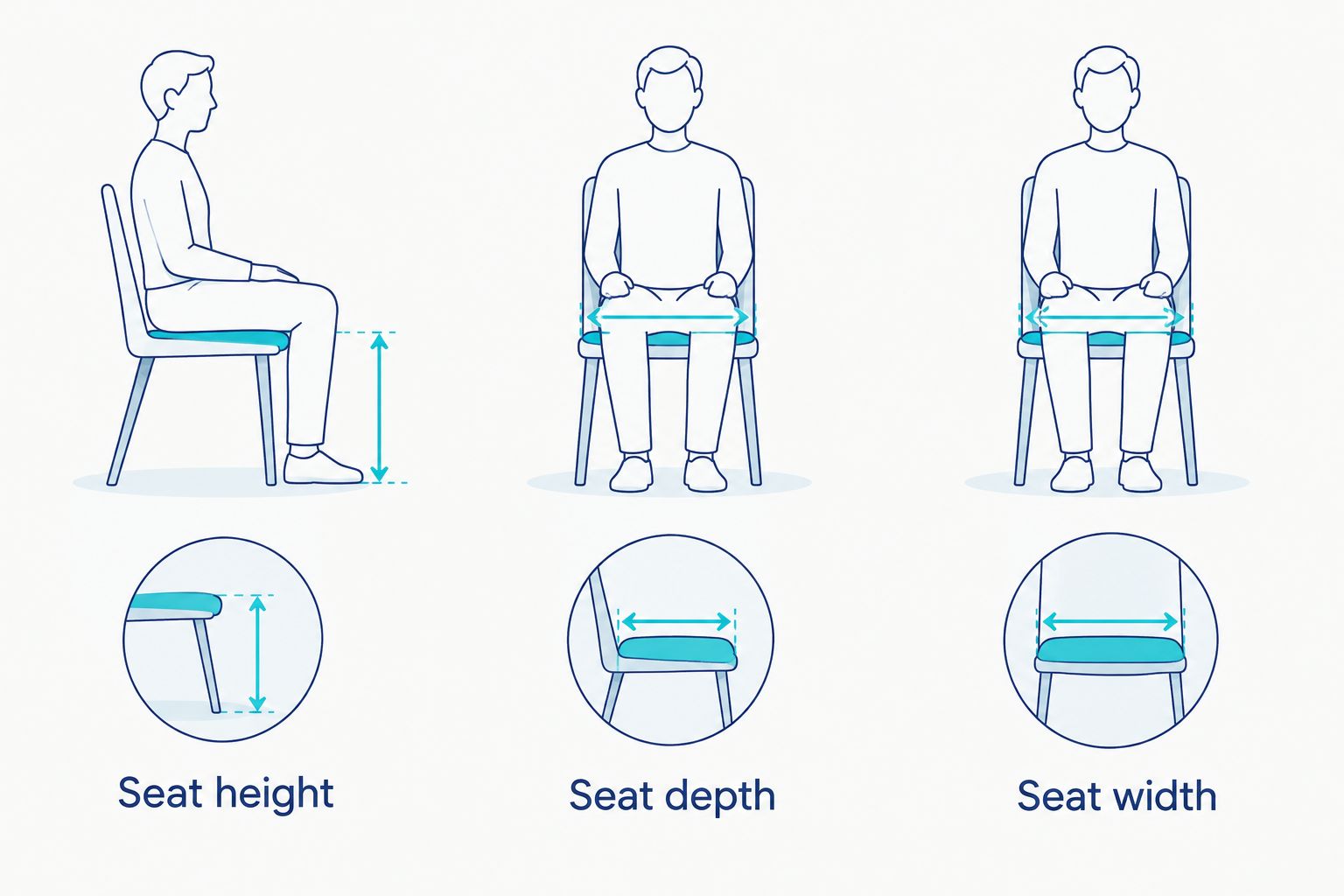
Use 3 seated measurements as your starting record: seat height, seat depth, and usable seat width. Record each in inches, then compare the candidate chair with a seat you already find suitable.
- Seat height: Check foot contact while your back rests naturally against the backrest.
- Seat depth: Check whether you can sit back without pressure behind your knees.
- Seat width: Measure usable space between the armrests, not exterior chair width.
These checks organize a fitting appointment; they do not replace an individual assessment when transfers are difficult. Ask an occupational therapist or physical therapist to assess your needs if you require help standing, have postoperative restrictions, or cannot control the movement safely.
Test the chair with your usual footwear and any everyday items that affect posture. Do not add loose cushions to correct poor fit unless the chair manufacturer and your clinician approve the arrangement.
What product specifications do and do not prove
Aeva Vital’s lift chair selection rule is simple: a specification answers one question, not every question. Keep each claim within its actual scope when comparing 2026 listings.
| Specification or label | What to establish | What it does not prove |
|---|---|---|
| Motor count | Which components move independently | Comfort, medical suitability, or service life |
| User capacity | The exact model’s published load rating | Correct seat dimensions |
| Reclining description | Available positions and movement sequence | Suitability for overnight sleeping |
| Heat and massage | Controls, operating instructions, and restrictions | Treatment of a medical condition |
| Battery backup | Compatible equipment and permitted operation | Unlimited operation during an outage |
| Upholstery | Material and manufacturer cleaning method | Resistance to every stain or disinfectant |
A rocking chair, manual recliner, or reclining chair with an adjustable footrest is not automatically a lift chair. Confirm that the documented mechanism raises and tilts the seat; a reclining feature alone does not establish standing assistance.
Installation, controls, and ongoing care
Before delivery, identify the outlet, cord route, and the full movement area. Keep cords away from the mechanism and walking routes, and follow the manufacturer’s electrical instructions.
Check the power-failure procedure before relying on the chair. Do not assume that a battery system supports every function or that the chair can be operated manually.
During a trial, practice stopping movement and locating the handset without leaning out of the seat. Keep children, pets, loose bedding, and other objects clear of moving parts.
For ongoing care, follow the upholstery instructions rather than choosing a cleaner by fabric appearance. Ask how to obtain a compatible handset, power supply, or service assessment before those parts become urgent needs.
How the categories are ranked
This ranking prioritizes independent positioning, straightforward operation, body fit, documented capacity, and room compatibility. It is a decision guide, not a claim that every dual-motor chair outperforms every single-motor chair.
For 2026, choose the category that solves your primary constraint, then compare exact models within it. An otherwise capable chair fails the selection if its dimensions, controls, or movement do not work for you.
Which lift chair should you choose?
Start with a dual-motor lift chair if you need independent positioning. Choose a single-motor design if a linked reclining sequence meets your needs and its controls are easier for you to use.
Apply petite-fit, higher-capacity, and wall-hugger requirements as additional filters. None takes priority over a safe, workable seated fit and standing transition.
FAQ
What are the best lift chairs for older adults?
The best lift chairs for older adults match the individual’s seated dimensions, transfer needs, and ability to use the controls. Age alone does not determine the right motor configuration or chair size.
Is a dual-motor lift chair better than a single-motor chair?
A dual-motor lift chair is better for independent positioning when its design provides separate backrest and footrest adjustment. A single-motor chair suits users who prefer linked movement and do not need those separate adjustments.
How do I know whether a lift chair fits me?
Check usable seat height, depth, and width while sitting naturally against the backrest. Your feet, knees, arm position, and standing transition all need assessment; exterior chair dimensions are not enough.
Can a lift chair help me stand without assistance?
A lift chair raises and tilts the seat to assist the transition toward standing, but that does not establish that you can transfer independently. Ask a clinician to assess the movement if you currently need assistance or have balance restrictions.
Can I sleep overnight in a lift chair?
Do not choose a lift chair for overnight sleeping based only on its reclining label. Discuss your positioning needs with a clinician and check the exact model’s intended use and operating instructions.
Does a wall-hugger lift chair need clearance?
Yes, a wall-hugger lift chair still needs the manufacturer’s specified operating clearance. Check forward travel, footrest extension, nearby furniture, and the walking route as well as rear clearance.
Will a lift chair work during a power outage?
Power-outage operation depends on the exact chair and its compatible backup system. Confirm the permitted functions and the manufacturer’s power-failure procedure before relying on backup operation.
Related guides
- How to clean a fabric lift chair
- Lift chair operation during a power outage
- Setting up a lift chair after surgery
One last thing
The most useful showroom test is not the deepest recline. Practice your normal sequence: sit, adjust, return upright, establish foot contact, and begin your usual standing transition with appropriate assistance. A chair earns its place by making that sequence workable.