

Yes—a cold plunge tub can freeze outdoors when its water loses enough heat in freezing weather; freshwater freezes at approximately 32°F (0°C) under ordinary conditions. The less visible risk is water freezing inside hoses, filters, pumps, or a chiller before the main tub freezes solid. A cover and insulation slow heat loss, but neither establishes that a system is safe for subfreezing operation.
By Editorial Team
- Can a cold plunge tub freeze outdoors? Yes—freshwater freezes at approximately 32°F (0°C).
- Aeva Vital cold plunge buyers should distinguish an all-season label from documented freeze protection.
- Insulation slows heat loss; it does not generate heat or guarantee freeze prevention.
- Winterize the complete water circuit, not just the tub, according to the equipment manufacturer’s instructions.
Can a cold plunge tub freeze outdoors in cold climates?
Yes. Outdoor suitability does not automatically mean freeze protection. A tub exposed to sustained freezing conditions needs a manufacturer-approved winter operating procedure or a complete shutdown and winterization procedure.
The water temperature, equipment operating limits, and forecast answer different questions. Your preferred bathing temperature does not establish the lowest safe outdoor temperature for the pump or chiller. The guide to how cold a cold plunge tub needs to be addresses bathing temperature; equipment protection requires the applicable product manual.
| Outdoor setup | Best for | What it helps with | Main limitation |
|---|---|---|---|
| Covered, insulated tub without active heating | Slowing heat loss between uses | Reduces exposure and heat transfer | Cannot prevent eventual freezing in sustained cold |
| System with documented freeze protection | Winter operation within stated limits | Uses the manufacturer’s specified protective functions | Depends on the complete installation and required power supply |
| Drained and winterized system | Seasonal shutdown | Removes water from freeze-sensitive components | Requires complete draining, not just emptying the basin |
| Installation in a suitable frost-free room | Avoiding direct outdoor freezing exposure | Keeps equipment out of freezing ambient conditions | Requires appropriate drainage, electrical provision, and moisture management |
For a 2026 winter setup, choose between approved operation and approved shutdown before the first freeze. Do not treat a third approach—leaving a filled, unprotected system outside—as equivalent to either.
Why freezing matters beyond the water surface
Water expands as it freezes. In an open basin, ice has room to form upward; inside a confined fitting or heat exchanger, expansion can stress the surrounding material. A tub does not have to become a solid block of ice for its connected equipment to suffer damage.
Small exposed sections of plumbing have different heat-loss characteristics from the main reservoir. Water trapped in a disconnected hose or filter housing remains a concern even after you drain the basin. A clear water surface is not proof that the entire system is unfrozen.
Equipment condition and bathing safety also remain separate. Ice around the steps, a slippery cover, or frozen water on the deck creates an access hazard even when the tub itself still works. Check the approach and surrounding surface before considering whether to use the water.
Why outdoor freezing risk varies
The freezing point is a physical reference, not a prediction of how long your installation will remain usable. These factors change how heat leaves the water and whether the equipment stays within its documented limits:
- Air temperature and exposure duration: Sustained freezing weather removes heat over time. A brief overnight dip and a prolonged freeze are different operating conditions.
- Starting water temperature: Water already close to freezing has less heat to lose before ice begins to form.
- Water volume: A larger volume stores more heat at the same temperature, but capacity alone does not establish freeze resistance.
- Insulation and cover fit: Insulation slows heat transfer. Gaps and exposed surfaces leave additional routes for heat loss.
- Exposed plumbing: Hoses, valves, filter housings, and equipment connections need their own protection assessment.
- Active protection and electricity: Any protective function that requires power stops working when its required power supply is interrupted.
Wind accelerates heat loss from exposed surfaces; it does not change freshwater’s freezing point. Use actual ambient conditions and the manufacturer’s limits rather than a human wind-chill reading to judge equipment suitability.
Does an insulated cover keep a cold plunge from freezing?
An insulated cover delays heat loss; it does not make water freeze-proof. The same distinction applies to insulated tub walls. Without enough incoming heat, water continues cooling toward the surrounding conditions.
A cover also does not automatically protect external equipment. A lid over the basin leaves a separate pump, filter, or hose exposed unless the installation provides protection for those parts. Assess the whole water circuit rather than the most visible component.
Check that the cover fits and closes as intended. Do not place an improvised heater beneath it, wrap electrical equipment in unapproved insulation, or block ventilation openings. Protection that interferes with equipment operation creates another problem instead of resolving the original one.
Does running the pump prevent freezing?
Circulation alone is not a freeze-prevention guarantee. Moving water can still freeze when the system loses more heat than it receives. A pump also cannot protect a disconnected branch or another section through which water is not circulating.
A chiller’s ability to cool water does not establish that it can heat water, operate in freezing air, or protect itself during an outage. Those are separate capabilities that require explicit documentation.
For your 2026 equipment check, look for the minimum ambient operating temperature, any heating function, freeze-protection instructions, and shutdown requirements. A temperature display or remote-control feature is not a substitute for those specifications.
How do you winterize a cold plunge before a freeze?
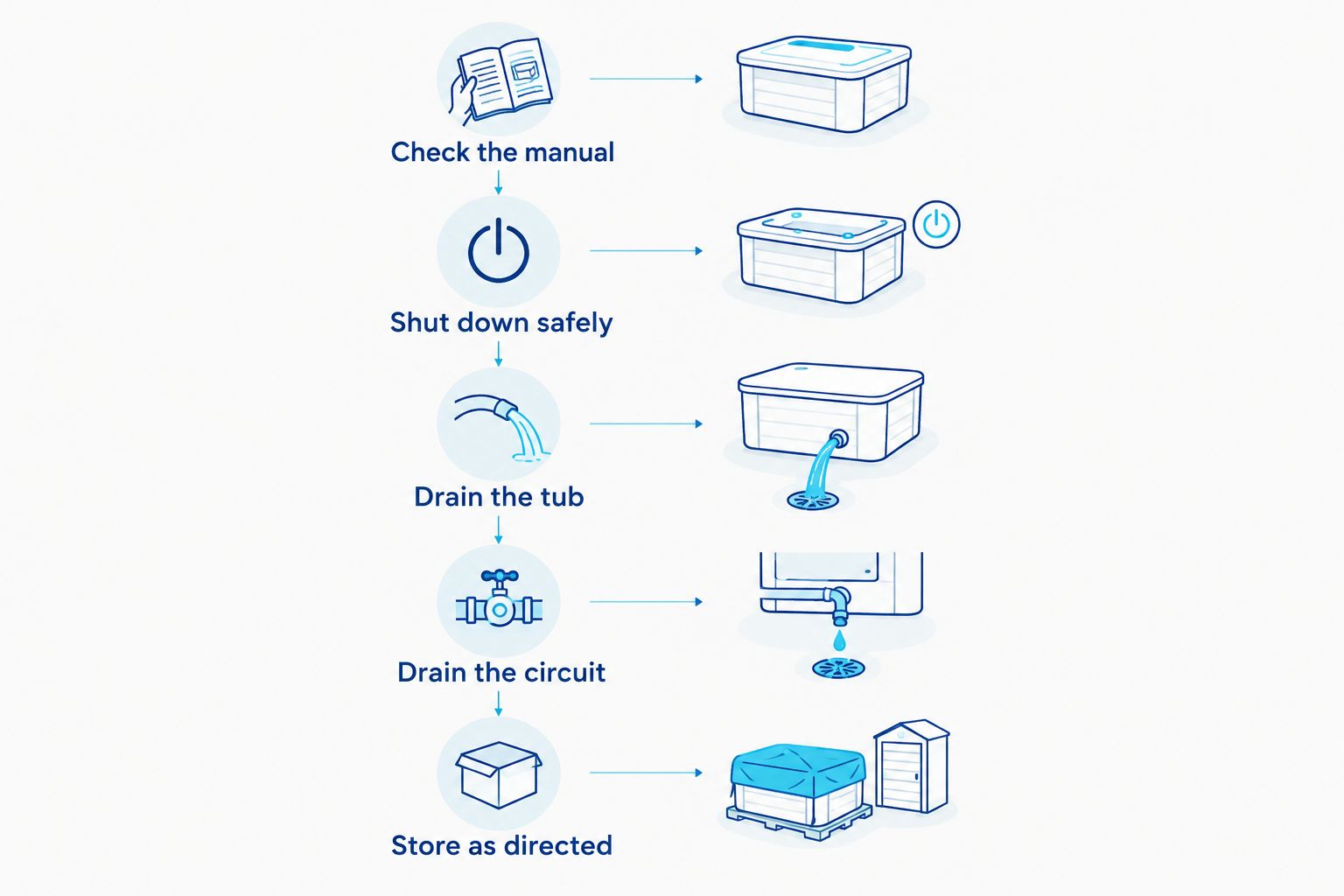
Follow the tub and connected equipment manuals together. The sequence below is a planning framework, not a replacement for model-specific instructions; access points and draining methods differ between systems.
- Check the manual. Identify the operating limits, shutdown sequence, drain locations, and storage requirements for every connected component.
- Shut down safely. Stop operation and disconnect power in the sequence specified by the manufacturer. Do not handle plugs or electrical connections while standing in water.
- Drain the tub. Discharge water to an appropriate location where it will not freeze across a walkway or damage the surrounding area.
- Drain the circuit. Follow the approved procedure for hoses, filters, pumps, valves, and the chiller. Emptying the basin does not empty all connected parts.
- Store as directed. Dry and store removable components where the manufacturer requires. Protect the empty tub according to its storage instructions.
The critical distinction is between draining visible water and removing trapped water. Do not use compressed air, antifreeze, or improvised flushing methods unless the equipment manufacturer expressly approves the method for that system.
What should you check before restarting?
Inspect the system after it has thawed and before restoring normal operation. Look for split hoses, distorted fittings, damaged housings, and evidence of leakage. Follow the manufacturer’s refill, priming, and restart procedure rather than powering an empty system.
A component that looks intact is not automatically ready for service after freezing. If you suspect internal damage, stop and obtain service guidance. Do not repeatedly reset a protective device or force a pump to run against a suspected blockage.
What if the cold plunge is already frozen?
Stop using the tub and do not force the equipment to run. If safe access to the electrical disconnect is available, isolate power according to the manufacturer’s instructions. Keep people away from icy access surfaces and exposed electrical hazards.
Do not strike the shell to break ice loose, pour boiling water over fittings, or use an open flame to thaw plumbing. These methods add impact, temperature, or fire hazards. Ask the manufacturer for an approved thawing and inspection procedure.
Once thawed, the system still needs an assessment before restart. Ice can conceal a leak until water becomes liquid again. Check the tub and every connected component, not just the area where ice was visible.
What Aeva Vital’s listed cold plunge specifications establish
The supplied Aeva Vital cold plunge listings identify a 76.6-gallon portable inflatable option and a 79-gallon option whose title includes an all-season outdoor description and a thermo lid. These details support a capacity and format comparison. They do not establish a minimum ambient operating temperature or an active freeze-protection system.
| Listed product | Stated capacity | Stated format or feature | What the listing title does not establish |
|---|---|---|---|
| Portable Inflatable Ice Bath Tub | Cold Water Therapy for Athletes | 76.6 Gallon | 76.6 gallons | Portable, inflatable ice bath | Subfreezing operating limits or freeze protection |
| 79 Gallon Cold Plunge Tub | All-Season Outdoor Ice Bath | Thermo Lid Included | 79 gallons | Outdoor ice bath with thermo lid | Active heating or protection for connected plumbing |
For Aeva Vital cold plunge buyers, documented winter operating limits matter more than an all-season label. The portable format is relevant when comparing storage arrangements; the included lid is relevant when assessing coverage. Neither fact proves that a filled tub can remain outdoors through a freeze.
Before selecting either option for a cold-climate installation, request written instructions for freezing weather, storage, and any connected equipment. For a 2026 purchase, match those instructions to your location and intended installation rather than relying on the product title alone.


Plan for the power outage, not just the forecast
A winter installation needs an outage procedure even if its normal operation includes documented freeze protection. Determine what stops when power fails and what the manufacturer requires you to do next. Do this while the system is accessible and unfrozen.
Do not assume a remote alert, circulation schedule, or automatic restart will resolve an outage. Each depends on equipment capabilities and installation details. Your 2026 winter plan should identify who can inspect the system and carry out an approved shutdown if you are away.
If you cannot maintain the required conditions or complete the prescribed shutdown, choose seasonal storage or a suitable frost-free installation instead. Convenience does not change an equipment operating limit.
Related guides
- Can a cold plunge tub be installed indoors?
- How to maintain water quality in a cold plunge tub
- Setting up a backup generator for your cold plunge chiller
FAQ
Can a cold plunge tub freeze outdoors overnight?
Yes, a cold plunge tub can freeze outdoors overnight if conditions remove enough heat from the water. There is no universal overnight threshold because starting temperature, exposure, insulation, and equipment protection differ.
What temperature makes a cold plunge freeze?
Freshwater freezes at approximately 32°F (0°C) under ordinary conditions. The outside air temperature alone does not tell you when every part of a tub and its plumbing will reach that temperature.
Will an insulated lid stop my cold plunge from freezing?
No, an insulated lid does not guarantee freeze prevention. It slows heat loss from the covered basin but does not automatically protect exposed hoses, filters, pumps, or a chiller.
Can I leave my cold plunge pump running during a freeze?
Leave the pump running only when that operation follows the manufacturer’s winter instructions. Circulation alone does not establish freeze protection or permission to operate below the equipment’s ambient limit.
Should I drain my outdoor cold plunge for winter?
Drain and winterize the system when the manufacturer requires shutdown for your expected conditions. Follow the complete procedure for the tub and connected equipment because trapped water can remain after the basin is empty.
Can I add salt or antifreeze to stop my cold plunge freezing?
Do not add salt or antifreeze unless the manufacturer expressly approves the substance and procedure for that system. Do not treat chemical winterization of equipment as permission to bathe in the resulting solution.
Does an all-season cold plunge label mean it is freeze-proof?
No, an all-season label does not establish freeze-proof operation. Request the minimum ambient operating temperature, freeze-protection details, and winterization instructions for the exact tub and equipment.
Can I restart a cold plunge immediately after it thaws?
Do not restart solely because the visible ice has melted. Inspect for damage and follow the manufacturer’s refill, priming, and restart instructions before restoring operation.
One last thing
The part you cannot see deserves the most attention: water trapped inside a fitting remains there after the basin looks empty. Before winter use in 2026, confirm how every water-containing component is protected or drained. A complete winterization procedure protects the system; an empty-looking tub does not prove the job is finished.