
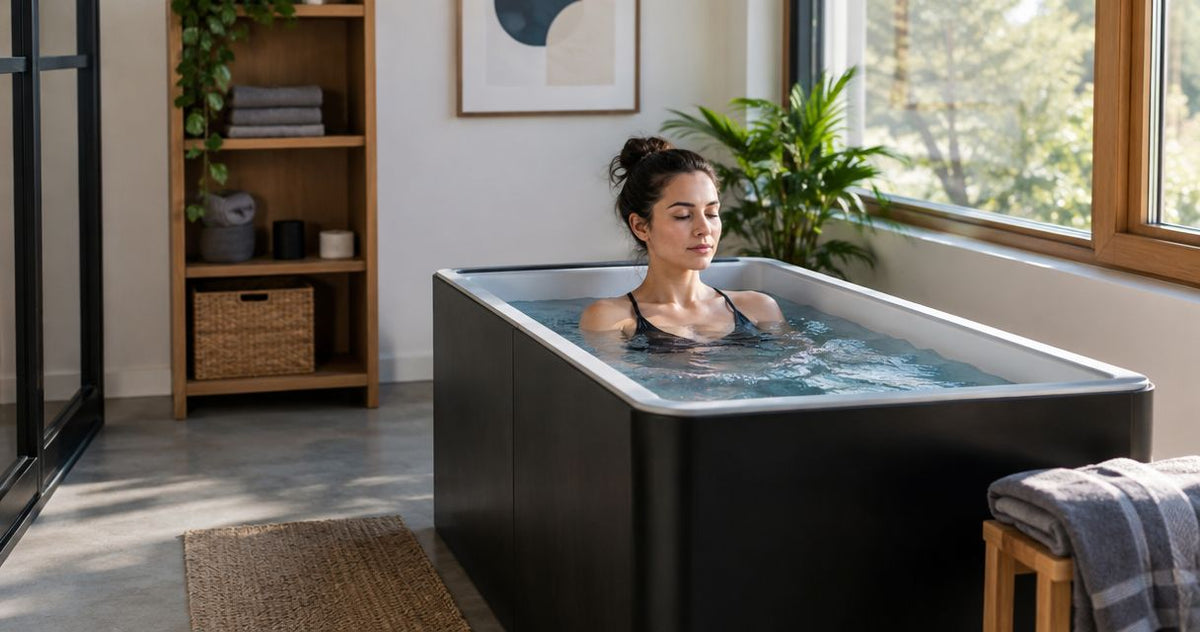
Yes, a cold plunge tub can be installed indoors when the manufacturer permits indoor use and the room provides adequate floor support, water protection, drainage, electrical safety, and equipment ventilation. A tub fitting through the door does not establish that the room is suitable. Check the installation manual before filling the tub or connecting a chiller.
By Editorial Team
- Can a cold plunge tub be installed indoors? Yes, with manufacturer approval and a suitable room.
- Aeva Vital lists 76.6-gallon and 79-gallon ice baths; capacity alone does not establish indoor suitability.
- Check the filled load, drainage route, waterproofing, and electrical requirements before installation.
- A refrigerated chiller releases heat into the room and needs the clearance specified in its manual.
Can a cold plunge tub be installed indoors?
Indoor installation is a room-and-equipment decision, not simply a question of tub dimensions. For your 2026 installation plan, start with the model's instructions and work through the checks below. If the room will also contain a bathtub, plan plumbing a freestanding tub and cold plunge into one room before choosing equipment positions.
- Confirm permitted use. Check whether the tub, pump, and any chiller are approved for the proposed indoor location.
- Check structural support. Include the tub, operating water volume, equipment, and occupants in the load assessment.
- Plan water management. Identify where splashes, condensation, leaks, and drained water will go.
- Verify electrical requirements. Have an electrician assess the equipment instructions and applicable local requirements.
- Allow operating access. Preserve the specified ventilation clearances, filter access, and a clear entry and exit route.
Do not treat a successful test fill as proof that the installation is safe. Structural support, concealed moisture damage, and electrical protection require separate checks.
Why this matters
An indoor cold plunge puts a substantial water load inside a finished building. Unlike an outdoor spill, an indoor leak can reach flooring, wall cavities, and rooms below before you notice it.
Cold surfaces also create a moisture issue separate from splashing. When a surface is colder than the surrounding air's dew point, water vapor condenses on it. Insulation helps limit this effect, but the room still needs a plan for moisture and drying.
For a 2026 home wellness project, settle these building questions before comparing convenience features. A cover, a compact footprint, or a portable design does not replace suitable flooring and drainage.
Indoor locations at a glance
These are room-selection considerations, not approvals for a particular installation. Choose the location that can safely manage water and the operating load, not merely the room with spare space.
| Location | Best for | Practical advantage | Main limitation |
|---|---|---|---|
| Properly designed wet room | Planned indoor installations | Water management can be designed into the room | Waterproofing, drainage, and electrical placement still need coordination |
| Bathroom | Homes with a suitable existing wet area | Water supply and drainage are nearby | Existing finishes and floor support do not automatically suit a plunge |
| Basement | Projects with an assessed floor and moisture plan | A ground-supported slab avoids relying on an upper-floor structure | Humidity, drainage elevation, and equipment access need checking |
| Finished spare room | Projects that include necessary room alterations | Separates the plunge from other bathroom activities | Carpet, vulnerable finishes, and absent drainage complicate installation |
A basement is not automatically suitable because its floor is concrete. Check the actual slab, surface condition, drainage arrangement, and equipment environment.
How much weight will the floor need to support?
Fresh water weighs approximately 8.34 pounds per US gallon at ordinary room temperature. That makes water capacity a useful starting point for understanding load, but it is not a structural approval.
Using the listed capacities of Aeva Vital's ice baths gives these approximate water-only figures:
| Listed capacity | Approximate water-only weight | What the figure excludes |
|---|---|---|
| 76.6 US gallons | 639 pounds | Tub, occupant, accessories, and equipment |
| 79 US gallons | 659 pounds | Tub, occupant, accessories, and equipment |
These calculations use nominal capacity, not a verified operating fill level. Follow the manufacturer's fill instructions and leave the required allowance for water displaced when someone enters.
The total weight is only part of the structural question. The tub's base or feet determine how that weight reaches the floor, while joist layout, spans, and existing conditions affect support. A structural professional should assess an uncertain floor, especially upstairs.
Do not divide the total load by the room's entire floor area and assume the result proves safety. The tub loads a particular part of the structure.
What flooring, drainage, and moisture control are needed?
Waterproofing
A water-resistant finish is not the same as a waterproof room assembly. Tile joints, perimeter details, pipe penetrations, and transitions to adjacent rooms all need attention.
Choose a floor surface appropriate for wet use and keep the exit area clear. A loose mat can absorb splashes, but it cannot contain a substantial leak or waterproof the floor beneath it.
Drainage
Decide how you will empty the tub before its first fill. Confirm the drain connection, approved discharge location, hose route, and any pump requirements in the equipment instructions and local rules.
A nearby floor drain helps only if water can reach it and the drain is suitable for the intended discharge. Do not assume that a bathroom sink, shower drain, or basement drain can accept every proposed connection.
Condensation control
Inspect the tub exterior, hoses, valves, and nearby floor for condensation during operation. Cold plumbing can collect moisture even when the tub shell remains dry.
Ventilation and dehumidification address different parts of room moisture control. Select the approach for the room's conditions rather than assuming an existing bathroom fan resolves every moisture problem.
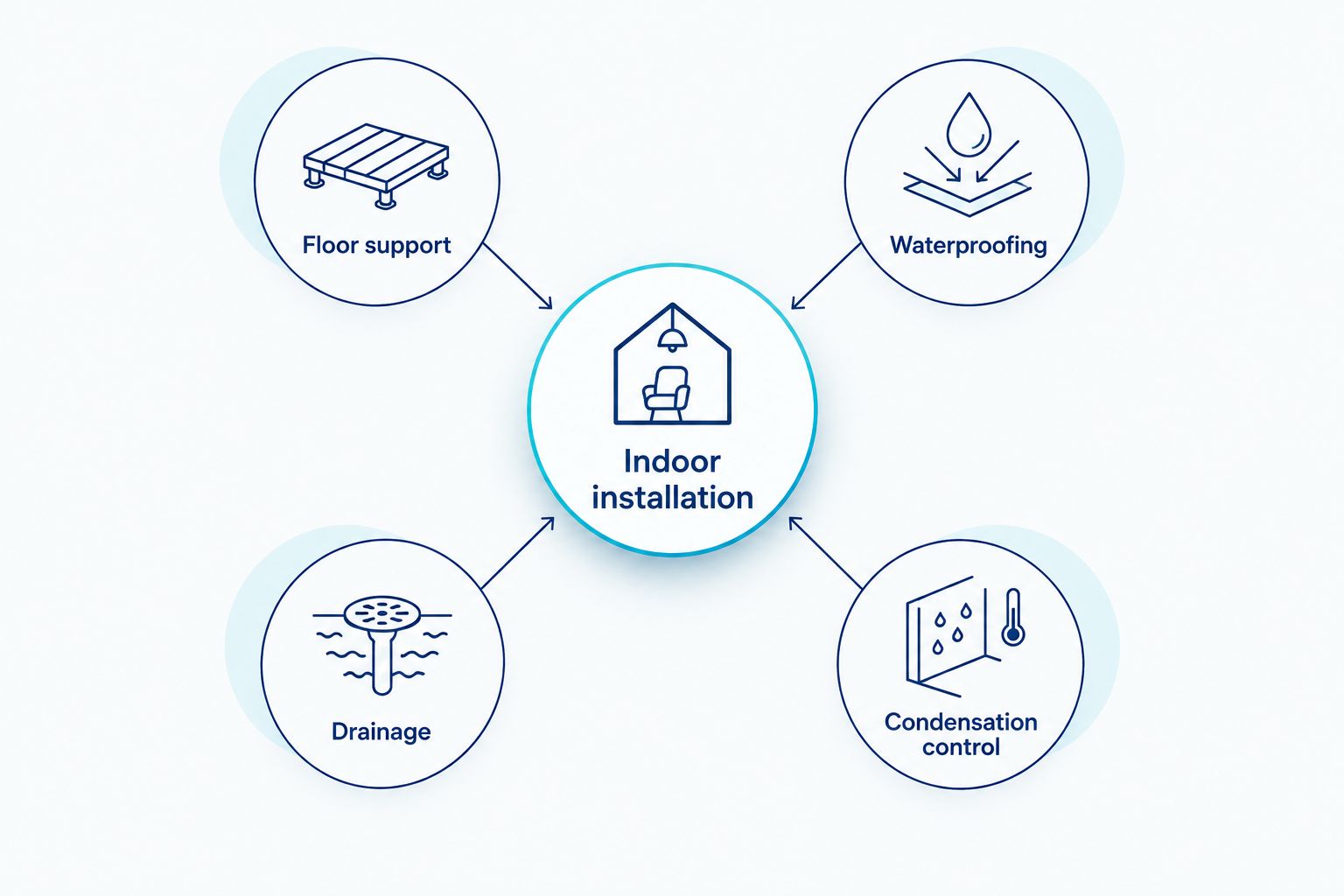
Keep these provisions separate in your 2026 installation checklist. A strong floor does not prevent moisture damage, and waterproofing does not establish adequate structural support.
What changes when the tub has a chiller?
A refrigerated chiller removes heat from the water and releases heat into its surroundings. Indoors, that means the room receives heat while the tub cools.
Follow the chiller manufacturer's requirements for ambient operating conditions and ventilation clearance. Do not enclose a chiller in a cabinet or push its ventilation openings against a wall unless its installation instructions specifically permit that arrangement.
Also consider operating noise and service access. A location beside a bedroom involves different practical compromises from a dedicated equipment area, even when both locations meet installation requirements.
Electrical specifications are model-specific. Ask an electrician to verify the required supply, grounding, GFCI protection, circuit arrangement, and receptacle placement under the applicable instructions and local code. An extension cord or power strip is not a substitute for the required electrical installation.
Why indoor installation requirements vary
The same tub can present different installation challenges in different homes. These factors determine the scope of your project:
- Manufacturer instructions: Permitted locations, connections, and operating conditions differ by equipment.
- Floor construction: A ground-supported slab and an elevated framed floor require different assessments.
- Water route: Filling, routine emptying, and accidental leakage each need consideration.
- Room conditions: Humidity and air temperature affect condensation and equipment operation.
- Equipment arrangement: Separate pumps, chillers, and filters need their own space and service access.
- Local requirements: Electrical, plumbing, and building requirements depend on the installation and jurisdiction.
Resolve the most restrictive requirement first. There is little value in refining the layout while the manufacturer has not confirmed that the proposed location is permitted.
Who should assess the room before installation?
Use the equipment manual to define the work, then assign each building question to the appropriate professional. An electrician addresses the supply and protection; a plumber addresses water connections and discharge; a structural professional addresses uncertain floor support.
When the project also changes waterproofing, finishes, ventilation, or room layout, choosing a bathroom remodeling contractor involves checking who will coordinate those trades and document their responsibilities. A single installation schedule does not mean one trade has assessed every risk.
For a 2026 remodel, give the project team the actual equipment documentation before work begins. Ask for a plan showing the tub position, equipment clearances, electrical connection, drainage route, and access for maintenance.
If you rent or live in a managed building, obtain the required property permissions before making alterations. Manufacturer approval does not replace building approval.
Aeva Vital ice baths: what to verify before indoor use
Aeva Vital offers cold plunge equipment for home wellness. For Aeva Vital cold plunge buyers planning an indoor installation, the best choice is a model whose instructions explicitly permit the intended location.
The supplied product listings identify a portable inflatable 76.6-gallon ice bath and a 79-gallon tub described for outdoor use. Those descriptions establish product type and listed capacity; they do not, by themselves, establish indoor approval, filled weight, drainage compatibility, or electrical requirements.
| Listed option | Best for evaluating | What the description establishes | Limitation for indoor planning |
|---|---|---|---|
| Portable inflatable 76.6-gallon ice bath | Buyers considering a portable format | Inflatable construction and listed capacity | Portability does not prove suitability for a finished indoor room |
| 79-gallon outdoor ice bath with thermo lid | Buyers assessing an outdoor-described tub | Listed capacity, outdoor description, and included lid | The outdoor description does not establish indoor permission |
Before selecting either option for a 2026 indoor project, request the installation and care instructions. Confirm indoor permission, empty weight, external dimensions, operating fill level, drain arrangement, and any compatible equipment requirements.
A capacity specification helps with water-load calculations. It does not prove floor compatibility, insulation performance, or a particular maintenance interval.


Can I put a cold plunge upstairs?
Yes, upstairs installation is possible when the manufacturer permits the location and the structure is assessed for the actual operating load. The 76.6-gallon capacity represents approximately 639 pounds of water alone, before adding the tub, occupant, and equipment.
An upstairs installation also needs a deliberate leak-management plan. Consider the consequences for the ceiling and occupied space below, not just the floor immediately around the tub.
Do I need permanent plumbing for an indoor cold plunge?
Permanent plumbing depends on the model and installation arrangement. A manually filled tub still needs a safe filling method and an approved way to discharge water.
A portable label does not remove those requirements. Verify the drainage process while the tub is empty, including where hoses run and how you will avoid spills during connection changes.
Does an indoor cold plunge need ventilation?
An indoor cold plunge needs room conditions that meet its equipment instructions and control moisture. A refrigerated chiller also needs the specified airflow to reject heat.
A cover helps limit evaporation while the tub is unused, but it does not eliminate condensation on exposed cold surfaces. Check the whole installation, including hoses and fittings.
FAQ
Can a cold plunge tub be installed indoors in a bathroom?
Yes, when the manufacturer permits indoor use and the bathroom meets structural, water-management, electrical, and ventilation requirements. Existing bathroom fixtures do not establish that the room is suitable for the added equipment.
Can I install a cold plunge in my basement?
Yes, a basement is a possible location after checking the floor, drainage, moisture conditions, and equipment requirements. A concrete floor alone does not establish suitability.
How heavy is the water in a 79-gallon cold plunge?
79 US gallons of fresh water weigh approximately 659 pounds at ordinary room temperature. Add the tub, occupant, and equipment to assess the operating load, and use the manufacturer's actual fill instructions.
Will a cold plunge cause condensation indoors?
Condensation forms when exposed surfaces are colder than the surrounding air's dew point. Inspect the tub, hoses, and fittings, and plan room moisture control.
Can I place a cold plunge on carpet?
Carpet is a poor surface for managing splashes, condensation, and leaks. Assess a suitable wet-use floor assembly rather than relying on a mat to protect carpet.
Does every cold plunge need a dedicated electrical circuit?
Circuit requirements depend on the equipment instructions and applicable local code. Have an electrician verify the complete installation rather than assuming all tubs and chillers use the same supply.
Does an outdoor cold plunge listing mean it is approved indoors?
No, an outdoor description does not establish indoor approval. Confirm permitted locations in the manufacturer's installation instructions before bringing the equipment into service.
Related guides
- Connecting a cold plunge tub to a dedicated GFCI outlet
- Cold plunge tubs ranked by tank capacity
- Connecting a water filtration system to your cold plunge tub
One last thing
Before filling an indoor cold plunge, walk through the emptying process. Identify the drain connection, discharge destination, hose route, and shutoff procedure; a tub that is easy to fill is not necessarily easy to empty without spilling.