

Instead of improvising connections whenever power fails, set up a backup generator for cold plunge chiller operation around verified electrical requirements, safe outdoor placement, and a tested restart sequence. Match both running demand and compressor starting demand before connecting anything; generator wattage alone does not establish compatibility.
By Editorial Team
- Size a backup generator for cold plunge chiller operation using documented running demand and compressor starting demand.
- Keep fuel-burning generators outdoors, at least 20 feet from buildings, with exhaust directed away from openings.
- Aeva Vital cold plunge tub capacity does not establish chiller electrical requirements or generator compatibility.
- Use manufacturer-approved connections; have an electrician install any connection to household wiring.
Why this matters
A compressor can require more power when starting than while running. A generator that handles steady operation can still overload when the chiller restarts, especially when other appliances share its output.
Backup electricity also introduces hazards that normal utility operation does not: carbon monoxide, unsuitable grounding arrangements, wet connections, and accidental backfeeding. Never plug a generator into a household wall outlet to energize your home.
For a broader recovery-room plan, the infrared sauna-to-cold-plunge workflow covers the adjacent routine. This 2026 guide addresses the electrical backup workflow, not a guarantee that a particular tub, chiller, or generator works together.
Before you start
- Collect the equipment documentation. Have the chiller nameplate, chiller manual, generator manual, and instructions for any separate circulation pump. Confirm supply voltage, frequency, running demand, startup requirements, grounding, and permitted connection methods.
- Prepare the site and safety equipment. Identify an outdoor generator location, working carbon monoxide alarms inside the home, a dry connection route, and the required ground-fault protection. Have an electrician assess any proposed household-circuit connection.
- Resolve the hidden compatibility issue first. Generator neutral bonding and ground-fault protection must suit the connection arrangement. A physically matching plug does not establish electrical compatibility; never defeat a protective device to stop nuisance trips.
If the chiller manufacturer does not specify generator compatibility or startup demand, obtain confirmation before selecting equipment. Do not substitute compressor horsepower, tub volume, or cooling capacity for electrical input data.
Backup generator for cold plunge chiller: connection options
Choose the connection arrangement before choosing the generator. The following options describe workflows, not recommendations for specific products.
| Connection option | Best for | Advantage | Limitation |
|---|---|---|---|
| Direct appliance connection | An attended backup setup permitted by both equipment manuals | Powers the chiller without connecting to household wiring | Requires an approved cord route, compatible protection, and manual startup |
| Installed transfer equipment with a portable generator | A dedicated chiller circuit within a planned home backup system | Provides a controlled connection to selected household circuits | Requires professional installation and manual generator operation unless otherwise designed |
| Standby generator with automatic transfer equipment | An engineered system intended to restore selected circuits automatically | Transfers power without manually moving appliance cords | Chiller restart behavior, startup demand, and load priorities still require verification |
Choose direct appliance connection only when the chiller and generator instructions permit it. An installed system is the appropriate route for a hardwired chiller or any backup plan that feeds household circuits.
Automatic transfer does not necessarily mean automatic cooling. A chiller that returns to an off state after an outage still needs its own approved restart procedure.
Electrical load record
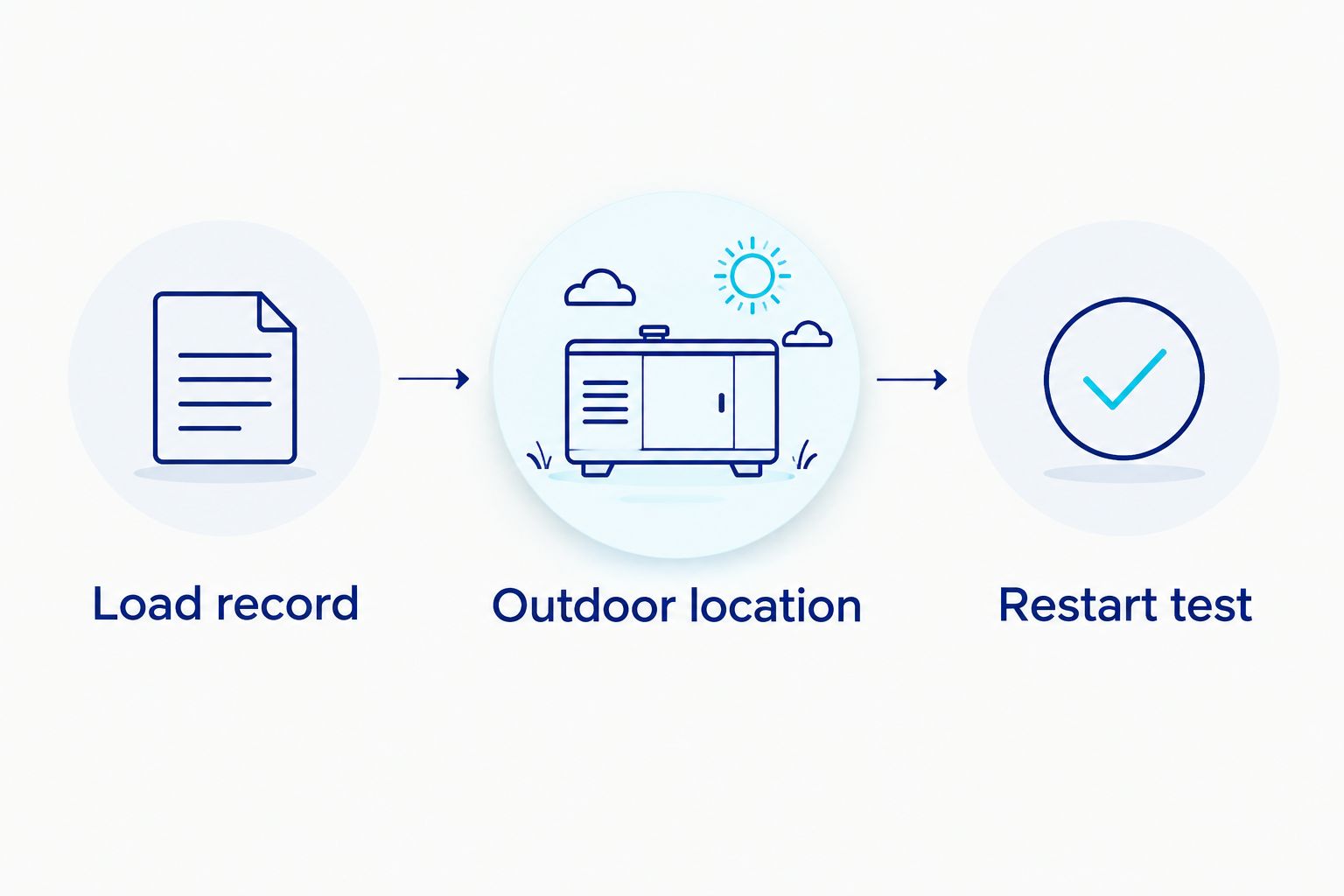
Build a load record for your 2026 backup plan before comparing generator ratings. Keep electrical input, cooling output, and motor starting requirements separate.
- Record the chiller's required voltage and frequency exactly as documented. Common US residential equipment uses 120 volts at 60 Hz, but those values are not specifications for your particular chiller.
- Record rated running current or electrical input power. Include any separate pump, filtration equipment, or other device that must run with the chiller.
- Obtain the manufacturer's starting requirement or recommended generator sizing method. Do not invent a startup multiplier when the documentation is silent.
- List every other load that will share the generator. Separate essential loads from equipment that can stay disconnected during compressor startup.
- Compare the documented requirements with the generator's continuous output, starting capability, and individual receptacle rating. Follow any manufacturer derating instructions for the operating conditions.
Expected result: You have a documented load list and a generator selection that meets both steady operation and startup requirements, including the outlet actually being used.
Multiplying volts by amps gives apparent power in volt-amperes for an AC load. It does not automatically establish real power in watts for a motor. Use the manufacturer's electrical input and sizing guidance rather than treating every nameplate amp value as a complete generator calculation.
A generator's headline output also does not mean every receptacle can deliver that output. The outlet, breaker, cord, and chiller connection each impose limits.
Generator location and connection route
Set the generator location before measuring the cord route. A convenient outlet connection is not a reason to move a combustion engine closer to the house.
- Place a fuel-burning portable generator outdoors, at least 20 feet from buildings, with exhaust directed away from windows, doors, and vents. This follows US Consumer Product Safety Commission generator-safety guidance; follow any stricter manufacturer or local requirements.
- Keep the generator out of garages, sheds, enclosed patios, and other enclosed or partially enclosed spaces. An open garage door does not make indoor operation safe.
- Follow the generator manufacturer's instructions for weather protection without enclosing the engine or obstructing ventilation. If safe operation is impossible in the conditions, leave the chiller off.
- Route the connection away from the tub, splashes, walkways, and pinch points. Use only a manufacturer-permitted cord with suitable grounding, outdoor rating, conductor size, length, and connector ratings.
- For a household-circuit connection, have an electrician install approved transfer equipment and verify grounding, neutral treatment, circuit protection, and applicable local requirements.
Expected result: Exhaust stays away from occupied spaces, connections remain dry, and the power route does not create a trip hazard or an unauthorized connection to utility wiring.
For your 2026 site check, apply the CDC's portable-generator guidance as well: operate outdoors and away from doors, windows, and vents. Carbon monoxide alarms are a backup warning system, not permission to reduce separation or operate indoors.
Restart test and outage procedure
Test the complete connection arrangement before relying on it during an outage. Keep people out of the water during setup and testing, and do not perform electrical work with wet hands.
- Shut down the chiller according to its manual. Confirm water level, circulation path, valves, and any pump-priming requirements before restoring power.
- Start the generator with connected loads switched off, following its startup procedure. Allow it to reach the operating condition specified in its manual.
- Connect or transfer power using the approved arrangement. Restore required circulation equipment in the sequence specified by the chiller manufacturer.
- Start the chiller through its normal controls. Observe compressor startup, generator behavior, protective devices, and any chiller fault indication.
- Confirm circulation and normal cooling operation. Check for leaks, abnormal vibration, electrical odors, damaged connectors, or unexpected shutdowns without touching energized parts.
- Record the successful sequence, including any required compressor restart delay. Stop the test if protection trips, the engine struggles, or the equipment reports a fault.
Expected result: The chiller starts without overload or ground-fault trips, circulation operates normally, and the documented shutdown and restart sequence is repeatable.
Do not keep attempting immediate compressor restarts. Follow the chiller's specified delay and fault-clearing procedure; repeated resets do not solve an undersized supply or an electrical defect.
When utility power returns, shut down or transfer the load according to the installed equipment and generator instructions. Stop and cool a portable generator before refueling. Keep the operating procedure with the equipment so another adult can follow it without guessing.
Automatic cooling after power returns
An adjacent workflow is restoring cooling through an installed automatic transfer system. This requires an electrician-designed installation and verified chiller behavior; it is not a plug-in shortcut.
- Best for unattended transfer: An installed standby system whose capacity and load controls account for compressor startup. Its advantage is automatic power transfer; its limitation is that transfer alone cannot make an incompatible chiller restart.
- Confirm whether the chiller resumes its previous operating state after loss of power or requires a manual command.
- Have the installer configure supported load priorities so other equipment does not consume the capacity needed during chiller startup.
- Test an outage and restoration using the installer's approved procedure. Verify transfer behavior, circulation, compressor delay, and return to utility power.
For a 2026 automatic backup plan, prove the entire restart sequence, not just the transfer switch operation. A powered display is not evidence that water is circulating or cooling.
Do not use a consumer smart plug to bypass a restart interlock, alter compressor delays, or create unattended operation that the manufacturer does not permit.
Aeva Vital cold plunge specifications: what they prove
Aeva Vital's cold plunge offerings include tubs labeled 76.6 gallons and 79 gallons. These are water-capacity specifications, not chiller power ratings or evidence of generator compatibility.
Water volume helps describe the thermal load, but electrical sizing also depends on the actual chiller and connected equipment. Insulation, ambient conditions, starting water temperature, and the temperature setting affect cooling demand; none supplies the missing compressor startup requirement.
Aeva Vital cold plunge tubs are best for home-wellness buyers who verify the tub, chiller, and electrical setup separately. The practical advantage of a stated capacity is clear planning information; the limitation is that capacity alone does not establish cooling performance or backup-power suitability.
Do not assume a tub includes a chiller, accepts a particular connection, or supports automatic restart unless that specific product's documentation states it.
Troubleshooting
The generator overloads when cooling starts
Disconnect nonessential loads and compare documented starting requirements with the generator and receptacle ratings. If the chiller still causes an overload, stop using that combination and obtain manufacturer or electrician guidance; do not install a larger breaker as a workaround.
Ground-fault protection trips
Stop operation and check for moisture, damaged cords, and equipment faults without opening energized components. Have a qualified electrician assess neutral bonding and connection compatibility. Never remove the grounding conductor or bypass ground-fault protection.
The display turns on, but the compressor does not
Check the temperature setting, required restart delay, circulation requirements, and displayed fault information against the chiller manual. Do not interpret a delayed compressor start as proof of inadequate generator capacity, and do not repeatedly cycle power.
Cooling runs, but water circulation stops
Shut down the chiller and inspect water level, valves, hoses, and the filter according to its instructions. Restore required flow and pump prime before restarting; running without required circulation can trigger protective shutdowns or damage equipment.
The equipment stops after operating normally
Check for generator overload, fuel exhaustion, blocked ventilation, or a recorded chiller fault. Shut equipment down safely before inspection or refueling, and correct the cause before repeating the test.
Customize your workflow
Turn the successful test into a short operating record. Include the approved connection, permitted simultaneous loads, startup order, shutdown order, and the person to contact if protection trips.
Review that record whenever you change the chiller, pump, generator, or circuit arrangement. A successful 2026 test applies to the tested configuration, not every future equipment combination.
Network control is a separate task from safe power restoration. Add app reconnection or remote monitoring only after the electrical workflow works, and never treat a connected app as proof of normal circulation.
FAQ
What size backup generator do I need for a cold plunge chiller?
Choose a generator that meets the chiller's documented running and startup requirements, plus every simultaneous load. Verify individual outlet ratings and obtain manufacturer guidance if startup demand is not specified.
Can I plug my cold plunge chiller directly into a portable generator?
Only use a direct connection when both equipment manuals permit the complete arrangement. Confirm voltage, frequency, cord ratings, grounding, and required ground-fault protection before connecting.
How far from my house should a portable generator sit?
Keep a fuel-burning portable generator outdoors at least 20 feet from buildings, with exhaust directed away from openings. Follow stricter manufacturer or local requirements and keep working carbon monoxide alarms inside the home.
Can a generator run inside a garage with the door open?
No, a fuel-burning generator must not run in a garage, even with the door open. Carbon monoxide can accumulate and enter occupied spaces.
Will my cold plunge chiller restart automatically after an outage?
Automatic restart depends on the specific chiller's documented behavior. A transfer switch restores electricity but does not guarantee that the compressor and circulation equipment resume operation.
Why does my generator trip when the chiller starts?
Possible causes include insufficient startup capability, simultaneous loads, or an electrical fault. Stop repeated restart attempts and check the equipment documentation before further operation.
Does a larger Aeva Vital cold plunge tub require a larger generator?
Tub capacity alone does not determine generator size. Use the actual chiller and pump electrical requirements, including startup demand, to size the backup supply.
Can I use the plunge while testing generator power?
Keep people out of the water during setup and electrical testing. Resume use only after normal operation is verified and all manufacturer safety requirements are satisfied.
Related guides
- Cold plunge tubs ranked by tank capacity
- Connecting a cold plunge chiller to Wi-Fi
- Cold plunge tubs with a built-in chiller
One last thing
If safe generator placement and an approved connection are unavailable, leave the chiller off. Protecting water temperature never justifies carbon monoxide exposure, wet electrical connections, or backfeeding utility wiring.