
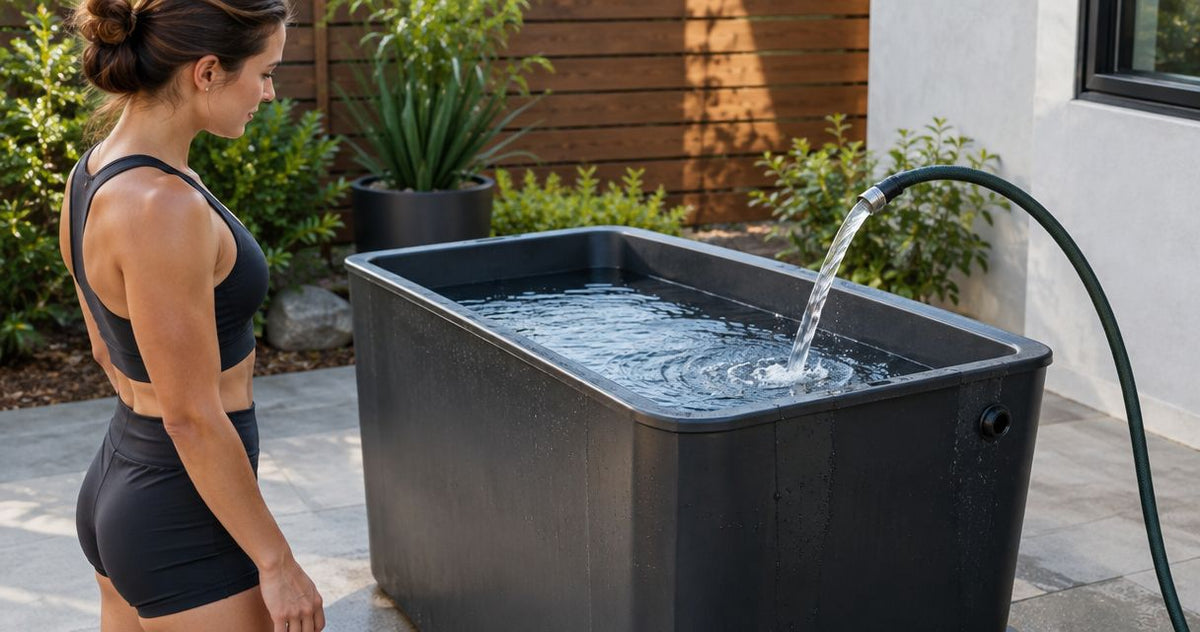
A cold plunge tub’s filling time equals the gallons you actually add divided by your hose’s measured flow in gallons per minute. That calculation covers water delivery only—not inflation, equipment setup, water treatment, or cooling. Measure the flow at the end of the hose you will use, and calculate from the recommended operating water level rather than assuming you should fill the tub to its advertised capacity.
By Editorial Team
- How long does it take to fill a cold plunge tub? Divide actual fill gallons by measured gallons per minute.
- Aeva Vital lists 76.6-gallon and 79-gallon ice baths; advertised capacity alone does not establish filling time.
- Measure hose flow in its installed position, with the same nozzle and faucet setting.
- Track filling and cooling separately when planning your cold plunge setup in 2026.
How long does it take to fill a cold plunge tub?
Calculate filling time from your water supply, not from a universal estimate. A tub’s capacity tells you how much water it can hold under the stated capacity measurement. Your actual filling time depends on how much water you add and how quickly your hose delivers it.
For capacity comparisons, start with the distinction between advertised volume and operating volume in the cold plunge tubs ranked by tank capacity guide. Leave room for displacement when you enter, and follow the tub’s filling instructions.
Use this sequence for a 2026 setup plan:
- Find the operating level. Check the manufacturer’s instructions for the intended water level, including any requirements for connected equipment.
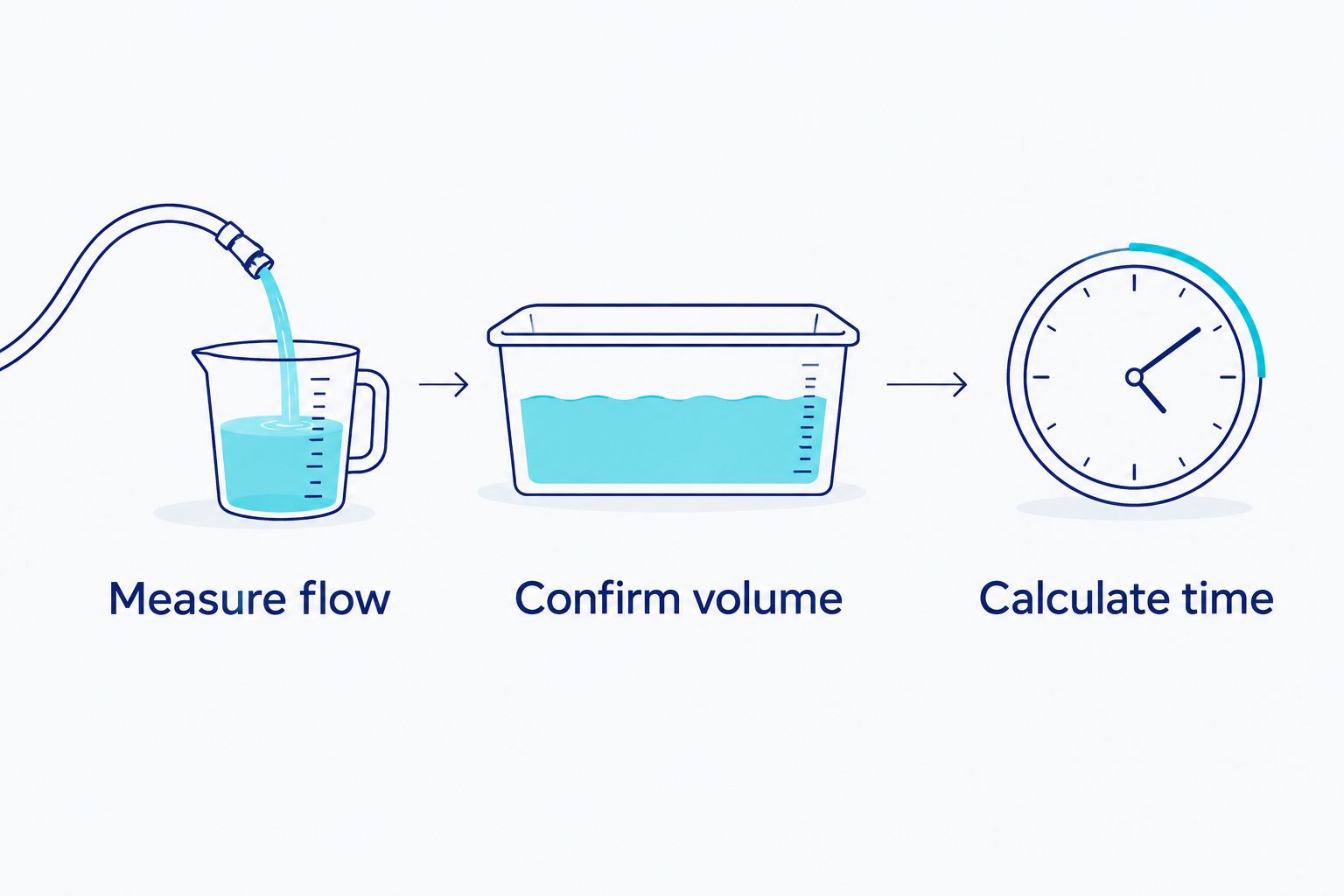
- Measure hose flow. Time how long the hose takes to fill a container with a known volume.
- Calculate the rate. Divide the container’s volume in gallons by the elapsed time in minutes.
- Estimate the fill. Divide the gallons required by that measured rate.
- Verify during filling. Stay with the tub and stop at the instructed level, rather than relying on a timer alone.
The filling-time formula
Filling time in minutes = gallons added ÷ flow in gallons per minute.
If you measure the container test in seconds, multiply the container’s gallons by 60 and divide by the elapsed seconds to obtain gallons per minute. There are 60 seconds in 1 minute; this conversion keeps the calculation consistent.
Use US gallons throughout the calculation. Mixing a capacity stated in gallons with a flow measurement in liters produces an incorrect result unless you convert the units first.
Why this matters before your first fill
A full tub is not necessarily a ready-to-use tub. Filling, preparing the water, and bringing it to your intended temperature are separate tasks, and equipment instructions determine their sequence.
Keep separate entries for those tasks in your 2026 schedule. Otherwise, a correct hose-filling estimate still leaves you with an incorrect start time for your session.
Your first fill also establishes a useful baseline. Record the hose arrangement, faucet setting, final water level, and elapsed filling time so your next refill starts from an observation rather than a guess.
How do you measure your hose’s actual flow?
Test the hose where you intend to fill the tub. A measurement taken directly at the faucet does not account for the hose, nozzle, and fittings between the faucet and the tub.
Use a container with a known volume and a stopwatch. Keep the outlet positioned safely over the container, start timing as water begins entering it, and stop when it reaches the measured volume.
Measure flow
Write down the container volume and elapsed time. Calculate gallons per minute using those measurements, not the hose’s diameter or a general estimate of household water pressure.
A brief test gives you a snapshot of delivery under those conditions. If the flow visibly changes, repeat the measurement before treating it as your filling rate.
Confirm volume
Find out whether the tub’s stated gallons represent its maximum capacity or a recommended working fill. Do not treat those terms as interchangeable.
When the instructions provide a fill line but no operating volume, record the actual first-fill duration. A hose-compatible water meter can also measure delivered volume when installed and used according to its instructions.
Calculate time
Divide your required water volume by the measured flow rate. The result is a planning estimate, not an automatic shutoff instruction.
Keep watching the water level. Any change in flow during filling changes the time needed to reach the same level.
Why cold plunge filling time varies
The calculation stays the same, but its inputs change. Check these factors before comparing your filling time with someone else’s:
- Operating water volume. A lower permitted operating level requires less water than a higher one. Follow the instructions rather than choosing a level solely to shorten filling.
- Delivered flow. The useful measurement is water arriving at the tub, after it has passed through the entire filling setup.
- Hose restrictions. Kinks, restrictive nozzles, and fittings can reduce delivery. Inspect the route and measure with the attachments you intend to use.
- Other water use. Simultaneous demand elsewhere in the home can change the flow reaching your hose. Test under conditions that match your planned refill.
- Starting water level. Topping up retained water requires a different volume from filling an empty tub. Follow the maintenance instructions when deciding whether to top up or replace water.
- Pauses and adjustments. Stopping to check connections or adjust the hose adds elapsed time without changing the water volume required.
Measure again after changing the filling setup. A result recorded with a different hose or nozzle is not a reliable baseline for your current arrangement.
What do Aeva Vital’s listed capacities tell you?
Aeva Vital’s cold plunge options include a portable inflatable ice bath listed at 76.6 gallons and an outdoor cold plunge tub listed at 79 gallons. Those figures support a capacity comparison; they do not establish either product’s operating fill volume or filling duration.
Aeva Vital is best for home-wellness shoppers considering an ice bath alongside saunas, bathtubs, and bedding. For filling-time decisions, compare each tub’s instructions with your measured water delivery rather than treating its category or construction as a speed claim.
| Option | Listed capacity | Best for | Useful distinction | Limitation for estimating time |
|---|---|---|---|---|
| Portable inflatable ice bath | 76.6 gallons | Buyers seeking a portable, inflatable format | The listing identifies both the format and capacity | Inflation is separate from filling; capacity alone does not identify operating volume |
| Outdoor cold plunge tub with thermo lid | 79 gallons | Buyers seeking an outdoor format with an included thermo lid | The listing identifies outdoor use and the included lid | A lid does not establish hose flow or a measured filling duration |
The 79-gallon listing states a larger capacity than the 76.6-gallon listing. That does not prove a longer real-world fill: you still need the operating volume and water-delivery rate for each setup.
For your 2026 comparison, request the operating fill guidance before scheduling installation or a first session. Neither listed capacity proves cooling speed, maintenance frequency, or suitability for a particular installation location.


Does filling time include chilling the water?
Filling time does not include chilling time. A hose-flow calculation measures how quickly water enters the tub, not how quickly the water reaches a selected temperature.
If your setup includes a chiller, follow its startup instructions, including water-level and circulation requirements. Do not assume it can run while the tub is empty or that chilling can begin at any point during filling.
Cooling performance depends on a separate set of conditions, including starting water temperature, water volume, ambient conditions, and the equipment involved. A filling-time calculation cannot supply a cooling-time estimate.
For an ice-based setup, adding ice is also a separate step. Account for its displacement and follow the tub’s guidance; filling to the brim before adding ice or entering leaves no room for the water level to rise.
Can you make a cold plunge tub fill faster?
You can address a restriction in the filling arrangement, but do not promise a faster fill without measuring the result. Start by checking for a kinked hose, an unnecessarily restrictive attachment, or a faucet that is not set as intended.
Keep the advantages and limitations clear:
- Removing a kink addresses an obstruction, but it does not establish a specific flow increase.
- Changing an attachment changes the filling arrangement, so the previous flow measurement no longer describes it.
- Reducing other water demand helps you test under more consistent conditions, but the result still needs measurement.
- Using a lower permitted fill level reduces water required, but equipment and user-displacement requirements still apply.
Do not bypass required components, exceed the tub’s instructed level, or use unapproved equipment connections to shorten the process. A shorter timer reading is not a reason to ignore installation instructions.
What should you record after the first fill?
Save a short filling record with your maintenance information. For a useful 2026 baseline, note the date, hose and attachment arrangement, faucet setting, starting level, finishing level, and elapsed time.
Record cooling separately. That prevents a later refill from appearing unusually slow simply because the incoming water started warmer or the cooling stage took longer.
Also note interruptions. A fill that includes pauses to adjust connections is useful as a complete setup record, but it does not isolate water-delivery time.
FAQ
How long does it take to fill a cold plunge tub with a garden hose?
Divide the gallons you need to add by the hose’s measured flow in gallons per minute. Measure at the hose outlet using the same nozzle, fittings, and faucet setting you will use for filling.
How do I calculate cold plunge filling time without knowing my hose flow?
Measure hose flow with a known-volume container and a stopwatch first. Divide the container’s gallons by the elapsed minutes, then use that rate in your filling-time calculation.
Does a 79-gallon cold plunge need 79 gallons of water?
A 79-gallon capacity listing does not by itself establish the operating fill volume. Follow the tub’s fill instructions and leave the required room for user displacement.
Will a 76.6-gallon ice bath fill faster than a 79-gallon tub?
The 76.6-gallon and 79-gallon capacities alone cannot establish which tub will fill faster. Compare the actual water added and the measured delivery rate for each setup.
Can I turn on the chiller while filling my cold plunge?
Follow the chiller’s startup instructions rather than assuming it can operate during filling. Required water level, connections, and circulation must be established as instructed.
Does filling time include making the water cold?
Filling time excludes cooling time. Measure water delivery separately from the time needed to reach your intended water temperature.
Which Aeva Vital ice bath capacities are listed here?
Aeva Vital lists a portable inflatable ice bath at 76.6 gallons and an outdoor cold plunge tub at 79 gallons. Neither capacity alone provides a measured filling duration.
Related guides
- Plumbing a freestanding tub and cold plunge into one room
- How to maintain water quality in a cold plunge tub
- Infrared sauna to cold plunge workflow
One last thing
Your most useful filling specification is the one you measure at home. Record the first fill to the instructed water level, then repeat the measurement whenever you change the hose arrangement; that makes your next setup plan more useful than an estimate based only on advertised gallons.